
- Release Year: 1999
- Platforms: Windows
- Publisher: Josh Bender
- Developer: Josh Bender
- Genre: Action, Platform
- Perspective: Side view
- Game Mode: Single-player
- Gameplay: 2D scrolling, Climbing, Jumping
- Setting: Sci-fi, Space
Description
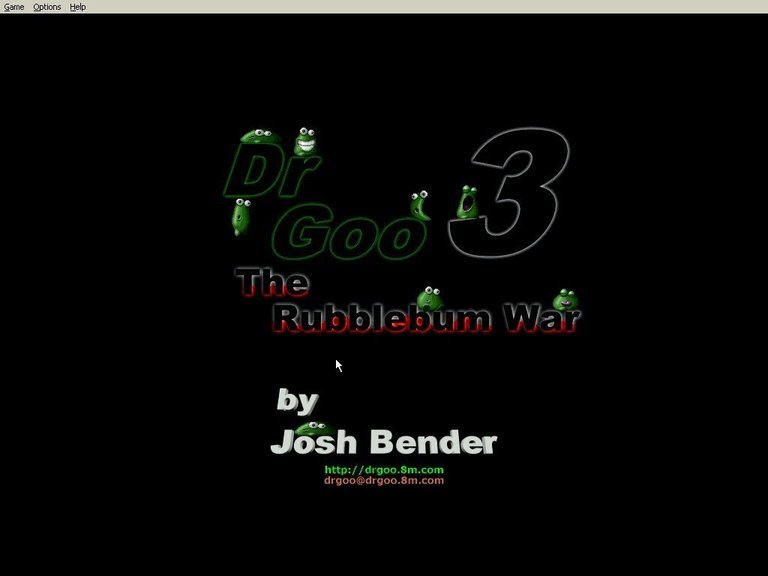
Dr Goo 3: The Rubblebum War is the final installment in a freeware, 2D platform game series where players control Dr. Goo, a green, intelligent slime, on a mission to save the world. The Earth is under threat from the Rubblebums, malevolent space invaders who have disabled the protective blue stars shielding the planet. Dr. Goo must navigate seven levels, retrieve the scattered stars, and restore them to their rightful place to prevent global destruction. With gooey physics allowing wall-climbing and jumping mechanics, the game offers a mix of action and puzzle-solving in a side-scrolling environment.
Gameplay Videos
Dr Goo 3: The Rubblebum War Guides & Walkthroughs
Dr Goo 3: The Rubblebum War Cheats & Codes
PC
Enter one of the following codes to activate the corresponding cheat function.
| Code | Effect |
|---|---|
| 4455 | Disable security shield |
| 6024 | Disable death box |
| 0750 | Walk on water |
| 7545 | Disable green zapper |
| 1272 | All stars collected |
| 9602 | Disable radioactive barrels |
| 2002 | Unlock Level 2 |
| 3392 | Unlock Level 3 |
| 4056 | Unlock Level 4 |
| 5152 | Unlock Level 5 |
| 6543 | Unlock Level 6 |
| 7470 | Unlock Level 7 |
Dr Goo 3: The Rubblebum War: A Forgotten Gem of the Freeware Platformer Era
Introduction: The Unsung Hero of 1999’s Indie Scene
In the crowded landscape of late-90s platformers, where Super Mario 64 and Crash Bandicoot dominated the mainstream, Dr Goo 3: The Rubblebum War emerged as a quiet, quirky rebellion—a freeware title that embodied the spirit of indie game development before the term even entered the cultural lexicon. Released in 1999 by Josh Bender, this final installment in the Dr Goo trilogy is a fascinating artifact of its time: a game built with passion, limited resources, and an unapologetic embrace of absurdity. While it may lack the polish of its commercial contemporaries, The Rubblebum War offers a raw, unfiltered glimpse into the creative potential of early digital distribution and the enduring appeal of simple, skill-based gameplay.
This review aims to dissect Dr Goo 3 with the rigor it deserves, exploring its development context, narrative eccentricities, mechanical quirks, and the subtle ways it reflects the gaming culture of its era. Far from a mere curiosity, The Rubblebum War stands as a testament to the power of freeware games to inspire, challenge, and—above all—entertain.
Development History & Context: The Birth of a Blob
The Studio and the Creator
Dr Goo 3: The Rubblebum War was the brainchild of Josh Bender, a solo developer working within the constraints of late-90s freeware culture. Unlike the corporate-backed studios of the time, Bender operated in the digital underground, where games were distributed via dial-up modems, early internet forums, and shareware CDs. His tool of choice was The Games Factory, a user-friendly game creation engine that empowered hobbyists to design 2D games without extensive programming knowledge. This tool, part of the Klik & Play family, was instrumental in democratizing game development, allowing creators like Bender to bring their visions to life with minimal financial investment.
Bender’s dedication to the Dr Goo series is evident in its rapid-fire release schedule: all three games—Dr Goo, Dr Goo 2: The Plague, and The Rubblebum War—were published in 1999, a feat that underscores both his prolificacy and the lightweight nature of the projects. The games were distributed as freeware, a model that relied on word-of-mouth and community engagement rather than commercial marketing. This approach was emblematic of the era, where games like Cave Story and I Wanna Be The Guy would later thrive, but in 1999, it was still a niche phenomenon.
The Technological Landscape
The late 90s were a transitional period for PC gaming. While 3D accelerators like the Voodoo2 and TNT2 were pushing visual boundaries, 2D platformers remained a staple, particularly in the indie and freeware scenes. Dr Goo 3 embraced the simplicity of 2D scrolling side-view gameplay, a deliberate choice that allowed Bender to focus on tight mechanics rather than graphical fidelity. The game’s 6 MB download size (a trivial figure today but significant in the dial-up era) made it accessible to a broad audience, further cementing its place in the freeware ecosystem.
The game’s direct control interface—arrow keys for movement, SHIFT for jumping—was intuitive by design, catering to the casual player while offering enough depth to engage platforming enthusiasts. The inclusion of wall-climbing mechanics, a rarity in many contemporary platformers, added a layer of verticality that distinguished Dr Goo 3 from its peers.
The Gaming Culture of 1999
1999 was a year of contrasts in gaming. On one hand, blockbusters like Half-Life, Unreal Tournament, and Age of Empires II dominated headlines. On the other, the internet was fostering a underground scene of bedroom developers, modders, and freeware creators who distributed their work through sites like Abandonware, Home of the Underdogs, and early game portals. Dr Goo 3 existed in this latter space, where games were judged not by their budgets but by their creativity and playability.
The game’s inclusion in compilations like 100+ Great Games (2000) highlights its recognition within the freeware community, even if it never achieved mainstream fame. Its legacy is one of grassroots appeal, a game made by a single developer for the sheer joy of creation and shared freely with the world.
Narrative & Thematic Deep Dive: A War of Stars and Slime
Plot Overview: Save the World, One Star at a Time
Dr Goo 3: The Rubblebum War abandons the personal stakes of its predecessors (where Dr Goo saved a child named ‘lil Jimmy) in favor of a cosmic conflict. The premise is delightfully absurd: the Rubblebums, a malevolent alien race, have discovered a way to destroy the Blue Galactic Stars that protect Earth. These stars, imbued with stardust lethal to the Rubblebums, are the planet’s only defense. As the stars fall from the sky, Dr Goo—a sentient, green, gooey blob—is tasked with collecting the fallen stars across seven levels and restoring them to their rightful place in the cosmos.
The narrative is delivered with minimal exposition, relying instead on environmental storytelling and brief text prompts to convey its premise. This approach is typical of freeware games of the era, where developers prioritized gameplay over cutscenes or dialogue. Yet, the simplicity of the story belies its thematic richness, which we’ll explore in the following sections.
Characters: The Blob and the Baddies
- Dr Goo: The protagonist is an amorphous, green blob with the ability to climb walls and jump (via the SHIFT key). His design is intentionally rudimentary, a product of the technological limitations of the time, but his gooey physics—which allow him to stick to surfaces and squeeze through tight spaces—give him a unique identity. Dr Goo is a silent hero, his motivations implied rather than stated, which adds to the game’s charm.
- The Rubblebums: The antagonists are never seen directly, their presence felt only through their destructive actions. Their Super Rubblebum Bubblegum gun, a weapon that shoots down the Blue Stars, is a delightfully silly conceit that underscores the game’s whimsical tone. The Rubblebums serve as a faceless threat, a common trope in platformers where the focus is on overcoming obstacles rather than narrative depth.
Themes: Environmentalism, Persistence, and the Power of the Underdog
Despite its lighthearted presentation, Dr Goo 3 touches on several surprisingly profound themes:
1. Environmental Stewardship: The Blue Galactic Stars act as a metaphor for ecological balance, their destruction symbolizing the consequences of unchecked exploitation. Dr Goo’s mission to restore them mirrors real-world efforts to preserve natural resources.
2. The Underdog’s Triumph: Dr Goo is a small, seemingly insignificant creature tasked with saving the world. His success hinges not on brute force but on agility, adaptability, and perseverance—qualities that resonate with the indie developer’s own journey.
3. The Fragility of Protection: The game suggests that Earth’s safety is precarious, dependent on forces beyond human control. This theme of cosmic vulnerability is rare in platformers, which typically focus on personal or local conflicts.
Dialogue and Tone: Minimalism with a Dash of Whimsy
The game’s text-based storytelling is sparse but effective. Lines like “Up to now we’ve been protected by blue stars but not any more ‘coz the Rubblebums have found a way to knock them out of the sky” exemplify the casual, almost conversational tone that defines freeware games of the era. The writing is unpolished but endearing, reflecting the personal touch of a solo developer unburdened by corporate oversight.
The dedication to Erin Holmes (“the definition of true beauty“) in the credits adds a human element to the game, reminding players that behind the pixels lies a real person with passions and inspirations.
Gameplay Mechanics & Systems: The Art of Gooey Platforming
Core Gameplay Loop: Collect, Climb, Conquer
At its heart, Dr Goo 3 is a collectathon platformer with a simple objective: gather all the Blue Stars in each level to progress. The game’s seven levels are designed with increasing complexity, introducing new obstacles and mechanics as the player advances.
The core mechanics are as follows:
– Movement: Dr Goo is controlled via the arrow keys, with SHIFT for jumping. His gooey physique allows him to climb certain walls, a mechanic that adds verticality to the level design.
– Star Collection: Each level contains multiple Blue Stars, often hidden in hard-to-reach areas or behind hazards. Collecting them all is mandatory for progression.
– Hazards: The game features a variety of environmental dangers, including spikes, pits, and enemy projectiles. Dr Goo’s vulnerability to these hazards demands precision platforming.
Level Design: A Study in Simplicity
The levels in Dr Goo 3 are handcrafted with a focus on challenge and exploration. While the visuals are rudimentary—pixelated backgrounds, basic sprites, and repetitive tilesets—the design is functional and occasionally ingenious. Key features include:
– Verticality: The wall-climbing mechanic encourages players to explore every inch of the level, rewarding curiosity with hidden stars.
– Pacing: The difficulty curve is steep but fair, with early levels serving as tutorials for later, more complex stages.
– Secret Areas: Some stars are tucked away in non-obvious locations, requiring players to experiment with Dr Goo’s abilities.
Combat and Enemy Interaction
Unlike many platformers of the era, Dr Goo 3 lacks direct combat mechanics. Dr Goo cannot attack enemies; instead, he must avoid or outmaneuver them. This design choice reinforces the game’s puzzle-platformer identity, where strategy and timing are paramount.
Enemies include:
– Floating projectiles: Shot by unseen Rubblebum forces, these must be dodged or timed carefully.
– Static hazards: Spikes and pits that require precise jumps to navigate.
Character Progression: The Illusion of Growth
Dr Goo 3 does not feature traditional character progression (e.g., unlockable abilities or power-ups). Instead, mastery comes from the player’s skill, not the character’s stats. This approach is reminiscent of classic arcade games, where improvement is measured in reflexes and memorization rather than numerical upgrades.
UI and Controls: Functional but Unrefined
The game’s user interface is minimalist to a fault. There are no health bars, maps, or inventory systems—just Dr Goo, the stars, and the obstacles. The controls are responsive but lack the polish of commercial platformers, with occasional imprecise jumps or unintuitive wall-climbing.
The lack of a save system is a notable omission, forcing players to complete the game in one sitting—a design choice that reflects the arcade roots of the platformer genre.
Innovations and Flaws
Innovations:
– Wall-Climbing Mechanics: A rare feature in 1999 platformers, adding depth to level design.
– Freeware Distribution: A pioneering model that foreshadowed the rise of indie games.
Flaws:
– Repetitive Visuals: The game’s lack of graphical variety can make levels blend together.
– No Checkpoints: The absence of mid-level saves can lead to frustration, especially in later stages.
– Limited Enemy Variety: The reliance on static hazards rather than dynamic enemies reduces replayability.
World-Building, Art & Sound: The Aesthetics of Constraint
Setting and Atmosphere: A Cosmic Playground
Dr Goo 3 takes place across seven distinct levels, each with its own thematic identity. While the game lacks a cohesive overarching world, the levels are designed to feel like self-contained challenges, from cavernous depths to floating platforms in space.
The atmosphere is one of urgency and isolation. Dr Goo is alone in his mission, facing insurmountable odds with nothing but his wits. The lack of music in some areas amplifies this sense of solitude, making the player’s journey feel intimate and personal.
Visual Design: The Beauty of Simplicity
The game’s 2D pixel art is functional rather than flashy, a product of both technological limitations and Bender’s solo development. Key visual elements include:
– Dr Goo’s Design: His green, blob-like appearance is instantly recognizable, if not visually complex.
– Level Tilesets: The backgrounds and platforms are repetitive but effective, using color coding to distinguish hazards from safe zones.
– Blue Stars: The glowing, celestial objects serve as both goals and narrative devices, their bright hue making them stand out against the darker level palettes.
While the visuals may appear dated by modern standards, they possess a charm born of necessity, a reminder of an era when games were judged by their gameplay first, graphics second.
Sound Design: Silence and Simplicity
The audio experience in Dr Goo 3 is minimalist, with no background music in most levels. The sound effects are limited to:
– Jumping noises
– Star collection chimes
– Enemy projectile sounds
This aural restraint creates a focused, almost meditative gameplay experience, where the player’s attention is directed entirely toward the platforming challenges. The absence of music is a bold choice, one that distinguishes Dr Goo 3 from its more bombastic contemporaries.
Reception & Legacy: The Forgotten Blob’s Impact
Critical and Commercial Reception
Dr Goo 3: The Rubblebum War was never reviewed by major gaming outlets, a fate shared by most freeware titles of the era. Its reception was confined to niche communities, where it was praised for its challenging gameplay and creative premise but criticized for its lack of polish.
The game’s inclusion in freeware compilations (e.g., 100+ Great Games) suggests it was well-regarded within its target audience, even if it never achieved mainstream recognition. Its MobyGames score remains “n/a”, a testament to its obscurity.
Evolution of Reputation
In the decades since its release, Dr Goo 3 has faded into obscurity, remembered primarily by retro gaming enthusiasts and freeware historians. Its legacy is one of cult appreciation, a game that resonates with those who value innovation over production values.
The lack of modern re-releases or remasters has further relegated it to the digital archives, accessible only through sites like My Abandonware and the Internet Archive.
Influence on Subsequent Games
While Dr Goo 3 did not directly inspire major commercial titles, its design philosophies can be seen in later indie platformers:
– Wall-Climbing Mechanics: Games like Celeste and Hollow Knight would later refine this concept, but Dr Goo 3 was an early adopter.
– Freeware Distribution: The game’s free-to-play model foreshadowed the rise of indie game culture, where developers like Derek Yu (Spelunky) and Phil Fish (FEZ) would thrive.
– Minimalist Storytelling: The trend toward environmental narrative in games like Limbo and Inside owes a debt to titles like Dr Goo 3, which proved that less can be more.
Conclusion: A Small Game with a Big Heart
Dr Goo 3: The Rubblebum War is not a masterpiece by conventional standards. It lacks the polish of commercial platformers, the depth of narrative-driven adventures, and the visual splendor of modern indie darlings. Yet, it possesses something far rarer: authenticity.
This is a game made by one person, for the love of creation, and distributed freely to anyone willing to give it a chance. It is a time capsule of the late-90s freeware scene, a testament to the power of constraints, and a reminder that great ideas can come from anywhere.
In the grand tapestry of video game history, Dr Goo 3 may be a small thread, but it is one worth examining. It proves that gameplay innovation, thematic richness, and sheer determination can elevate even the humblest of projects.
Final Verdict: Dr Goo 3: The Rubblebum War is a flawed but fascinating relic of the freeware era. It won’t dethrone Super Mario or Sonic, but it deserves recognition as a pioneering indie platformer that punched above its weight. For historians, retro enthusiasts, and fans of challenging, no-frills platforming, it remains a hidden gem worth uncovering.
Score: 7.5/10 – A cult classic that transcends its limitations through sheer creativity.