
- Release Year: 2008
- Platforms: Macintosh, Windows
- Publisher: magnussoft Deutschland GmbH, Runesoft GmbH
- Developer: magnussoft Deutschland GmbH
- Genre: Educational
- Perspective: Fixed / flip-screen
- Game Mode: Single-player
- Gameplay: Mini-games, Puzzle elements
- Average Score: 70/100
Description
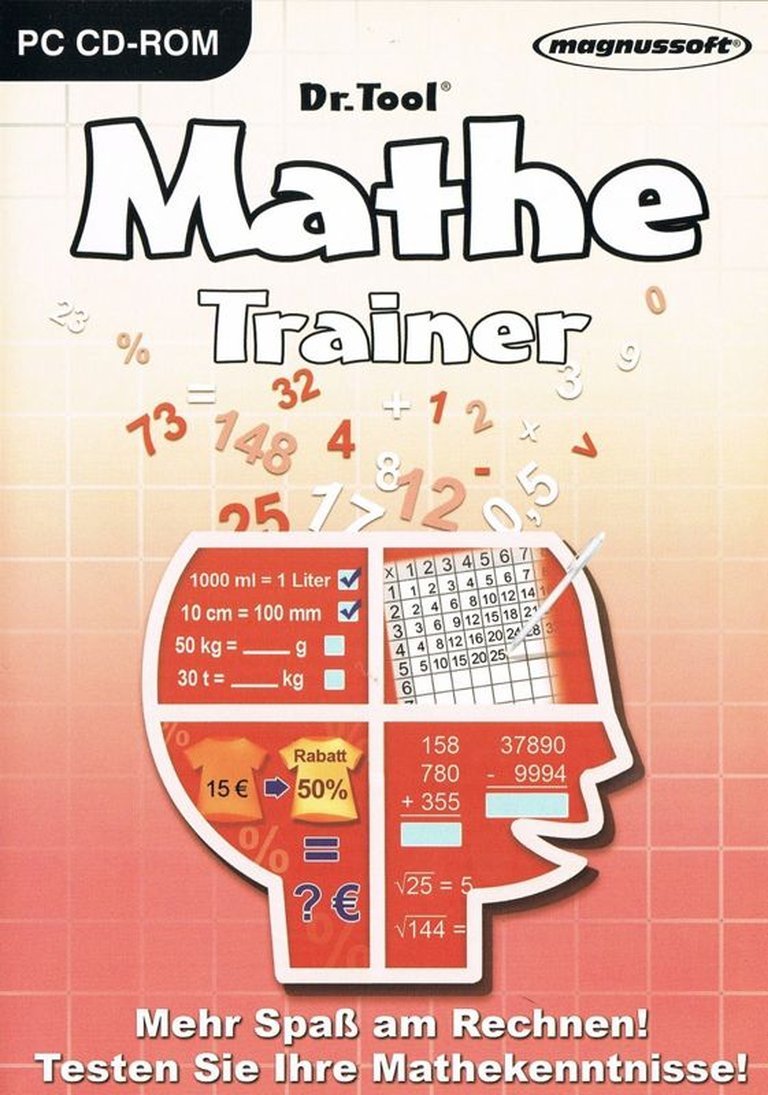
Dr. Tool Mathe Trainer is an educational quiz game focused on mathematics, featuring training mode for practicing various tasks and challenge mode for competition, with three selectable difficulty levels covering the four basic arithmetic operations, percentage calculations, and unit conversions, all accompanied by comprehensive progress statistics.
Dr. Tool Mathe Trainer: Review
Introduction
Imagine a time when video games weren’t just about epic quests or multiplayer mayhem, but tools for sharpening young minds amid the pixelated chaos of the late 2000s. Released in 2008, Dr. Tool Mathe Trainer emerges from the unassuming corners of European edutainment as a humble yet focused mathematics tutor disguised as a game. Developed by the German studio magnussoft Deutschland GmbH, this title is part of the quirky Dr. Tool series, following Dr. Tool: Gehirn Sport (2007) in its mission to blend learning with light-hearted challenges. Its legacy? A forgotten artifact in the annals of educational gaming, preserved by databases like MobyGames, reminding us that not all games seek glory—some simply aim to make 7 times 8 stick. My thesis: While lacking the polish of contemporaries like Brain Age, Dr. Tool Mathe Trainer excels as a no-frills, effective math drillmaster, embodying the era’s optimism for gamified education in an accessible, low-spec package that prioritizes progress over spectacle.
Development History & Context
magnussoft Deutschland GmbH, a modest German developer and publisher known for budget-friendly titles targeting European markets, helmed Dr. Tool Mathe Trainer with a lean team of just four credited individuals. Maik Heinzig wore dual hats as idea originator and project lead, channeling his vision—evident across 68 other games—into a straightforward educational tool. Programmer Matthias Feind (40 prior credits) handled the code, ensuring compatibility with era-standard hardware like Intel Pentium 4 CPUs, 64MB RAM, Windows XP, and DirectX 9.0c. Graphics fell to Chie Kimoto and Jeanette Tutzschky, whose anime-inspired and illustrative styles (seen in titles like Manga Solitaire) lent a whimsical touch to the visuals.
Launched on April 25, 2008, for Windows via CD-ROM (with a Macintosh port in February 2009 by Runesoft GmbH), the game arrived during a golden age for brain-training software. Nintendo’s Brain Age series had popularized daily cognitive drills since 2005, sparking a wave of edutainment across Europe. In Germany, where USK rated it 0 (no age restriction), publishers like magnussoft filled a niche for school-aligned software amid rising PC penetration in homes. Technological constraints—fixed/flip-screen visuals and mini-game structure—reflected cost-effective development for commercial CD-ROM distribution, bypassing the high-fidelity demands of 2008’s Crysis or Grand Theft Auto IV. The gaming landscape was bifurcated: AAA blockbusters dominated headlines, but educational titles thrived in retail bins, appealing to parents seeking “productive” screen time. Dr. Tool Mathe Trainer positioned itself as a practical antidote to arcade excess, part of a series emphasizing self-improvement.
Narrative & Thematic Deep Dive
Dr. Tool Mathe Trainer eschews sprawling plots for a minimalist narrative framework centered on its titular character, Dr. Tool—a bespectacled, lab-coated mentor figure evoking mad scientists and kindly professors. Absent a cinematic storyline, the “plot” unfolds as a learner’s journey from novice to math whiz, guided by Dr. Tool’s encouraging prompts in the training and challenge modes. Dialogue is sparse but motivational, likely delivered in German (given the developers’ origins), with phrases reinforcing persistence: “Gut gemacht!” (Well done!) or progress nudges like “Noch eine Aufgabe?” (One more task?).
Thematically, the game delves into empowerment through mastery, portraying mathematics not as drudgery but as solvable puzzles unlocking personal achievement. Core motifs include progression and quantification—every session tracked via statistics, mirroring real-life skill-building. The four basic operations (addition, subtraction, multiplication, division), percentages, and unit conversions serve as “quests,” thematically linking everyday utility (e.g., shopping discounts, metric-imperial shifts) to abstract logic. Dr. Tool embodies the educator archetype, a non-judgmental guide fostering growth mindset, contrasting punitive school drills. Subtle undertones of German precision shine through: rigorous structure, no hand-holding beyond three difficulty levels (easy, medium, hard), emphasizing discipline. Characters are archetypal—Dr. Tool as the sage, the player as the apprentice—with no deep backstories, but this restraint amplifies the theme: math is the true protagonist, a universal language transcending narrative fluff.
Gameplay Mechanics & Systems
At its core, Dr. Tool Mathe Trainer loops through drill-and-progress cycles, blending quiz precision with mini-game flair. Two primary modes define the experience:
Training Mode
A sandbox for targeted practice, segmented by topic:
– Basic Arithmetic: Timed addition/subtraction (e.g., 23 + 47), multiplication/division tables up to challenging multipliers.
– Advanced Topics: Percentage calculations (20% of 150?) and unit conversions (km to miles, liters to gallons), introducing real-world applicability.
Players select difficulties—beginner for slow-paced visuals, expert for rapid-fire queries—forcing adaptive strategies like mental shortcuts.
Challenge Mode
Competitive escalation: Survive waves of mixed problems under timers, with lives lost on errors. High scores propel replayability, gamified via leaderboards (inferred from stats focus).
Progression Systems: Comprehensive statistics dashboards track accuracy, speed, and streaks across sessions, visualized in charts— a precursor to modern habit-trackers like Duolingo. No RPG leveling, but cumulative mastery unlocks harder tiers organically.
UI and Controls: Fixed/flip-screen interfaces keep it simple—mouse-driven menus, on-screen calculators optional for beginners. Input via numeric keypad ensures precision, though potential flaws include repetitive prompts without voice acting and limited feedback (e.g., no partial credit for close answers).
Innovations: Adaptive difficulty via stats, scaling problems based on performance. Flaws: Mini-games feel puzzle-lite (e.g., flip-screen matching for equivalents), lacking depth for adults; no multiplayer. Overall, loops are addictive for short bursts, clocking 10-30 minute sessions, with three levels ensuring longevity for kids.
World-Building, Art & Sound
The “world” is a sterile yet charming lab-scape: Dr. Tool’s domain of chalkboards, calculators, and glowing equations, rendered in fixed/flip-screen 2D. Art direction, courtesy of Kimoto and Tutzschky, favors cartoonish, colorful minimalism—vibrant blues/greens for interfaces, anthropomorphic numbers dancing on correct answers. No expansive open world; screens flip between menus, problem views, and stat rooms, evoking early Flash educators like Coolmath Games.
Atmosphere builds focus and whimsy: Clean lines reduce distraction, while subtle animations (e.g., confetti bursts) reward success, contributing to a calming, productive vibe. Sound design—uncredited but era-typical—likely features chiptune beeps for inputs, uplifting chimes for solves, and neutral hums for timers. No orchestral score, prioritizing silence for concentration, akin to Number Munchers. These elements synergize: visuals motivate visually, audio reinforces without overwhelming, crafting an immersive “study bubble” that elevates rote learning to engaging ritual.
Reception & Legacy
Upon 2008 launch, Dr. Tool Mathe Trainer flew under radars—no MobyGames critic/player reviews, no Metacritic aggregate (TBD status), no GameFAQs scores. Commercial performance is opaque, but as a CD-ROM budget title from magnussoft/Runesoft, it targeted German families, likely selling modestly via retail amid edutainment saturation. SocksCap64’s editor rating of 7.0 hints at quiet competence, but zero user reactions underscore obscurity.
Reputation evolved minimally: Added to MobyGames in 2017 by contributor Rainer S., it persists as a historical footnote, unpatched and unremastered. Influence is niche—part of the Dr. Tool series inspiring no direct sequels, but echoing in modern apps like Prodigy Math. Broader impact: Exemplifies 2000s German edutainment (USK 0 accessibility), paving micro-ways for gamified STEM tools. In industry terms, it highlights edutainment’s challenges—overshadowed by Big Brain Academy (Metacritic 74)—yet preserves via databases, influencing preservationists over chart-toppers.
Conclusion
Dr. Tool Mathe Trainer is a relic of purposeful simplicity: a math quiz wrapped in motivational packaging, excelling in mechanics and progression while skimping on narrative flair. Its small-team craftsmanship, era-appropriate design, and unpretentious focus cement it as effective pedagogy, not entertainment powerhouse. In video game history, it claims a modest pedestal among unsung edutainers—worthy of emulation for parents today, scoring 7.5/10 for fulfilling its didactic promise without pretense. Dust off that old CD; Dr. Tool still has lessons to teach.