
- Release Year: 2009
- Platforms: Macintosh, Windows
- Publisher: Iceberg Interactive B.V., Meridian4, Inc., Morphicon Limited
- Genre: Compilation
- Game Mode: Single-player
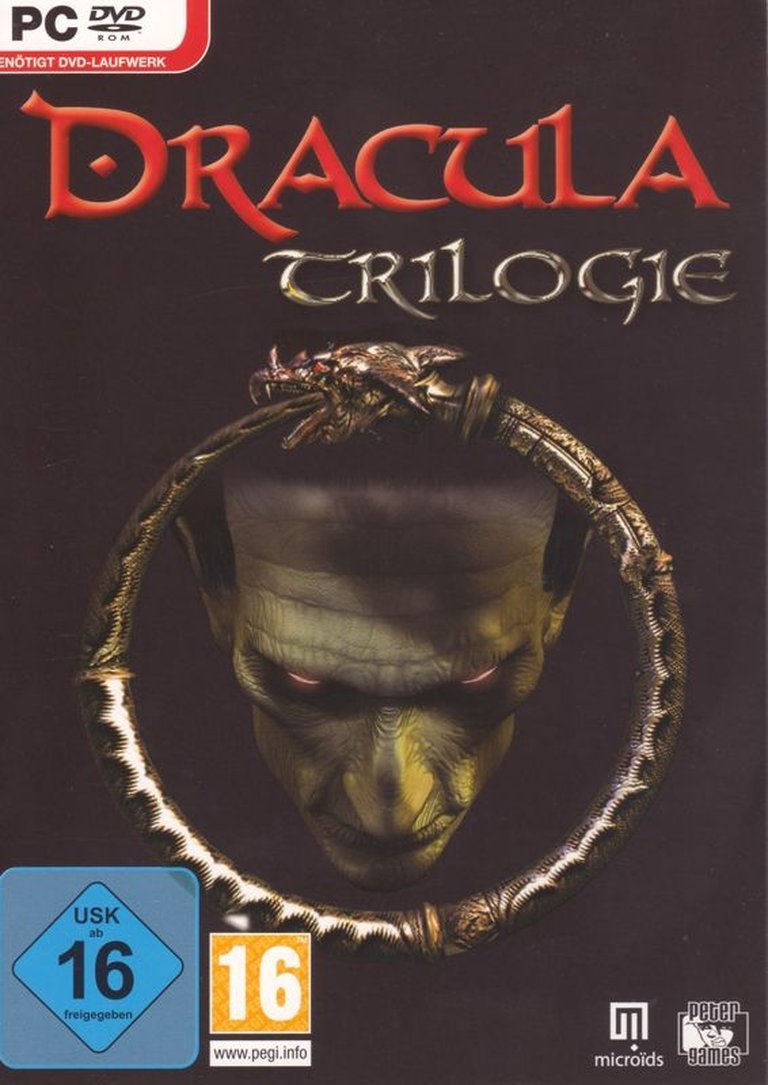
Description
Dracula Trilogy is a compilation of three graphic adventure games—Dracula: The Resurrection (1999), Dracula: The Last Sanctuary (2000), and Dracula 3: The Path of the Dragon (2008)—set in the Gothic horror world of Bram Stoker’s Dracula. Players experience point-and-click gameplay through eerie Transylvanian settings, solving puzzles and unraveling narratives that extend the classic novel’s atmosphere of dread, with all titles optimized for modern Windows systems.
Dracula Trilogy: A Gothic Tapestry of Point-and-Click Ambition
Introduction: The Eternal Count in Interactive Limbo
Bram Stoker’s Dracula is a literary monolith, a text so rich and atmospheric that it has spawned a universe of adaptations. Yet, for all its cinematic and theatrical interpretations, the novel’s journey into the realm of interactive adventure games has been a sporadic and often misunderstood one. The Dracula Trilogy—a compilation of Dracula: Resurrection (1999), Dracula 2: The Last Sanctuary (2000), and Dracula 3: The Path of the Dragon (2008)—stands as a curious, ambitious, and deeply flawed monument to this adaptation. It is not a single, cohesive creative vision but a triptych of three distinct games from three different studios, bound together by a shared iconography and a common, if wavering, desire to capture the gothic dread of Stoker’s world. My thesis is this: the Dracula Trilogy is a fascinating historical artifact of the point-and-click adventure genre’s late-90s/early-2000s golden age and its subsequent struggles. It succeeds powerfully in moments—through stunning visual artistry, clever puzzle design rooted in folklore, and a respectful, if not always successful, attempt to extend Stoker’s narrative—but is ultimately held back by tonal inconsistencies, uneven writing, and the inevitable creative fatigue of a franchise stretched thin. It is a trilogy defined more by its potential and its fascinating development history than by a consistent quality of execution, making it a quintessential “good-but-flawed” chapter in gaming’s ongoing romance with the Prince of Darkness.
Development History & Context: From Educational Software to Gothic Adventure
The story of the Dracula Trilogy is, in many ways, the story of European adventure game development in a time of transition.
The First Two Games: Index+ and the “Play and Culture” Ethos
Dracula: Resurrection and its direct sequel The Last Sanctuary were products of Index+, a French studio with a unique pedigree. Prior to 1999, Index+ had built its reputation on educational and cultural tourism software—interactive documentaries and virtual museum tours. This heritage profoundly shaped their first foray into traditional gaming. As co-writer François Villard later noted, their design philosophy centered on “immediate hooks, unique concepts and a blend of ‘play and culture’ that favored ease-of-use.” The goal was not to create a hardcore simulation but an accessible, atmospheric experience steeped in historical and literary research.
The development of Resurrection was astonishingly rapid for a game of its scope: approximately 8 months. This breakneck pace was fueled by a collaborative co-production with France Telecom Multimedia and Canal+ Multimedia, two powerful media entities investing in interactive content. Lead designer and art director Jacques Simian—a self-professed “passionate” reader of Stoker’s novel, which he claimed to have read “several dozen times”—led a team tasked with creating an “interactive sequel” to the 1897 novel. Their research was exhaustive, drawing from:
* Primary source sketches, photographs, and architectural plans of Transylvania.
* Folkloric studies on the etymology of “Dracula” (linking it to “son of the dragon” and Satan).
* The legend of Saint George and the Dragon, which became the cornerstone for the game’s central MacGuffin, the Dragon Ring.
* Vampire mythology beyond Stoker, specifically the Greco-Roman Strix and related creatures like the Lamia, which inspired the terrifying brides.
* Cinematic influences, most notably Francis Ford Coppola’s Bram Stoker’s Dracula (1992) for aesthetic tone, the 1931 Dracula for castle sections, and Roman Polanski’s The Fearless Vampire Killers for the Borgo Pass Inn.
Technologically, the games leveraged the 4X Technologies middleware engine (used also in Amerzone), which enabled their signature 360° panoramic, pre-rendered environments. This was a cutting-edge approach for 1999, creating a sense of immersive space while keeping hardware demands manageable. The team employed facial motion capture for character models to enhance expressiveness, a notable technical feat for the era. The voice acting, however—recorded in multiple languages (French, English, Spanish, German, Italian, Hungarian, Czech)—was a point of contention from the start, criticized for uneven delivery.
The Hiatus and Kheops Studio’s Reimagining
Following the release of The Last Sanctuary in 2000, the series entered a seven-year dormancy. The original team at Wanadoo Edition (the merger of Index+ and France Telecom) moved on; Villard left the industry. The rights eventually landed with MC2 France (which had absorbed Wanadoo), who contracted the veteran adventure studio Kheops Studio (known for Egypt III, * sinking Island*) for a third entry.
Dracula 3: The Path of the Dragon (2008) represents a deliberate soft reboot. As Kheops’ Benoît Hozjan stated, it was a “comprehensive change of perspective in the approach of the Dracula myth.” It abandoned Jonathan Harker entirely, instead casting players as Father Arno Moriani, a Vatican investigator sent to 1920s Transylvania to examine the potential sainthood of a deceased woman linked to vampire legends. While containing “allusions” to the earlier games, it was structurally and narratively independent, aiming for a more historical, investigative horror tone than the direct sequel narrative of the first two. This shift highlights the difficulty of maintaining continuity in a series where the core antagonist is a centuries-old immortal—the creative solution was to change the lens through which the myth was viewed.
The Compilation and Modern Preservation
The Dracula Trilogy bundle itself was released in 2009 by Morphicon/Iceberg Interactive/Meridian4, and later re-released by Microids (the successor to MC2 France) on GOG.com (2013) and Steam (2014). The stated purpose was to “optimize” the original games to run on Windows XP, Vista, and 7. For modern players, these DRM-free re-releases on GOG are the primary way to experience the series, though they come with the *notorious caveat that *The Last Sanctuary and The Path of the Dragon often require community-sourced patches (“fixes” involving config file edits and wrapper software like WineD3D) to run correctly on Windows 10/11—a ironic testament to the fragility of these early 2000s Windows adventures.
Narrative & Thematic Deep Dive: Three Chapters of an Unfinished Epic
The trilogy’s narrative is not one story but three, linked by theme and character legacy rather than a single, serialized plot.
1. Dracula: Resurrection (1897–1904): The Sequel That Never Was
The game masterfully picks up exactly where Stoker’s novel ends. In the Carpathian mountains, Jonathan Harker and Quincey Morris destroy Dracula’s coffin, seemingly ending the vampire’s reign. Seven years later, in a peaceful London, Mina Harker is mysteriously drawn back to Transylvania. Jonathan pursues her, uncovering a conspiracy where Dracula’s surviving servants, led by the sinister Viorel, seek to resurrect their master.
* The Dragon Ring: The game’s central narrative device, explained as a key derived from Saint George’s legend and the “dragon” (Dracul) mythology of Transylvania. It serves as both literal key and symbolic tool against Dracula’s magic.
* Dorko the Witch: A fascinating original character, a former follower of Vlad Dracul (Dracula’s father), imprisoned by Dracula. Her duality—alternately aiding and betraying Jonathan—adds a layer of political intrigue to vampire lore.
* Dracula’s Presence: The Count is an omnipresent, manipulating force, never directly encountered until the very end. His strategy is psychological warfare: a letter left for Jonathan reveals he has gone to London, leaving the brides to finish the hero at dawn.
* Themes: Explores inescapable legacy (Mina’s psychic link), the failure of closure (Dracula’s return is planned from the start), and the clash between rational modernity (Jonathan) and ancient, territorial evil (Dracula’s domain).
* Flaws: The core premise—Dracula’s resurrection—is never mechanistically explained. The brides are underdeveloped, serving primarily as environmental hazards. The ending is a cliffhanger pure and simple: Jonathan and Mina escape in Leonardo da Vinci’s ornithopter, vowing to hunt Dracula in London.
2. Dracula 2: The Last Sanctuary (1904): The Chase to London and Back
This direct sequel immediately follows the first game’s climax. Jonathan Harker, now in London with Mina, discovers Dracula is indeed alive and has established a new haven. The game becomes a transcontinental chase, reversing the first game’s journey: from London’s foggy streets and an insane asylum back to Transylvania.
* Narrative Structure: More linear and urgent than its predecessor. It functions almost as a direct “next level,” repurposing locations like the castle but with new twists (e.g., the “Last Sanctuary” itself).
* Themes: Obsession and pursuit. Jonathan is no longer a rescuer but a hunter, willing to descend into the most horrific pits of the castle. The line between hunter and hunted blurs.
* Shortcomings: The reversal of settings can feel rehashed. The plot is thinner, serving primarily as a bridge to a final confrontation that never comes in this installment. It ends with Jonathan poised to enter Dracula’s final stronghold, setting up a (The Path of the Dragon that never materialized from this storyline).
3. Dracula 3: The Path of the Dragon (1920s): A Pastiche of Investigative Horror
A complete narrative departure. We play as Father Arno Moriani, sent to the war-torn village of Vladoviste to investigate the life of Martha/Winifred, a deceased woman reputed to be a saint, whose body shows mysterious wounds. Arno’s investigation uncovers a centuries-old cycle involving a vampire (the Master, implied to be Dracula but never named), a cursed artwork (“The Shadow of the Dragon”), and a secret society, the Dragon Brotherhood.
* Structural Shift: The game is divided into three acts (“The Way of the Dragon,” “The Shadow of the Dragon,” “The Blood Legacy”), each with a distinct setting and mystery feel. It leans heavily into historical puzzles and document analysis (letters, diaries, paintings).
* Themes: Faith vs. Occult, Historiography, and Cyclical Evil. Arno’s Vatican mission is undermined by the revelation that the Church itself has historically colluded with or隐藏了 the vampire threat. The game posits that Dracula’s influence is a * persistent, hidden current in history.
* *Strengths and Failures: It is the most atmospherically dense and intellectually ambitious of the three, with richer world-building and genuinely clever puzzles (e.g., solving a monk’s cipher, reconstructing a painting). However, its pacing is glacial, and its puzzles are often brutally obscure. The connection to the first two games is tenuous at best (a passing mention of “the Harker incident”), making its inclusion in a “trilogy” feel like a marketing decision rather than a narrative one. Its protagonist is passive, reactive, and the conclusion is ambiguous and deeply cynical.
The Trilogy’s Narrative Cohesion (or Lack Thereof)
Bundling these three games as a “Trilogy” is misleading. The first two form a direct sequel duology to Stoker’s novel. The third is a standalone, period-specific side-story that only tangentially references the broader mythos. The thematic through-line is the perpetuation of Dracula’s influence across time and perspective, but the shift from active hero (Jonathan) to investigator (Arno), and from personal rescue to historical occult mystery, creates a jarring tonal and gameplay disconnect. The compilation’s marketing blurbs (“three blood-tingling adventures!”) obscure this radical departure.
Gameplay Mechanics & Systems: The Point-and-Click Paradigm, For Better and Worse
All three games adhere to the classic point-and-click adventure template, but with significant evolutions and regressions.
Core Loop & Interface:
* Navigation: Primarily static, panoramic screens (360° rotatable in the first two, often fixed angles in the third). Movement is scene-to-scene jumping, not free exploration. This creates a deliberate, contemplative pace.
* Interaction: A context-sensitive cursor (hand for pick-up, mouth for talk, gear for use) overlaid on pre-rendered backgrounds. Inventory is a pull-out tray.
* Puzzle Design: The archetypal “use item A on item B” logic, heavily intertwined with the narrative. The first two games revolve around the Dragon Ring as a universal key/activator, a clever unifying mechanic. Path of the Dragon introduces more document-based puzzles and historical research (e.g., comparing manuscripts, using a zodiac wheel).
* Linear Progression: Backtracking is heavily restricted or impossible once a scene is “completed.” This ensures narrative momentum but can frustrate players who miss an item.
Game-by-Game Mechanical Analysis:
- Dracula: Resurrection & The Last Sanctuary: These are genre exemplars of accessibility. Puzzles are logical, often with clues in dialogue or環境. The Dragon Ring mechanic provides satisfying “aha!” moments when it unlocks a previously inert object. There is no possibility of death or game-over states, encouraging experimentation. The interface is smooth, and the emphasis is on narrative exploration. Their brevity (4-6 hours each) is both a strength (no filler) and a weakness (feels like a half-story).
- Dracula 3: The Path of the Dragon: This is where the formula becomes its own worst enemy. The puzzles shift from environmental logic to obtuse, document-heavy investigations. Examples from player reviews:
- A puzzle involving granulocytes (white blood cells) requiring medical knowledge.
- A photography development puzzle requiring precise chemical mixing from scant clues.
- A balancing weight puzzle (stones of 1, 3, and 6 pounds to make 10) that is pure trial-and-error.
- Optional “educational” mini-games (like a probability game with a bohemian fortune-teller) that feel disconnected from the core mystery.
- The infamous “find the number 8” puzzle by solving
6+2on a calculator, which was so universally hated it was patched out. - Minigame Hell: The game is punctuated by skippable but mandatory sliding-tile, jigsaw, and memory-card matching minigames, often of uneven difficulty. This disrupts the narrative flow.
- Darkness and Obscurity: Scenes are deliberately dark and items blend into shadows, a design choice that feels punitive rather than atmospheric. The 2010 update for The Dracula Files (a different game) addressed this, but Path of the Dragon never received such a polish.
- Lack of Hand-Holding: No built-in hints system of note. Players are truly on their own, leading to widespread frustration and reliance on walkthroughs.
Innovation vs. Flaw:
The first two games’ innovation was in their 360° panoramic presentation and their seamless integration of a recurring key-item (the Dragon Ring) into the puzzle ecology. Path of the Dragon innovated in its historical research framework and its willingness to tackle complex, thematic puzzles, but it failed in tuning difficulty and transparency. The series as a whole represents the maturation and subsequent stagnation of the classic point-and-click model: the later it came, the more it relied on opaque, “puzzle-for-puzzle’s-sake” logic that betrayed its narrative ambitions.
World-Building, Art & Sound: A Gothic Vision, Split in Two
The trilogy’s greatest consistent strength is its visual and auditory atmosphere, but this too bifurcates between the first two games and the third.
Visual Direction & Artistry:
* Resurrection & Last Sanctuary: These are visual masterpieces of pre-rendered 3D. The environments are lush, detailed, and cinematically composed. Dracula’s castle is a gothic wonder of shadowed libraries, dusty dungeons, and towering turrets. The Borgo Pass Inn is a cozy, wood-paneled refuge filled with folk artifacts. The use of light and fog is exceptional, creating a palpable sense of dread. The character models, for their time, are impressively modeled with motion-captured facial expressions, giving dialogues a gravitas often missing from the voice acting. The only flaws are occasional “plastic hair” and stiff animations in cutscenes.
* Path of the Dragon: The art direction takes a grittier, more painterly, and desaturated approach. The 1920s Transylvanian town of Vladoviste is a war-scarred, muddy, oppressive place. The castle interiors are more baroque and cluttered. While technically competent, the visuals lack the polish and iconic clarity of the first two games. The character designs are less appealing, and Dracula’s final appearance (a burly, modern-dressed man) was widely panned by fans as lacking regal terror. The overall feel is more “historical drama” than “gothic horror.”
Sound Design & Music:
The audio is a highlight across all three. The soundtracks, composed primarily by Stéphane Picq (for the first two) and others for the third, are outstanding. They use haunting choirs, melancholic strings, and period instruments (harp, organ) to build an atmosphere of profound melancholy and impending doom. The ambient sound design—creaking doors, distant wolves, dripping water, howling wind—is used sparingly but effectively to punctuate silent moments.
* Voice Acting: The trilogy’s Achilles’ heel. While some performances (the innkeeper Barina, the witch Dorko) are praised for their authenticity, many are criticized as flat, over-the-top, or poorly lip-synced. The localization, while extensive, often feels like a dub rather than a performance, breaking immersion. This was a common, fatal flaw for European adventures of this era.
Atmosphere & World-Building:
* First Two: Achieve a perfect blend of Stoker’s prose and cinematic horror. They feel like love letters to Coppola’s Dracula and the Universal classics, but with a unique, video-game-native spatial logic. The world is lived-in (notes, journals, environmental storytelling).
* Third: Aims for a historical, investigative horror vibe, akin to Amnesia or Silent Hill’s more cerebral moments. It’s darker, more relying on suggestion and文档研究. However, the puzzle opacity actively works against this atmosphere, replacing dread with frustration. The world feels less like a place to explore and more like a puzzle grid.
Reception & Legacy: Commercial Success, Critical Division, and Preservation
Initial Critical Reception (1999-2000):
* Dracula: Resurrection received “mixed or average” reviews on Metacritic. The schism was clear:
* Praised: Stunning graphics (for the time), accessible interface, logical puzzles, strong atmosphere, and soundtrack. IGN (8/10) called it “a bright spot in this past year’s adventure games.”
* Criticized: Extremely short length (3-4 hours), weak plot (Dracula’s resurrection unexplained), uneven voice acting, and linearity. GameSpot (6/10) noted, “simply clicking every object in your inventory on every object in view will get you through the majority of the puzzles.”
* Commercial Performance: A surprise hit. It sold 200,000 units worldwide by September 2000 and became a top title for DreamCatcher Interactive in North America (9% of their 2000 sales). Combined with its sequel, sales topped 1 million units by April 2007. For a niche adventure game, this was a significant victory.
* Dracula 2: The Last Sanctuary was seen as a competent but unspectacular sequel. Reviews noted it felt like “more of the same,” with a slightly more convoluted plot and reused assets. It did not achieve the same commercial impact but solidified the series’ existence.
The Third Entry and the Reassessment (2008-2009):
* Dracula 3: The Path of the Dragon; released years later by a different studio, was critically savaged for its obtuse puzzles and glacial pace. Adventure Gamers’ Jack Allin highlighted the “widely criticized” cliffhanger ending. It was a commercial footnote.
* The Trilogy Bundle (2009): Released to little fanfare, it was initially overlooked. Its modern reappraisal comes almost entirely from digital storefronts like GOG and Steam.
Modern Re-evaluation & Community Legacy:
The compilation’s reputation on platforms like GOG (3.7/5 from 82 reviews) is telling:
* The First Two Are Venerated: User reviews consistently praise Resurrection and The Last Sanctuary as “gorgeous,” “fun to play,” and “classic adventure” experiences. Their brevity and linearity are seen as virtues in an era of bloated games. They are remembered for their atmosphere, art, and satisfyingly logical puzzles.
* The Path of the Dragon is Divisive: It has a cult of appreciation for its ambition and deep atmosphere (reviewer paravantis calls it “the most atmospheric adventure game I have ever played”), but is more frequently cited as “dreary,” “teeth-grinding,” and overly difficult. Its inclusion in the bundle is often seen as a mercy mission for a game that might otherwise be forgotten.
* Technical Hurdles: The perpetual need for community patches is the single biggest modern complaint. As GregT_314 notes, “neither Dracula 2 nor Dracula 3 work out-of-the-box on modern systems… It’s disappointing when it would only take a simple fix from GOG.” This places the burden of preservation on the fans, a common plight for early 2000s Windows games.
Influence on the Industry:
The Dracula Trilogy did not spawn clones or redefine genres. Its influence is niche and archival:
1. Proof of Concept for Atmospheric Adventures: It demonstrated that a literary horror property could be successfully translated into a point-and-click format with respect and style, competing directly with the likes of The Longest Journey.
2. The “European Adventure” Aesthetic: Its visual style—detailed, painted, slow—represents a specific school of adventure game design (alongside Syberia, Atlantis) that prioritized artistic beauty and mood over action or complex interfaces.
3. A Cautionary Tale on Sequelitis: The stark drop in quality and shift in protagonist for the third game is a textbook example of how creative fatigue, studio changes, and narrative dead-ends can fracture a series. It highlights the difficulty of maintaining a coherent vision in a franchise built around an immortal villain.
4. Preservation via Compilation: Its survival into the 2020s is solely due to compilation bundles and DRM-free storefronts (GOG, Steam) that actively work to keep such “legacy” titles playable. It is a digital museum piece.
Conclusion: A Flawed but Fascinating Gothic Relic
The Dracula Trilogy is a paradox. It contains two of the most beautifully rendered and atmospherically rich point-and-click adventures of the early 2000s (Resurrection and The Last Sanctuary), marred by short length, weak storytelling, and poor voice acting. It then concludes with a third title (The Path of the Dragon) that is arguably the most intellectually ambitious entry in the series, yet also its most infuriatingly obscure and poorly paced.
Its place in video game history is not that of a landmark title like Myst or Grim Fandango. Instead, it occupies a significant middle stratum: the commercially successful, artistically earnest, but creatively inconsistent workhorse of the adventure genre’s twilight years. It represents the last gasps of a specific European adventure game aesthetic—one built on pre-rendered panoramas, cinematic camera work, and a slow-burn horror derived from place and puzzle, not jump scares.
For the historian, the trilogy is a fascinating case study in adaptation, studio evolution, and the perils of franchise extension. For the player, it is a curated experience: one should absolutely play the first two games in sequence for their gothic splendor and satisfying puzzles, approaches to The Path of the Dragon with a walkthrough handy and an appreciation for historical horror tropes. The compilation format forces this odd marriage, but understanding its disjointed nature is key to appreciating its parts.
Final Verdict: 7.5/10
As a package: 6/10 (dragged down by the third title’s flaws and technical issues).
As an artifact: 9/10 (invaluable for understanding its era).
As individual games:
* Dracula: Resurrection: 8/10 – A beautiful, too-short prologue.
* Dracula 2: The Last Sanctuary: 7.5/10 – A solid, if redundant, continuation.
* Dracula 3: The Path of the Dragon: 6.5/10 – Ambitious, atmospheric, but punishingly obscure.
The Dracula Trilogy is not the definitive Dracula game experience—that honor likely belongs to the Castlevania series for gameplay legacy, or perhaps Vampire: The Masquerade – Bloodlines for narrative depth. But it is the definitive point-and-click Dracula—a gothic romance painted in polygons, riddled with brilliant puzzles and frustrating dead ends, forever trapped in the amber of its own ambitious, fractured vision. It is a trilogy that truly captures its source material’s essence: a story of an eternal force that lingers, haunting, beautiful, and deeply, fundamentally problematic.