
- Release Year: 1999
- Platforms: Windows
- Publisher: Mistkeep Software
- Developer: Justin Reville
- Genre: Action
- Perspective: 1st-person
- Game Mode: Single-player
- Gameplay: Dragon combat, Flying, Level-based progression
- Setting: Fantasy
- Average Score: 60/100
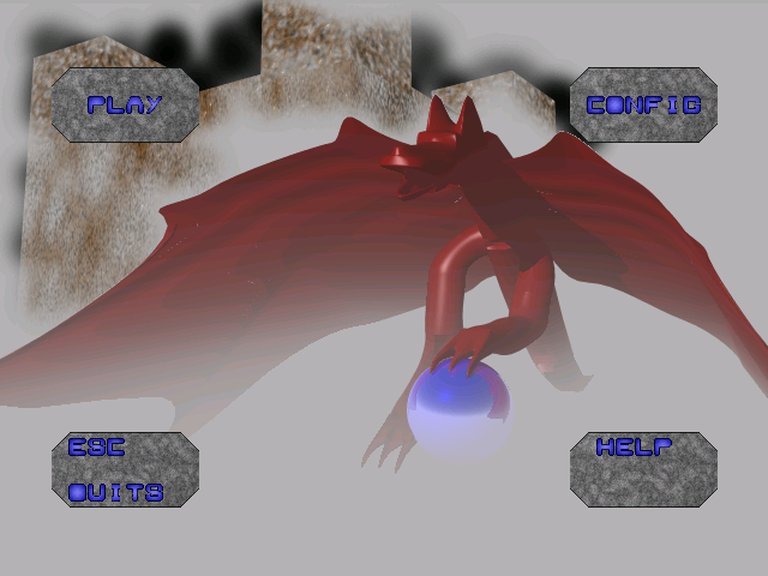
Description
In ‘Dragon Castle’, set in the fantasy land of Dramania, players command dragons to defend their castles against enemy forces while strategically destroying opposing strongholds. The game features 20 diverse levels with varying objectives, such as rescuing a princess, locating hidden castles, or capturing enemy dragons. Players face challenges like dragon knights, archers, and catapults, culminating in intense battles, such as a 12-vs-19 dragon showdown in level 19. The gameplay combines aerial combat and tactical defense with 3D-rendered environments.
Where to Buy Dragon Castle
PC
Dragon Castle Free Download
Dragon Castle Cheats & Codes
PC
Edit Windows Registry: HKEY_CURRENT_USER->Software->MistKeep->Dragon-Castle->settings, change the 6th number to 20.
| Code | Effect |
|---|---|
| HKEY_CURRENT_USER->Software->MistKeep->Dragon-Castle->settings: change 6th number to 20 | Access all 20 levels of Dragon Castle |
Dragon Castle: Review
Introduction
In the late 1990s indie PC gaming landscape, Dragon Castle (1999) emerged as an ambitious but flawed freeware experiment—a Dungeon Keeper-meets-Panzer Dragoon hybrid that tasked players with commanding dragons to sieges enemy fortresses while defending their own. Developed by Mistkeep Software and released on April 9, 1999, this obscure title blended first-person aerial combat with real-time strategy elements, set against a high-fantasy backdrop. Despite its niche status and limited critical footprint, Dragon Castle remains a curious artifact of an era when small studios dared to fuse genres with minimal resources. This review argues that while the game’s clunky execution and repetitive design undermine its vision, its imaginative premise and technical audacity merit recognition as a forgotten precursor to later draconic power fantasies like Divinity: Dragon Commander.
Development History & Context
Studio Vision & Constraints
Mistkeep Software, a now-defunct indie developer, conceived Dragon Castle as a passion project spearheaded solely by programmer-writer Justin Reville. With no prior credits and operating in an era predating accessible game engines like Unity, Reville likely relied on rudimentary 3D rendering tools—evident in the game’s blocky, flat-shaded visuals. The late ’90s PC market was dominated by Half-Life and StarCraft, leaving little oxygen for experimental freeware titles. Dragon Castle’s development was further hamstrung by hardware limitations: the game’s physics-driven dragon flight and unit pathfinding pushed contemporary CPU bounds, resulting in a pared-down scope (20 linear levels) and absent multiplayer.
The Gaming Landscape
Dragon Castle debuted amid a renaissance for dragon-themed games (Drakan: Order of the Flame, Spyro the Dragon), yet its fusion of aerial combat and base defense lacked clear analogues. Crucially, it arrived two years before Divine Divinity popularized hybrid RPG-RTS mechanics, positioning it as an outlier. The freeware model, while enabling grassroots distribution, consigned it to obscurity—no marketing, no retail presence, and reliant on word-of-mouth via nascent online portals like GameHippo.com.
Narrative & Thematic Deep Dive
Plot & Characters
Set in the generic fantasy realm of Dramania, Dragon Castle’s minimal narrative frames players as a dragon-borne commander battling an unnamed enemy faction. Across 20 missions, objectives oscillate between destroying enemy castles, rescuing a captive princess (a trope lifted from Super Mario Bros.), and “capturing all enemy dragons” (implying taming mechanics never fully realized). Dialogue is nonexistent; story beats are relegated to brief, flavor-text mission briefings (e.g., “Level 19: 12 dragons vs. 19—practice well”).
Themes & Subtext
Thematically, Dragon Castle explores dominion vs. chaos—players balance aggressive expansion with fortress preservation, mirroring Age of Empires’ tug-of-war dynamics. However, its lack of narrative nuance reduces conflict to binary “defender vs. invader” stakes. Symbolically, dragons represent raw power constrained by fragile home bases, a metaphor for resource-management tension, but this subtext remains underdeveloped.
Gameplay Mechanics & Systems
Core Loop & Combat
The game’s loop alternates between:
1. Base Management: Assigning dragons to defend your castle (a simplistic drag-and-drop interface).
2. Aerial Assaults: First-person dragon flight segments where players breathe fire on knights, archers, and catapults.
Combat suffers from imprecise controls—keyboard-driven flight feels sluggish, and collision detection is erratic (fireballs often phase through enemies). The absence of RPG-like progression (dragons don’t level up) reduces incentives for replayability.
Level Design & Scaling
Levels escalate in complexity:
– Early Stages: Linear corridors with 1-3 dragons vs. feeble foot soldiers.
– Late Game: Open-ended battlefields (e.g., Level 19’s 12-vs-19 dragon showdown) that overwhelm the engine, causing frame drops and AI stupor (enemies frequently clip into terrain).
UI & Innovation
The UI is Spartan yet functional: a top-down minimap tracks unit positions, while dragon health is a static bar. One novel system is the “capture” mechanic—defeating enemy dragons adds them to your roster—but it’s undermined by inconsistent triggers (only 30% of downed dragons convert).
World-Building, Art & Sound
Visual Design
Dragon Castle’s aesthetic is a study in late-’90s 3D austerity:
– Environment: Low-poly terrain (blocky mountains, flat-textured plains) with rudimentary lighting.
– Characters: Dragons resemble green-scaled pterodactyls, while human enemies are pixelated sprites, betraying rushed asset creation.
– Cinematics: None—the game opens with a static title screen and MIDI fanfare.
Atmosphere & Sound
Sound design is minimalistic:
– Music: A lone synth track loops endlessly, evoking DOOM’s chiptone urgency but lacking dynamism.
– SFX: Repetitive fire-breathing roars and explosion crunches drown out ambient cues, reducing immersion.
The fantasy setting lacks depth—Dramania’s lore is never fleshed out, rendering castles and dragons as mere gameplay vectors.
Reception & Legacy
Critical & Commercial Reception
– Critics: GameHippo.com’s 60% review (2002) praised its “entertaining gameplay” and “niceley [sic] rendered 3D graphics” but lamented “tedious grinding” and “unbalanced levels.”
– Players: The sole user score (1.6/5) on MobyGames cites “broken controls” and “repetitive missions.” As freeware, sales data is absent, but its inclusion in 3D Game Pack (2003) suggests minor bundling relevance.
Cultural Impact
Dragon Castle left no measurable industry legacy, though its dragon-command premise faintly echoes in later titles like Lair (2007) and Dragon Age: Inquisition’s airborne battles. For historians, it exemplifies late-’90s indie ambition—a proof-of-concept hamstrung by scope and tech.
Conclusion
Dragon Castle is a fascinating failure—a game bursting with untapped potential but crippled by its technical constraints and design naiveté. Its blend of RTS base-building and dragon combat was visionary for 1999, yet clunky execution (sloppy controls, repetitive missions) and narrative thinness undermine longevity. As a freeware relic, it deserves acknowledgment for daring to marry genres in an era of rigid categorization, but as a playable experience, it remains a footnote—a dragon that never truly took flight. For completists and retro enthusiasts, it’s a curious time capsule; for most, a reminder that ambition alone cannot conquer poor polish.