
- Release Year: 2022
- Platforms: Nintendo Switch, Windows
- Publisher: Square Enix Co., Ltd., Square Enix, Inc.
- Developer: Square Enix Co., Ltd., Tose Co., Ltd.
- Genre: Role-playing (RPG)
- Perspective: 3rd-person
- Game Mode: Single-player
- Gameplay: Action, Monster Recruiting, RPG, Treasure hunting
- Setting: Fantasy
Description
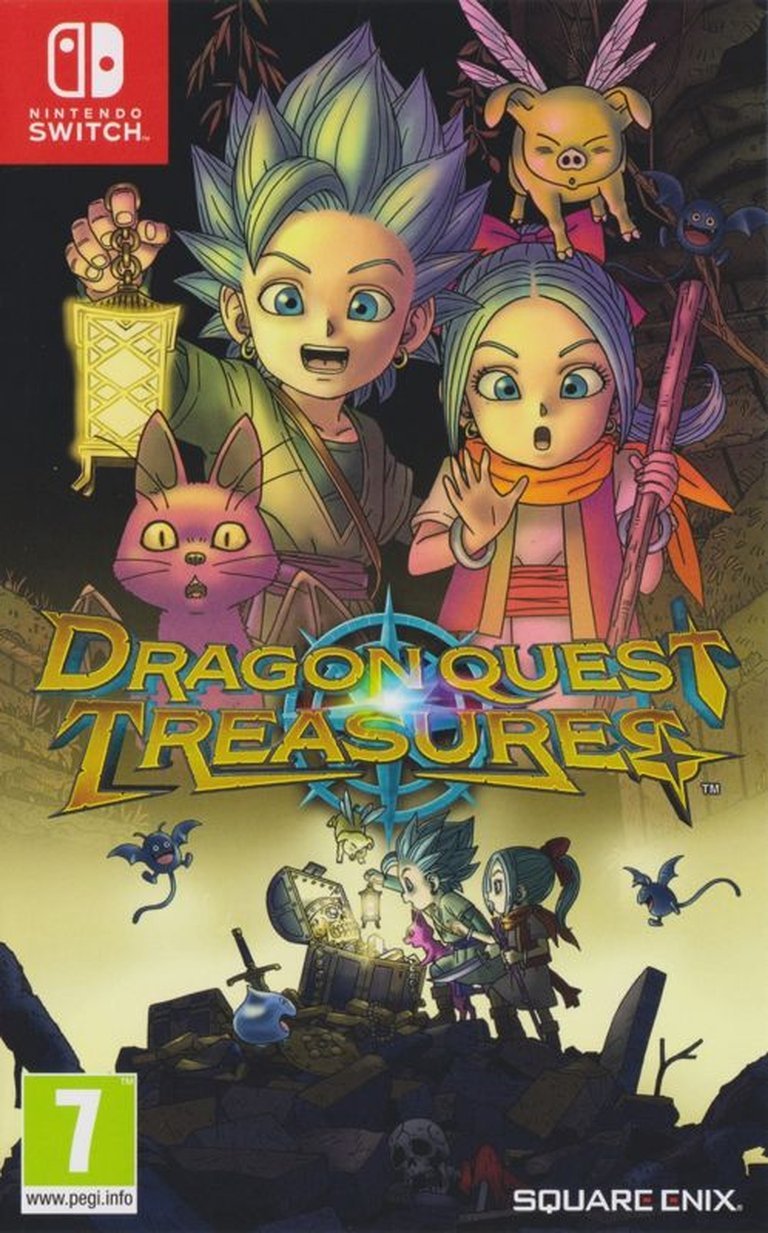
Dragon Quest Treasures is a fantasy action RPG where players join siblings Erik and Mia as they embark on a treasure-hunting adventure in a whimsical, monster-filled world. Set in the Dragon Quest universe, the game features exploration, combat, and recruiting unique monsters to aid in searching for legendary treasures across floating islands and diverse landscapes. Designed with vibrant anime-style visuals, the game blends traditional RPG elements with treasure-seeking mechanics on platforms like Nintendo Switch and Windows.
Gameplay Videos
Where to Buy Dragon Quest Treasures
Dragon Quest Treasures Free Download
Dragon Quest Treasures Guides & Walkthroughs
Dragon Quest Treasures Cheats & Codes
Nintendo Switch
Open the Gang menu by pressing the Up arrow button. Select ‘Gift Code’, enter the code, and confirm.
| Code | Effect |
|---|---|
| YUB | Rewards a King Slime voiced by Yuji Horii. |
| PEK | Rewards a Killing Machine voiced by VTuber Usada Pekora. |
Dragon Quest Treasures: A Gem-Crusted Journey Through Draconia’s Skies
Introduction
In the pantheon of Dragon Quest spin-offs, Dragon Quest Treasures (2022) emerges as a curious hybrid—part monster-collecting romp, part treasure-hunting odyssey—set against the whimsical backdrop of Draconia. Centered on Dragon Quest XI’s breakout sibling duo, Erik and Mia, this Nintendo Switch (and later PC) title trades epic stakes for breezy exploration and dopamine-rich scavenging. While critics praised its charm and accessibility, it faced scrutiny for repetitive combat and shallow systems. This review posits that Treasures is a flawed but fascinating experiment: a gateway RPG for newcomers and a cozy, if uneven, diversion for series loyalists.
Development History & Context
Developed by Tose Co., Ltd. (the prolific support studio behind Final Fantasy and Dragon Quest ports) under the creative oversight of Square Enix, Treasures inherits the legacy of series architect Yuji Horii, iconic artist Akira Toriyama, and composer Koichi Sugiyama. Released on December 9, 2022, it arrived in a crowded landscape dominated by open-world epics and live-service titans. Yet, Treasures deliberately sidestepped complexity, targeting younger audiences and casual players with its streamlined action-RPG mechanics.
Technologically, the Switch’s hardware limitations loomed large. While Toriyama’s vibrant character designs (reimagined here with youthful exuberance) shone through, performance hiccups—frame rate dips, texture pop-in—tested player patience. The game’s development cycle aligned with a wave of Dragon Quest multimedia expansion, bridging Dragon Quest of the Stars (2019) and the monster-taming sequel The Dark Prince (2023). Treasures’ focus on Erik and Mia’s backstory served dual purposes: fleshing out fan-favorite characters while offering a narrative foothold for newcomers.
Narrative & Thematic Deep Dive
Treasures casts players as pre-teen Erik and Mia, orphaned siblings who escape captivity aboard a Viking ship, befriend winged companions Porcus and Purrsula, and stumble into the floating realm of Draconia—a world teeming with magic, monsters, and untold riches. Their goal? Establish a treasure-hunting guild, recruit monsters, and uncover legendary relics tied to Draconia’s fractured history.
Thematically, the game revels in youthful ambition and discovery, eschewing apocalyptic threats for personal growth. Erik’s moral pragmatism and Mia’s optimistic leadership drive lightweight but endearing interactions, punctuated by slapstick humor (e.g., the gelatinous monster Mewsha’s “slurping” antics). However, the plot rarely digs deeper. Villains like the rival gang “The Snarl” feel underbaked, and Draconia’s lore—while peppered with callbacks to classic DQ artifacts—lacks emotional heft.
Where Treasures excels is in character vignettes. The monsters, voiced by talent like Hiroshi Kamiya (Nyagos) and Tomokazu Sugita (Citron), brim with personality, transforming Recruitment Missions into miniature comedies. Yet, as Nintendo Life noted, this is “not the intricate plot the series is known for”—a trade-off for accessibility.
Gameplay Mechanics & Systems
Core Loop: Treasure Hunting as Addiction
The heart of Treasures is its treasure-hunting triad:
1. Exploration: Traverse six biomes (e.g., lava-flooded Cinderback Ridge, fungal Gladetropolis) using monster-mounted traversal skills (e.g., gliding, tunneling).
2. Scouting: Deploy monsters to “sniff out” treasures via a radar-like interface, factoring in elevation, distance, and environmental puzzles.
3. Appraisal: Return loot to base to unveil its value—a slot-machine-style reveal that channels Animal Crossing’s fossil assessments.
This loop is compulsively satisfying. Each treasure—from parody items like the “Femme Fatale” statue to nostalgic DQ gear—fuels progression, funding base upgrades and monster recruitment. As Pocket Tactics lauded, it’s “unique and engaging… full of surprises.”
Combat: Automated Simplicity
Combat, however, falters. Players control Erik or Mia directly, slinging catapults (ranged) or swords (melee), while AI-controlled monsters auto-attack. Though players can issue basic commands (“Heal!” “Focus Fire!”), strategy rarely evolves beyond elemental matchups. RPGFan lamented that battles “fail to evoke wonder,” and GameSpot called them “unfulfilling.” The lack of difficulty—even bosses pose little threat—underserves the robust monster roster (60+ species).
Progression & Economy
- Monster Recruitment: Befriend monsters via defeated-item bribes (“Revival Stones”). Each boasts unique field abilities (e.g., flight, mining) and combat perks (e.g., healing, AoE).
- Base Building: Expand your airship HQ with facilities like a Cafe (quest hub) and Stables (monster storage).
- Online Rivalry: Compete globally to amass the highest “Treasure Value” weekly—a shallow but persistent hook.
Post-game content, including an endless dungeon and high-tier quests, extends playtime but leans heavily on repetition.
World-Building, Art & Sound
Visual Charm, Technical Blemishes
Toriyama’s art direction dazzles: neon-tinted skies, candy-colored vistas, and expressive monster designs (Slime variants remain impossibly cute). Yet, the Switch version’s performance issues—muddy textures in handheld mode, flickering shadows—tarnish immersion (WCCFtech: “Unremarkable visuals”). Draconia’s biomes lack ecological cohesion, feeling more like themed playgrounds than living worlds.
Audio: Nostalgia vs. Originality
Sugiyama’s soundtrack recycles Dragon Quest classics (e.g., the “Overture,” “Fighting Spirit”) with sparse new compositions. While comforting, this reliance on legacy themes borders on creative complacency. Voice acting, however, shines—particularly Inori Minase’s spirited Maya and Junichi Suwabe’s smug Janema—elevating thin dialogue.
Reception & Legacy
Critical Divide
Scoring a 75% MobyGames average (based on 65 critics), Treasures polarized reviewers:
– Praise: LadiesGamers (100%) hailed its “delightful” freedom, while God is a Geek celebrated its “infinitely likeable” charm.
– Criticism: TheGamer (50%) condemned its lack of depth, and Game Informer likened it to “Dragon Quest trash” for non-fans.
Consensus centered on its strengths—addictive exploration, monster-collecting joy—and weaknesses—repetitive combat, performance flaws.
Commercial Impact & Influence
Though sales figures remain undisclosed, its December 2022 release capitalized on holiday demand. As a gateway RPG, it succeeded; Atomix noted it’s “ideal for newcomers.” Its legacy may lie in refining systems for future spin-offs: The Dark Prince (2023) iterated on monster-taming, while rumors suggest treasure-hunting mechanics could return in handheld entries.
Conclusion
Dragon Quest Treasures is neither a crown jewel nor fool’s gold. It delivers a charming, accessible adventure buoyed by Akira Toriyama’s art, irresistible treasure loops, and Erik/Mia’s infectious chemistry. Yet, shallow combat, technical hiccups, and narrative simplicity prevent it from rivaling mainline greatness. For parents seeking a child’s first RPG, or fans craving low-stakes DQ comfort food, Treasures is a worthy expedition. For others, it’s a fleeting diversion—a shimmering but weightless relic in the franchise’s storied vault. 7.5/10.