
- Release Year: 2002
- Platforms: Windows
- Publisher: Blackstar Interactive GmbH
- Developer: Soft Enterprises GmbH
- Genre: Action, Strategy, Tactics
- Perspective: 3rd-person
- Game Mode: Single-player
- Gameplay: Arcade, Base building, Economic simulation, Turn-based
- Setting: Fantasy
Description
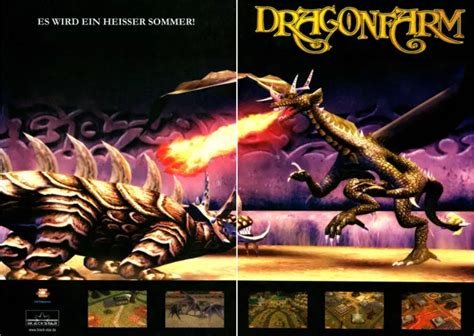
Dragonfarm is a unique blend of Pokémon-inspired dragon breeding and economic simulation, where players manage a dragon farm by expanding infrastructure, trading resources, and sabotaging rivals. Each round represents a month, requiring strategic planning to compete in dragon championships featuring turn-based combat (using number pad controls) and pattern-based beauty contests (Simon Says style), with difficulty scaled to dragon stats. The game offers four modes—Fighting, Beauty, Gold Rush, and Regular—each with distinct winning conditions.
Dragonfarm Patches & Updates
Dragonfarm Cheats & Codes
PC
While in the main house menu, move the mouse cursor quickly to the four corners of the screen in this order: top‑left, bottom‑right, bottom‑left, top‑right.
| Code | Effect |
|---|---|
| Links oben, rechts unten, links unten, rechts oben | Grants 30,000 gold |
Dragonfarm: A Flawed Gem of Genre Fusion
1. Introduction
In the pantheon of video game oddities, few titles exemplify the ambitious-yet-clumsy spirit of early 2000s PC gaming quite like Dragonfarm. Released in 2002 by German developer Soft Enterprises and publisher Blackstar Interactive, this isometric adventure promised a revolutionary blend of Pokémon-style dragon collecting, economic simulation, and tactical combat. Yet today, it remains a footnote—a cult curiosity with a MobyGames score of 5.9 and critical reception hovering near 50%. This review argues that while Dragonfarm fails to deliver on its grand promise due to technical limitations, repetitive design, and a niche appeal, it remains a fascinating artifact of experimental game design. Its core concept—managing a dragon-breeding enterprise amid cutthroat rivalry in a fantasy world—feels ahead of its time, even if its execution is grounded in the constraints of its era. The true legacy of Dragonfarm lies not in its gameplay, but in its audacious attempt to merge disparate genres into a cohesive, if flawed, experience.
2. Development History & Context
Dragonfarm emerged from the German studio Soft Enterprises, a team with a history of real-time strategy titles like Highland Warriors. Their vision was audacious: to create a “Pokémon with dragons” simulator layered with economic management and multiplayer competition. The project was helmed by lead programmer Stefan Schraut and project manager Bodo Thevissen, who envisioned a robust 3D engine to render dragons and the fantasy realm of Alterica. Technologically, the game was constrained by the era’s hardware limitations—requiring a Pentium III 500MHz CPU, 64MB RAM, and a 16MB graphics card. This modest specification suggests an engine that prioritized functionality over spectacle, resulting in a game that felt technically competent but visually dated upon release.
The 2002 gaming landscape was dominated by the rise of MMORPGs and cinematic action games, yet strategy and simulation genres remained vibrant. Dragonfarm arrived in the wake of Pokémon’s global success and the burgeoning popularity of tycoon games like Theme Park. Soft Enterprises sought to capitalize on these trends by fuing them, but their small team struggled to balance depth with accessibility. The game’s German-only release (with limited English support) further confined its audience, reflecting a regional developer’s attempt to challenge international giants. Despite its niche origins, Dragonfarm was included in the 2003 compilation 10 Spiele-Hits Vol. 3, hinting at a fleeting commercial foothold. The ambition, however, outpaced the studio’s resources, resulting in a product that was technically sound but creatively compromised.
3. Narrative & Thematic Deep Dive
Set in the mythical land of Alterica—a “last refuge of legendary dragons” described as “full of secret places, treacherous marshes, dense forests, and endless deserts”—Dragonfarm frames its narrative around a cutthroat industry of dragon breeding. Players assume the role of an entrepreneur competing in a world where “human trafficking, ruthless breeding methods, and dragon street fights are accepted elements of everyday life.” The plot is thin, serving as a backdrop for gameplay: rise to become the ultimate dragon breeder by outmaneuvering rivals. This lack of narrative depth is a missed opportunity, as the setting’s potential for moral ambiguity and world-building is largely unrealized.
Characters are functional archetypes—the player, rival breeders, and city NPCs—rather than developed personas. Dialogue is sparse and utilitarian, limited to menu-driven interactions for resource trading or tournament announcements. The game’s themes, however, resonate unexpectedly. It explores commodification of nature (dragons as livestock), capitalist competition, and the ethics of selective breeding. The beauty competitions, where dragons are judged on aesthetics, satirize the vanity of show-animal industries, while the combat arenas glorify violence as entertainment. Yet these themes remain underdeveloped, overshadowed by the game’s focus on mechanical loops. The narrative’s greatest strength is its world, Alterica, which evokes a sense of untamed wildness—but without quests, lore, or character-driven stories, it remains a static backdrop rather than a living world.
4. Gameplay Mechanics & Systems
Dragonfarm’s core loop revolves around managing a dragon farm through monthly turns, blending base-building, resource management, and competitive minigames. The gameplay unfolds in three interconnected phases:
- Farm Management: Players expand their infrastructure (e.g., breeding pens, food silos) to improve dragon health and offspring stats. Resources (food, gold) are procured via city trips, creating a logistical grind. Trading and sabotage add strategic depth but are underutilized, often devolving into repetitive menu navigation.
- Dragon Care: Dragons require feeding, healing, and breeding. Breeding involves simple two-click interactions, leading to anticlimactic offspring generation. The system lacks depth, with genetic inheritance feeling random rather than meaningful.
- Championships: The game’s centerpiece is dragon competitions. Combat is a grid-based number-pad affair where players maneuver dragons to attack/defend, relying on stat-based dice rolls. Beauty contests are Simon Says pattern-matching, scaled by dragon stats. Both suffer from shallow mechanics—combat feels turn-based and sluggish, while beauty trials are arbitrary.
The four game modes (Fighting, Beauty, Gold Rush, Regular) offer variety but fail to mask the underlying tedium. UI design is cluttered, with opaque stat displays and frequent loading screens between locations. Progression is linear, with no late-game complexity to reward long-term play. A multiplayer feature—promised for LAN and internet—was reportedly buggy and underdeveloped, according to contemporary sources, further crippling replayability. In essence, Dragonfarm’s systems are a collection of functional but disjointed ideas, lacking the polish or innovation to sustain engagement.
5. World-Building, Art & Sound
Alterica is Dragonfarm’s strongest asset, a world brimming with potential yet visually underrealized. The setting—a refuge for endangered dragons—evokes ecological wonder, but its exploration is limited to menu-driven travel between the farm and city. Environments are rendered in an isometric 3D style, with soft, textured landscapes that convey fantasy tranquility but suffer from low-poly models and repetitive textures. Dragons are the highlight: six distinct races (e.g., fire-breathers, serpentine creatures) are animated with personality, their movements during battles and beauty contests showing technical competence. However, the game’s reliance on static screens and loading screens (noted by GameStar) breaks immersion, making the world feel fragmented.
Art direction leans into cartoonish fantasy, with vibrant colors and whimsical dragon designs that contrast sharply with the game’s darker themes. Sound design is functional but uninspired. The soundtrack, by Bernd Sippel and Nils Vasko, uses generic fantasy motifs that fail to evoke Alterica’s mystique. Sound effects are serviceable—dragon roars, clashing combat—but lack punch. The German voice acting (for city NPCs) adds regional flavor but is marred by robotic delivery. Ultimately, the audio-visual presentation fails to elevate the world beyond its technical limitations, leaving Alterica a missed opportunity.
6. Reception & Legacy
Upon release, Dragonfarm was met with lukewarm reception, epitomized by a 49% average critic score from 7 reviews. German publications like Gamezone (68%) acknowledged its niche appeal, praising its “mature” take on dragon collecting but criticizing its lack of innovation. Conversely, PC Games (36%) and Gamesmania.de (29%) savaged it, with the latter calling it a “masterwork” of insomnia-inducing tedium. Common complaints included repetitive gameplay, technical bugs (e.g., crashes, save-file corruption), and a steep learning curve. Players mirrored this sentiment, rating it 3.3/5, with complaints about its German-only interface.
Commercially, the game was a footnote, though its inclusion in a 2003 compilation suggests modest sales. Its legacy is defined by its genre experimentation rather than influence. No major titles cite it as an inspiration, though its fusion of simulation and creature-collecting foreshadowed modern hybrids like Temtem. In retrospect, Dragonfarm is remembered as a cult curiosity—valued for its ambition but condemned for its execution. It persists on abandonware sites, where it finds a small audience drawn to its quirkiness, but it remains a historical artifact of an era when German developers dared to dream big with limited resources.
7. Conclusion
Dragonfarm stands as a testament to the double-edged sword of genre fusion. Its core concept—combining dragon breeding, economic simulation, and tournament combat—was visionary, yet the game’s execution is mired in technical mediocrity, repetitive design, and a reliance on niche appeal. The world of Alterica, with its vivid lore and ethical underpinnings, deserves a richer narrative, while the gameplay systems, functional as they are, lack the depth to sustain long-term engagement. Its legacy is one of unfulfilled potential: a game that, for all its flaws, remains a fascinating experiment in blending disparate genres.
In the annals of video game history, Dragonfarm will not be remembered as a classic, but as an audacious outlier. It captures the spirit of early 2000s PC gaming—ambitious, flawed, and unapologetically niche. For historians, it offers a window into the aspirations of mid-tier developers striving to compete with industry giants. For players, it’s a curiosity best approached with tempered expectations: a flawed gem that, despite its shortcomings, hints at what might have been. Verdict: A historically significant but mechanically underwhelming curiosity, Dragonfarm earns a 6/10 for its ambition, yet falls short of being a truly memorable experience.