
- Release Year: 1996
- Platforms: DOS, Windows
- Publisher: Alcachofa Soft S.L., Digital Dreams Multimedia, Erbe Software, S.L., Midas Interactive Entertainment Ltd.
- Developer: Alcachofa Soft S.L.
- Genre: Adventure
- Perspective: 3rd-person
- Game Mode: Single-player
- Gameplay: Point-and-click, Puzzle
- Setting: Vampire
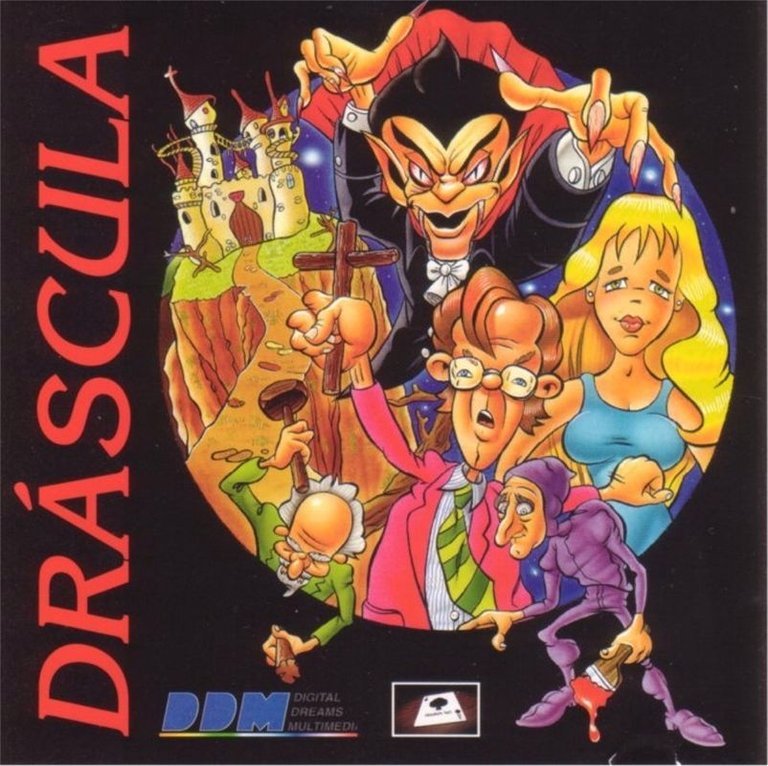
Description
Dráscula: The Vampire Strikes Back is a classic Spanish point-and-click adventure game from 1996 where players control John Hacker, a British property agent tasked with negotiating lands with the vampire Count Dráscula. After a blond woman is kidnapped by the Count, John embarks on a humorous and puzzle-intensive quest to rescue her, set in a gothic, cartoony world with adult-oriented wit and an easy-to-use interface.
Gameplay Videos
Where to Buy Dráscula: The Vampire Strikes Back
Dráscula: The Vampire Strikes Back Guides & Walkthroughs
Dráscula: The Vampire Strikes Back Reviews & Reception
mobygames.com : If you wanna have a good time at the old puzzle solving style you will enjoy playing Drascula, maybe it’s a bit hard to find nowadays, but if you find a copy, dont think twice and get it!
justgamesretro.com : your true arch-nemesis will be the game’s Godawful voice acting.
Dráscula: The Vampire Strikes Back: The Transylvanian Curio That Forged a Spanish Adventure Legacy
Introduction: A Cult Classic from the Shadows
In the grand tapestry of graphic adventure history, certain titles gleam with the polish of blockbuster budgets and iconic legacies—Monkey Island, Day of the Tentacle, King’s Quest. Others, however, exist in the charming, half-remembered haze of regional obscurity, their virtues often overshadowed by technical shortcomings or linguistic barriers. Dráscula: The Vampire Strikes Back is firmly planted in the latter category, a 1996 Spanish point-and-click adventure that has journeyed from commercial disappointment to cult freeware classic. This review posits that Dráscula is not merely a curiosity but a pivotal, if flawed, artifact of Spain’s nascent game development scene. It represents a passionate, home-grown attempt to emulate the golden age of LucasArts and Sierra, infused with a distinct, politically incorrect European humor. While its English localization is notoriously shambolic and its design often derivative, the game’s earnest craftsmanship, clever puzzles, and preservation via ScummVM grant it an enduring, if niche, significance in the annals of adventure gaming.
1. Development History & Context: The Birth of a Pioneer
Alcachofa Soft and the Spanish Adventure Boom
Dráscula was developed by Alcachofa Soft S.L., a Spanish studio for whom this was their very first foray into the adventure genre. The credits, listing 50 individuals, speak to a modest but dedicated team, with key roles filled by Emilio de Paz (lead programmer, dialogues, music), Santiago Lancha (2nd programmer, animation), and Germán Yepes (characters/cover design). This was a period of significant growth for Spain’s video game industry, moving from the 8-bit era into the CD-ROM age. Studios like Pendulo Studios were soon to redefine the genre globally with titles like Hollywood Monsters (1997), but in 1996, Dráscula stood as one of the trailblazers. As noted by HobbyConsolas in 2017, it was declared one of the nine best Spanish graphic adventures, a pioneer alongside Igor: Objective Uikokahonia.
The Technological Constraints of a 1996 DOS CD-ROM
Released in 1996 for DOS, the game arrived at the twilight of the golden age of 2D adventures and the dawn of 3D hardware acceleration. Its technical specs are telling: a CD-ROM title using digitally recorded music (taken from the audio tracks, as a player reviewer noted) and supporting mouse and keyboard input. The graphics, described by one critic as having a “cartoony feel” and by another as reminiscent of Day of the Tentacle or Larry 6 (games from 1993), suggest a development cycle working within the color palette and resolution limits of the VGA/SVGA era, likely targeting the burgeoning Spanish and European home PC market.
Publishers, Distribution, and a Parody Title
The game’s publishing history is complex, involving Digital Dreams Multimedia (original Spanish release), Midas Interactive Entertainment Ltd. (1999 UK English release), and later Erbe Software, S.L.. This speaks to the common practice of regional publishing deals in Europe at the time. The title itself, Dráscula: The Vampire Strikes Back, is an unmistakable parody of Star Wars: The Empire Strikes Back. This cheeky naming sets the tone for the game’s humor: a broad, referential, and consciously silly take on horror tropes that blends Dracula with Frankenstein (the need for a brain for a monster) and modern idiom. Its commercial failure is often attributed, in part, to “dismal distribution by DMM” (GameLive PC), meaning its cult status was earned not on store shelves, but through word-of-mouth and, later, digital preservation.
2. Narrative & Thematic Deep Dive: Real Estate, Revenge, and Raunchy Humor
Plot Synopsis: A Transylvanian Property Scam
The narrative is pure B-movie setup: You are John Hacker, a British realtor sent to Transylvania to negotiate a land deal with the eponymous Count Dráscula. Before the business can begin, Hacker meets a “gorgeous blond” bombshell named, with zero subtlety, B.J. (a juvenile double entendre that establishes the game’s comedic register). She is promptly kidnapped by the Count, who intends to use her “shiny and not used yet” brain for his handmade monster—a direct Frankenstein lift. Hacker’s quest is thus a rescue mission through a castle and surrounding town, aided by a cast of eccentric locals and a mentor figure, Von Braun, who tasks you with creating a “brew” (a marijuana joint).
Characters and Dialogue: A Study in Broad Strokes
The characters are archetypes played for laughs. Count Dráscula is not the brooding, aristocratic predator of Gothic literature but a bumbling, scheming fool with a thick, absurd accent (criticized in the English dub as part-Harrison Ford, part-Potsylvanian). Igor is the standard hunchbacked assistant. Hacker himself is a cipher, a conventional everyman hero whose responses, especially in the English version, are often monotonously functional (“I do not see the reason”). The dialogue is where the game’s central conflict—between its original Spanish wit and its botched translation—becomes most acute. The Spanish original, while described by MeriStation as having a “totally outdated nowadays” politically incorrect style, was presumably filled with local humor and puns. The official English translation, however, is slammed across multiple reviews as “poor,” “odd,” and filled with glaring errors: “It’s not well parked” (for a gate), “strong noise” vs. “loud noise,” and confusion between “towers” and “drawers.” This fundamentally breaks the narrative’s comedic timing and character voice.
Themes: Parody, Political Incorrectness, and the Adventure Genre Itself
Thematically, Dráscula operates on two levels. First, it’s a parody of horror icons, mashing up Dracula and Frankenstein with a modern, risqué edge. The joke about B.J.’s name, the “anti-vampire reefer,” and the casual objectification of the damsel in distress place it firmly in the tradition of the Leisure Suit Larry series, though without that series’ self-aware irony. Second, and more interestingly, it’s a meta-commentary on adventure game conventions. As the Just Games Retro review highlights, Hacker explicitly notes the trope of the “man in the alley who sells you an item you need.” This self-referential humor, while not groundbreaking by 1996, shows an awareness of the genre’s clichés. However, the game ultimately succumbs to those clichés, offering a simplistic “find the girl, kill the bad guy” plot with little character depth or narrative surprise.
3. Gameplay Mechanics & Systems: Classic Point-and-Click with Frustrating Flaws
Interface and Core Loop
Dráscula employs the classic LucasArts/Sierra verb-coin interface. The cursor morphs into seven icons: Walk, Look, Take, Open, Close, Talk, Push. A notable, quirky detail is that all icons are based on a cartoon hand (a closed fist for Close, a walking hand for Walk, a puppet hand for Talk). While charming, this design choice has a practical downside: the Look icon is imprecise, a “weird hand with glasses” that makes pinpointing objects difficult, often failing to trigger the floating text that identifies interactive hotspots. This is compounded by bugs where floating text fails to appear even on correct items (potentially a ScummVM emulation issue or an original flaw).
A glaring omission is the universal “Use” verb, which had become standard in adventures of the era (like in Indiana Jones and the Fate of Atlantis). Forcing players to choose between Open, Close, and Push for what would logically be a single “use” action adds unnecessary friction and leads to illogical solutions. The final puzzle, in particular, requires using Take in a contextually bizarre way, highlighting this design gap.
Puzzle Design: Clever Ideas Marred by Arbitrary Logic
The puzzles are a mixed bag. Some are praised by players as “real great, like one in special i liked a lot from the castle.” The core “brew” puzzle, where you must collect numerous ingredients to roll a joint, is a memorable, multi-stage fetch quest that occupies much of the first act. However, the puzzle logic is frequently arbitrary and opaque. The Just Games Retro review provides a perfect example: assembling a complete disguise doesn’t inherently relate to triggering a character’s departure, yet it does. Then, being locked in a room, the only solution is to put on that disguise, which triggers another character’s return and the provision of a key—a Rube Goldberg chain of events with no causal reasoning.
Furthermore, the game suffers from a “single puzzle, many items” problem. The player may collect a dozen items thinking they’re for separate puzzles, only to find they all combine into one convoluted solution. Hints are often delivered in fleeting dialogue and never repeated, forcing the player to rely on memory or trial-and-error. The overall structure is bifurcated: a first half of gathering items in a town, and a second half of exploration and puzzle-solving within Dráscula’s castle, evoking Maniac Mansion’s “trapped in a house” format but without its systemic depth or branching possibilities.
Progression and Failure States
There is no formal character progression system; advancement is purely inventory and knowledge-based. The game is relatively short, as one player review laments, leaving players wanting more. Death or unwinnable states are rare or absent, adhering to the “no dead ends” philosophy of its inspirations, but the obtuse puzzles can create soft locks where the player is truly stuck without understanding why.
4. World-Building, Art & Sound: A Sparse but Atmospheric Castle
Visuals and Atmosphere
The visual presentation uses a cartoony, hand-drawn aesthetic for sprites and pre-rendered backgrounds. The art direction is described as alternating between “kinda sparse and kinda muddled.” The castle interiors are the primary setting, featuring typical Gothic elements—candelabras, stone corridors, secret passages—but with a cartoonish twist. The color palette is likely limited by VGA standards, and animations are functional but not fluid. A specific gameplay complaint highlights how poor visual clarity can hinder progress: a bookshelf blocking the view of a torch needed for a puzzle, forcing the player to guess at hidden object placement.
The world-building is thin. Transylvania is a generic haunted village/castle locale with little unique cultural texture. The few townsfolk are stereotypes (the innkeeper, the shopkeeper, the mad scientist-type Von Braun). The atmosphere relies more on the horror parody premise than on environmental storytelling.
Sound Design and Music
The sound design is a point of mild pride for the developers. The music is digitally recorded CD audio, a step up from MIDI chiptunes, though its quality is not described in detail. The Spanish release featured full voice acting, which one player review calls “not great but just ok.” The English dub, however, is one of the game’s most infamous elements. As dissected by Just Games Retro, the voice actors mispronounce basic words, slur lines, and deliver jokes with zero comedic timing, sounding “Eastern European” regardless of character nationality. This dub is so poorly synced and translated that it actively harms comprehension and immersion.
The Translation Catastrophe: Text vs. Voice
A unique and devastating problem arises for modern players using ScummVM. When Alcachofa Soft open-sourced the game and released it as freeware in 2008, the ScummVM team performed cleanup on the English text files, correcting many translation errors. However, the voice clips are untouched. The result is a dissonance where the on-screen text is coherent, but the spoken dialogue remains garbled and incorrect. This forces the player to choose between reading good text while hearing nonsense or turning off voices entirely to engage with the (still imperfectly translated) script. This schism makes Dráscula a fascinating case study in localization failure and preservation challenges.
5. Reception & Legacy: From Commercial Failure to Cult Preservation
Contemporary Reviews and Initial Reception
Critical reception at the time was mixed to negative, with an average critic score of 66% from three contemporary reviewers. Abandonia Reloaded (78%) was the most forgiving, acknowledging the poor translation but finding a “wee gem” underneath. Aventura y Cía (70%) saw it as a fun, if unambitious, diversion. Just Games Retro (50%) was scathing, declaring it “subpar” and “not worth your time” due to the translation, lack of originality, and uninspired presentation. Player reviews on MobyGames are slightly more positive (3.0/5), with one fan calling it “one of the earlier Spanish commercial adventure games, and one of my favourites,” praising its humor and castle puzzle while lamenting its brevity and lack of sequel.
Commercially, it was a failure. Poor distribution by its UK publisher, Digital Dreams Multimedia (DMM), meant it rarely reached a wide audience. As Gerard Masnou wrote in GameLive PC (2003), this dismal distribution “prevented many players from enjoying this little cult classic.”
Re-evaluation and Cult Status
Over time, perspective shifted. Its status as an early Spanish commercial adventure granted it historical importance. The 2017 HobbyConsolas list cemented this. Its “politically incorrect” humor was later deemed “totally outdated” by MeriStation (2012) but also celebrated as a “guilty pleasure.” The key to its longevity was the 2008 freeware release via ScummVM. By handing over the source code, Alcachofa Soft ensured the game would not become abandonware rot. ScummVM’s emulation brought it to modern platforms (Windows, Linux, macOS), drastically lowering the barrier to entry. This act of preservation transformed it from a forgotten retail flop into an accessible piece of gaming archaeology.
Modern Reception: Steam and Beyond
On Steam (released May 15, 2019 by Erbe Software), Dráscula enjoys a “Very Positive” rating (93/100 from 14 reviews at the time of research). This starkly contrasts with its earlier critic scores, indicating that a dedicated niche audience appreciates it today, likely attracted by its curiosity value and retro aesthetic. The Steam store page describes it as “An old Spanish 2D classic point & click style adventure with tons of humor and an easy interface,” a marketing spin that glosses over the translation issues but accurately targets adventure aficionados.
6. Conclusion: Verdict on a Transylvanian Oddity
Dráscula: The Vampire Strikes Back is a game defined by contradictions. It is a pioneer without an heir, a Spanish attempt to capture the magic of LucasArts that never spawned a franchise. It is technologically modest yet ambitious in scope. Its humor is adult-oriented yet often juvenile, and its narrative is a derivative parody that occasionally winks at the genre it loves.
Its fatal flaw is unequivocally the English localization, a cascade of errors that mangles the script and voice acting, creating a schizophrenic experience when combined with ScummVM’s text fixes. For non-Spanish speakers, playing with voices off is not a choice but a necessity. Judged solely on its gameplay puzzles—which are standard adventure fare with flashes of cleverness but marred by arbitrary logic—it is an average, forgettable title.
However, judged as a historical artifact, it is fascinating. It provides a window into the early Spanish game dev scene, a time before global digital distribution, where local studios played in the same genre sandbox as the American giants with limited resources and a distinct cultural voice. Its preservation by ScummVM is a victory for game history, ensuring this quirky, problematic, and earnest little adventure is not lost.
Final Verdict: Dráscula is not a “must-play” masterpiece. It is a curio for dedicated adventure game historians and completionists. Its value lies in its context: a proud, flawed, and genuinely funny (in its original language) early effort from a region not then known for graphic adventures. For those willing to navigate its translation woes and dated puzzles, it offers a brief, bizarre journey into an alternate 1996 where Transylvanian counts sell real estate and the key to victory is a legally dubious herbal cigarette. It is, ultimately, a flawed但重要的垫脚石—a stepping stone in the evolution of European adventure gaming, now saved from obscurity for all to curiously dissect.
(Word Count: ~1,550)