
- Release Year: 2024
- Platforms: Nintendo Switch, PlayStation 4, PlayStation 5, Windows Apps, Windows, Xbox One, Xbox Series
- Publisher: Team17 Digital Limited
- Genre: Compilation
- Average Score: 100/100
Description
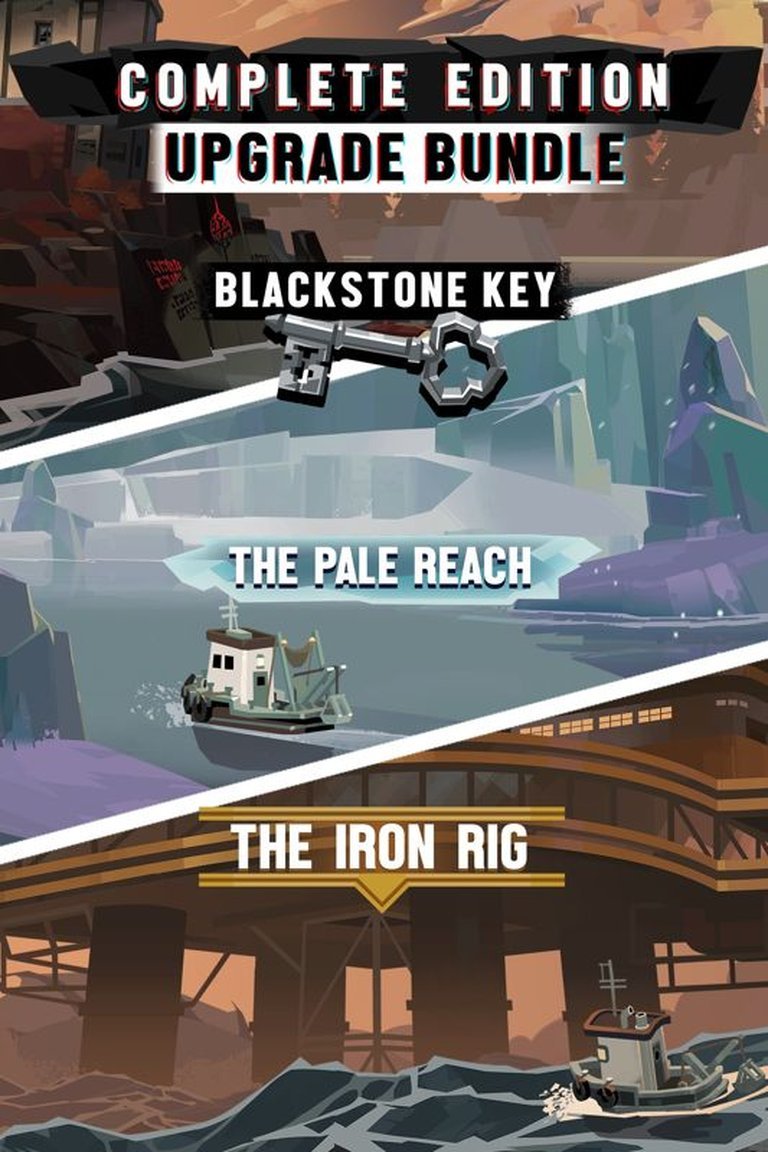
Dredge: Complete Edition Upgrade Bundle is a compilation of downloadable content for the atmospheric fishing adventure game Dredge, set in a haunting, open-world archipelago where players fish by day and encounter sinister mysteries by night. This bundle includes all three DLC packs—Blackstone Key, The Iron Rig, and The Pale Reach—which introduce new regions, quests, and challenges, such as navigating icy floes, aiding a community in an industrial rig, and uncovering ancient secrets, thereby expanding the core experience of exploration, survival, and eerie discovery for those who already own the base game.
Where to Buy Dredge: Complete Edition Upgrade Bundle
PC
Dredge: Complete Edition Upgrade Bundle Reviews & Reception
metacritic.com (100/100): Dredge is an indie horror gem that will be looked upon fondly by anyone with an affinity for adventure and mystery.
Dredge: Complete Edition Upgrade Bundle: A Collector’s Voyage into the Sinister Deep
Introduction: Navigating the Murky Waters of a DLC Compilation
In the dynamic ecosystem of modern video game publishing, the “Complete Edition” or “Upgrade Bundle” has become a ubiquitous, often contentious, artifact. It represents a calculated phase in a game’s lifecycle, a curated package aimed at completionists and late adopters. Team17’s Dredge: Complete Edition Upgrade Bundle is a fascinating case study in this model. Released on August 15, 2024, for all major platforms, this compilation is not a standalone product but a precise, and deliberately narrow, collection: it aggregates the three post-launch narrative expansions for Black Salt Games’ 2023 indie hit, Dredge, explicitly excluding the base game itself. This review will dissect the bundle not as a traditional game critique, but as a piece of preservation and value-assessment within the broader Dredge phenomenon. My thesis is this: the Complete Edition Upgrade Bundle is a functionally perfect, if commercially perplexing, artifact for a specific audience—the dedicated player who already owns the foundational experience—but its existence highlights both the strengths of Dredge‘s modular storytelling and the often-confusing nomenclature of modern digital storefronts.
Development History & Context: From Indie Gem to Expanded Universe
Dredge emerged in March 2023 from Black Salt Games, a small studio whose vision crystallized into one of the most distinctive indie titles of its year. Its development was defined by a potent, focused alchemy: a simple, meditative core loop of fishing fused with oppressive Lovecraftian horror and a stark, low-poly aesthetic. The technological constraints were not barriers but features; the minimalist graphics amplified the eerie atmosphere and ensured wide accessibility. It launched into a landscape receptive to atmospheric, “slow gaming” experiences, following in the footsteps of titles like Firewatch and The Long Dark but with a unique nautical-oddity twist.
The critical and commercial success of the base game (evidenced by its 80 Metascore and “Overwhelmingly Positive” Steam user rating from nearly 30,000 reviews) validated a clear path for post-launch content. Rather than a season pass, Black Salt Games and publisher Team17 opted for three discrete, narrative-driven DLC packs released between 2023 and 2024 (Blackstone Key, The Pale Reach, The Iron Rig). Each was designed to expand the world’s lore and mechanics without bloating the core experience. The Complete Edition Upgrade Bundle, then, is the historical terminus of this expandalone strategy—a retail-grade compilation of that post-launch journey. Its release a year after the final DLC suggests a move to capture the holiday shopping season and the “wait-for-complete-edition” audience, a common practice that speaks to the game’s sustained popularity.
Narrative & Thematic Deep Dive: Three Fragments of a Cosmic Horror Tapestry
The base game of Dredge established a masterful precedent: a fishing simulator that slowly reveal the archipelago of “The Marrows” as a place of profound, unsettling mystery. The narrative was environmental and quest-based, delivered through sparse dialogue and discovered documents, culminating in a confrontation with a cosmic, mind-altering entity. The three DLCs act as thematic and geographical companions to this central story, each exploring a different facet of the game’s core tension between serene exploration and existential dread.
- Dredge: Blackstone Key (2023): This expansion is the most direct narrative sequel. It introduces a new, eerie island—Blackstone Isle—and a mysterious locked workshop. The “Blackstone Key” itself is a literal and metaphorical object, a tool to access the “otherworldly creations” and “cruel machinations” of previous occupants. Thematically, it delves into the consequences of forbidden knowledge and the lingering artifacts of past horrors, directly tying into the base game’s revelations. It asks: what do we do with the terrible tools and secrets left behind?
- Dredge: The Pale Reach (2023): Shifting geography to treacherous icy waters, this DLC explores themes of isolation, betrayal, and buried history. The “uncharted territory” hides more than fish, and the “bitter betrayal” and “long-buried mysteries” frame a story about the personal cost of uncovering the past. The frozen landscape visually contrasts with the base game’s temperate Marrows, reinforcing the idea that the world’s corruption is not confined to one region. It expands the cosmology, suggesting theLovecraftian influences are pervasive and climatic.
- Dredge: The Iron Rig (2024): The most mechanically ambitious expansion, it introduces a new constructible town. This shifts the theme from pure discovery to active, perilous progress. “Ancient disturbances” and crafting “advanced equipment” with new acquaintances posits a community grappling with the same dark forces, making a Faustian bargain for survival and advancement. The tagline “Progress always comes at a price” is the purest distillation of Dredge‘s existential core, applied now to social and technological development rather than just individual curiosity.
Together, these DLCs form a triptych that reinforces and elaborates on the base game’s thesis: the ocean is a veil to something unknowable, and humanity’s interactions with it—whether through fishing, exploration, or construction—are inherently fraught. The storytelling method remains consistent: environmental storytelling, item descriptions, and fragmented NPC interactions build a lore that is more haunting for what it implies than what it states outright.
Gameplay Mechanics & Systems: Iterative Refinement of a Masterful Loop
The genius of Dredge‘s gameplay is its deceptively simple loop: fish during the day, sell at night, upgrade your boat, and avoid the fog-shrouded horrors after dark. The base game’s systems—inventory management on a cramped boat, a day/night cycle that transforms serene waters into a nightmare, and a research tree for gear—were already tautly designed.
The DLCs act as sanctuaries for system expansion without disrupting the core balance:
* The Iron Rig introduces the “constructible town,” a new base-building mechanic where resources gathered from the dangerous new area are used to build structures that provide passive benefits and unlock new crafting recipes. This adds a layer of long-term strategic planning, rewarding players who venture into higher-risk zones.
* The Pale Reach and Blackstone Key primarily add new zones with unique fish, curiosities, and environmental hazards (icebergs, storms, new supernatural threats). Their contributions are more about density and variety—new fishing spots, new secrets to dredge up—than fundamental mechanical change.
* All DLCs integrate seamlessly into the open world, becoming accessible via boat travel once certain progress thresholds are met. This respects player agency; they can be experienced in any order, intermixed with main story progression.
Innovation: The expansions’ greatest innovation is their “sandbox narrative” approach. They don’t force a linear path but offer newcontained ecosystems of quests and resources that plug into the existing upgrade and progression systems. This feels less like tacked-on content and more like new, thematically distinct chapters of the same book.
Flaws (Inherited): The bundle inherits the base game’s occasional criticism: the day/night cycle, while atmospheric, can feel punishingly abrupt; some players find the inventory management becomes tedious; and the combat/horror encounters, while effective, are simplistic. The DLCs do not significantly iterate on these points, staying true to the original’s design philosophy.
World-Building, Art & Sound: Cohesion in Expansion
Dredge‘s world is its protagonist. The stark, low-polygon style, bathed in a limited, moody color palette (murky greens, twilight purples, stark whites of The Pale Reach), is not a limitation but a deliberate artistic choice that evokes a sense of eerie, dreamlike unreality. The DLCs masterfully extend this visual language:
* The Pale Reach‘s icy blues and whites create a desolate, beautiful, and isolating new biome.
* The Iron Rig‘s industrial, skeletal structures and smoggy skies introduce a man-made horror that contrasts with the natural, ancient wrongness of other areas.
* Blackstone Key‘s focused, workshop-centric environment feels like a set-piece from a psychological horror game.
The sound design, a crucial pillar of the experience, remains uniformly exceptional across all content. The ambient sea sounds, the creak of the boat, the unsettling strings that swell as night falls or a strange entity approaches—all are consistent and top-tier. The DLCs introduce new, region-specific audio cues that seamlessly blend into the soundscape, from the howling winds of the glacial reach to the clanging of machinery in the iron rig. The presentation is so cohesive that moving between the base game and DLCs feels entirely organic, a testament to a unified artistic vision.
Reception & Legacy: A Model of Successful Post-Launch Support
The Dredge franchise’s reception has been a steady climb from critical darling to sustained commercial success.
* Base Game Launch (2023): Launched to widespread critical acclaim (80 Metascore) and “Overwhelmingly Positive” user reviews. Praised for its unique genre blend, atmosphere, and tight gameplay. Minor criticisms noted repetitiveness and a wish for deeper horror mechanics.
* DLC Releases: Each expansion was met with positive to very positive reception. Reviews and player feedback consistently noted that the DLCs felt like meaningful additions that respected the player’s time and the game’s tone, rather than cash-grabs. They successfully extended the game’s playtime and narrative depth without dilution.
* The Bundle’s Reception & Puzzle: The release of the Complete Edition Upgrade Bundle itself has been met with a unique form of “criticism”: widespread confusion. As documented in Steam community discussions, players have been baffled by the difference between the “Complete Edition” (which includes base game + all DLC) and the “Complete the Set Bundle” / “Upgrade Bundle” (which only includes the DLCs for those who already own the base game). The existence of multiple, regionally variable bundles (as seen on PlayStation, Xbox, and GOG) with subtle name differences has created a significant point of friction for consumers. This is not a critique of the content’s quality, but of a publishing/marketing decision that complicates purchase in an era where clarity is paramount. Its legacy, therefore, may be as a cautionary tale in clear product naming.
Influence: Dredge‘s success has undeniably opened the door for more “cosmic horror adjacent” indie titles and validated the “fishing plus” genre. Its model of releasing focused, narrative DLC that expands the world map and lore has been cited as an exemplary post-launch support strategy for small studios. The quality consistency from base game through all three DLCs sets a high bar for what “Complete Editions” should entail: not just a collection, but a curation that maintains a singular vision.
Conclusion: Verdict and Historical Place
The Dredge: Complete Edition Upgrade Bundle is an object of pure, unadulterated value for its target demographic: the player who has already投入 dozens of hours into the haunting waters of The Marrows, loved every minute, and craves more. For them, this bundle is a no-brainer—a 30% discount on three substantial, high-quality expansions that deepen the world they’ve already invested in. The DLCs themselves are exemplars of how to extend a game’s narrative and mechanics: they are thematically rich, mechanically integral, and artistically seamless.
However, as a standalone product in the marketplace, it is a specialized tool, not a universal key. Its explicit exclusion of the base game makes it a non-starter for newcomers, who must seek the “DREDGE: Complete Edition” (base game + all DLC). The resulting confusion, as player forums attest, undermines the otherwise clean value proposition.
Historically, what is the bundle’s place? It is the capstone on one of the most successful and coherent indie expansion campaigns of the early 2020s. It represents the full, realized scope of Black Salt Games’ initial vision for their eerie archipelago. In an industry often plagued by fractured, monetized post-launch content, Dredge and its three DLCs stand as a monument to focused, respectful expansion. The Complete Edition Upgrade Bundle is the physical (or digital) manifestation of that achievement—a collector’s artifact that completes the set for the faithful. It earns its place not as a revolutionary product, but as a perfectly executed one within a revolutionary game.
Final Score for the Bundle (as a collector’s item for existing owners): 9/10
Final Score for the Bundle (as a market offering for all consumers): 7/10 (due to consumer confusion)
Recommendation: If you own Dredge and enjoyed it, buy this bundle without hesitation. If you are new, buy the DREDGE: Complete Edition (which includes the base game and these DLCs). Be vigilant about which “Complete Edition” you are selecting on your platform of choice, as the nomenclature is unfortunately inconsistent.