
- Release Year: 2005
- Platforms: Windows
- Publisher: Greenstreet Software Ltd.
- Developer: iSurf, Inc.
- Genre: Puzzle
- Perspective: Side view
- Game Mode: Single-player
- Gameplay: Falling block puzzle, Tile matching puzzle
Description
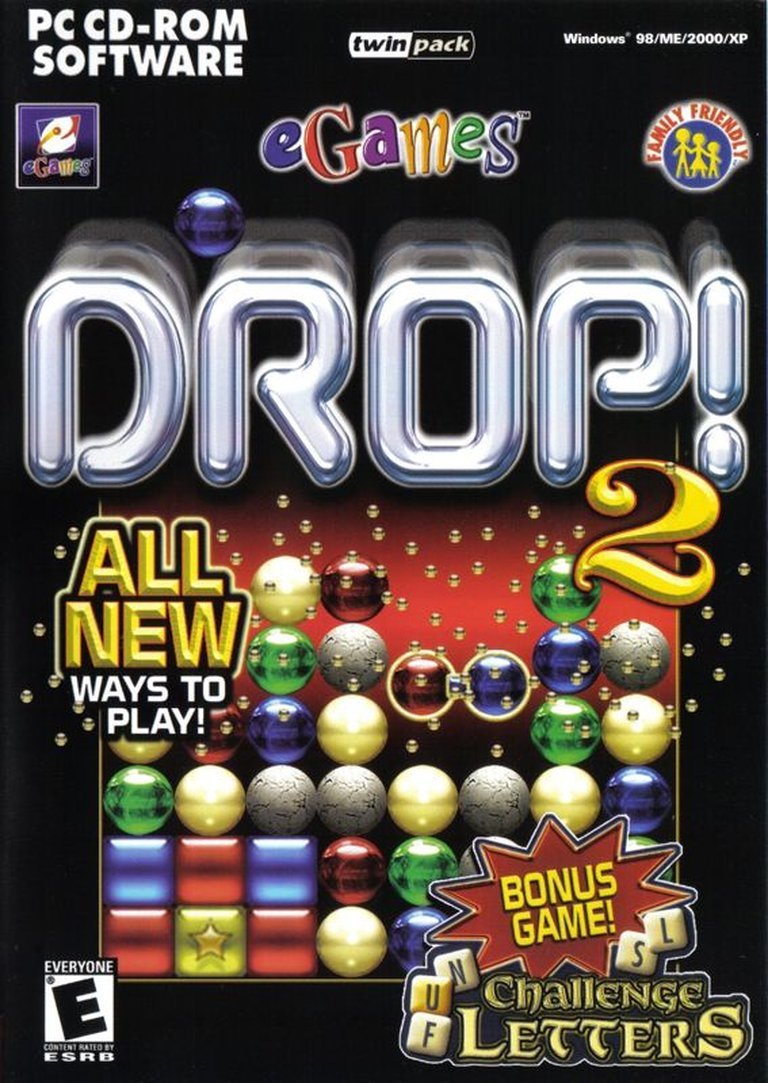
Drop! 2 is a Tetris-like falling block puzzle game set in a side-view playfield where colorful drops, blocks, or marbles descend from the top, and players must align three or more of the same color horizontally or vertically to remove them and prevent the screen from filling up. Released in 2005 for Windows, it offers four modes—Extreme for basic gameplay, Reloaded to clear all star blocks per level, Gold with special unremovable stone blocks and explosive steel ones, and Vertical for vertical-only movement—plus a bonus Challenge Letters game for forming words from letter tiles.
Drop! 2 Free Download
Drop! 2: Review
Introduction
In the frenetic world of falling-block puzzles, where milliseconds count and chain reactions can spell triumph or doom, Drop! 2 emerges as a gleaming gem of casual gaming mastery—a sequel that refines the hypnotic drop-and-match formula of its predecessor into an even more compulsive experience. Released in 2005 as the follow-up to the 2002 hit Drop!, this Windows-exclusive title from iSurf, Inc. captures the essence of puzzle perfection amid the mid-2000s casual gaming renaissance. With its vibrant orbs cascading relentlessly from above, Drop! 2 hooks players into endless sessions of strategic swapping, offering not just a game, but a test of reflexes and foresight. My thesis: Drop! 2 stands as a pinnacle of accessible, mode-diverse puzzle design, proving that in an era dominated by emerging 3D blockbusters, the purest 2D tile-matchers remain timelessly addictive, influencing the casual genre’s evolution toward bite-sized, high-replay challenges.
Development History & Context
Drop! 2 was crafted by the small but nimble iSurf, Inc., a developer specializing in polished casual titles for the PC market, with publishing handled by Greenstreet Software Ltd. in some regions and eGames in others. The core team was lean—merely four credited individuals: Eric Blankenburg, Jonathan Birch, Johan Salomonsson, and Johan Landstrom—whose collective tagline, “You Can’t Stop The Drop!”, encapsulated their vision of unrelenting, momentum-building gameplay. Building directly on Drop! (2002, with a 2004 Macintosh port), iSurf iterated on proven mechanics rather than reinventing the wheel, a pragmatic choice reflective of the era’s indie-like development constraints.
The mid-2000s marked a golden age for casual PC puzzles, coinciding with broadband’s spread and the rise of digital distribution precursors like Steam (launched 2003). Yet Drop! 2 clung to CD-ROM roots, bundled with bonuses like Challenge Letters in UK/US physical releases and even appearing in eGames Doppelpacks (Drop! 2 – Bees & Bears, 2005). Technological limits were modest: fixed/flip-screen visuals on Windows PCs demanded no high-end hardware, aligning with direct-control interfaces suited to keyboard/mouse precision. The gaming landscape was bifurcated—AAA consoles waged HD wars (Xbox 360 launch 2005, PS3 2006), while PC casuals thrived via shareware portals and bargain bins. Amid Tetris clones and Bejeweled’s match-3 dominance, iSurf targeted “everyone” (ESRB E-rated), capitalizing on post-1983 crash recovery where puzzles proved recession-proof. Vision-wise, the devs emphasized variety via four modes, addressing single-player fatigue in a market hungry for value-packed $5-10 titles, foreshadowing mobile free-to-plays.
Narrative & Thematic Deep Dive
Drop! 2 eschews traditional storytelling for abstract, emergent narrative—the player’s saga unfolds through escalating chaos on a blank canvas of peril. No protagonists, no lore dumps; instead, the “plot” is the inexorable descent of colorful drops (orbs/marbles/blocks), symbolizing entropy’s triumph over order. Each mode crafts its micro-narrative:
- Extreme (basic mode): A pure survival tale, where hubris leads to overflow, thematizing human frailty against mounting pressure.
- Reloaded: Objective-driven redemption arcs, clearing star blocks to “complete” levels, evoking themes of persistence and targeted salvation amid randomness.
- Gold: Moral ambiguity via special blocks—immovable stone as fate’s anchors, explosive steel as cathartic destruction—exploring risk-reward duality.
- Vertical: Constrained movement mirrors existential limits, forcing vertical ingenuity in a horizontal world.
Dialogue is absent, but the UI’s score multipliers and combo cues “speak” volumes, narrating feats like chain reactions as euphoric payoffs. Thematically, it delves into addiction’s cycle: the dopamine rush of vanishing rows critiques compulsive play, akin to Tetris’s “Tetris Effect.” Bonus Challenge Letters shifts to linguistic creativity, forming words from tiles in “Eternity” or “Winds of Sand” modes—longer words demand thrift, theming scarcity and expression. Collectively, Drop! 2 philosophizes puzzle purity: no heroes, just the void-filling void, a minimalist meditation on pattern recognition in chaos.
Gameplay Mechanics & Systems
At its core, Drop! 2 refines the falling-block loop: orbs drop from the top in side-view playfields; players swap adjacent ones via direct control (likely arrow keys/mouse) to align 3+ matching colors horizontally/vertically, triggering removals and potential cascades. Overflow to the top ends the game, enforcing tense field management. Innovation lies in mode-specific systems, elevating replayability:
Core Loop Breakdown
- Dropping Phase: Pairs or singles fall at accelerating speeds, demanding predictive positioning.
- Swap & Match: Instantaneous swaps enable chain reactions—multipliers skyrocket scores (e.g., 4x bonuses for cascades).
- Clearance & Progression: Vanished orbs refill space; high scores track mastery via leaderboards (implied).
Mode Deep Dive
-
Extreme: Vanilla endurance—pure reflexes, no objectives. Flaw: Repetitive post-marathon.
Mechanic Strength Weakness Speed Ramp Builds tension masterfully Punishes casuals early Chain Bonuses Rewards foresight RNG-dependent setups -
Reloaded: Level-based, clear all stars. Adds progression gates, mitigating endless-mode burnout.
- Gold: Hazard integration—stone blocks clog (innovation: immovable anchors force adaptation); steel explodes on match, chaining violently. High-risk flair.
- Vertical: Vertical-only swaps twist spatial logic, innovating on Tetris’s gravity.
UI/Progression: Clean, flip-screen for focus; no deep RPG trees, but score ladders and unlocks (via bundles) provide meta-progression. Flaws: No multiplayer, limited save states. Strengths: Intuitive controls, sub-minute learn curve, hours-to-master depth. Compared to Magical Drop series (related via genre), Drop! 2‘s marble physics feel bouncier, swaps snappier.
Bonus: Challenge Letters
Tile-based wordplay: Form longest words from falling letters. Modes escalate length requirements; “Winds of Sand” adds timers. Bridges puzzles to brainteasers, extending value.
Overall, systems synergize for “just one more game” loops, flawless for casuals yet challenging pros.
World-Building, Art & Sound
The “world” is an abstract void—a stark playfield where colors clash in cosmic descent, evoking a minimalist universe of perpetual motion. No lore-heavy environments; atmosphere builds via kinetic frenzy: fields swell like living organisms, cascades as explosive births/deaths.
Visual Direction: Fixed/flip-screen keeps focus razor-sharp. Colorful orbs (drops/marbles) pop vividly—primary hues for matches, metallics for specials (stone gray, steel silver). Smooth animations sell physics: gentle falls accelerate to frenzy, pops with particle bursts. 2005-era 2D shines on low-spec PCs, unburdened by bloat. Contributions: Clarity aids strategy; vibrancy combats fatigue, immersing via synesthesia.
Sound Design: Standard puzzle fare inferred—plink drops, satisfying pop-pop-pops for matches, escalating tempo beeps, triumphant fanfares for chains. No voiceovers; chiptune-esque score ramps tension. Atmosphere: Pulsing urgency mirrors heartbeat, making sessions visceral. Together, art/sound forge hypnotic flow-state, elevating mechanics beyond rote matching.
Reception & Legacy
Launched quietly in 2005, Drop! 2 evaded major critics—no Metacritic aggregation, zero MobyGames/Metacritic/IGN reviews. Commercial footprint: Budget CD-ROM ($5 eBay now), bundled releases suggest modest sales in casual bins. Only 2 MobyGames collectors note obscurity, yet no patches imply stability.
Reputation evolved minimally—nostalgia niche for puzzle fans. Influence: Reinforces falling-block lineage (Tetris, Magical Drop II/III, Puyo Puyo), popularizing mode-variety in casuals (pre-Bejeweled Blitz). Echoes in mobile (Gummy Drop!, 2014); Challenge Letters anticipates word games (Words With Friends). Industry-wide: Exemplifies 2000s PC casual boom, paving digital bundles amid console dominance. Cult status grows via archives (Internet Archive ISO), preserving as shareware relic.
Conclusion
Drop! 2 distills puzzle gaming to its addictive zenith: four masterful modes, chain-reaction ecstasy, and bonus wordplay in a lean, colorful package. iSurf’s modest team crafted an evergreen testament to casual brilliance, thriving despite scant reception. In video game history, it claims a vital niche—the unheralded sequel sustaining Tetris’s spirit through innovation amid 2005’s HD upheaval. Verdict: Essential for puzzle aficionados (9/10). Unearth a CD or ISO; you can’t stop the drop, nor will you want to. A timeless drop in gaming’s vast ocean.