
- Release Year: 2001
- Platforms: DOS, Windows
- Publisher: Electronic Arts, Inc.
- Genre: Compilation
- Game Mode: LAN, Single-player
- Average Score: 88/100
Description
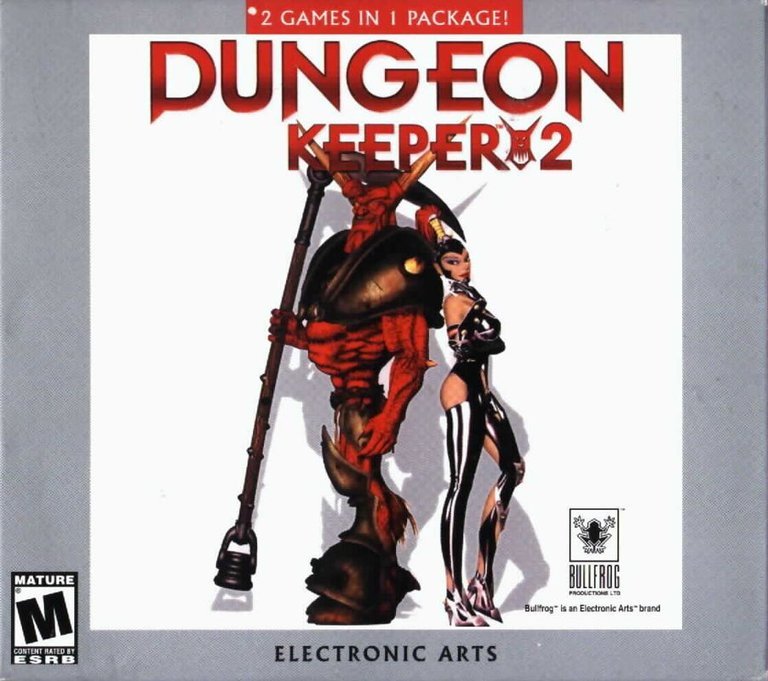
Dungeon Keeper + Dungeon Keeper 2 is a compilation of two classic strategy games where players take on the role of an evil dungeon keeper, building and managing an underground lair to defend against invading heroes and rival keepers. The games blend real-time strategy with dungeon management, featuring a mix of creatures, traps, and spells to create a unique and darkly humorous experience.
Where to Buy Dungeon Keeper + Dungeon Keeper 2
PC
Dungeon Keeper + Dungeon Keeper 2 Cracks & Fixes
Dungeon Keeper + Dungeon Keeper 2 Patches & Updates
Dungeon Keeper + Dungeon Keeper 2 Mods
Dungeon Keeper + Dungeon Keeper 2 Guides & Walkthroughs
Dungeon Keeper + Dungeon Keeper 2 Reviews & Reception
metacritic.com (89/100): Very good, sad how a game from 1999 can have more fun than a game made today.
ign.com (89/100): Bullfrogs devious sequel has all the strengths of the original… and a lot more.
mobygames.com (88/100): This is the first kind 3D RTS I’ve played. Some idiot on another review said this is a C&C clone? Either he’s never played C&C or didn’t pay close attention, or I’m the one who’s blind.
Dungeon Keeper + Dungeon Keeper 2 Cheats & Codes
PC
While playing the game, press [Ctrl] + [Alt] + C, then enter one of the following codes to activate the corresponding cheat function.
| Code | Effect |
|---|---|
| do not fear the reaper | Level skip |
| feel the power | All monsters’ skills set to 10 |
| this is my church | All rooms |
| fit the best | All rooms and traps |
| i believe its magic | All magic |
| show me the money | Extra money |
| ha ha thisaway ha ha thataway | Additional 100,000 mana |
| now the rain has gone | Full map |
PC (Command Line)
Start the game with the ‘dk2.exe -level [level name]’ command line, using one of the following level names.
| Code | Effect |
|---|---|
| level1 | Select level 1 |
| level2 | Select level 2 |
| level3 | Select level 3 |
| level4 | Select level 4 |
| level5 | Select level 5 |
| level6a | Select level 6a |
| level6b | Select level 6b |
| level7 | Select level 7 |
| level8 | Select level 8 |
| level9 | Select level 9 |
| level10 | Select level 10 |
| level11a | Select level 11a |
| level11b | Select level 11b |
| level11c | Select level 11c |
| level12 | Select level 12 |
| level13 | Select level 13 |
| level14 | Select level 14 |
| level15a | Select level 15a |
| level15b | Select level 15b |
| level16 | Select level 16 |
| level17 | Select level 17 |
| level18 | Select level 18 |
| level19 | Select level 19 |
| level20 | Select level 20 |
| secret1 | Select secret level 1 |
| secret2 | Select secret level 2 |
| secret3 | Select secret level 3 |
| secret4 | Select secret level 4 |
| secret5 | Select secret level 5 |
Dungeon Keeper + Dungeon Keeper 2: A Masterclass in Evil Management
Introduction
Few games in the pantheon of strategy titles dare to invert the hero’s journey as boldly as Dungeon Keeper and its sequel. Released in 1997 and 1999 respectively, these games cast players not as valiant knights or noble mages, but as malevolent overlords tasked with building, defending, and expanding subterranean empires. The Dungeon Keeper + Dungeon Keeper 2 compilation, released in 2001, bundles these two landmark titles into a single package, offering a rare opportunity to experience the evolution of Bullfrog Productions’ darkly humorous and mechanically rich dungeon management sims. This review will dissect the games’ development, narrative, gameplay, and legacy, arguing that they remain unparalleled in their blend of strategy, humor, and subversive design.
Development History & Context
The Birth of Bullfrog’s Evil Brainchild
Bullfrog Productions, founded by Peter Molyneux and Les Edgar in 1987, was already a powerhouse in the strategy genre by the mid-1990s, thanks to titles like Populous and Syndicate. Dungeon Keeper (1997) emerged from Molyneux’s desire to subvert traditional fantasy tropes. Instead of playing as the hero storming a dungeon, players would be the dungeon—a concept both novel and ripe with dark humor. The game’s development was ambitious, utilizing a modified Magic Carpet engine to render its isometric dungeons in pseudo-3D.
The sequel, Dungeon Keeper 2 (1999), was developed by a team of around fifty people, including veterans from the original game like programmer Alex Peters and voice actor Richard Ridings. Electronic Arts, which had acquired Bullfrog in 1995, pushed for a sequel that capitalized on the original’s success while modernizing its mechanics. The team embraced hardware-accelerated 3D graphics, a necessity in the late ’90s, and refined the game’s multiplayer and AI systems. Notably, the development process was influenced by feedback from testers, leading to the creation of the “My Pet Dungeon” mode—a sandbox where players could experiment without campaign constraints.
Technological Constraints and Innovations
The original Dungeon Keeper was constrained by the hardware of its era, relying on sprite-based graphics and a software renderer. Dungeon Keeper 2 leveraged DirectX for improved lighting and 3D models, though it retained a software renderer for lower-end systems. The shift to full 3D models for creatures and environments was a significant leap, though the blocky, angular aesthetics of early 3D gaming are evident. The UI was redesigned over ten times to ensure clarity, a testament to Bullfrog’s commitment to accessibility despite the game’s complexity.
The Gaming Landscape of the Late ’90s
The late 1990s were a golden age for real-time strategy (RTS) games, with Command & Conquer, Age of Empires, and StarCraft dominating the market. Dungeon Keeper stood out by rejecting the hero’s journey in favor of villainy, a concept that resonated with players tired of conventional fantasy narratives. Its sequel arrived at a time when 3D acceleration was becoming standard, and its dark humor and unique gameplay loop carved a niche that few competitors could replicate.
Narrative & Thematic Deep Dive
Dungeon Keeper: The Rise of the Keeper
The original Dungeon Keeper lacks a traditional narrative, instead presenting players with a simple premise: conquer the world by building dungeons, training minions, and crushing heroic invaders. The game’s charm lies in its tone—darkly comedic, with a narrator (voiced by Richard Ridings) who gleefully encourages players to embrace their inner tyrant. The lack of a structured plot allows the game to focus on emergent storytelling, where each dungeon’s evolution tells its own tale of expansion, betrayal, and domination.
Dungeon Keeper 2: The Portal Gems and the Horned Reaper
Dungeon Keeper 2 introduces a more structured narrative centered on the Horned Reaper (affectionately nicknamed “Horny”), a demonic warrior seeking to reclaim the Portal Gems scattered across the kingdom of Harmonia. These gems, created by King Reginald’s wizards, trap evil creatures in the underworld. The player’s mission is to conquer each realm, defeat its guardian (the “Lord of the Land”), and claim the Portal Gem to unlock access to the surface world.
The narrative is delivered through a series of darkly humorous cutscenes, often featuring the Horned Reaper’s over-the-top villainy. The writing is sharp, blending Shakespearean grandeur with slapstick comedy—such as the infamous “chicken slapping” mechanic, where players can smack their minions to motivate them (at the cost of their health). The game’s tone is consistently irreverent, mocking both fantasy tropes and the player’s own sadistic tendencies.
Themes: Power, Corruption, and the Banality of Evil
At its core, the Dungeon Keeper series explores the allure of power and the mundane realities of evil. Players are not omnipotent gods but managers of chaos, balancing budgets (gold and mana), morale (creatures rebel if mistreated), and logistics (digging tunnels, placing traps). The games subvert the idea of evil as a grand, operatic force—here, it’s a bureaucratic nightmare of spreadsheets and disgruntled employees.
The series also plays with the concept of perspective. Heroes are not noble paladins but invasive pests, and the player’s dungeon is a fragile ecosystem that can collapse under poor management. This inversion of roles forces players to reconsider their assumptions about good and evil, all while reveling in the absurdity of their actions.
Gameplay Mechanics & Systems
Core Gameplay Loop: Dig, Build, Conquer
Both games follow a similar loop:
1. Digging and Claiming Territory: Imps, the player’s primary workforce, dig out tunnels and claim land, expanding the dungeon’s influence.
2. Room Construction: Players build rooms like the Lair (for resting), Hatchery (for breeding creatures), and Training Room (for leveling up minions). Each room serves a specific function and attracts different creatures.
3. Creature Management: Minions must be paid, fed, and kept happy. Unhappy creatures may rebel, defect, or even sabotage the dungeon.
4. Combat and Defense: Players defend against heroic invasions using traps, spells, and direct combat. Offensively, they can possess creatures in first-person mode to lead attacks.
Innovations in Dungeon Keeper 2
The sequel refines and expands upon the original’s mechanics:
– Mana System: Spells now cost mana instead of gold, adding a layer of resource management.
– Torture Chamber: Captured enemies can be converted into allies, a risky but rewarding strategy.
– Combat Pit: Creatures can fight each other to gain experience, though higher levels (9–10) can only be achieved through real combat.
– Elite Creatures: Post-launch patches introduced elite variants of creatures, attracted by specific room layouts.
– My Pet Dungeon: A sandbox mode where players can build without campaign constraints, adjusting hero invasion frequency.
Flaws and Frustrations
Despite its strengths, Dungeon Keeper 2 is not without flaws:
– Micromanagement: The game demands constant attention, from slapping lazy minions to healing tortured prisoners. The lack of a “pick up highest/lowest level creature” feature (present in the original) is a notable omission.
– AI Quirks: Creatures sometimes behave erratically, such as stopping to dance in the casino mid-battle.
– Multiplayer Limitations: While the game supports LAN and online play, the multiplayer experience is marred by balance issues and a lack of depth compared to the campaign.
World-Building, Art & Sound
Visual Design: From Sprites to 3D
The original Dungeon Keeper used 2D sprites with isometric projection, giving it a charming, almost cartoonish aesthetic. Dungeon Keeper 2 transitioned to full 3D models, which, while technically impressive for 1999, suffer from the jagged edges and stiff animations typical of early 3D games. The dungeon environments are claustrophobic and atmospheric, with flickering torches, ominous shadows, and grotesque creature designs.
Sound and Voice Acting
The games’ audio design is a standout feature. Richard Ridings’ narration is a masterclass in dark humor, delivering lines with a mix of menace and absurdity. The creature sound effects—from the guttural growls of Trolls to the manic cackling of Warlocks—add depth to the world. The ambient music, composed by Mark Knight, blends orchestral grandeur with eerie, synth-heavy tracks that evoke the dungeon’s oppressive atmosphere.
Atmosphere: A Living, Breathing Dungeon
The Dungeon Keeper series excels in creating a sense of a living, chaotic dungeon. Creatures interact with their environment in humorous ways, such as Dark Mistresses torturing themselves in Iron Maidens or Goblins gambling in the casino. The dungeon feels like a dysfunctional workplace, where every creature has its own quirks and demands.
Reception & Legacy
Critical and Commercial Reception
Dungeon Keeper was a critical and commercial success, praised for its innovation and humor. Dungeon Keeper 2 received similarly positive reviews, with critics lauding its improved graphics, AI, and multiplayer. However, some criticized its similarity to the original and its occasional sluggishness.
The games’ legacy is complicated by Electronic Arts’ handling of the franchise. A planned Dungeon Keeper 3 was canceled in 2000, and subsequent attempts to revive the series—such as the ill-fated Dungeon Keeper Mobile (2014)—failed to capture the magic of the originals. Despite this, the games have inspired spiritual successors like War for the Overworld (2015) and Dungeons (2011–2023).
Influence on the Genre
The Dungeon Keeper series pioneered the “dungeon management” subgenre, influencing games like Evil Genius and Two Point Hospital. Its blend of RTS, simulation, and dark humor remains unmatched, and its inversion of traditional fantasy roles continues to inspire developers.
Conclusion
Dungeon Keeper + Dungeon Keeper 2 is more than a compilation—it’s a time capsule of late-’90s gaming innovation. These games dared to ask: What if the villain won? The answer is a masterclass in strategy, humor, and subversive design. While the sequels and spin-offs have struggled to recapture their magic, the originals remain timeless, offering a unique blend of management, combat, and dark comedy.
Final Verdict: Essential playing for strategy fans and a landmark in gaming history. The compilation is a must-own for those who appreciate games that challenge conventions and revel in their own wickedness. 9.5/10