
- Release Year: 2011
- Platforms: PlayStation 3, Windows, Xbox 360
- Publisher: Atari Europe S.A.S.U., Atari, Inc., Atari Interactive, Inc.
- Developer: Bedlam Games Inc.
- Genre: Role-playing (RPG)
- Perspective: 3rd-person
- Game Mode: Co-op, LAN, Online Co-op, Single-player
- Gameplay: Action RPG
- Setting: Fantasy
- Average Score: 40/100
Description
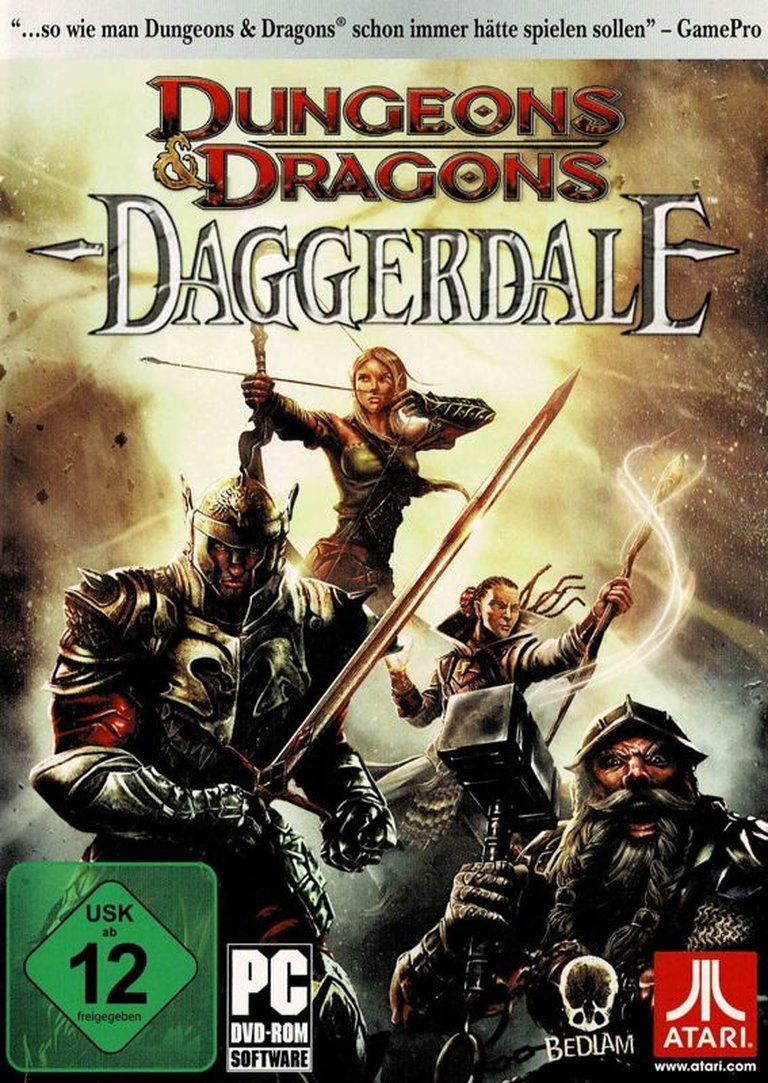
Dungeons & Dragons: Daggerdale is an action-oriented RPG set in the Forgotten Realms during 1420 DR, where players control a party of heroes—a Halfling Wizard, Human Fighter, Elven Rogue, and Dwarven Cleric—summoned by Lorin-Aria to defend Daggerdale from the invading forces of the evil wizard Rezlus, a devotee of Bane, and his Zhentarim army. Starting from the Dwarven Mines of Tethyamar, players venture through Zhentarim-controlled territories like the Tower of the Void, engaging in quests with third-person or top-down views, character progression based on 4th Edition D&D rules up to level 10, and co-op multiplayer for up to four players.
Gameplay Videos
Where to Buy Dungeons & Dragons: Daggerdale
PC
Dungeons & Dragons: Daggerdale Free Download
Dungeons & Dragons: Daggerdale Cracks & Fixes
Dungeons & Dragons: Daggerdale Guides & Walkthroughs
Dungeons & Dragons: Daggerdale Reviews & Reception
metacritic.com (46/100): Generally Unfavorable
pcgamer.com (35/100): Slow, clunky, and prone to glitchiness, playing Daggerdale feels like a sentence to an actual dungeon.
gamespot.com : The decent hack-and-slash action of Dungeons & Dragons: Daggerdale is plagued by more problems than its heroic adventurers can handle.
engadget.com : a monotonous, hideously buggy hack-and-slash RPG.
thegamingreview.com : Multiplayer in Daggerdale is a great fun packed adventure… which for me really made the game.
Dungeons & Dragons: Daggerdale: Review
Introduction
In the shadowed annals of video game history, few licenses carry the mythic weight of Dungeons & Dragons (D&D), the tabletop titan that birthed modern RPGs with its polyhedral dice rolls and epic tales of heroism. By 2011, the franchise’s digital legacy spanned gold-box classics like Pool of Radiance, BioWare masterpieces such as Baldur’s Gate, and arcade-style brawlers like Dark Alliance. Enter Dungeons & Dragons: Daggerdale, Bedlam Games’ bold bid to resurrect D&D on consoles via the nascent digital download era—XBLA, PSN, and PC—at a budget-friendly $15. Inspired by the streamlined combat of 4th Edition D&D (4E) and predecessors like Dungeons & Dragons: Heroes, it promised co-op dungeon-delving in the iconic Forgotten Realms. Yet, this rogue-lite action-RPG emerges as a tragic curio: an ambitious proof-of-concept for 4E’s video game potential, undermined by crippling bugs, repetitive design, and unfulfilled trilogy dreams. Daggerdale isn’t a critical failure of imagination but of execution—a fleeting spark in D&D’s digital flameout during the early 2010s.
Development History & Context
Bedlam Games, a small Canadian studio founded in 2005, spearheaded Daggerdale‘s creation starting in March 2010, with around 60 developers by January 2011. Led by Creative Director Zandro Chan, Lead Designer Stuart Wheeler, and Art Director Lui Francisco, the team collaborated closely with Wizards of the Coast to adapt 4E’s ruleset—emphasizing balanced powers, tiers of play, and accessible combat—into a real-time action framework. Powered by Unreal Engine 3 and NVIDIA PhysX for physics, the game targeted the booming digital marketplace: Xbox Live Arcade (XBLA) on May 25, 2011, followed by PC and a delayed PSN release in 2012.
This was the gaming landscape of post-Spellplague Forgotten Realms (year 1420 DR), where 4E’s tactical grid combat sought broader appeal amid MMOs like Dungeons & Dragons Online and ARPGs such as Diablo II clones. Atari, the publisher grappling with its own decline, positioned Daggerdale as the first in a trilogy: level 1-10 for Heroic tier, with sequels escalating to Paragon (11-20) and Epic (21-30), save-transfer included. Bedlam became a bitHeads subsidiary in January 2011, hinting at cross-platform ambitions (e.g., Xbox-to-iPhone continuity), but technical constraints loomed. As a budget title, it prioritized co-op over polish, echoing Gauntlet-style dungeon crawlers amid XBLA’s arcade revival. Tragically, Bedlam shuttered three months post-launch in August 2011, dooming the trilogy and stranding a post-credits tease for Gamma World: Alpha Mutation.
| Key Development Team Members | Role |
|---|---|
| Trevor Fencott | Executive Producer |
| Zandro Chan | Creative Director |
| Stuart Wheeler | Lead Designer |
| Valere Grams | Lead Artist |
| Alan Van Arden | Lead Programmer |
Technological limits—UE3’s demands on last-gen hardware—exacerbated issues like screen tearing, while rushed QA reflected Atari’s instability. In context, Daggerdale bridged 4E’s tactical purity with console action, but arrived amid superior co-op like Torchlight (2009) and looming giants like Diablo III (2012).
Narrative & Thematic Deep Dive
Daggerdale‘s plot, a linear 6-hour jaunt through Tethyamar’s dwarven mines and the towering Void (erected by Banite wizard Rezlus), weaves Forgotten Realms lore into a serviceable hack-and-slash yarn. Summoned by priestess Lorin-Aria to thwart Rezlus’s Zhentarim conquest of Daggerdale, four fixed heroes—a Human Fighter, Dwarven Cleric (Moradin-worshipper), Elven Rogue, and Halfling Wizard—battle goblin hordes, tieflings, dragonborn, and undead. Key beats include aiding Granstone dwarves against poisoned wells (revealing traitor Garbo Silvertongue), jailbreaking the Void’s pits under tiefling Kilkar Demoneye, allying with brigand Daewen Bael and Cyricist defector Nezra (Lorin-Aria’s sister), and climaxing atop the tower against Rezlus and red dragon Incendius.
Characters & Twists:
– Rezlus: Grotesque Bane zealot, amassing armies to restore Zhentarim glory post-Spellplague. His taunts underscore themes of divine rivalry.
– Lorin-Aria/Nezra: Banite-to-Cyricist betrayal culminates in Nezra’s backstab, flipping heroism into moral ambiguity—Cyricists seize Daggerdale.
– Allies: Dwarves like Union Leader Esar (forges anti-Rezlus hammer) and ghosts like Krollan add flavor; brigands provide cannon fodder.
Thematically, it probes Zhentarim schisms (Bane vs. Cyric factions weakening the Black Network), dwarven resilience in lost Tethyamar, and heroism’s futility amid godly intrigue. Dialogue is sparse and wooden—minimal VO, static cutscenes—but lore nods (phaerlocks, skull lords, chaos shards) immerse Forgotten Realms fans. Quests (fetch dryad dust, rescue patrols) feel rote, diluting epic scope; the cliffhanger (Nezra’s coup) teases unmade sequels. No player agency exists—pure linearity—but the twist elevates it beyond fetch-quest drudgery, echoing D&D’s intrigue over heroism.
Gameplay Mechanics & Systems
At its core, Daggerdale is a third-person action-RPG with top-down toggle, blending Dark Alliance‘s linearity and Heroes‘ co-op frenzy. Core loop: accept quests from NPCs, follow minimap waypoints through enemy-packed tunnels, return for XP/gold/loot. Death resets quest progress (retaining XP/gold/exp’d gear), enforcing checkpoint discipline.
Combat & Classes:
Four pre-gens (no customization beyond name/loot):
– Human Fighter: Melee tank, block defense, cleaves/slows.
– Dwarven Cleric: Hybrid healer (Healing Word, Shield of the Gods), mace bashes.
– Elven Rogue: Ranged focus (arrows/shurikens), stealthy dodges.
– Halfling Wizard: Burst DPS (Fireball, Ice Storm), teleport evade.
Each wields two attacks (melee/ranged), defense, and 3-6 swappable powers (4E-inspired, cooldown-based). Loot (e.g., Frostbrand greataxes, Necklace of Adaptation) and leveling (1-10 cap) yield feats/stats. UI: Radial menus for gear/hotbars, but console-pad prompts plague PC; remapping limited.
Progression & Flaws:
– Strengths: Deep loot variety (aketon armor, mordenkrads), co-op scaling (1-4 online/LAN, 2 local split-screen). Powers synergize (Cleric heals, Wizard AoEs).
– Innovations: Quest autosave mid-mission; freeplay mode post-campaign.
– Flaws: Repetitive waves (goblins respawn endlessly), poor targeting (attacks whiff), camera locks/no vertical pan. Bugs: Lost skills/gear, frozen controls, enemy clipping.
| Mechanic | Pros | Cons |
|---|---|---|
| Combat | Fast, power-synergy | Tedious attrition, shaman oversight |
| Co-op | Fun horde-slaying | Lag freezes, no lobbies/levels shown |
| Progression | Loot grind satisfying | Level 10 cap, min-max exploits |
| UI/Controls | Hotkey powers | Console bleed, unresponsive menus |
Multiplayer shines in chaos but crumbles: random joins mismatch levels, host-priority bugs. Solo feels grindy; co-op elevates to Gauntlet-lite.
World-Building, Art & Sound
Rooted in Forgotten Realms’ Dalelands, Daggerdale evokes Tethyamar’s haunted mines: Granstone ruins, Oxenmoor camps, Void’s antimagic pits rising to Desertsmouth peaks. Atmosphere builds via wind-whipped gloom, plague-ghoul lairs, and catapult-top finales—dwarven forges bellow, tiefling arenas roar. UE3 renders detailed models (rockfist smashers shatter convincingly via PhysX), but pop-in (skulls materialize feet away) and tearing shred immersion. Environments repeat (cave-to-ruin palette swaps), art bland beyond bosses.
Sound design: Sparse VO (decent accents, forgettable lines), clangorous metal clashes, ominous flutes. No score overwhelms; isolation amplifies tension. Multiplayer voice chat (Gamespy) flops—stunted, buggy. Collectively, it crafts moody D&D vibes but visuals betray the $15 sheen.
Reception & Legacy
Launched to middling fanfare as D&D’s first console title since 2004’s Heroes, Daggerdale tanked critically: MobyGames 5.2/10 (45% critics), Metacritic 46-49/100. Positives (Just RPG 85%, 360 LIVE 70%): Co-op value, 4E adaptation, length for price. Pans (GameSpy/Joystiq 1.5/5, GameStar 52%): Bugs (skill loss, lag), repetition, “Daggerfail” unpolish. Reviews decry “Diablo-1-level” depth, lazy QA (“borderline unfinished”).
Commercially modest (31 Moby collectors), it influenced naught—Bedlam’s closure killed sequels, stranding Gamma World tease. Reputation soured to “missed potential”: proof 4E works digitally (RPGamer: “good proof of concept”), but emblem of licensed misfires amid Neverwinter (2013). Steam lingers at $14.99; patches fixed some, but legacy warns: ambition sans polish slays dragons.
| Aggregates | Score | Notes |
|---|---|---|
| MobyGames | 5.2 | #26K/27K ranked |
| Metacritic (XBLA/PC/PS3) | 46-49 | “Generally Unfavorable” |
Conclusion
Dungeons & Dragons: Daggerdale endures as a flawed artifact—a $15 co-op crawler that captures 4E’s power fantasies amid Forgotten Realms grit, yet crumbles under technical rot and design myopia. Its co-op romps evoke Dark Alliance‘s glory days, but bugs, repetition, and truncation relegate it to obscurity. In D&D videogame history, it marks 4E’s halting debut and licensed digital pitfalls, a “critical miss” unworthy of the dice-rolling gods. Verdict: 4.5/10—play co-op cheaply for nostalgia, but history’s dungeon claims better heroes.