
- Release Year: 2009
- Platforms: Windows
- Publisher: Puny Human, LLC
- Developer: Puny Human, LLC
- Genre: Action
- Perspective: 1st-person
- Game Mode: Single-player
- Gameplay: Shooter
- Setting: Cyberpunk, dark sci-fi
- Average Score: 82/100
Description
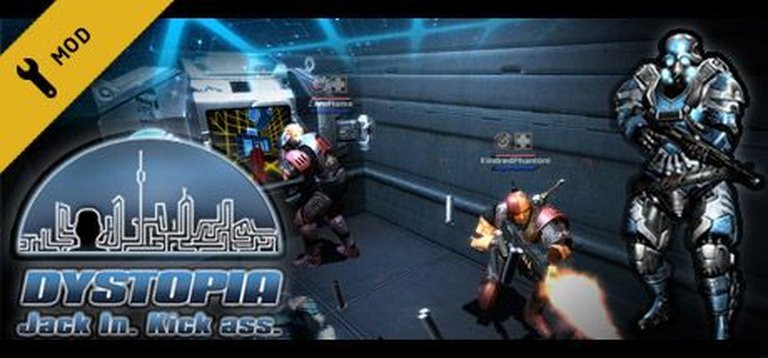
Dystopia is a team-based, objective-driven first-person shooter set in a cyberpunk universe, developed as a free total conversion mod on Valve’s Source engine. Players engage in tense combat as either the Punk Mercenaries or Corporate Security Forces, battling across both the physical world (meatspace) and virtual reality (cyberspace), where actions in one realm directly impact the other. The game features class-based gameplay with three distinct armor types, customizable implants, and a mix of real-world and cyber warfare, requiring strategic coordination between teams to complete objectives.
Where to Buy Dystopia
PC
Dystopia Patches & Updates
Dystopia Mods
Dystopia Reviews & Reception
en.wikipedia.org : Dystopia has been received positively from critics, with praise being given for its graphical quality, unique meatspace/cyberspace gameplay, overall polish and its representation of cyberspace.
steambase.io (85/100): Dystopia has earned a Player Score of 85 / 100.
steamscore.io (80/100): Dystopia has 8/10 rating.
mobygames.com : Dystopia is a cyberpunk game on the Source engine that places the player into tense combat situations in a high-tech world spanned by computer networks.
Dystopia: A Cyberpunk Masterpiece of Dual-Layered Gameplay
Introduction
In the mid-2000s, the cyberpunk genre was experiencing a renaissance in gaming, yet few titles truly captured the essence of its high-tech, low-life aesthetic. Enter Dystopia, a Half-Life 2 mod that not only embraced the genre’s themes but also innovated with its groundbreaking dual-layered gameplay. Released in 2007 after three years of development, Dystopia stands as a testament to the creativity of modding communities, blending objective-based combat with a seamless integration of physical and virtual worlds. This review explores its development, mechanics, narrative depth, and lasting influence on the cyberpunk and multiplayer shooter genres.
Development History & Context
The Birth of a Cyberpunk Vision
Dystopia was developed by Team Dystopia, a group of passionate modders led by Dustin “Teddy” Hulm, Robert “Fuzzy” Crouch, and Tim “Termi” Grant. Built on Valve’s Source engine, the mod began as a total conversion project in 2004, drawing inspiration from Shadowrun and classic cyberpunk literature. The team’s goal was to create a multiplayer-first experience that merged traditional FPS combat with a fully realized cyberspace layer—a concept rarely executed with such depth.
Technological Constraints & Innovations
- Source Engine Limitations: While the Source engine provided robust tools, the team had to work within its constraints, particularly in rendering cyberspace as a distinct, gravity-free environment.
- Dual-Layered Design: The mod’s defining feature—meatspace (physical world) and cyberspace (virtual world)—required meticulous balancing to ensure both layers felt meaningful.
- Community-Driven Development: Early builds (like dys_vaccine) were released for public testing, allowing the team to refine mechanics based on player feedback.
The Gaming Landscape of 2007
At the time of Dystopia’s release, cyberpunk games were scarce, with Deus Ex (2000) being the last major title to explore the genre. Multiplayer shooters like Counter-Strike and Team Fortress 2 dominated, but Dystopia carved its niche by offering objective-based, asymmetrical gameplay—a rarity in an era of deathmatch-focused shooters.
Narrative & Thematic Deep Dive
A World of Corporate Oppression & Punk Rebellion
Dystopia’s setting is a corporate-dominated dystopia, where two factions clash:
– Punk Mercenaries (Punks): Anti-establishment hackers and mercenaries fighting for freedom.
– Corporate Security Forces (Corps): A militarized force protecting corporate interests.
While the game lacks a traditional single-player campaign, its environmental storytelling—through level design, voice lines, and objective briefings—immerses players in a world where information is power.
Themes of Control & Resistance
- Cyberspace as a Battleground: The game’s cyberspace isn’t just a gimmick—it’s a parallel warzone where deckers (hackers) manipulate real-world systems.
- Augmentation & Identity: The three character classes (Light, Medium, Heavy) reflect different levels of cybernetic enhancement, raising questions about humanity vs. machine dependency.
- Teamwork as Survival: The game’s design forces players to coordinate between meatspace and cyberspace, reinforcing themes of interdependence in rebellion.
Gameplay Mechanics & Systems
Objective-Based Combat
Dystopia’s core gameplay revolves around attack vs. defense rounds, similar to Enemy Territory or Unreal Tournament’s Assault mode. However, its dual-layered objectives set it apart:
– Meatspace Objectives: Traditional FPS combat (e.g., capturing control points, escorting payloads).
– Cyberspace Objectives: Hacking terminals, disabling security systems, or sabotaging enemy networks.
Class System & Customization
The game features three distinct classes, each with unique weapons and implants (cybernetic enhancements):
| Class | Role | Weapons | Implants |
|---|---|---|---|
| Light | Scout/Infiltrator | Shotgun, Boltgun, Laser Rifle, Smartlock Pistols | Stealth, Leg Boosters, EMP Grenades |
| Medium | Balanced Combatant | Assault Rifle, Sniper, Grenade Launcher, Tesla Gun | Thermal Vision, Health Boosters |
| Heavy | Tank/Brawler | Rocket Launcher, Minigun, Ion Cannon, Auto-Shotgun | Armor Plating, Spider Grenades |
Cyberspace: A Hacker’s Playground
- Jacking In: Players with a Cyberdeck implant can enter cyberspace via Jack-In Points (JIPs).
- Zero-G Combat: Movement is fluid and disorienting, with no gravity and Escher-like node structures.
- Program Warfare: Deckers launch viruses, firewalls, and hacking tools to control real-world systems.
Phistball: A Unique Side Mode
A soccer-like arena mode where teams compete to score goals using melee attacks, adding a fun, casual contrast to the main game’s tactical depth.
World-Building, Art & Sound
Aesthetic & Atmosphere
- Meatspace: Gritty, neon-lit urban environments with industrial decay and corporate opulence.
- Cyberspace: A Tron-inspired digital void, with glowing data streams and geometric nodes.
Sound Design
- Ambient Cyberpunk: Synth-heavy soundtracks and glitchy electronic effects enhance immersion.
- Voice Acting: Minimal but effective, reinforcing the game’s noir-inspired tone.
Reception & Legacy
Critical Acclaim & Awards
- Independent Games Festival (2006): Best Half-Life 2 Mod.
- Mod DB Awards: Originality Award (2005), Mod of the Month (Oct 2005).
- Media Praise:
- Planet Half-Life: “A crisp, clean-cut, and well-planned package.”
- PC Zone: “Translates cyberpunk into a balanced multiplayer game.”
- Destructoid: “Everything Microsoft’s Shadowrun hoped to be.”
Influence on Cyberpunk Games
- Cyberpunk 2077’s Netrunning: Dystopia’s cyberspace mechanics foreshadowed Cyberpunk 2077’s hacking systems.
- Asymmetrical Multiplayer: Games like Evolve and Deceit later explored similar dual-layered gameplay.
- Modding Community Impact: Proved that free, passion-driven mods could rival commercial titles in polish and innovation.
Conclusion: A Cyberpunk Gem Ahead of Its Time
Dystopia remains a cult classic, celebrated for its ambitious design, deep mechanics, and faithful cyberpunk execution. While its steep learning curve and niche appeal limited mainstream success, its influence is undeniable. For fans of cyberpunk, tactical shooters, or innovative modding, Dystopia is a must-play relic of gaming’s golden modding era.
Final Verdict: 9/10 – A Masterclass in Cyberpunk Gameplay
Pros:
✔ Unique dual-layered combat
✔ Deep class customization
✔ Faithful cyberpunk aesthetic
✔ Free-to-play with lasting replayability
Cons:
✖ Steep learning curve
✖ Limited single-player content
✖ Small but dedicated player base
Dystopia isn’t just a mod—it’s a love letter to cyberpunk, a testament to modding’s potential, and a blueprint for future asymmetrical shooters. If you’ve ever dreamed of jacking into a digital warzone, this is the game for you.
Where to Play: Steam (Free)