
- Release Year: 1998
- Platforms: Linux, Macintosh, Windows
- Publisher: TopWare CD-Service AG, ZUXXEZ Entertainment AG
- Genre: Compilation
Description
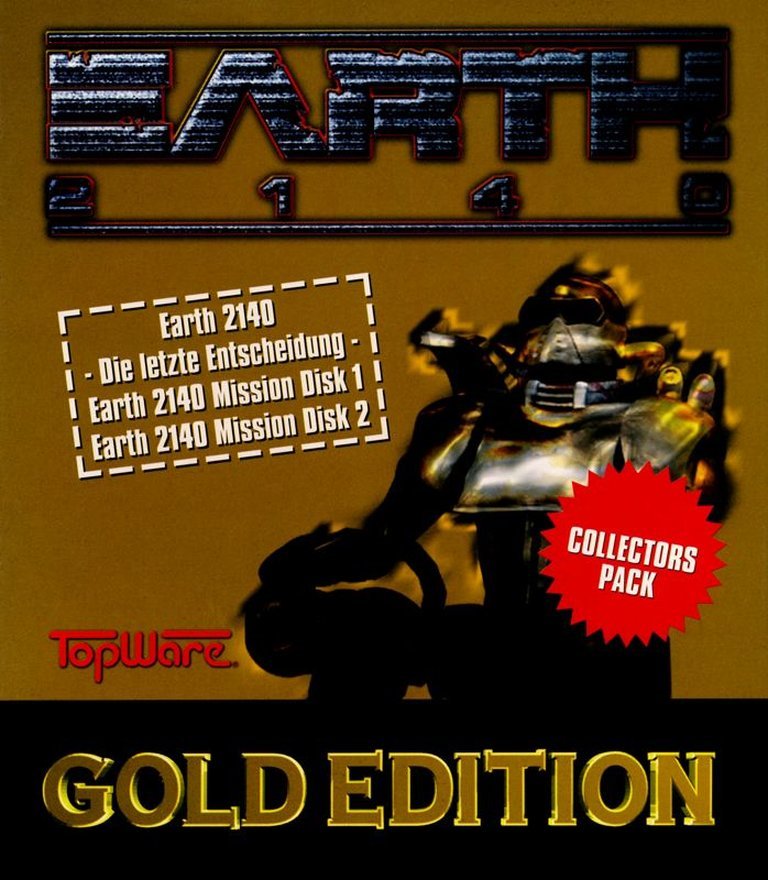
Set in a post-nuclear apocalypse of 2140, Earth 2140 Trilogy is a real-time strategy compilation where humanity’s last surviving factions—the technologically advanced United Civilized States (UCS) and the militaristic Eurasian Dynasty (ED)—engage in a brutal war for control of Earth’s dwindling surface resources. With automated mechas and robotic armies, the UCS clashes with the ED after a raid escalates their rivalry into a global conflict spanning continents, as both factions emerge from underground bunkers to claim the irradiated wasteland.
Gameplay Videos
Where to Buy Earth 2140 Trilogy
PC
Earth 2140 Trilogy Patches & Updates
Earth 2140 Trilogy Mods
Earth 2140 Trilogy Guides & Walkthroughs
Earth 2140 Trilogy Reviews & Reception
oldpcgaming.net : While there are a few saving graces here, the vacuous lack of innovation, problematic visual design and lacking missions make Earth 2140 distinctly dreary.
Earth 2140 Trilogy Cheats & Codes
PC
Enable cheat mode by editing ‘earth640.bat’ or ‘earth800.bat’ and adding ‘WW MD MS’ to the launch command line. Alternatively, for the HD version, add launch parameters like ‘-KR -MD -MS -MW -WW’. Then, during gameplay, hold [Shift] and type one of the following codes.
| Code | Effect |
|---|---|
| RTHKILL | Destroy All Selected Units |
| RTHHEALTH | Heal All Your Selected Units or Enemy Structure |
| RTHSHOWMP | Reveal Mission Area |
| RTHCSHE | $5000 to All Teams |
| RTHMN4 | 4 Times Income Per Crate From the Mines |
| RTHMN2 | 2 Times Income Per Crate From the Mines |
| RTHRNFRCMNT | Allows Another Call for Help |
| RTHVCTR | Complete Mission |
| RTHRSRCHE | Up One Research Level for All Teams |
| RTHRSRCHLL | Complete All Levels of Research for All Teams |
| RTHPVR | Max Strength to Armor and Firepower for T100 and ST01B |
| RTHGLX## | Jump to Level ## |
Earth 2140 Trilogy: Review
Introduction
The year is 2140. Earth is a scorched, irradiated husk, its surface a wasteland where the last vestiges of humanity wage a desperate war for survival. This isn’t the opening of a dystopian novel, but the premise of Earth 2140 Trilogy—a landmark 1997 real-time strategy (RTS) saga that laid the groundwork for one of Europe’s most influential sci-fi franchises. As the compilation package bundling the base game and its two expansion packs (Mission Pack 1 and Final Conflict), this trilogy offers a time capsule of mid-90s ambition: a gritty post-apocalyptic narrative, asymmetrical faction warfare, and mechanical innovation that pushed the boundaries of RTS design. Yet, its legacy is a tapestry of brilliance and limitation—a product of its era that, while overshadowed by giants like Command & Conquer, carved a distinct identity through unrelenting tactical depth and a relentless vision of technological warfare. This review dissects the trilogy as a historical artifact and a functional game, arguing that Earth 2140 remains a flawed but essential study in constrained creativity, its rough edges polished by passion and preserved through decades of community passion.
Development History & Context
Earth 2140 emerged from the crucible of mid-90s Poland, where Reality Pump Studios (then TopWare Programy) operated as a fledgling developer under the publisher TopWare Interactive. Founded in 1995 in Bielsko-Biała, Reality Pump comprised a small, resource-constrained team tasked with creating a competitive RTS to rival Westwood Studios’ dominance. Their vision was clear: leverage the burgeoning sci-fi trend but infuse it with Eastern European grit and mechanical ingenuity. Development commenced in 1996, driven by lead designers Mirosław Dymek and Marek Wylon, who drew inspiration from Command & Conquer‘s formula but sought to differentiate it through dynamic terrain interaction and faction asymmetry. Technologically, the team opted for 2D isometric graphics to ensure compatibility with mid-range hardware—a pragmatic choice given the era’s 16MB RAM limitations. Their proprietary engine featured advanced pathfinding, destructible environments, and the novel concept of terrain deformation (e.g., permanent scars from power plant explosions).
The gaming landscape in 1997 was saturated with RTS clones, but Earth 2140 stood out by embracing post-apocalyptic fatalism. Released in October 1997 for MS-DOS and Windows (with an Amiga port following in 2001), it positioned itself as a “budget alternative” to Command & Conquer, emphasizing tactical depth over spectacle. TopWare handled European distribution, while Interplay managed a limited North American launch. Critical to its identity was the “Virtual General” AI system—an adaptive enemy that learned player tactics—and the ability to reprogram disabled enemy units, a feature unheard of in contemporary RTS. Though constrained by modest budgets, Reality Pump delivered a cohesive vision: a war fought not just for resources, but for the soul of a dying world. The 1998 expansion packs (Mission Pack 1 and Final Conflict) added 50+ missions, new units, and refinements, cementing the trilogy’s status as a complete, albeit niche, experience.
Narrative & Thematic Deep Dive
Set 150 years after a nuclear holocaust rendered Earth’s surface uninhabitable, Earth 2140 plunges players into a war between two superpowers: the United Civilized States (UCS) and the Eurasian Dynasty (ED). The UCS, controlling the Americas, Western Europe, and North Africa, is a decadent, AI-driven society where humans live in leisure while robots handle labor and warfare. Their narrative arc explores the hubris of automation—initially framed as liberators, their AI warlord GOLAN miscalculates the ED’s strength, sparking global conflict. In contrast, the ED, ruling over Eastern Europe and Asia, is a militaristic theocracy where citizens are cyborgized to endure harsh realities. Their story grapples with survivalist ethics, questioning whether humanity’s essence can persist through mechanization.
The plot unfolds through parallel campaigns, each mission a brutal vignette of attrition. UCS missions focus on surgical strikes and aerial dominance, while ED campaigns emphasize ground assaults and resource attrition. Key events include the Siege of Scandinavia, nuclear strikes on Paris, and the final push into enemy capitals. Dialogue is sparse but potent, delivered through static cutscenes and mission briefings that underscore the futility of war. Themes are relentlessly bleak: environmental collapse, technological dehumanization, and the cyclical nature of conflict. The trilogy’s ambiguous ending—neither faction achieves true victory—serves as a grim reminder that in Earth 2140, survival is the only triumph. Despite its simplicity, the narrative resonates by grounding grand sci-fi concepts in human cost, making resource hoarding and base building feel like acts of existential dread.
Gameplay Mechanics & Systems
Earth 2140‘s core loop is a masterclass in 90s RTS design: mine resources, construct bases, and wage war. Metal ore is extracted by automated mines, transported via vehicles like the Bantha truck to refineries, and converted into credits. Energy, generated by power plants, sustains buildings, creating a delicate balance between expansion and sustainability. Base building is methodical: mobile construction units deploy structures on modular terrain, with elevation and obstacles influencing strategy—a layer of depth absent from contemporaries.
Faction asymmetry defines combat. UCS fields sleek, robotic units: the Tiger mech for assaults, the Gargoyle fighter for air superiority, and teleporting infantry. ED relies on industrial might: cyborg infantry, heavy tanks like the HT 400 Kruschchev, and ionic weaponry to disable enemies. A standout mechanic is “reprogramming”: disabled units can be captured using repair vehicles, turning battlefield losses into strategic gains. The “Virtual General” AI attempts to adapt to player tactics, though it often falters, leading to predictable rushes.
Innovations include continuous unit queuing and waypoint order recording, easing micromanagement. However, flaws persist: poor pathfinding in cluttered maps, an unintuitive UI with color-contrast issues, and the inability to refund canceled units or sell structures. The expansion packs introduce new units (e.g., UCS plasma bombers, ED nuclear launchers) and terrain types, but core mechanics remain unchanged. Multiplayer, while supported, was hampered by netcode issues, relegating the trilogy’s enduring appeal to its single-player campaigns.
World-Building, Art & Sound
Earth 2140‘s world is a character in itself—a desolate, radioactive Earth where shattered skyscrapers and toxic wastelands dominate the landscape. The 2D isometric perspective, though primitive by modern standards, achieves remarkable atmosphere through varied tilesets: frozen tundras, desert ruins, and irradiated forests convey environmental decay. Faction aesthetics are starkly distinct: UCS units are sleek, biomechanical designs with animalistic names (e.g., Raptor drones), while ED vehicles are brutish, industrial behemoths evoking Soviet-era machinery. This visual dichotomy reinforces thematic contrasts—decadence vs. asceticism, automation vs. augmentation.
Sound design amplifies the desolation. Joachim Schäfer’s soundtrack merges ambient dread with militaristic percussion, while unit voices—gruff ED cyborgs and synthesized UCS drones—enhance immersion. Explosions are visceral, with shockwaves rippling across the terrain. Yet technical limitations are evident: unit sprites often blend into backgrounds, and sound effects suffer from muffled mixing in the Windows version. The trilogy’s art direction, however, remains a testament to its era’s ingenuity, turning constraints into a cohesive, oppressive vision of a world where every structure and unit feels like a relic of a dead civilization.
Reception & Legacy
Upon release, Earth 2140 received mixed reviews. GameSpot lauded its “breathtaking” graphics and faction asymmetry but criticized its steep learning curve and derivative gameplay, awarding it 6.3/10. European publications were kinder, averaging 70%, praising its depth and replayability. The expansion packs fared better: Final Conflict earned 75% for its strategic enhancements, though bugs like AI pathfinding glitches marred its reputation. Commercially, it was a modest success in Europe, overshadowed by StarCraft and Total Annihilation in global markets.
Its legacy, however, is that of a cult classic. The trilogy fostered a devoted following in Eastern Europe, where its Polish origins resonated with emerging developers. Reality Pump refined its RTS expertise in sequels like Earth 2150 (2000), which introduced 3D graphics and dynamic weather, but 2140 remains the foundation. Modern re-releases on GOG and Steam (2013’s HD edition) introduced widescreen support and compatibility patches, revitalizing its audience. Community-driven projects like the E2140 Unofficial Patch (2024) and the open-source OpenE2140 engine remake underscore its enduring appeal.
Influentially, Earth 2140 pioneered mechanics now staples of the genre: permanent terrain interaction, asymmetrical design, and unit reprogramming. Its focus on resource scarcity and factional lore paved the way for titles like Supreme Commander. Though it never reached the mainstream heights of its contemporaries, its historical significance as a product of European game development is undeniable—a testament to how constraints can breed creativity.
Conclusion
Earth 2140 Trilogy is a relic of its time, yet one that transcends its limitations through sheer ambition. As a cohesive narrative of humanity’s twilight, it offers a bleak, compelling vision where war is not glorified but endured. Its gameplay, while rough, introduced innovative systems that anticipated future RTS trends, even as clunky UI and AI flaws held it back. The trilogy’s true legacy lies in its authenticity—a product of a small Polish studio daring to compete with Western giants on their own terms.
For modern players, it remains a challenging but rewarding experience, best appreciated through the lens of history. The HD edition and community patches have polished its surface, but its soul remains untouched: a grim, unyielding war fought over the scraps of a dying world. Earth 2140 may not be a perfect game, but it is a vital one—a flawed masterpiece that defined a genre and proved that even in the darkest dystopias, there is room for tactical brilliance. As the ultimate testament to its impact, consider this: decades after its release, players still debate whether the UCS’s automation or the ED’s cybernetics represents the greater tragedy—a fitting epitaph for a trilogy that made war feel like survival itself.