
- Release Year: 2000
- Platforms: Windows
- Publisher: 1C Company, Acer TWP Corp, Pointsoft GmbH, Snowball.ru, Strategic Simulations, Inc., TopWare CD-Service AG, Ubi Soft Entertainment Software, ZUXXEZ Entertainment AG
- Developer: TopWare Programmy Sp. z o.o.
- Genre: Strategy, Tactics
- Perspective: Diagonal-down
- Game Mode: LAN, Online PVP, Single-player
- Gameplay: Base building, Day, Dynamic Weather, night cycle, Real-time strategy (RTS), Resource Management, Tunneling, Unit customization
- Setting: Futuristic, Sci-fi
- Average Score: 84/100
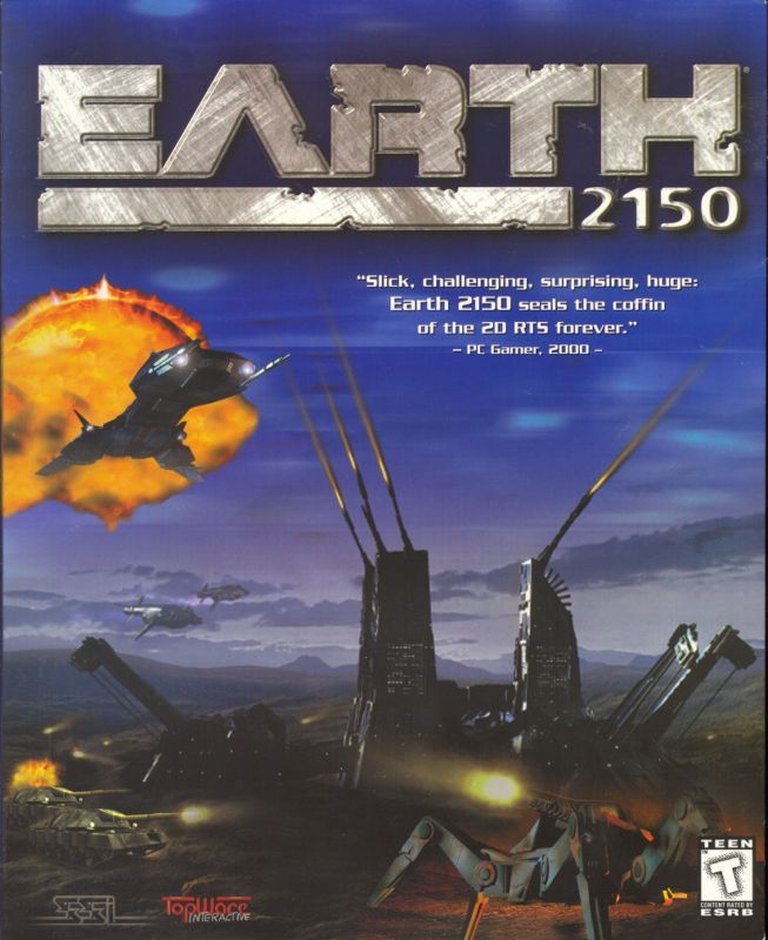
Description
Earth 2150 is a real-time strategy game set in a dystopian future where nuclear warfare has altered Earth’s orbit, bringing it dangerously close to the sun. The remaining three factions battle for control of resources to construct a massive spaceship and escape the dying planet. The game features 70 non-linear missions, a fully 3D environment with dynamic weather effects, and innovative unit customization. Players can dig tunnels through terrain, experience day-night cycles with functional lighting, and witness climate changes as the planet heats up. With a mix of land, air, and sea units, along with a built-in level editor, Earth 2150 offers deep strategic gameplay in a visually immersive sci-fi setting.
Gameplay Videos
Where to Buy Earth 2150
Earth 2150 Free Download
PC
Earth 2150 Cracks & Fixes
Earth 2150 Patches & Updates
Earth 2150 Guides & Walkthroughs
Earth 2150 Reviews & Reception
metacritic.com (78/100): Earth 2150 has without a doubt escaped the dull shadow of its predecessor to emerge as a well-crafted, highly complex and beautiful game.
gamespot.com (81/100): Earth 2150 delivers complex and challenging gameplay – and even an absorbing story.
game-over.net (89/100): It is all the more refreshing, then, when an RTS comes along that tries something different and succeeds.
ign.com (89/100): One of the finest examples of a classically-styled RTS we’ve seen in years.
Earth 2150 Cheats & Codes
PC
Press [Enter] and type ‘I_wanna_cheat’ to enable cheat mode. Press [Enter], type one of the following codes, then press [Enter] again to activate the corresponding cheat function.
| Code | Effect |
|---|---|
| x-mas_pack | Repair damage and reload ammo |
| fireworks | Put mines in area (range 8) |
| I_love_this_game | 1000 give 1000 CR |
| I_hate_limits | 100000 increase unit limit to 100000 CR |
| Einstein 1 | enable fast research |
| Einstein 0 | disable fast research |
| Help_me_please!!! 1 | enable fast research for player only |
| Help_me_please!!! 0 | disable fast research |
| Time_is_relative | faster researches |
| Dirt_cheap_research | cheaper researches |
| The_hammer_of_Thor | Kill all enemies in range of 8 |
| Massacre | Kill all objects in range of 8 |
| see_you_next_life | kill selected object |
| Hasta_la_vista_enemigos | kill visible enemy units and buildings |
| Bad_time_bad_place | Damage all objects in area |
| Eagle_eye | show area |
| Let_be_darkness | hide area |
| No_one_hides | shows all units |
| No_more_secrets | shows all map |
| Armageddon | meteor rain |
| einstein_1 | Enable fast exploration |
| einstein_0 | Disable fast exploration |
| help_me_please_1 | Enable fast exploration, player only |
| help_me_please_0 | Disable fast exploration, player only |
| the_hammer_of_thor | Kill all enemies at range of 8 |
| hasta_la_vista_enemigos | Destroy all visible units and objects |
| bad_time_bad_place | Damage all nearby units |
| eagle_eye | See all |
| let_be_darkness | Fog |
| no_more_secrets | Full map |
| time_is_relative | Faster research |
| dirt_cheap_research | Cheaper research |
| armageddon | Meteor shower |
| i_love_this_game_# | Receive indicated number of CR |
| i_hate_limits_# | Set unit CR limit to indicated number |
| one_more_please_ |
Create object or building at indicated coordinates |
| no_one_hides | See all units |
| see_you_next_life | Destroy selected unit |
| massacre | Destroy all objects at range of 8 |
| fireworks | Mines |
| x-mas_pack | Repair damage and reload ammo |
| help_me_please!!! 0/1 | Fast explore player only, 0 = off and 1 = on |
| I_wanna_cheat | Full repair |
| one_more_please_[x,y chassis number weapon] | Create object or building at indicated coordinates |
Earth 2150: A Masterclass in Real-Time Strategy and Atmospheric World-Building
Introduction: A Forgotten Gem of the RTS Golden Age
In the pantheon of real-time strategy (RTS) games, Earth 2150 (2000) stands as a towering yet underappreciated monument—a game that dared to innovate in an era dominated by StarCraft and Command & Conquer. Developed by Poland’s Reality Pump Studios and published by TopWare Interactive, Earth 2150 is a sequel to Earth 2140 (1997), but it is far more than a mere iteration. It is a bold reimagining of the RTS genre, blending a harrowing post-apocalyptic narrative with groundbreaking 3D gameplay mechanics, dynamic weather systems, and a level of strategic depth that few games of its time could match.
At its core, Earth 2150 is a story of desperation and survival. The Earth, knocked off its orbital axis by a catastrophic nuclear war, is spiraling toward the Sun. Humanity’s last hope lies in constructing a massive evacuation ship to escape the doomed planet. Three factions—the technocratic United Civilized States (UCS), the brutal Eurasian Dynasty (ED), and the enigmatic Lunar Corporation (LC)—compete for the dwindling resources needed to build this ship. The game’s premise is simple yet devastatingly effective: every credit spent on warfare is a credit that could have been used to save lives.
This review will dissect Earth 2150 in exhaustive detail, exploring its development history, narrative depth, gameplay innovations, artistic achievements, and lasting legacy. We will argue that Earth 2150 is not just a great RTS but a landmark title that pushed the boundaries of what the genre could achieve in terms of immersion, strategy, and atmospheric storytelling.
Development History & Context: A Polish Studio’s Ambition
The Rise of Reality Pump Studios
Earth 2150 was developed by Reality Pump Studios, a Polish developer that emerged in the late 1990s during a period of rapid growth for the Eastern European gaming industry. The studio’s previous work, Earth 2140 (1997), was a 2D RTS that laid the groundwork for the series’ lore and factions. However, Earth 2150 represented a quantum leap in ambition, transitioning to a fully 3D engine at a time when most RTS games were still tethered to 2D sprites or isometric perspectives.
The development of Earth 2150 was led by Mirosław Dymek, who served as both lead designer and level designer. The game’s programming was handled by a trio of Polish developers—Tomasz Barabasz, Jan Nitecki, and Jacek Sikora—while the 3D graphics and artwork were spearheaded by Tomasz Radon and a team of artists including Kajetan Czarnecki and Wojciech Drazek. The game’s haunting orchestral score, a standout feature, was composed by Maciej Pawłowski and Łukasz Targosz, blending original compositions with classical samples to create a soundscape that was both epic and melancholic.
Technological Constraints and Innovations
Earth 2150 was one of the first commercial RTS games to embrace a fully 3D environment, a decision that came with significant technical challenges. The game’s engine supported dynamic lighting, weather effects (including rain, fog, and thunderstorms), and a day-night cycle that affected visibility and gameplay. Units cast shadows, craters filled with water during rain, and buildings illuminated the battlefield at night. These features were not merely cosmetic; they had tangible strategic implications. For example, fog and darkness could obscure enemy movements, while rain could slow down units and reduce visibility.
The game’s physics engine was equally impressive. Units could tunnel through mountains, bridges could be destroyed to cut off enemy advances, and terrain could be deformed by explosions. The game also featured a unique “active pause” system, allowing players to issue orders while the game was paused—a feature that would later become a staple in games like Total War.
However, these innovations came at a cost. Earth 2150 was demanding on hardware, requiring a 3D accelerator and a powerful CPU (preferably a Pentium II 233 MHz or better) to run smoothly. This limited its accessibility to players with high-end PCs, a factor that may have contributed to its mixed commercial performance.
The Gaming Landscape of 2000
Earth 2150 was released in May 2000, a year that saw the launch of several landmark RTS titles, including Command & Conquer: Tiberian Sun, Age of Empires II: The Age of Kings, and Homeworld. The competition was fierce, and Earth 2150 struggled to carve out a niche for itself. While it was praised for its innovation and depth, it was often overshadowed by the more polished and widely marketed titles from Westwood Studios and Blizzard Entertainment.
Critically, Earth 2150 was well-received, earning an 81% aggregate score on Metacritic and glowing reviews from outlets like PC Action (92%), PC Games (92%), and IGN (89%). However, its commercial performance was lackluster, particularly in the U.S., where it sold only 23,163 copies in its first year. In Germany, it fared slightly better but was still outsold by Tiberian Sun and Age of Empires II.
Despite its modest sales, Earth 2150 developed a cult following, particularly in Europe, where its depth and complexity were appreciated by hardcore strategy fans. Its legacy would be cemented by two stand-alone expansions—The Moon Project (2000) and Lost Souls (2001)—and a sequel, Earth 2160 (2005), which further refined the series’ mechanics.
Narrative & Thematic Deep Dive: A World on the Brink
The Premise: Earth’s Final Days
The narrative of Earth 2150 is a masterclass in high-stakes storytelling. The game is set in the year 2150, decades after a devastating nuclear war (World War III, which began in 2048) has left the planet in ruins. The war’s final act—a desperate nuclear strike by the Eurasian Dynasty on the polar ice caps—has knocked Earth off its axis, sending it spiraling toward the Sun. The game begins as the first signs of the impending catastrophe become apparent: temperatures drop to winter levels, and scientists estimate that humanity has only 180 days before the planet is consumed.
The three factions vying for survival are:
-
The United Civilized States (UCS): A technocratic superstate controlling the Western Hemisphere (North and South America, Western Europe, and North Africa). The UCS is a demarchy ruled by AI advisors, with human leaders reduced to figureheads. Their military consists entirely of robots and mechs, reflecting their reliance on automation and artificial intelligence.
-
The Eurasian Dynasty (ED): A brutal, militaristic empire encompassing Eastern Europe, Russia, and Asia. The ED is a fusion of Soviet-style authoritarianism and Mongolian expansionism, ruled by a Khan who demands absolute loyalty. Their military is composed of tanks, helicopters, and cyborgized soldiers, emphasizing brute force and numerical superiority.
-
The Lunar Corporation (LC): A matriarchal society based on the Moon, founded by idealistic scientists and wealthy elites who fled Earth before the nuclear war. The LC is technologically advanced but militarily inexperienced, forced to weaponize their mining equipment to defend themselves. Their society is pacifistic but pragmatic, willing to fight when necessary.
The game’s campaign is structured around a non-linear mission tree, with players choosing which faction to align with and which territories to conquer. The ultimate goal is to accumulate 1,000,000 credits (500,000 for the LC) to fund the construction of an evacuation ship. Every credit spent on warfare is a credit that could have been used to save lives, creating a constant tension between military necessity and moral responsibility.
Thematic Depth: Survival, Sacrifice, and Moral Ambiguity
Earth 2150 is not just a game about war; it is a meditation on the cost of survival. The game’s narrative is delivered through a series of news broadcasts, mission briefings, and propaganda videos, all of which reinforce the desperation of the situation. The factions are not merely fighting for dominance; they are fighting for the very survival of their people, and the stakes could not be higher.
The game’s themes are explored through several key mechanisms:
-
The Global Countdown: The 180-day timer is a constant reminder of the impending apocalypse. As the days tick by, the environment changes: winter thaws into a brief spring, followed by scorching deserts and, finally, volcanic wastelands. The visual transformation of the planet is a powerful narrative device, reinforcing the urgency of the situation.
-
Resource Scarcity: Resources are finite, and every credit spent on warfare is a credit that could have been used to build the evacuation ship. This creates a moral dilemma: do you invest in military superiority to secure more resources, or do you conserve what you have to ensure your people’s survival? The game forces players to grapple with this question in every mission.
-
Factional Propaganda: Each faction has its own propaganda videos, which play at the start of missions and during loading screens. These videos are not just flavor text; they provide insight into the factions’ ideologies and motivations. The UCS’s propaganda is cold and calculating, emphasizing efficiency and progress. The ED’s propaganda is brutal and militaristic, demanding absolute loyalty. The LC’s propaganda is idealistic but increasingly desperate, reflecting their struggle to adapt to the horrors of war.
-
Betrayal and Alliances: The game’s non-linear campaign allows for shifting alliances and betrayals. For example, the UCS and LC may form a temporary alliance to defeat the ED, only for the UCS to turn on the LC when it suits their interests. These betrayals are not just gameplay mechanics; they reflect the desperation of the factions, willing to do whatever it takes to survive.
Character and Dialogue: A World of Cold Calculations and Desperate Pleas
The characters in Earth 2150 are not deeply developed in the traditional sense, but they are effective in conveying the game’s themes. The UCS’s leaders are faceless bureaucrats, their dialogue delivered in monotone voices that emphasize their reliance on AI advisors. The ED’s leaders are brutal and authoritarian, their dialogue filled with threats and demands for loyalty. The LC’s leaders are idealistic but increasingly desperate, their dialogue reflecting their struggle to maintain their pacifist principles in the face of annihilation.
One standout character is Neo, a rogue UCS hacker who defects to the ED. Neo’s actions drive much of the game’s plot, including a pivotal moment where he reprograms UCS robots to attack the LC, sabotaging their alliance. Neo is a fascinating figure—a traitor motivated by a desire to escape the UCS’s AI-controlled society, but also a ruthless opportunist willing to betray anyone to survive.
The game’s dialogue is sparse but effective, delivered through mission briefings, propaganda videos, and in-game radio chatter. The voice acting is competent, though not exceptional, but it serves its purpose in reinforcing the game’s atmosphere of desperation and urgency.
Gameplay Mechanics & Systems: A Masterclass in Strategic Depth
Core Gameplay Loop: Resource Management and Tactical Combat
At its heart, Earth 2150 is a real-time strategy game, and its core gameplay loop will be familiar to fans of the genre: build a base, gather resources, research technologies, produce units, and engage in combat. However, Earth 2150 distinguishes itself through a series of innovative mechanics that add depth and complexity to the formula.
-
Resource Management: Resources are gathered through mining operations, which extract ore from the ground. The ore is then processed into credits, which are used to build units, structures, and research technologies. Unlike many RTS games, resources are finite in Earth 2150, and players must carefully manage their stockpiles to ensure they have enough to fund their evacuation ship.
-
Base Building: Each faction has its own unique approach to base building. The UCS and ED construct buildings traditionally, using construction units to place structures on the map. The LC, however, drops prefabricated buildings from orbit, allowing them to place structures anywhere, even behind enemy lines. This gives the LC a unique strategic advantage but also makes their buildings vulnerable to attack while they are descending.
-
Unit Production and Customization: Earth 2150 features a deep unit customization system, allowing players to mix and match chassis, weapons, and equipment to create specialized units. For example, a player might attach a plasma cannon to a heavy mech chassis, or equip a scout vehicle with a stealth generator. This system adds a layer of strategic depth, as players must consider the strengths and weaknesses of different unit configurations.
-
Combat: Combat in Earth 2150 is tactical and nuanced. Units have different strengths and weaknesses, and terrain plays a crucial role in battles. For example, tunnels can be used to ambush enemy forces, while bridges can be destroyed to cut off reinforcements. The game also features a day-night cycle, which affects visibility and unit behavior. At night, units must use headlights to see, making them more vulnerable to ambushes.
Innovative Mechanics: Weather, Ammo, and Unit Levels
Earth 2150 introduces several mechanics that were groundbreaking at the time and remain impressive today:
-
Dynamic Weather and Day-Night Cycle: The game’s weather system is not just a visual effect; it has tangible gameplay implications. Rain reduces visibility and slows down units, while fog can obscure enemy movements. The day-night cycle affects unit behavior, with nighttime battles requiring the use of headlights, which can give away a unit’s position.
-
Ammunition Management: Unlike many RTS games, where units have infinite ammunition, Earth 2150 requires players to manage their units’ ammo supplies. Units must return to supply depots to rearm, adding a logistical layer to combat. This mechanic forces players to think carefully about their unit compositions and supply lines, as running out of ammo in the middle of a battle can be disastrous.
-
Unit Experience and Levels: Units in Earth 2150 gain experience through combat, becoming more effective as they level up. This adds a strategic dimension to unit management, as players must decide whether to preserve experienced units or sacrifice them for tactical advantages.
-
Terrain Deformation: The game’s physics engine allows for terrain deformation, meaning that explosions can create craters, and tunnels can be dug through mountains. This adds a dynamic element to the battlefield, as players can alter the terrain to their advantage.
-
Superweapons: Each faction has access to a superweapon, which can turn the tide of battle. The UCS has the Plasma Control Center, which fires devastating plasma bolts from orbit. The ED has nuclear silos, which can launch ballistic missiles at enemy bases. The LC has the Weather Control Center, which can summon storms, meteors, or even drop asteroids on enemy positions.
Faction Asymmetry: Three Distinct Playstyles
One of Earth 2150’s greatest strengths is its faction asymmetry. Each faction plays differently, with unique units, structures, and strategic approaches:
-
United Civilized States (UCS):
- Strengths: The UCS fields powerful, durable mechs and robots, with access to advanced technologies like plasma cannons and stealth generators.
- Weaknesses: UCS units are slow and expensive, and their reliance on automation makes them vulnerable to hacking and sabotage.
- Playstyle: The UCS is a slow, methodical faction that excels in defensive play. Their units are tough but require careful management, and their superweapon (the Plasma Control Center) is devastating but slow to charge.
-
Eurasian Dynasty (ED):
- Strengths: The ED fields cheap, fast units in large numbers, with a focus on tanks and helicopters. They also have the most powerful navy in the game.
- Weaknesses: ED units are individually weak and lack advanced technologies like shields and stealth.
- Playstyle: The ED is a swarm faction, relying on overwhelming numbers and brute force. Their superweapon (nuclear silos) is powerful but requires careful timing to use effectively.
-
Lunar Corporation (LC):
- Strengths: The LC fields fast, fragile units with unique abilities like hovering and self-repair. They also have the most flexible base-building system, allowing them to place structures anywhere.
- Weaknesses: LC units are fragile and lack heavy armor, making them vulnerable to sustained fire.
- Playstyle: The LC is a hit-and-run faction, relying on speed and mobility to outmaneuver enemies. Their superweapon (the Weather Control Center) is versatile but situational, requiring the right environmental conditions to be effective.
Multiplayer and Skirmish Modes
Earth 2150 features robust multiplayer and skirmish modes, allowing players to compete against each other or the AI in custom battles. The game supports up to 8 players in multiplayer, with options for LAN, internet, and modem connections. The skirmish mode allows players to customize their battles, choosing from a variety of maps, factions, and victory conditions.
The multiplayer mode is particularly notable for its depth and complexity. The game’s faction asymmetry and unit customization system make for a rich and varied multiplayer experience, with each match offering unique strategic challenges.
World-Building, Art & Sound: A Dying Planet Brought to Life
Setting and Atmosphere: A World in Decay
Earth 2150’s setting is one of its greatest strengths. The game’s world is a dying planet, ravaged by war and environmental collapse. The visual design reflects this, with landscapes that transform as the game progresses. Early missions take place in frozen wastelands, while later missions feature scorching deserts and volcanic hellscapes. The game’s art direction is bleak and oppressive, reinforcing the desperation of the situation.
The game’s environments are richly detailed, with dynamic weather effects, day-night cycles, and terrain deformation. The 3D engine allows for a level of immersion that was rare in RTS games at the time, with units casting shadows, buildings illuminating the battlefield at night, and craters filling with water during rain. These details are not just cosmetic; they have tangible gameplay implications, adding depth and realism to the experience.
Visual Direction: A Bleak and Beautiful Apocalypse
The visual design of Earth 2150 is a masterclass in atmospheric world-building. The game’s art style is gritty and industrial, with a focus on realism and detail. The UCS’s mechs are sleek and futuristic, reflecting their reliance on advanced technology. The ED’s tanks and helicopters are rugged and utilitarian, emphasizing their brute-force approach. The LC’s hovering vehicles are delicate and ethereal, reflecting their lunar origins.
The game’s unit designs are particularly impressive. Each faction’s units are distinct and instantly recognizable, with unique silhouettes and color schemes. The UCS’s mechs are predominantly gray and blue, the ED’s tanks are green and brown, and the LC’s vehicles are white and silver. This visual distinction makes it easy to identify units in the heat of battle, a crucial consideration in an RTS game.
The game’s environments are equally detailed, with a variety of terrains ranging from frozen tundras to volcanic wastelands. The dynamic weather system adds another layer of visual richness, with rain, fog, and snow all affecting the battlefield. The day-night cycle is particularly effective, with nighttime battles requiring the use of headlights, which cast eerie glows across the landscape.
Sound Design: A Symphony of Desperation
The sound design of Earth 2150 is a standout feature, contributing significantly to the game’s atmosphere. The game’s soundtrack, composed by Maciej Pawłowski and Łukasz Targosz, is a blend of original compositions and classical samples. The music is orchestral and epic, with a melancholic undertone that reflects the game’s themes of desperation and survival.
The soundtrack is divided into three moods: daytime, nighttime, and combat. The daytime tracks are slow and atmospheric, emphasizing the bleakness of the environment. The nighttime tracks are darker and more ominous, reflecting the dangers of the night. The combat tracks are fast-paced and intense, driving the action forward.
The game’s sound effects are equally impressive. The roar of engines, the crack of gunfire, and the explosion of artillery are all rendered with a level of detail that adds to the immersion. The game also features voice acting, with each faction having its own distinct vocal style. The UCS’s voices are cold and monotone, the ED’s voices are gruff and authoritarian, and the LC’s voices are soft and melodic.
Reception & Legacy: A Cult Classic’s Enduring Influence
Critical Reception: Praise and Criticism
Earth 2150 was met with critical acclaim upon its release, earning an 81% aggregate score on Metacritic. Critics praised the game’s innovation, depth, and atmosphere, with many highlighting its 3D engine, dynamic weather system, and faction asymmetry as standout features.
However, the game was not without its critics. Some reviewers found the interface clunky and the learning curve steep, particularly for casual players. The game’s hardware requirements were also a point of contention, as it demanded a powerful PC to run smoothly. Despite these criticisms, Earth 2150 was widely regarded as a landmark title in the RTS genre, pushing the boundaries of what was possible in terms of immersion and strategic depth.
Commercial Performance: A Mixed Success
Commercially, Earth 2150 was a mixed success. In the U.S., it sold only 23,163 copies in its first year, a figure that was considered disappointing by industry standards. In Germany, it fared slightly better but was still outsold by competitors like Command & Conquer: Tiberian Sun and Age of Empires II. The game’s high hardware requirements and steep learning curve likely contributed to its modest sales, as it appealed primarily to hardcore strategy fans rather than casual gamers.
Despite its commercial underperformance, Earth 2150 developed a dedicated cult following, particularly in Europe. Its depth and complexity were appreciated by strategy enthusiasts, and its innovative mechanics influenced subsequent RTS games. The game’s legacy was further cemented by its expansions and sequel, which refined and expanded upon its core mechanics.
Influence on Subsequent Games
Earth 2150’s influence can be seen in several subsequent RTS games, particularly in its approach to faction asymmetry, unit customization, and environmental dynamics. Games like Total Annihilation, Supreme Commander, and Company of Heroes all owe a debt to Earth 2150’s innovations, particularly in their use of 3D environments, dynamic weather, and terrain deformation.
The game’s faction asymmetry was particularly influential, inspiring later RTS titles to experiment with distinct playstyles and unit rosters. The UCS’s reliance on mechs and automation, the ED’s swarm tactics, and the LC’s hit-and-run strategies all served as templates for future faction designs.
The game’s unit customization system was also ahead of its time, allowing players to mix and match chassis, weapons, and equipment to create specialized units. This mechanic would later become a staple in games like Warhammer 40,000: Dawn of War and StarCraft II, where unit customization and upgrades play a crucial role in strategic depth.
The Earth Series: A Legacy of Innovation
Earth 2150 was followed by two stand-alone expansions—The Moon Project (2000) and Lost Souls (2001)—and a sequel, Earth 2160 (2005). These games refined and expanded upon the original’s mechanics, introducing new units, factions, and gameplay features.
The Moon Project focused on the LC’s attempt to build a superweapon on the Moon, adding new units and missions to the original game. Lost Souls explored the final days of Earth’s evacuation, with a linear campaign that emphasized the desperation of the situation. Earth 2160 took the series to Mars, introducing a new faction (the alien Morphidians) and expanding the unit customization system.
Despite the series’ commercial struggles, it remains a beloved cult classic, remembered for its innovation, depth, and atmospheric storytelling. The Earth series is a testament to the creativity and ambition of its developers, who dared to push the boundaries of the RTS genre at a time when it was dominated by more established franchises.
Conclusion: A Landmark Title in RTS History
Earth 2150 is a game that defies easy categorization. It is at once a harrowing narrative of survival, a masterclass in strategic depth, and a technical marvel that pushed the boundaries of what was possible in real-time strategy gaming. Its innovative mechanics—dynamic weather, ammunition management, unit customization, and faction asymmetry—set it apart from its contemporaries and influenced the evolution of the genre.
While it may not have achieved the commercial success of StarCraft or Command & Conquer, Earth 2150 remains a cult classic, beloved by strategy enthusiasts for its depth, complexity, and atmospheric world-building. Its legacy is one of innovation and ambition, a testament to the creativity of its developers and the enduring appeal of its vision.
In the pantheon of RTS games, Earth 2150 stands as a towering achievement—a game that dared to be different, to challenge players with its depth, and to immerse them in a world on the brink of annihilation. It is a game that deserves to be remembered, not just as a relic of the past, but as a landmark title that helped shape the future of real-time strategy gaming.
Final Verdict: 9/10 – A Masterpiece of Strategic Depth and Atmospheric Storytelling
Earth 2150 is a must-play for any fan of real-time strategy games. Its innovative mechanics, deep faction asymmetry, and harrowing narrative make it a standout title in the genre. While its steep learning curve and hardware requirements may deter casual players, those who invest the time will be rewarded with one of the most immersive and strategically rich RTS experiences ever created.