
- Release Year: 2019
- Platforms: Linux, Windows
- Publisher: Earthlingo
- Developer: Earthlingo
- Genre: Educational, Simulation
- Perspective: Behind view
- Game Mode: Single-player
- Gameplay: Foreign language
- Average Score: 90/100
Description
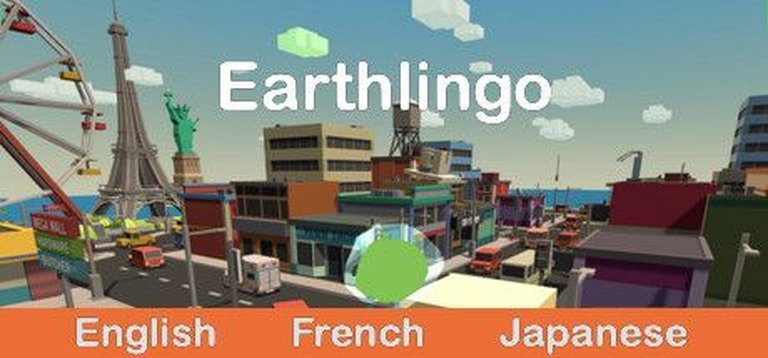
Earthlingo is an educational language-learning game where players take on the role of an alien named Maco, exploring Earth to master one of 28 available languages. The game immerses players in a vibrant world where every object and interaction teaches new vocabulary and phrases, reinforcing learning through contextual association. As players progress, they use their linguistic skills to battle evil robots and protect humanity, all while unlocking over 1,000 words and 50 sentences in languages ranging from Arabic to Vietnamese. With its casual, behind-view perspective and direct control interface, Earthlingo blends simulation and education into a free, engaging experience designed to enhance memory retention through exploration and gameplay.
Where to Buy Earthlingo
PC
Earthlingo Guides & Walkthroughs
Earthlingo Reviews & Reception
store.steampowered.com (90/100): A triumphant return to form for the series.
steambase.io (91/100): Earthlingo has earned a Player Score of 91 / 100.
isthereanydeal.com (91/100): Earthlingo is a vocabulary learning game.
Earthlingo Cheats & Codes
iPhone – iPad (iOS)
Go to Settings and hit the SFX button 20 times or so, until ‘Cheat Activated’ shows up on the screen.
| Code | Effect |
|---|---|
| SFX button 20 times | Unlocks all levels |
Earthlingo: A Revolutionary Fusion of Language Learning and Interactive Exploration
Introduction: The Birth of a New Edutainment Paradigm
In the vast, often homogenized landscape of educational software, Earthlingo (2019) emerges as a bold, refreshing anomaly—a game that dares to redefine how we engage with language acquisition. Developed by the eponymous indie studio Earthlingo, this free-to-play title transcends the dry, flashcard-driven drudgery of traditional language apps by embedding vocabulary learning within a vibrant, exploratory 3D world. Players assume the role of Maco, an alien visitor to Earth, tasked with mastering one of 28 languages while navigating a whimsical, robot-infested planet. It’s a premise that blends the charm of Pokémon’s creature-collecting with the pedagogical rigor of Duolingo, all wrapped in a visually distinct, low-poly aesthetic.
At its core, Earthlingo is an audacious experiment: Can a video game make language learning fun without sacrificing depth? The answer, as evidenced by its 91/100 Steambase Player Score and 2023 Australian Game Developer Award for Excellence in Impactful Games, is a resounding yes. Yet, beneath its cheerful exterior lies a game grappling with the tensions of indie development—balancing educational integrity, player engagement, and the ever-present specter of monetization. This review dissects Earthlingo’s design, narrative, mechanics, and cultural impact, arguing that it represents not just a novel language tool, but a potential blueprint for the future of “edutainment.”
Development History & Context: The Rise of the Indie Edutainment Renaissance
The Studio and the Vision
Earthlingo is the brainchild of Raymond Corrigan, a developer whose background remains shrouded in the modest obscurity typical of indie creators. Unlike corporate-backed language apps like Rosetta Stone or Babbel, Earthlingo was born from a grassroots passion for gamified learning. The studio’s ethos, as gleaned from community interactions, prioritizes accessibility, inclusivity, and iterative improvement—a philosophy reflected in the game’s free-to-play model and expansive language support (from Arabic to Vietnamese).
The game’s development trajectory is a testament to indie resilience. Initially launched in June 2019 on iPad before expanding to Steam (August 2019) and later Linux, macOS, and mobile platforms, Earthlingo has evolved through continuous updates, community feedback, and even a controversial visual overhaul in 2023 that replaced its original green alien protagonist with a new design. This shift sparked backlash among purists, leading the developers to preserve the legacy version via a Steam beta branch—a rare nod to player nostalgia in an industry often obsessed with forward momentum.
Technological Constraints and Design Choices
Built with Unity, Earthlingo leverages a low-poly, cel-shaded art style that balances performance with charm. The game’s technical demands are modest (minimum 3GB RAM, Windows 10), ensuring broad accessibility—a critical factor for an educational tool targeting global audiences. However, this simplicity belies its ambitious scope:
- 28 supported languages (including less commonly taught ones like Burmese, Swahili, and Uzbek).
- 1,000+ words and 50+ sentences per language, with plans for expansion.
- Procedural world design, where objects are dynamically labeled in the target language, reinforcing spatial memory.
The developers’ decision to avoid grammar-heavy instruction (recommending supplementary tools like Pimsleur for syntax) is both a strength and a limitation. By focusing on vocabulary acquisition through environmental context, Earthlingo sidesteps the pitfalls of rote memorization, but it also leaves gaps that more structured programs fill.
The Gaming Landscape: Edutainment’s Resurgence
Earthlingo arrived amid a renaissance of educational games, or “edutainment,” a genre that had languished since the heyday of The Oregon Trail and Carmen Sandiego. Modern titles like Human: Fall Flat (physics-based problem-solving) and DragonBox (math puzzles) proved that learning games could thrive if they prioritized engagement over didacticism. Earthlingo distinguishes itself by:
- Gamifying Language Learning Without Gimmicks: Unlike Duolingo’s streak-based psychology, Earthlingo ties progression to exploration and combat, making retention feel organic.
- Cultural Inclusivity: Its support for minority languages (e.g., Kazakh, Uzbek) reflects a commitment to linguistic diversity often ignored by mainstream apps.
- Free-to-Play Without Exploitation: In an era where “free” games are riddled with microtransactions, Earthlingo’s monetization remains non-intrusive, with cosmetic upgrades and optional content planned for the future.
Narrative & Thematic Deep Dive: The Alien’s Odyssey
Plot and Premise: A Whimsical Invasion
Earthlingo’s narrative is deceptively simple: You are Maco, an extraterrestrial linguist sent to Earth to study human languages. Your mission? Learn vocabulary, defeat robotic invaders, and save humanity—all while absorbing the nuances of your chosen tongue. The story unfolds across several themed zones (e.g., a town, hospital, zoo) where players interact with objects, NPCs, and enemies, each labeled in the target language.
While the plot lacks the depth of a Mass Effect or Disco Elysium, its minimalism serves a purpose: It avoids distracting from the core educational goal. The game’s humor and charm—Maco’s alien perspective, the absurdity of battling robots with words—keep the tone lighthearted, making it accessible to children and adults alike.
Characters and World-Building
- Maco (The Protagonist): The alien avatar is more than a vessel; their outsider status mirrors the player’s own journey into a new language. The 2023 redesign, while divisive, aimed to make Maco more expressive, though some fans lament the loss of the original’s “retro charm.”
- Humans and Robots: NPCs are largely static, serving as walking vocabulary prompts, while the robotic enemies function as combat-based reinforcement—players must “attack” using correct word associations.
- The World: Earth is rendered as a stylized, toy-like planet, with each biome (e.g., urban, rural) introducing context-specific terms. This spatial learning technique is rooted in memory palace methodologies, where associating words with locations enhances retention.
Themes: Language as Power and Connection
Beneath its playful veneer, Earthlingo explores profound themes:
1. Language as a Tool of Empowerment: By learning words, Maco gains the ability to combat threats, framing linguistic mastery as a form of superpower.
2. Cultural Exchange: The game subtly encourages cross-cultural understanding by exposing players to languages they might never encounter otherwise.
3. The Joy of Discovery: Unlike traditional language apps that feel like chores, Earthlingo rewards curiosity, turning every object into a potential lesson.
Gameplay Mechanics & Systems: Learning Through Play
Core Gameplay Loop: Explore, Learn, Battle
Earthlingo’s structure is elegantly simple:
1. Exploration Phase: Players wander through environments, clicking on objects to reveal their names in the target language. Words are audibly pronounced and visually displayed.
2. Reinforcement Phase: Mini-games and quizzes test recall, with spaced repetition algorithms ensuring words resurface at optimal intervals.
3. Combat Phase: Players engage in turn-based battles against robots, where correct word identification deals damage. This mechanic ingeniously ties language proficiency to gameplay progression.
Progression and Customization
- Word Mastery: As players learn words, they unlock new areas and abilities, creating a sense of achievement tied to linguistic growth.
- Vehicle Unlocks: Later updates introduced vehicles (e.g., cars, spaceships) as rewards, adding a metaprogression layer beyond vocabulary.
- Seasonal Events: Planned updates (e.g., Halloween, Christmas 2024) promise time-limited content, though their educational value remains to be seen.
UI and Accessibility
The interface is clean and intuitive, with:
– Toggleable subtitles in 14+ languages.
– Audio pronunciation for every word.
– Minimalist HUD that avoids overwhelming players.
However, some UX flaws persist:
– Lack of a search function for revisiting words.
– Occasional text rendering issues (e.g., missing Hiragana/Kanji on Linux).
– No grammar explanations, which may frustrate learners seeking structural understanding.
Innovations and Flaws
✅ Strengths:
– Contextual Learning: Associating words with 3D objects boosts retention compared to flashcards.
– Multi-Language Support: Few games offer such diverse linguistic options.
– Non-Punitive Design: Mistakes don’t hinder progress, reducing frustration.
❌ Weaknesses:
– Repetitive Combat: Battles can feel shallow after prolonged play.
– Limited Grammar Focus: Not a standalone language solution.
– Graphical Divide: The 2023 art overhaul alienated some long-time players.
World-Building, Art & Sound: A Sensory Language Lab
Visual Design: Low-Poly Charm
Earthlingo’s cel-shaded, low-poly aesthetic evokes indie darlings like A Short Hike or Stardew Valley, prioritizing clarity and warmth over realism. The color-coded environments (e.g., lush greens for nature, stark blues for urban zones) aid cognitive mapping, reinforcing word associations.
The controversial 2023 redesign replaced the original alien with a more “cartoonish” model, which some players argue lacks the original’s personality. The developers’ decision to preserve the legacy version via Steam beta was a savvy compromise, acknowledging that art is subjective—especially in a game where nostalgia plays a role.
Sound Design: The Symphony of Learning
Audio is paramount in language acquisition, and Earthlingo excels here:
– Native Speaker Pronunciations: Every word is voiced by fluent speakers, ensuring accuracy.
– Ambient Soundtrack: The relaxing, synth-based score avoids distraction while maintaining immersion.
– Feedback Sounds: Correct answers trigger satisfying chimes, while errors elicit gentle, non-punitive tones.
Atmosphere: A Playful, Non-Threatening World
Unlike dystopian language apps that guilt-trip users into daily streaks, Earthlingo’s world is inviting and stress-free. The whimsical robot enemies and friendly NPCs create a low-stakes environment where failure is part of the journey—not a source of shame.
Reception & Legacy: From Niche Hit to Award-Winning Innovator
Critical and Commercial Reception
Despite its modest player base (peaking at 19 concurrent Steam users), Earthlingo has garnered overwhelmingly positive reviews:
– Steam: 90% Positive (216 reviews)
– Steambase Score: 91/100
– 2023 Australian Game Developer Award Winner
Players praise its:
✔ Effectiveness (“I learned more Japanese in a week than months with Duolingo.”)
✔ Accessibility (“Perfect for kids and adults alike.”)
✔ Charm (“The alien premise makes learning feel like an adventure.”)
Criticisms center on:
✖ Repetition (“Combat gets old fast.”)
✖ Lack of Depth (“Needs more grammar/sentence structure.”)
✖ Graphical Preferences (“Bring back the old alien!”)
Evolution and Community Engagement
The developers’ transparency and responsiveness have fostered a loyal fanbase. Key milestones:
– 2023 Redesign Backlash: Addressed by offering a legacy beta version.
– 2024 Roadmap: Plans for seasonal events, new levels (zoo, hospital), and cosmetics.
– Community Suggestions: Players have advocated for Steam Achievements, multiplayer, and library/school integration.
Influence on the Industry
Earthlingo proves that edutainment can thrive outside corporate monopolies. Its success has:
– Inspired indie devs to explore gamified learning.
– Challenged language apps to incorporate more interactive, less punitive designs.
– Highlighted the demand for minority language representation in gaming.
Conclusion: A Masterclass in Edutainment—Flaws and All
Earthlingo is not a perfect game. Its combat is repetitive, its grammar coverage is sparse, and its art direction remains contentious. Yet, these flaws are overshadowed by its bold vision and execution. By transforming language learning into a joyful, exploratory adventure, it achieves what few educational tools do: making the process feel like play, not work.
Final Verdict: 8.5/10 – A Pioneering Gem with Room to Grow
- For Language Learners: An essential supplement to traditional methods.
- For Gamers: A refreshing casual experience with unexpected depth.
- For Educators: A potential classroom tool, pending further updates.
Earthlingo stands as a testament to indie innovation, proving that even in a market dominated by giants, a small team with a clear vision can redefine an entire genre. As it continues to evolve—with new languages, levels, and community-driven features—it may well become the gold standard for gamified language learning.
Play it. Learn with it. And maybe, just maybe, save the world with words.
Post-Script: The developers’ commitment to free, ad-free education in an era of exploitative monetization is commendable. Here’s hoping Earthlingo’s legacy inspires a new wave of ethical, engaging edutainment.
Where to Play:
– Steam (Free)
– itch.io (DRM-Free)
– Mobile (iOS/Android)
Join the Community:
– Reddit
– Steam Discussions