
- Release Year: 2002
- Platforms: Windows
- Publisher: Electronic Arts, Inc.
- Genre: Compilation
- Perspective: Various
- Game Mode: Single-player
- Average Score: 86/100
Description
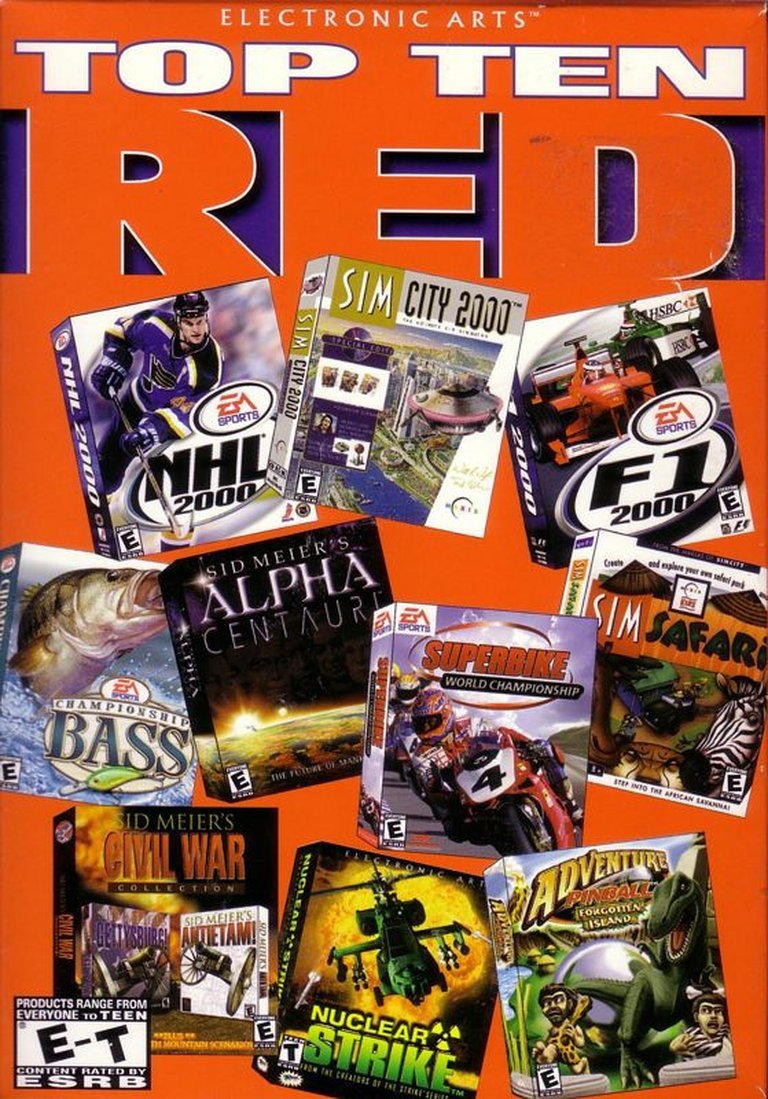
Electronic Arts Top Ten: Red is a 2002 Windows compilation pack featuring ten diverse classic games from Electronic Arts, including sports titles like NHL 2000, F1 2000, and Championship Bass; strategy games such as Sid Meier’s Alpha Centauri, SimCity 2000, and Sid Meier’s Civil War Collection; action games like Nuclear Strike; simulation experiences in SimSafari and Adventure Pinball: Forgotten Island; and racing in Superbike World Championship, offering players a broad anthology of EA’s early 2000s hits across multiple genres.
Electronic Arts Top Ten: Red Reviews & Reception
retro-replay.com : delivers an eclectic mix of gameplay styles, ranging from high-octane racing and sports simulations to deep strategy and lighthearted casual titles.
Electronic Arts Top Ten: Red: Review
Introduction
In the annals of PC gaming history, few artifacts capture the sprawling ambition of Electronic Arts during its late-1990s zenith quite like Electronic Arts Top Ten: Red, a 2002 compilation that bundles ten disparate titles into a single, value-packed jewel case. Released at a time when broadband was nascent, 3D accelerators were becoming standard, and EA reigned supreme as the publisher of blockbuster franchises, this “Red” edition—part of a color-coded series including Blue and others—serves as a time capsule of the company’s golden era. From god-game simulations to pulse-pounding racers and real-time strategy epics, it encapsulates EA’s mastery of genre-defining formulas. My thesis: Top Ten: Red isn’t just a budget bin filler; it’s a masterful curation of evergreen hits that democratized high-caliber gaming for casual PC owners, cementing EA’s legacy as the architect of accessible excellence while foreshadowing the compilation model’s role in game preservation.
Development History & Context
Electronic Arts, founded in 1982 by Trip Hawkins, had evolved from a developer-friendly publisher into a behemoth by the late 1990s, leveraging in-house studios like Maxis, Westwood, and EA Canada alongside third-party talents such as Firaxis Games. Top Ten: Red, released on January 10, 2002, for Windows (priced around $20-30 new, per MobyGames listings), emerged from EA’s strategy of repackaging back-catalog hits amid economic pressures and rampant software piracy. The early 2000s PC market was defined by hardware leaps—Pentium III/IV CPUs, GeForce 2/3 GPUs, and 128-512MB RAM—allowing older DirectX 5-8 titles to shine on modest rigs without the bloat of contemporary AAA releases like The Sims expansions or Battlefield 1942.
The compilation’s creators drew from EA’s vast library, selecting titles spanning 1993-2001 to appeal to families and bargain hunters. Technological constraints of the era shaped the lineup: isometric 2D sprites in SimCity 2000 and Sid Meier’s Alpha Centauri prioritized simulation depth over polygons, while racers like F1 2000 pushed polygon counts (up to 500k/track) with MIDI-derived audio to fit 600-700MB CDs. The gaming landscape was competitive—Activision’s Call of Duty precursors and Microsoft’s Age of Empires II expansions loomed—but EA dominated sports (Madden, NHL) and sims, using bundles like Top Ten: Red to extend shelf life. No single “visionary” director helmed this; it was a marketing-driven effort by EA’s product managers, akin to prior packs like Top Ten Pak (1994 DOS) or Top Ten: Blue (2002), capitalizing on the post-dot-com slump where consumers craved value over novelty.
Narrative & Thematic Deep Dive
As a compilation, Top Ten: Red eschews a unified plot, instead weaving a tapestry of micro-narratives that reflect humanity’s drive to conquer, create, and compete. Themes of dominion and simulation dominate: Sid Meier’s Alpha Centauri (1999, Firaxis) thrusts players into a sci-fi odyssey where seven factions vie for planetary supremacy, laced with UN charters, alien “proxies,” and philosophical barbs like Lady Deirdre’s ecology manifesto—”Human behavior is economic behavior”—probing manifest destiny in zero-g. Sid Meier’s Civil War Collection (2000, Firaxis/BreakAway) shifts to historical grit, simulating Gettysburg and Shiloh with turn-based campaigns that humanize the American Civil War through leader bios and morale mechanics, emphasizing strategy’s human cost amid slavery’s shadow.
Sports titles embody rivalry and precision: NHL 2000 (1999, EA Canada) delivers gritty locker-room banter and overtime thrillers, with stars like Gretzky narrating triumphs; F1 2000 (2000, Visual Sciences/Image Space) chronicles Schumacher’s Ferrari dominance via authentic grids and weather drama; Superbike World Championship (1999, Milestone) and Championship Bass (2000, Engineering Animation) glorify niche mastery—leaning into superbike bends or bass lures—without deep lore, prioritizing emergent stories from leaderboards.
Exploration and whimsy shine in sims: SimCity 2000 (1993, Maxis) lets players architect utopias or dystopias, haunted by disasters like Godzilla; SimSafari (1998, Maxis) tasks zookeepers with balancing animal welfare and profits, thematically echoing environmentalism. Action entries like Nuclear Strike (1997, Westwood) deliver pulp-military tales—pilot the Apache against rogue generals in Southeast Asia—with campy radio chatter. Adventure Pinball: Forgotten Island (2001, Digital Extremes) offers light fantasy via island-hopping tables, where bumpers unlock pirate lore. Dialogue is sparse but flavorful (e.g., Alpha Centauri’s faction quotes), underscoring EA’s blend of emergent narrative and player agency.
Gameplay Mechanics & Systems
Top Ten: Red‘s core loop is discovery-driven: a unified launcher (simple Win32 menu) lets users pick from ten icons, with no cross-game progression but shared value. Mechanics vary wildly, showcasing EA’s genre prowess.
Core Loops & Progression:
– Strategy/Sims (Alpha Centauri, Civil War Collection, SimCity 2000, SimSafari): Deep 4X/tycoon systems. Alpha Centauri excels with tech trees branching into ecology/gaia worlds, base customization, and native lifeforms; Civil War adds supply lines and fog-of-war. SimCity’s zoning/disaster cycles build to megacities; SimSafari’s ranger patrols fund enclosures.
– Sports/Racing (NHL 2000, F1 2000, Superbike, Championship Bass): Arcade-realism hybrids. NHL’s checking/passing shines in 6v6 AI matches; F1’s traction control/physics simulate tire wear; Superbike’s leaning physics demand rhythm; Bass’s lure-casting mini-games reward patience.
– Action/Pinball (Nuclear Strike, Adventure Pinball): Mission-based (Nuclear Strike‘s top-down chopper runs with power-ups/scrolling maps) and physics-driven (Pinball‘s multiball tables with combos).
Combat & Progression: Minimal unified combat—Nuclear Strike’s lock-on missiles vs. tanks; NHL fights. Character growth via unlocks (Alpha Centauri factions, SimCity advisors).
UI/Systems: Era-typical: crisp 800×600 menus, hotkeys galore (e.g., SimCity’s query tool). Flaws include dated controls (no native gamepads) and install quirks on modern OSes. Innovations: Alpha Centauri’s “Secret Projects”; F1’s multiplayer splitscreen.
| Game | Key Mechanic | Progression Depth | Multiplayer |
|---|---|---|---|
| SimCity 2000 | Zoning/Disasters | Infinite scenarios | None |
| Alpha Centauri | 4X Expansion | 7 factions, tech web | Hotseat |
| Civil War Collection | Turn-Based Battles | Historical campaigns | PBEM |
| NHL 2000 | Ice Hockey Sim | Season mode | LAN |
| F1 2000 | Formula Racing | Championship GP | Splitscreen |
| Superbike WC | Motorcycle Leaning | World tour | None |
| Championship Bass | Fishing Lures | Tournament ladder | None |
| SimSafari | Zoo Management | Animal breeding | None |
| Nuclear Strike | Helicopter Shooter | Mission unlocks | None |
| Adventure Pinball | Table Physics | Island unlocks | None |
World-Building, Art & Sound
The compilation’s worlds span procedural vastness to circuit-tight realism, fostering immersion via era-defining 2.5D/isometric visuals. SimCity 2000‘s pixelated skyscrapers pulse with traffic animations; Alpha Centauri‘s alien biomes evolve from fungi to monoliths, with voxel terrain. Civil War‘s sepia maps evoke battlefields; racers like F1 2000 boast detailed Monza/Suzuka with dynamic weather.
Art direction: Vibrant sprites (SimSafari‘s critters) contrast gritty textures (Nuclear Strike‘s explosions). Sound design elevates: MIDI-orchestrated scores (Alpha Centauri‘s ethereal synths), crowd roars (NHL), engine wails (F1), and voice acting (Nuclear Strike‘s Spec Ops banter). Contributions: Builds tension (racing apexes), nostalgia (SimCity beeps), and replayability—e.g., Pinball’s clangs trigger dopamine loops.
Reception & Legacy
At launch, Top Ten: Red flew under radar—no Metacritic aggregate, zero critic reviews on MobyGames (as of 2025 data), one player rating of 4.3/5 praising value. Commercially modest ($13 used/$31 new today), it sold via budget channels amid The Sims fever. Reputation evolved from “pirate bait” to collector’s gem, influencing bundles like GOG re-releases and Steam anthologies.
Legacy: Preserved icons—Alpha Centauri inspired Civilization: Beyond Earth; SimCity 2000 defined god-games. Industry impact: Pioneered “greatest hits” model (e.g., Humble Bundles), sustaining franchises pre-digital. In history, it embodies EA’s pivot from innovation to aggregation, bridging 90s sim boom to 00s sports empire.
Conclusion
Electronic Arts Top Ten: Red stands as a triumphant anthology, distilling EA’s creative peak into an unbeatable package of strategic depth, sim mastery, and adrenaline sports. Flaws like archaic UIs pale against its breadth—ten classics for the price of one new release. Verdict: Essential for historians (9/10); a must-own relic securing its place as a cornerstone of PC compilation heritage, proving value packs as vital preservation tools in gaming’s vault.