
- Release Year: 2010
- Platforms: iPad, iPhone, Macintosh, Windows
- Publisher: Big Fish Games, Inc
- Developer: Vogat Interactive
- Genre: Adventure
- Perspective: 1st-person
- Game Mode: Single-player
- Gameplay: Hidden object, Puzzle elements
- Setting: Fantasy
- Average Score: 80/100
Description
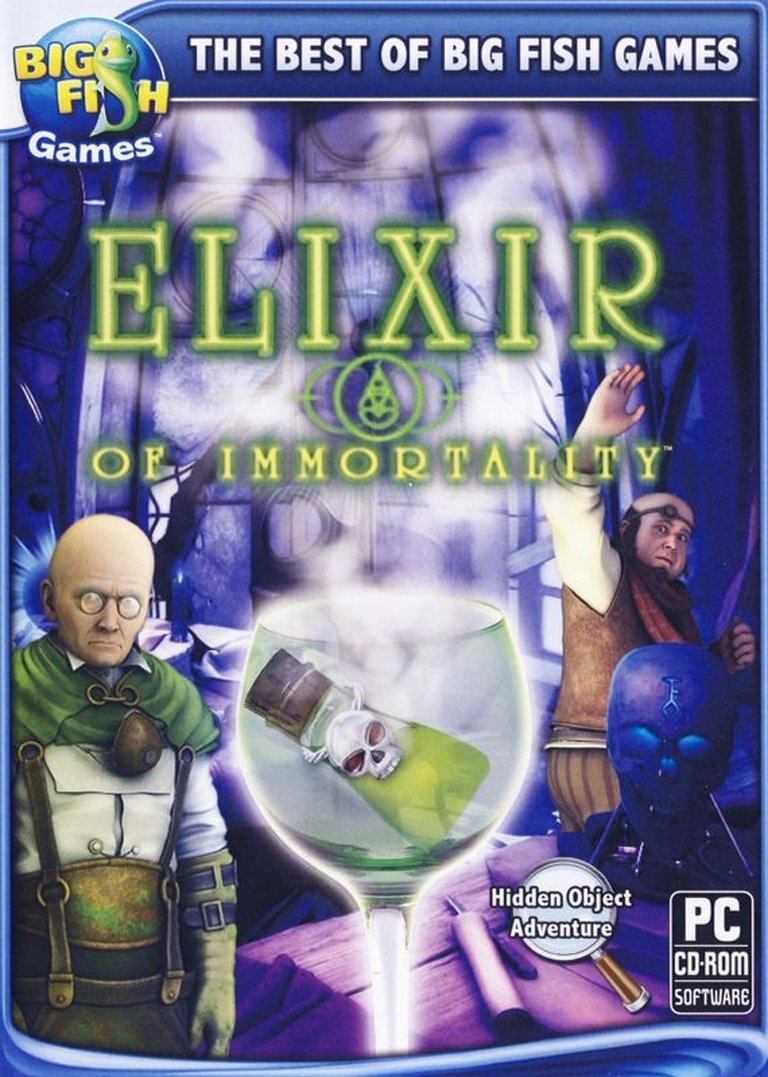
In a mystical world where magic is commonplace, players control a detective sent undercover by the police as an employee to the owners of a dilapidated isolated island, where several hired helpers have mysteriously disappeared. The sleuth explores the ruins, interacts with a cast of eccentric characters, performs chores, and solves hidden object scenes and simple puzzles to uncover the island’s secrets.
Gameplay Videos
Where to Buy Elixir of Immortality
PC
Elixir of Immortality Free Download
Elixir of Immortality Guides & Walkthroughs
Elixir of Immortality Reviews & Reception
gamezebo.com (80/100): consider Elixir of Immortality to be the beach reading of hidden object games.
Elixir of Immortality: Review
Introduction
In the shadowy annals of early 2010s casual gaming, few titles evoke the eerie allure of a fog-shrouded island riddled with ancient secrets and untimely deaths quite like Elixir of Immortality. Released in 2010 by Vogat Interactive and published by Big Fish Games, this point-and-click hidden object adventure thrusts players into a mystical realm where magic intertwines with murder, and the pursuit of eternal life claims victims one by one. As an undercover detective posing as hired help, you unravel a web of disappearances amid eccentric inhabitants—alchemists, botanists, physicists, and occultists—culminating in a quest for the legendary elixir itself. Though brief at just 2-3 hours, Elixir of Immortality punches above its weight with clever puzzles, atmospheric world-building, and a twisty narrative that keeps suspicions shifting. This review argues that, while its brevity curbs its ambition, it exemplifies the polished craftsmanship of Big Fish Games’ golden era, delivering a compact gem for casual mystery fans that lingers like a half-remembered incantation.
Development History & Context
Vogat Interactive, a modest Eastern European studio, crafted Elixir of Immortality amid the explosive growth of casual PC gaming in the late 2000s. Founded in the early 2000s, Vogat specialized in adventure titles blending hidden object hunts (HOGs) with light puzzles, often targeting Big Fish Games’ shareware model—trial demos leading to full purchases. The core team was tight-knit: producers Askold Kalnisky and Sergey Serov oversaw vision, while designers like Roman Gorbunov (‘Freeman’), Andrey Terekhov, Vyacheslav Nemiro, and lead artist Artem Fedorishchev (‘DizZArt’) shaped its intricate mechanics. Artists such as Ilya Titkov, Ruslan Smak, Pavel Bykov, and Andrey Bykov contributed hand-drawn visuals, programmers Andrey Yemelyanov, Alexander Uraga, and others handled the sliding inventory and mini-game logic, and sound producer Alexander Voloshin (‘Reality’) layered in atmospheric audio. Veronica Lisovina managed partnerships, ensuring smooth Big Fish integration.
Launched on July 17, 2010, for Windows (followed by Macintosh in 2010 and iOS in 2013), the game arrived during a HOG renaissance. Big Fish dominated with portals offering quick, accessible escapism for busy adults—think Mystery Case Files or Mortimer Beckett. Technological constraints were minimal: 2D point-and-click on low-spec PCs (800 MHz CPU, 256 MB RAM), relying on mouse/keyboard input and DirectX 8. The era’s landscape favored “casual” shareware—PEGI 16 rating nodded to mild violence—amid free-to-play precursors and iOS ports signaling mobile expansion. Vogat drew from classics like Myst for puzzle depth but tailored for speed, reflecting economic pressures post-2008 recession favoring bite-sized content. This context birthed a game unpretentious yet innovative, prioritizing replayable HOG randomization over sprawling epics.
Narrative & Thematic Deep Dive
At its heart, Elixir of Immortality weaves a taut detective yarn in a fantasy world where magic is mundane yet deadly. You arrive by boat at a dilapidated island castle, undercover as an employee after prior hires vanished. The plot unfolds in chapters—”The Alchemist,” “The Botanist,” “The Physicist,” “The Magician,” and “The Mastermind”—each spotlighting suspects via chores that double as clues. Dialogue is sparse but flavorful: the reclusive Alchemist demands chemicals for experiments; the botanist seeks frozen lizards for hybrid plants; the Physicist tinkers with electromagnetic revolvers; the Occultist (Magician) trades seals for notes; and the unseen Mansion Master communicates via pneumatic mail tubes.
Plot Breakdown: Chapter 1 establishes dread—light the dock, pick locks, aid the Alchemist with kerosene flasks—before his “murder” by silver bullet, retrieved via forceps. Twists abound: the Alchemist revives via elixir; bodies in the freezing chamber (including revived allies) point to immortality experiments. Mid-game, soup laced with sleeping potion knocks out the Physicist, revealing half-hearts for locker codes. The finale exposes the Mastermind orchestrating deaths for the elixir, synthesized from flower pollen, charged spheres, and chemicals. Climax: light the lighthouse after clock puzzles, symbolizing revelation.
Characters: Archetypes shine—Alchemist embodies mad science; Botanist, organic mysticism; Physicist, rational tech; Occultist, arcane rituals; Mastermind, shadowy puppet-master. No deep backstories, but interactions (e.g., trading spyglasses for lenses) humanize them, blurring guilt.
Themes: Immortality’s curse dominates—elixir promises life but breeds murder, echoing Frankenstein or The Island of Dr. Moreau. Magic-vs.-science tension (Freon pipes meet ritual portals) critiques hubris. Isolation amplifies paranoia; pneumatic notes evoke Bioshock‘s audio logs. GameZebo praised “immensely fun” twists, though brevity leaves threads dangling (e.g., skeleton ferryman). Pacing builds suspense via red herrings, rewarding notebook checks for tasks like “connect Freon pipes.”
Gameplay Mechanics & Systems
Core loop: explore dilapidated locales, Hunt Objects (HOG), solve mini-games, combine inventory for progression. First-person perspective limits to static screens with directional arrows—dock, courtyards, lab, storage, freezing chamber, park, castle hall, kitchen, library, observatory, grotto tunnels.
HOG Scenes: Randomized lists in cluttered scenes (e.g., boat yields lantern/gas/matches; urns/basins repeat with variety). Click items; sparkles/magnifier hint. Casual-friendly, but repetition (ladles, books) tests patience.
Inventory & Puzzles: Sliding bottom tray (hover to expand) holds combinables (e.g., gas+lantern+matches=LIT LANTERN). Drag-drop logical (e.g., valve on drain). Mini-games abound:
– Clocks: Levers adjust time (e.g., left -25min x8, right +45min x3=10 o’clock).
– Sliders/Locks: Swap tumblers or slide tiles (randomized but solvable).
– Rotations: Pipe connections, planet alignments, ring mechanisms.
– Others: Maze balls, pollen matching, candle tracing, tangrams, spice memory.
UI excels: Diary (bottom-left) tracks tasks; magnifier highlights hotspots; hints charge (candle/hourglass); skips after timers (Casual: 30s; Advanced: 60s). Flaws: Backtracking-heavy (e.g., park-grotto-castle loops); vague clues (“ornament”=Mayan calendar). Innovative: Pneumatic mail advances plot organically.
Progression: Linear chapters with branching chores, ~20-30 HOGs, 15+ mini-games. Replayable via randomization/modes, but short length limits depth.
World-Building, Art & Sound
The island is a gothic fantasy diorama: crumbling castle atop cliffs, foggy docks, overgrown parks, icy labs, ritual grottos. Ruins whisper history—gargoyles spit balls, statues hide gears—fostering immersion. Atmosphere: Foreboding yet whimsical, magic normalizing (lizards freeze for potions).
Visuals: Hand-drawn 2D art pops—detailed paraphernalia (barrels, chandeliers) rewards scrutiny. Sparkles guide casually; full-screen option enhances. iOS ports retained fidelity despite touch tweaks.
Sound: Voloshin’s production delivers moody ambiance: creaking doors, bubbling flasks, ethereal chimes. Sparse music underscores tension (e.g., ritual drone); SFX (clock ticks, ice cracks) integrate seamlessly. No voice acting preserves mystery, letting imagination fill eccentric barks.
Elements synergize: HOG clutter builds lived-in feel; puzzles exploit environment (torch+rag+oil=light). Result: Cozy horror, like beachside Gone Home.
Reception & Legacy
Launch reception was warmly niche: GameZebo’s 80% (4/5) lauded story twists but lamented brevity (“beach reading of HOGs”). MobyGames: 80% critics (1 review), 3.8/5 players (4 ratings, no text). Big Fish/iWin: 3.9/5, 3/5. No Metacritic aggregate; sales untracked but shareware success implied (Steam bundles later).
Evolution: Forgotten amid HOG glut, yet spawned 2018 sequel Elixir of Immortality: The League of Immortality. Influence: Epitomized Big Fish formula—quick, gorgeous casuals—inspiring Veronica Rivers clones. iOS ports presaged mobile HOGs. Cult status via walkthroughs/archives; ties to Immortality (2022) via title. Legacy: Transitional artifact, bridging PC adventures to touch-era puzzles.
Conclusion
Elixir of Immortality distills casual gaming’s essence: taut mystery, brain-teasing puzzles, and evocative fantasy in a digestible package. Vogat’s artistry and Big Fish polish shine, but 2-3 hour runtime—despite dense mechanics—feels truncated, backtracking amplifying brevity. For historians, it’s a snapshot of 2010 casual boom; for players, a delightful detour if you crave HOGs with narrative bite. Verdict: 8/10—essential for genre fans, a curious footnote in adventure history, warranting rediscovery amid modern indies. Seek the elixir; just don’t drink alone.