
- Release Year: 2015
- Platforms: Linux, Macintosh, Windows
- Publisher: Erik Svedäng AB
- Developer: Erik Svedäng
- Genre: Adventure
- Perspective: Diagonal-down
- Game Mode: Single-player
- Gameplay: Coding, Hacking, Puzzle-solving
- Setting: Futuristic, Sci-fi
- Average Score: 79/100
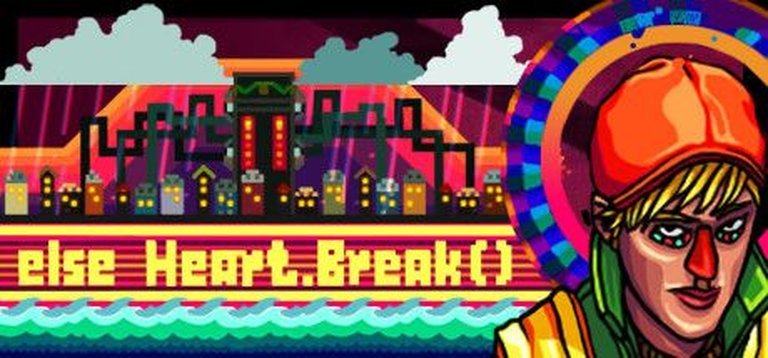
Description
Set in a sci-fi/futuristic town called Dorisburg, else Heart.Break() follows Sebastian as he arrives for a soda salesman job, befriends a rebel hacker group, and learns to manipulate the world’s code through a unique coding system to solve puzzles, challenge the town’s rulers, and pursue personal connections—all without quest logs or auto-maps.
Gameplay Videos
Where to Buy else Heart.Break()
else Heart.Break() Mods
else Heart.Break() Guides & Walkthroughs
else Heart.Break() Reviews & Reception
metacritic.com (79/100): A very ambitious mix of hacking, adventuring and an open world sandbox.
pcgamer.com : A beautiful adventure with heart, humour, and satisfying hacking puzzles you can enjoy even if you dont know anything about coding.
slantmagazine.com : A poignantly powerful moment when Else Heart.Break() validates this feeling of camaraderie by giving the player the option to greet the group with a friendly ‘Yo motherfuckers’—if you’re so inclined.
else Heart.Break() Cheats & Codes
PC
Enter codes into a computer terminal or use the game’s hacking system.
| Code | Effect |
|---|---|
| var tap = Connect(“DesolateHouseLobby_Poor_WaterTap_Poor_WaterTap_1”) Sleepiness(-100) Smelliness(-100) Charisma(100) Drunkenness(-100) Corruption(-100) tap.SetLiquidAmount(500) |
Creates a self-refilling drink that removes negative status effects and boosts charisma. |
| var svrQuery = Connect(“PoliceOfficeInterior_MinistryOfficeWorkstationComputer_1”) var svrUnlock = Connect(“Hotel_Lobby_ComputerCashier”) var room = svrQuery.GetRoom(“Logo”) var things = svrQuery.GetThingsInRoom(room) var doors = [] loop things if svrQuery.GetTypeOfThing(@) == “door” Append(doors, @) end end loop doors svrUnlock.Unlock(@) Print(@ + ” is unlocked”) Sleep(2) end DisconnectAll() |
Unlocks all doors in the room containing “Logo”. |
| door Hotel_Corridor_Door4 door Lodge_Entry_DoorToRoom1 |
Unlocks the specified doors. |
else Heart.Break(): Review
Introduction
In the ever-evolving landscape of independent game development, few titles embody the spirit of radical experimentation as boldly as else Heart.Break(). Released in 2015 by Swedish visionary Erik Svedäng, this ambitious adventure reimagines interactive storytelling by merging open-world exploration with genuine programming mechanics. Propelled by a minimalist yet profound narrative about identity, rebellion, and the fragile nature of human connection in a digitized world, the game challenges players to hack reality itself. Its legacy lies in its uncompromising vision: a world where “bits have replaced atoms,” and where the line between player and creator dissolves into creative possibility. This review argues that else Heart.Break(), despite its technical quirks and pacing issues, stands as a landmark title—an audacious love letter to adventure games and a prescient critique of digital control that continues to resonate in an era of increasing technological omnipresence.
Development History & Context
else Heart.Break() emerged from the mind of Erik Svedäng, a Swedish indie developer whose prior work included the surreal platformer Blueberry Garden. Development commenced in 2010, spanning five years of meticulous labor by a small, passionate team: Svedäng served as designer, lead programmer, and writer, collaborating with Niklas Åkerblad on art, animation, and music; Tobias Sjögren on additional art; Oscar Rydelius on sound design; and Johannes Gotlén on programming. Built on the Unity engine, the project was a technical and creative odyssey, constrained by the team’s indie resources yet fueled by a grand vision: to create a game where players could manipulate the very fabric of its reality through code.
Svedäng’s goal was to democratize programming, crafting an accessible yet deep system where no prior coding knowledge was required. This ambition reflected a broader 2010s indie ethos—one that championed player agency and subverted AAA conventions. Released on September 24, 2015, the game arrived during a fertile period for experimental storytelling (Kentucky Route Zero, Undertale) and cyberpunk revivals. It was an Independent Games Festival finalist, signaling its industry recognition. However, it also navigated a market dominated by polished, narrative-driven experiences, making its deliberate opacity and technical austerity both a statement and a risk. The result was a product of its time: a digital artifact born from the tension between artistic purity and commercial viability.
Narrative & Thematic Deep Dive
At its core, else Heart.Break() is a deconstruction of the classic adventure game, wrapped in a cyberpunk narrative that doubles as a metaphor for modern alienation. Players assume the role of Sebastian, a young man who relocates to the enigmatic city of Dorisburg for a mundane job at Wellspring Soda. The plot unfolds organically—there is no rigid quest log—through exploration, dialogue, and chance encounters. Sebastian’s mundane life of soda sales quickly unravels as he stumbles upon an underground hacker collective rebelling against the oppressive “Ministry,” a bureaucratic entity that has digitized Dorisburg’s infrastructure for surveillance and control. The narrative’s emotional anchor is Sebastian’s infatuation with Pixie, a free-spirited rebel whose pursuit ultimately leads to heartbreak, both literal and metaphorical.
The game’s dialogue is a study in restraint. Conversations use comic-style text bubbles with limited choices, emphasizing personality over plot divergence. Sebastian’s opening phone call—offering options like gratitude, entitlement, or confusion—immediately establishes his character as malleable, while repetitive social interactions with NPCs (e.g., “Yo motherfuckers” at parties) create a sense of belonging. Yet the narrative’s true power lies in its themes. It explores the tension between freedom and control through the lens of hacking: the Ministry represents institutional rigidity, while the hackers embody creative subversion. The “bits vs. atoms” premise critiques a world where digital systems overshadow human connection, culminating in a bittersweet ending where Sebastian’s victory is partial—he escapes the Ministry but loses Pixie to her rescued boyfriend, underscoring the game’s anti-romance stance: love cannot be coded or controlled.
Gameplay Mechanics & Systems
else Heart.Break() revolutionizes adventure gaming by replacing traditional puzzles with a fully functional programming language called Språk (Swedish for “language”). The core loop begins with exploration: players navigate Dorisburg’s labyrinthine streets, talking to NPCs and gathering clues. The game’s signature mechanic, the “Modifier,” is acquired early but requires patience to master. Once equipped, it allows players to view and edit the code governing objects—transforming beer into an energy drink by modifying SLEEPINESS() values, or brute-forcing doors via computational loops. This system is both ingenious and punishing; success hinges on reading in-game manuals (on floppy disks) and reverse-engineering code, rewarding persistence but punishing impulsivity.
Progression is non-linear and player-driven. The Ministry’s hacking challenges act as tutorials, teaching Språk syntax while advancing the plot. Yet the game rejects hand-holding: there is no map (only a static paper), no quest log, and a real-time clock that demands time management. Inventory is limited, forcing strategic choices, while sleep mechanics add realism but frustration. Combat is nonexistent; conflict resolves through social engineering or code-based exploits. The UI, however, is a point of contention. The diagonal-down perspective and camera glitches often obscure critical interactions, and the lack of fast-travel in a sprawling city tests patience. Despite these flaws, the hacking system’s depth is unparalleled—players can create teleportation devices, manipulate global variables, or even “slurp” (teleport) between networked objects, blurring the line between puzzle-solving and god-like creation.
World-Building, Art & Sound
Dorisburg, the game’s setting, is a character in its own right—a cyberpunk city rendered in chunky 3D with pixelated textures that evoke late-1990s PlayStation aesthetics. Its architecture is a blend of retro-futurism and decay: neon-lit nightclubs contrast with sterile Ministry buildings, while parks and cafes pulse with life. The city’s dynamic simulation is its masterstroke: NPCs follow daily schedules, reacting to time and player actions, creating a living world that mirrors the player’s growing familiarity. This is reinforced by art direction that uses light and shadow to evoke mood—seedy alleyways feel oppressive, while dance floors radiate energy. The “bits vs. atoms” theme permeates the visual design; even mundane objects like soda cans or hotel keys hum with digital potential.
Sound design amplifies this atmosphere. Oscar Rydelius’ score—comprising over 50 tracks of synthwave, jazz, and ambient electronica—elevates mundane moments into sensory experiences. Environmental sounds (city hums, footsteps, machinery) ground the world in realism, while radio snippets and in-game music tracks (e.g., a floppy disk playing a “micro-treatise on coding”) add layers of meta-commentary. The absence of voice acting forces players to inhabit Sebastian’s silence, making each conversation a personal act of interpretation. Together, art and sound craft a world that is both alien and inviting—a digital sandbox that rewards curiosity and punishes haste.
Reception & Legacy
Upon release, else Heart.Break() received generally positive reviews, with a Metacritic score of 79%. Critics lauded its ambition and innovation: PC Gamer (86%) praised its “stylish, original” blend of genres, while Darkstation (90%) hailed it as a “unique and challenging experience” that invited players to “take a turn on the other side of the program.” Adventure Gamers (70%) noted its “steep learning curve” and “aimless first half,” conceding it was “enjoyable yet can’t be outright recommended for all.” Players echoed this sentiment, with Steam reviews praising its creativity but criticizing pacing and UI issues. Commercially, it was a niche success, finding its audience among indie enthusiasts and budding programmers.
Its legacy, however, has deepened over time. The game spawned a dedicated community exploring Språk’s limits—players created teleporters, infinite money exploits, and even mods that blurred the game/real-world boundary. It influenced subsequent titles like Quadrilateral Cowboy, which similarly merged programming with gameplay, and became a touchstone in critical discussions about “hacking games” and player agency. Academically, it was analyzed as a “tactical media” artifact (Ryan Leach, UCSB), where surfacing code on-screen disrupts traditional game hierarchies. Today, it stands as a cult classic—a testament to the power of small teams to reimagine what games can be.
Conclusion
else Heart.Break() is not merely a game; it is a manifesto. In its five-year gestation, Erik Svedäng and his team forged a title that defies easy categorization, blending adventure, programming, and social simulation into a singular experience. Its flaws—a punishing pace, inconsistent UI, and narrative ambiguity—are inseparable from its identity, demanding patience but rewarding tenacity with moments of profound creative revelation. Thematically, it offers a prescient critique of digital control and a poignant meditation on human imperfection in a coded world. While its story may lack the polish of AAA epics, its world-building and mechanics remain unparalleled, offering a sandbox where the line between player and dissident dissolves.
In the annals of game history, else Heart.Break() occupies a unique space: it is both a product of its indie renaissance and a precursor to a future where players co-create realities. It may not be for everyone, but for those who embrace its challenge, it offers an unforgettable journey—one where the heart of the game lies not in its code, but in the courage to break it.