
- Release Year: 2014
- Platforms: Macintosh, Windows
- Publisher: Koch Media GmbH (Austria), Promotion Software GmbH
- Developer: Sixteen Tons Entertainment
- Genre: Simulation
- Perspective: Diagonal-down
- Game Mode: Online Co-op, Single-player
- Gameplay: Mission-based, Resource Management, Strategy, Unit control
- Setting: Firefighting, Law enforcement
- Average Score: 52/100
Description
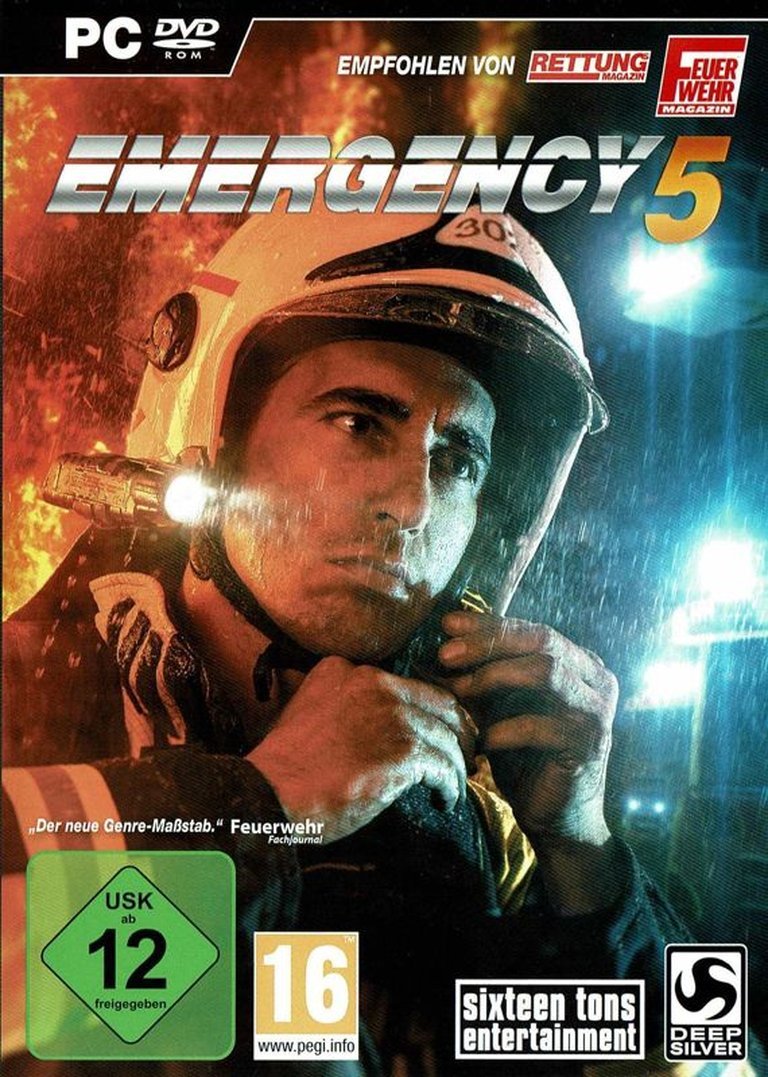
Emergency 5 is a simulation game that places players in the role of a disaster response coordinator. The game features a dynamic open-world environment where players manage various emergency services, including firefighters, police, and medical units, to handle a wide range of crises. The objective is to effectively coordinate these teams to save lives and maintain public safety amidst chaotic and unpredictable scenarios.
Gameplay Videos
Emergency 5 Free Download
Emergency 5 Cracks & Fixes
Emergency 5 Patches & Updates
Emergency 5 Mods
Emergency 5 Guides & Walkthroughs
Emergency 5 Reviews & Reception
en.wikipedia.org (53/100): More fun than any Emergency before, but with blunders.
metacritic.com (54/100): At the core it’s a game full of potential but it will need lots of patches for lots of technical problems.
steambase.io (45/100): The fact that the devs have hidden this game from the Steam store just to cover up the negative reviews so EM 2016 would sell better is just ridiculous.
mobygames.com (55/100): The only thing that can’t be rescued in Emergency 5 is the game itself.
Emergency 5: A Fractured Rescue Operation in Need of Triage
Introduction
Emergency 5 arrives as both a triumph of ambition and a cautionary tale of technical hubris. The fifth installment in Sixteen Tons Entertainment’s long-running crisis management series (1998–present) promises a bold evolution: massive open maps, cooperative multiplayer, and a revamped modding toolkit. Yet beneath its glossy facade lies a game hobbled by systemic flaws, earning it a lukewarm 55% critical average and a polarized fanbase. This review dissects Emergency 5’s paradoxical legacy—a conceptually rich strategy experience buried under layers of technical malfunction and design missteps.
Development History & Context
Studio Vision & Technological Ambitions
Developed by German studio Sixteen Tons Entertainment, Emergency 5 sought to modernize the series’ formula after the well-received Emergency 4 (2006). Led by series creator Ralph Stock, the team transitioned from a proprietary engine to OGRE, aiming for enhanced visual fidelity and dynamic environments. The shift aimed to address fan demands for larger-scale disasters and procedural events, but the engine’s unfamiliarity plagued development. As 4Players.de noted, the game “felt like an early alpha” at launch, with erratic performance even on high-end PCs.
A Crowded Landscape
Released in November 2014, Emergency 5 entered a market saturated with simulation titles like Cities: Skylines and Prison Architect. Unlike these polished competitors, Sixteen Tons prioritized scope over stability, gambling on the franchise’s niche appeal. The decision backfired: critics lambasted its technical state, while fans of earlier entries accused it of abandoning the tight mission design of Emergency 3 and 4.
Narrative & Thematic Deep Dive
Structure Over Story
Emergency 5 forgoes traditional narrative, instead framing its 11 campaigns as escalating crisis scenarios across Munich, Hamburg, and Berlin. Missions range from localized accidents (e.g., a hang glider collision at Munich’s Frauenkirche) to city-wide disasters (a flood in Hamburg’s Speicherstadt district). Themes of systemic fragility emerge organically: a chemical spill in Berlin’s subway underscores the domino effect of urban negligence, while a gang war highlights the thin line between order and chaos.
Character as Mechanic
Units lack personality—firefighters and SWAT teams are interchangeable cogs—but their roles reinforce the game’s central theme: collaborative urgency. The inability to pause during missions amplifies tension, forcing players to embody the overwhelmed dispatcher. However, the lack of procedural storytelling (a hallmark of contemporaries like This War of Mine) limits emotional engagement.
Gameplay Mechanics & Systems
Core Loop: Chaos Management
The gameplay revolves around four agency types:
- Fire Department: Extinguish blazes, clear debris.
- Medical Teams: Treat injuries, transport victims.
- Police: Arrest suspects, control crowds.
- Technical Units: Repair infrastructure, remove hazards.
Missions begin modestly (e.g., a tram accident) before spiraling into multi-layered crises (radioactive leaks, terrorist bombings). Success demands meticulous unit coordination across 3D maps, though the lack of unit persistence between missions (Emergency 4’s campaign continuity is sorely missed) undermines investment.
Innovation & Flaws
- Open Maps: A series first, these allow emergent events (e.g., random car crashes) but suffer from poor pathfinding. PC Games criticized units “getting stuck on geometry,” requiring constant micromanagement.
- Multiplayer: Four-player co-op introduces camaraderie but falters with frequent disconnects.
- Modding Tools: The Lua-based editor enables custom scenarios, yet veterans panned its complexity compared to Emergency 4’s accessible toolkit.
World-Building, Art & Sound
Visual Identity
Emergency 5’s German locales are meticulously detailed, with Hamburg’s dockside cranes and Berlin’s Brandenburg Gate rendered in crisp, if dated, fidelity. The day-night cycle and weather effects add atmosphere, though texture pop-in and unstable framerates (noted by GameStar) mar immersion.
Sound Design
Benny Oschmann’s score blends orchestral urgency with electronic beats, accentuating high-stakes moments. Yet repetitive unit barks (“We need a doctor!”) grate over time, and environmental sounds (e.g., crackling fires) lack spatial depth.
Reception & Legacy
Launch Fallout
Critics savaged its technical state:
– 4Players.de: “Under the code rubble lies a solid strategy game—if you can tolerate the bugs.”
– GameStar: “Potential exists, but only with extensive patches.”
Post-launch updates (notably Patch 1.4.1) improved performance, yet the damage was done. The Steam version holds a “Mixed” 45/100 rating, with players lamenting abandoned support as Sixteen Tons shifted focus to Emergency 20 (2017).
Influence & Redemption
Despite its flaws, Emergency 5 laid groundwork for later entries. Its open maps inspired Emergency 2017’s dynamic campaigns, while modders salvaged its replayability with overhauls like Bieberfelde – Next Generation. Still, it remains a footnote—a flawed experiment overshadowed by its predecessors.
Conclusion
Emergency 5 is a paradox: a game brimming with innovative ideas yet crippled by its inability to execute them. While hardened fans may find joy in its unique demands, most players should heed Gameplay (Benelux)’s advice: “Wait for patches—unless your PC is already on fire.” Seventeen years after the series’ debut, Emergency 5 stands as a stark reminder that ambition alone cannot save a disaster.
Final Verdict: A historically significant misstep—best appreciated as a museum piece rather than a playable classic.