
- Release Year: 2007
- Platforms: Macintosh, Windows
- Publisher: Gammafon Multimedia AB
- Developer: Bajoum Interactive AB, Gammafon Multimedia AB
- Genre: Action
- Perspective: 3rd-person
- Game Mode: Single-player
- Gameplay: Carving, Gate management, Mini-games, Obstacle course, Pranks
- Setting: Farm, Småland
- Average Score: 60/100
Description
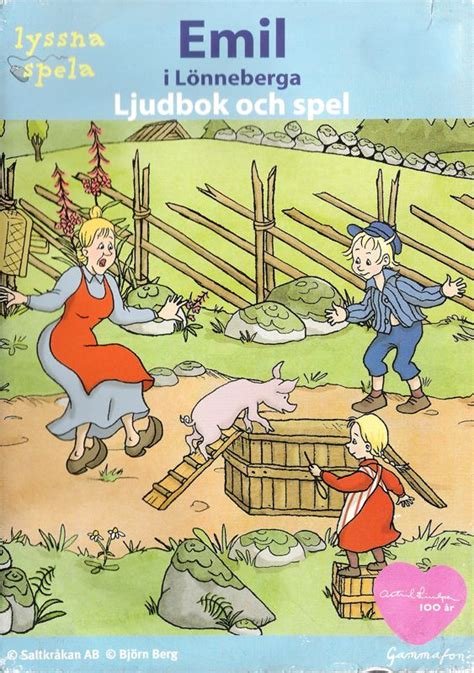
Emil i Lönneberga is a game based on Astrid Lindgren’s beloved children’s book character, set on the farm Katthult in Småland. Players interact with the farm environment to trigger Emil’s famous pranks, such as hoisting his sister up the flagpole, while evading his father’s pursuit. If caught, Emil is locked in the tool shed, where players can carve wooden figures. The game also features two mini-games: one involving a pig navigating an obstacle course using tricks triggered by snacks, and another where players direct carriages to their destinations while preventing animals from escaping.
Gameplay Videos
Emil i Lönneberga Reviews & Reception
sockscap64.com (60/100): This Game has no review yet, please come back later…
Emil i Lönneberga Cheats & Codes
Emil I Lönneberga
Redeem codes in the game.
| Code | Effect |
|---|---|
| 8xTHc1hRbVad | Unknown reward |
| nhzkkAaJwt1E | Unknown reward |
| E3bO6fgzYFnY | Unknown reward |
| v42ihHRhNIZ8 | Unknown reward |
| J6wLAYyBj8Gv | Unknown reward |
| bC8oblGV2TVS | Unknown reward |
| Gu1C5721f2XO | Unknown reward |
| zyQw85bDKjy9 | Unknown reward |
| mhfRGzgGtIx5 | Unknown reward |
| 0uS0tDKSm579 | Unknown reward |
| dLn6HWJEK2EN | Unknown reward |
| z5TW6Ew0ww8E | Unknown reward |
| jGAvsrpx5SHZ | Unknown reward |
| VGTWAaI4uY8m | Unknown reward |
| z6WQpHJ1KRQv | Unknown reward |
| Isxn7Fp2xPbX | Unknown reward |
| MtJTLBIA7mPR | Unknown reward |
| TUl4eTkJIEy2 | Unknown reward |
| 8wRXCI8n8nom | Unknown reward |
Emil i Lönneberga: A Whimsical Journey Through Astrid Lindgren’s Mischievous World
Introduction: The Legacy of a Literary Icon in Interactive Form
Few children’s literary characters have left as indelible a mark on global culture as Emil Svensson, the mischievous yet endearing protagonist of Astrid Lindgren’s beloved Emil i Lönneberga series. Since his debut in 1963, Emil’s antics—hoisting his sister up a flagpole, getting his head stuck in a soup tureen, and outsmarting adults with childlike ingenuity—have captivated generations. The 2007 video game adaptation, Emil i Lönneberga, developed by Bajoum Interactive AB and published by Gammafon Multimedia AB, attempts to bottle this magic into an interactive experience. But does it succeed in translating Lindgren’s timeless charm into a playable format, or does it falter under the weight of its own nostalgia?
This review will dissect the game’s development, narrative fidelity, gameplay mechanics, and cultural significance, arguing that while Emil i Lönneberga is a flawed yet earnest adaptation, it serves as a fascinating artifact of early 2000s edutainment—a bridge between literature and digital play for young audiences.
Development History & Context: A Swedish Edutainment Experiment
The Studio and Creative Vision
Bajoum Interactive AB, a relatively obscure Swedish developer, took on the daunting task of adapting Lindgren’s work. The studio’s portfolio, which includes other children’s titles like Pippi Långstrump and Pettson o Findus, reveals a specialization in licensed, family-friendly content. Their collaboration with Gammafon Multimedia AB—a publisher with a focus on multimedia adaptations of Swedish cultural properties—suggests a shared mission: to preserve Lindgren’s legacy in the digital age.
The game’s development coincided with a broader trend in Scandinavian edutainment, where interactive media sought to blend storytelling with playful learning. Unlike the high-budget, cinematic adaptations of Western children’s properties (e.g., Harry Potter games), Emil i Lönneberga embraces a modest, almost artisanal approach, prioritizing authenticity over spectacle.
Technological Constraints and Design Choices
Released in 2007 for Windows and Macintosh, the game’s technical specifications reflect the era’s limitations:
– Hardware Requirements: A Pentium III processor and 128MB of RAM were standard for the time, but the game’s 2D art style and simple mechanics ensured accessibility on low-end systems.
– Input: Mouse-only controls, a deliberate choice to cater to young children unfamiliar with complex inputs.
– Media: Distributed on CD-ROM, a dying format by 2007, signaling the game’s niche appeal.
The decision to include an audiobook component alongside the game underscores its dual identity as both a literary companion and a standalone experience. This hybrid approach was likely influenced by earlier Scandinavian multimedia projects, such as Inget knussel, sa Emil i Lönneberga (1996), a CD-ROM adventure that blended point-and-click gameplay with narrated storytelling.
The Gaming Landscape of 2007
The late 2000s were a transitional period for children’s gaming. While consoles like the Wii dominated with motion-controlled family titles (Wii Sports, Mario Party), PC edutainment was waning, overshadowed by flash games and emerging mobile platforms. Emil i Lönneberga arrived in this liminal space, targeting a shrinking demographic of parents seeking “wholesome” digital experiences for their kids.
Its competition included:
– Disney’s interactive storybooks (e.g., The Lion King Activity Center), which set the standard for licensed children’s software.
– Humongous Entertainment’s Putt-Putt and Freddi Fish series, which perfected the “exploration + mini-games” formula.
– Scandinavian peers like Mulle Meck (another Gammafon title), which shared Emil’s focus on rural, craft-based gameplay.
In this context, Emil i Lönneberga was neither revolutionary nor redundant—it was a cultural preservation project, a digital homage to a national treasure.
Narrative & Thematic Deep Dive: Faithfulness vs. Interactivity
Plot and Structure
The game eschews a linear narrative in favor of an episodic, sandbox-like structure, mirroring the books’ vignette-style storytelling. Players explore Katthult farm, triggering Emil’s infamous pranks by interacting with objects:
– Hoisting Ida up the flagpole (a direct reference to the books).
– Getting chased by Anton Svensson (Emil’s long-suffering father).
– Carving wooden figures in the toolshed (a callback to Emil’s creative punishments).
This design choice is both the game’s greatest strength and weakness:
– Strength: It captures the spirit of the books—Emil’s mischief is spontaneous, not scripted. The lack of a rigid plot allows players to “live” in Lindgren’s world.
– Weakness: Without a compelling through-line, the experience feels repetitive. The pranks, while charming initially, lack escalation or consequence.
Characterization and Voice Acting
The voice cast, featuring Swedish actors like Jimmy Elfving (Emil) and Mia Johansson (Ida), delivers performances that align with the books’ tone—warm, exaggerated, and slightly theatrical. However, the dialogue is sparse, relying more on visual gags and sound effects (e.g., Anton’s frustrated grunts) to convey emotion.
Key characters:
– Emil: The game portrays him as a force of nature, not a malicious troublemaker. His pranks are framed as accidents, reinforcing Lindgren’s theme that childhood curiosity should be nurtured, not stifled.
– Anton Svensson: His perpetual exasperation is comedic gold, but the game misses an opportunity to explore his hidden affection for Emil (a nuance present in the books).
– Alfred the farmhand: A fan-favorite in the books, his role here is reduced to a background NPC, a missed chance to deepen the farm’s social dynamics.
Themes: Childhood, Freedom, and Swedish Rural Life
The game faithfully reproduces Lindgren’s core themes:
1. The Sanctity of Childhood: Emil’s pranks are never punished harshly—even when locked in the toolshed, he’s carving toys, turning confinement into creativity. This reflects Lindgren’s belief that children’s imaginations should be free.
2. Rural Nostalgia: Katthult farm is rendered in pastoral detail, from the wooden fences to the clucking chickens. The game romanticizes early 20th-century Swedish countryside life, a setting Lindgren used to critique urbanization.
3. Subversion of Authority: Emil’s defiance of adults (e.g., outsmarting his father, tricking the priest) is played for laughs but carries a subtly anarchic undertone, aligning with Lindgren’s progressive views on children’s rights.
Missed Opportunities
While the game excels in atmosphere, it stumbles in narrative depth:
– No Branching Paths: Unlike modern narrative games (The Stanley Parable, Night in the Woods), Emil offers no meaningful choices. Pranks play out the same way every time.
– Underutilized Characters: Lina the maid, Krösa-Maja, and other colorful figures from the books are relegated to static roles, stripping the farm of its social richness.
– Lack of Consequences: In the books, Emil’s antics sometimes have real stakes (e.g., nearly sending his sister to America). The game sanitizes these moments, making the world feel weightless.
Gameplay Mechanics & Systems: Simple Pleasures and Flawed Design
Core Gameplay Loop
The game’s structure revolves around three pillars:
1. Exploration: Players click around Katthult to trigger pranks or mini-games.
2. Chase Sequences: After a prank, Anton chases Emil in a side-scrolling chase (reminiscent of Pac-Man but slower).
3. Toolshed Carving: If caught, players carve wooden figures by dragging a knife across a block, a surprisingly meditative activity.
This loop is easy to grasp but grows tedious quickly:
– Chase Mechanics: The chase sequences are too slow and lack tension. Anton’s AI is predictable, making escape trivial.
– Carving Mini-Game: While novel, the carving lacks depth—there’s no skill progression or variety in the figures.
Mini-Games: Hit or Miss
The game includes two standalone mini-games:
1. Pig Obstacle Course:
– Premise: Feed a pig snacks (apples, carrots) to make it perform tricks (stand, crawl) and navigate obstacles.
– Analysis: The most engaging part of the game, blending puzzle-solving with animal physics. The pig’s animations are charming, and the snack-based mechanics are intuitive for kids.
– Flaw: Only one level, severely limiting replayability.
- Carriage Direction:
- Premise: Open/close gates to guide carriages to their destinations while preventing animals from escaping.
- Analysis: A logic puzzle disguised as a farm chore. The concept is clever but poorly executed—the controls are clunky, and the stakes feel arbitrary.
- Flaw: The animal escape mechanic is underdeveloped; there’s no penalty for failure, making it feel pointless.
UI and Accessibility
The game’s interface is minimalist, with large icons and clear visual feedback—ideal for its target audience (ages 5+). However:
– No Save System: Progress resets after closing the game, a baffling oversight.
– Limited Feedback: Some interactive objects are hard to identify, leading to frustration.
– No Difficulty Scaling: Older kids may find it too simplistic, while younger players might struggle with the mini-games’ timing.
Innovation vs. Flaws
Innovative Elements:
– Hybrid Media: The inclusion of an audiobook was ahead of its time, anticipating modern “interactive storytelling” apps.
– Cultural Authenticity: The game’s Swedish-language option and Sami localization reflect a commitment to linguistic diversity rare in children’s games.
Flawed Systems:
– Repetition: The lack of procedural elements (e.g., random pranks, dynamic NPC routines) makes Katthult feel static.
– No Progression: Unlike games like Animal Crossing, there’s no long-term growth—no unlockables, no evolving farm.
– Technical Limitations: The fixed camera angles (side-view for chases, top-down for exploration) create disorientation when switching between modes.
World-Building, Art & Sound: A Love Letter to Småland
Visual Design: Björn Berg’s Influence
The game’s art direction is heavily inspired by Björn Berg’s original illustrations, which defined Emil’s visual identity. Key features:
– Hand-Drawn Aesthetic: Characters and backgrounds mimic Berg’s watercolor-style, with soft edges and warm tones.
– Authentic Farm Layout: Katthult is faithfully recreated, from the red wooden barn to the flagpole where Ida is hoisted.
– Expressive Animations: Emil’s exaggerated facial expressions (wide-eyed surprise, mischievous grin) enhance the comedy.
However, the 2D sprites and pre-rendered backgrounds feel dated even for 2007, lacking the polish of contemporaries like The Legend of Zelda: Phantom Hourglass.
Sound Design: Whimsy and Nostalgia
- Music: Composed by Georg Riedel, the soundtrack features folk-inspired melodies that evoke rural Sweden. The main theme, a fiddle-driven jig, perfectly captures Emil’s playful energy.
- Ambient Sounds: The farm is alive with clucking chickens, mooing cows, and wind rustling through trees, creating an immersive atmosphere.
- Voice Acting: The Swedish cast delivers authentic performances, though the lack of English localization limits its global appeal.
Atmosphere: A Digital Postcard of Småland
The game’s greatest achievement is its sense of place. Every detail—from the stone walls to the wooden toys in the toolshed—feels lived-in. The developers clearly loved the source material, and it shows in the attention to cultural nuances:
– Seasonal Changes: While not dynamic, the game’s fixed autumnal palette reflects the books’ setting (most of Emil’s adventures occur in late summer/fall).
– Cultural Easter Eggs: References to Swedish traditions (e.g., Julbord preparations, midsummer decorations) add depth for fans of the books.
Reception & Legacy: A Niche Gem with Limited Impact
Critical and Commercial Reception
- No Metacritic Score: The game flew under the radar of major critics, likely due to its regional focus and limited marketing.
- Player Reception: Anecdotal evidence suggests it was well-received by Swedish families but unknown elsewhere. Its MobyGames rating is nonexistent, and user reviews are scarce.
- Commercial Performance: Likely a modest seller, given its niche appeal and CD-ROM distribution in an era shifting to digital downloads.
Cultural Legacy
Despite its obscurity, Emil i Lönneberga holds significance as:
1. A Digital Archive: It preserves Astrid Lindgren’s world for a new generation, functioning as both a game and a cultural artifact.
2. A Precursor to Modern Edutainment: Its blend of storytelling + mini-games foreshadows apps like Toca Boca and Sago Mini.
3. A Testimony to Swedish Children’s Media: It reflects Sweden’s progressive approach to children’s rights and creativity, mirroring Lindgren’s own advocacy.
Influence on Later Games
While Emil didn’t spawn direct sequels, its design philosophy influenced:
– Scandinavian Edutainment: Titles like Mulle Meck and Pettson och Findus games adopted its rural, craft-based gameplay.
– Narrative Sandboxes: Modern games like A Short Hike and Stardew Valley share its exploration-driven, consequence-free design.
Conclusion: A Flawed but Endearing Tribute
Emil i Lönneberga is not a great game by conventional metrics—it’s repetitive, simplistic, and technically dated. Yet, it succeeds as a heartfelt adaptation, capturing the spirit of Astrid Lindgren’s work with remarkable fidelity. Its strengths lie in:
– Authenticity: A loving recreation of Katthult and its inhabitants.
– Charm: The voice acting, music, and art evoke nostalgia for both the books and rural Sweden.
– Cultural Value: A digital time capsule of Lindgren’s legacy.
Its weaknesses—lack of depth, repetition, and limited interactivity—are forgivable when viewed through the lens of its intended audience: young children and nostalgic parents. For fans of the books, it’s a delightful curiosity; for others, it’s a historical footnote in the evolution of children’s gaming.
Final Verdict: 6.5/10 – “A Nostalgic Stroll Through Katthult”
Emil i Lönneberga is not essential playing, but it’s a worthy experiment—a reminder that games can be more than just challenges or stories; they can be digital playgrounds where literature and play intersect. In an era of hyper-polished, monetized children’s games, its simplicity and sincerity are refreshing.
For those who grew up with Emil’s pranks, this game is a trip down memory lane. For everyone else, it’s a glimpse into a quieter, kinder era of gaming—one where mischief was celebrated, and childhood was sacred.
Post-Script: If you’re a parent or educator, Emil i Lönneberga is best experienced alongside the books, using the game as a complementary tool to spark a child’s imagination. And if you’re a game historian? It’s a fascinating case study in how to (and how not to) adapt literature into interactive form.