
- Release Year: 2007
- Platforms: Windows
- Publisher: Mastertronic Group Ltd., Rebellion Developments Ltd., Sierra On-Line, Inc.
- Developer: Mad Doc Software, LLC
- Genre: Strategy, Tactics
- Perspective: Diagonal-down
- Game Mode: LAN, Online PVP, Single-player
- Gameplay: Base building, Diplomacy, Real-time strategy (RTS), Resource collection, Turn-based strategy (TBS)
- Setting: Fantasy, Futuristic, Historical events, Sci-fi
- Average Score: 51/100
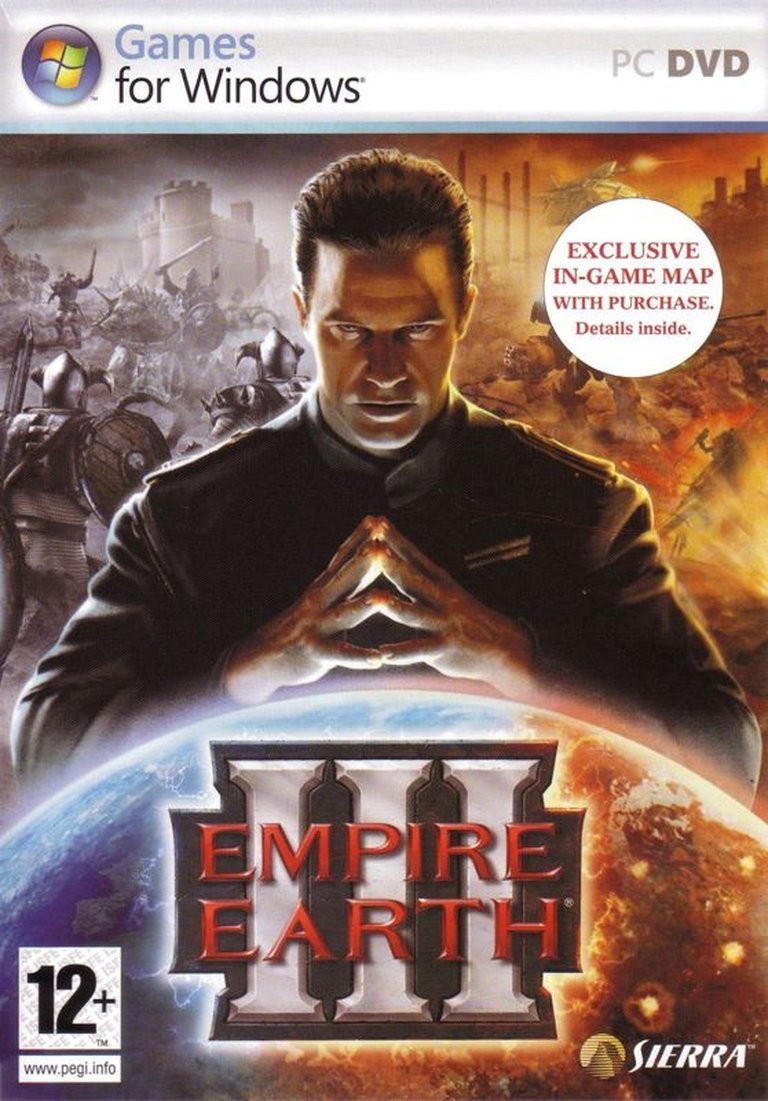
Description
Empire Earth III is a real-time strategy game that spans the entirety of human history, from ancient times to the far future. Players choose one of three unique factions—Western, Middle Eastern, or Far Eastern Regions—and engage in both turn-based global conquest on a world map and real-time tactical battles. The core gameplay involves conquering neutral provinces by either defeating or allying with local tribes, then managing those territories to produce resources and recruit armies to achieve world domination.
Gameplay Videos
Where to Buy Empire Earth III
PC
Empire Earth III Free Download
Crack, Patches & Mods
Guides & Walkthroughs
Reviews & Reception
metacritic.com (50/100): Mixed or Average Based on 40 Critic Reviews
gamepressure.com (69/100): Empire Earth III is another part of the popular real-time strategy series. The production was developed by Mad Doc Software, which has also had its previous release. This is still an RTS game, but it is much more dynamic than the rest of the series.
gamesreviews2010.com : Empire Earth III is a solid RTS game, but it doesn’t quite live up to the high standards set by its predecessors.
gamespot.com (35/100): While it may be a lot smoother and simpler than its predecessors, Empire Earth III has been dumbed down to the point of irrelevance.
gamewatcher.com : Units can be upgraded still with investments of resources though these are fixed and you won’t be able to choose like in the original where you could opt for more health, better speed or longer fuel times etc.
Empire Earth III: A Requiem for an Empire
Introduction
In the pantheon of real-time strategy games, the Empire Earth series once stood as a titan. Its ambition was staggering: to let players guide a civilization from the clubbing brutality of the Stone Age to the nano-tech warfare of a speculative future. The first game, a brainchild of Rick Goodman and his team at Stainless Steel Studios, was a monumental success in 2001, hailed as a spiritual successor to Age of Empires with an even grander scope. Its 2005 sequel, developed by Mad Doc Software, expanded on this foundation with new features and deeper complexity. Then, in November 2007, came Empire Earth III. It was to be the culmination of this epic journey, a game that promised to put the very “Earth” into its name with a globe-spanning conquest mode. Instead, it arrived not as a crowning achievement, but as a catastrophic collapse—a game so fundamentally flawed it didn’t just disappoint fans; it shattered the legacy of its forebears and brought the entire empire crashing down. This is the story of a vision simplified into oblivion, a case study in how a beloved franchise can be undone by a misguided pursuit of accessibility over depth.
Development History & Context
The Studio and The Vision
Empire Earth III was developed by Mad Doc Software, a studio founded by Ian Lane Davis, which had previously handled the expansion for Empire Earth II. The project began in 2005, almost immediately after the release of the second game. The publisher, Sierra Entertainment, was a storied name in PC gaming but was itself in a state of corporate flux, having been acquired by Vivendi Games in the years leading up to release.
The developers’ stated vision, as gleaned from pre-release interviews and promotional material, was one of radical simplification and focus. They aimed to make the game more accessible, to strip away the perceived bloat and complexity that they felt might have alienated a broader audience. The lead designer, Matthew Nordhaus, and his team sought to create a more “streamlined” experience. The technological foundation was the Gamebryo engine, a middleware solution also used in titles like Oblivion, which was almost completely rewritten from the EEII codebase to allow for improved visual effects, ragdoll physics, and higher resolution textures. The ambition was to create a more “cartoonish” and distinct visual style, moving away from realism.
The Gaming Landscape of 2007
The game’s release in late 2007 placed it in one of the most competitive years in RTS history. It was launching into a market dominated by critical darlings and commercial giants. Company of Heroes (2006) had redefined tactical combat with its cover systems and destructible environments. Supreme Commander (February 2007) offered unparalleled scale and strategic depth. World in Conflict (September 2007) delivered a thrilling, story-driven Cold War thriller. Even the genre’s old guard was present, with Age of Empires III still a recent release. This was an era where the RTS genre was innovating, becoming more cinematic, more complex, and more demanding. In this landscape, Mad Doc’s vision of a simplified, back-to-basics RTS was not just counterintuitive; it was anachronistic.
Technological Constraints and Ambitions
The decision to use the Gamebryo engine was a curious one. While capable, it was not renowned for handling the vast unit counts and large-scale battles that were a hallmark of the series. The developers’ focus on a new art style—bulky, colorful, and exaggerated—was a significant departure from the more grounded (though still stylized) look of the previous games. This shift, combined with the goal of a global “World Domination” mode, placed immense strain on the project. The result was a game that, despite its technical ambitions, launched with severe performance issues, notorious pathfinding bugs, and a visual presentation that many critics and players found dated and unappealing, even for its time.
Narrative & Thematic Deep Dive
The Abandoned Campaign
Perhaps the most telling and damning failure of Empire Earth III is its complete abandonment of a traditional narrative campaign. The first two games featured lengthy, historically-inspired campaigns that served as interactive history lessons, guiding players through the rise of Rome, the campaigns of Napoleon, and the futuristic conflicts of a space-faring humanity.
EEIII replaces this with three “World Domination” campaigns, one for each faction: the Western, Middle Eastern, and Far Eastern blocs. These are not narratives but glorified skirmish modes played on a Risk-style global map. There is no plot, no characters, no dialogue, and no sense of historical context or drama. The objectives are generic “convince a tribe” or “destroy all enemies” tasks repeated ad infinitum across different maps. As one player review on MobyGames lamented, this strips the game of “references to ancient history, the very core topic of an Empire Earth game.”
The tribes that inhabit the neutral provinces are a thematic mess. The game makes no effort to contextualize them geographically or historically. A player conquering Europe might find themselves battling a generic “Native American”-style tribe, a bizarre ahistorical oversight that shatters any immersion. The dialogue, what little there is, consists of repetitive, often irritating unit barks that reviewers universally panned. A German review in PC Games noted the developers missed a chance to create a “schmissig-trashige Kampagne im Stile von Mel Brooks” (a catchy, trashy campaign in the style of Mel Brooks), highlighting the tonal confusion.
Thematic Bankruptcy
The overarching theme of the original games was the awe-inspiring sweep of human progress. EEIII reduces this to a bland, almost cynical, clash of three stereotyped cultural blocs. The West is “tech-heavy,” the East is “population heavy,” and the Middle East is “unconventional.” This simplification doesn’t just lack nuance; it feels reductive and devoid of the educational and inspirational spirit that defined the series. The game offers a theme park version of history, where all nuance is sanded away in favor of a bland, easily marketable, and ultimately empty concept of global conflict.
Gameplay Mechanics & Systems
The Core Loop: A Hollow Shell
The core gameplay loop of EEIII is a stark devolution from its predecessors. The game is built around two primary modes: Skirmish and World Domination.
- World Domination Mode: This is the game’s flagship feature, a clear attempt to emulate the successful global conquest mode of Rise of Nations. Players choose a faction and vie for control of a globe divided into provinces. On this strategic map, played in a turn-based style, players assign conquered provinces to roles: Military (produces armies), Commerce (generates wealth), Imperial (produces raw materials), or Research. Armies are then moved between provinces to initiate battles.
- Real-Time Battles: When armies clash, the game zooms into a real-time battle on a map representing that province. Here, players must build a base, gather resources, and destroy the enemy—standard RTS fare.
This meta-game structure is a sound idea on paper. In practice, it fails spectacularly due to the poor quality of the real-time component and repetitive objectives.
A Legacy of Features Stripped Away
The simplification crusade eviscerated the series’ defining mechanics:
- Epochs: The glorious 14-15 epoch progression from previous games was brutally cut down to just five: Ancient, Medieval, Colonial, Modern, and Future. This crushes the sense of epic progression, making technological leaps feel sudden and unearned.
- Civilizations: The rich array of unique civilizations was replaced by three homogenous factions. While each has a unique tech tree and units, the differences are superficial compared to the deep civ bonuses of old.
- Resources: The classic four-resource system (food, wood, stone, gold) was replaced by a generic “raw materials” and “wealth” system, with “research” as a third resource. This removes any strategic nuance in base placement and economy management.
- Features Removed: Key innovations from EEII, such as the Citizen Manager and the Picture-in-Picture feature for managing multiple fronts, were excised entirely.
Combat, AI, and Technical Failures
The real-time battles are where the game’s flaws become painfully acute.
- Pathfinding & AI: Universally condemned by critics, the pathfinding is among the worst in the genre. Units consistently get stuck on terrain, on each other, and on buildings. They teleport, jitter, and fail to follow commands. The enemy AI is passive and predictable, offering little challenge. As IGN noted, “the animations aren’t very good and the performance leaves a lot to be desired.”
- Unit Design and Balance: The units, with their bulky, cartoonish designs, lack visual clarity. The balance between the three factions was often cited as uneven, further undermining the strategic experience.
- Bugs and Performance: The game launched in a notoriously buggy state, suffering from memory leaks, crashes, and poor optimization that made it run poorly even on high-end hardware of the era. 1UP’s review highlighted that the game would frequently crash after battles, preventing players from even seeing their stats.
World-Building, Art & Sound
A World Without Soul
The world-building of EEIII is its most tragic failure. The series was built on a foundation of historical authenticity and futuristic speculation, giving players a digital sandbox to explore human achievement. EEIII replaces this with a generic, almost parody-like setting.
The art direction, aiming for a distinct “cartoonish” look, resulted in units and buildings that appear bulky, ugly, and devoid of detail. Environments are bland and repetitive, lacking the visual flair that distinguished maps in earlier games. Critic after critic noted that the graphics were hardly an improvement over EEII, and in some ways, a step backward. The game was not visually competitive in 2007, especially compared to the stunning detail of Company of Heroes or the epic scale of Supreme Commander.
The sound design is equally problematic. The soundtrack, while serviceable, is forgettable and often feels disconnected from the on-screen action. The unit voiceovers, however, are legendarily bad. They are repetitive, poorly acted, and tonally inconsistent, often injecting attempts at humor that fall completely flat. Many reviewers, including those from GameStar (Germany), explicitly stated they turned the unit voices off entirely—a first for an RTS.
The combination of weak art, boring sound, and a lack of narrative or historical context creates a world that feels utterly sterile and unengaging. There is no atmosphere, no sense of place or time, just a generic strategy game backdrop.
Reception & Legacy
Critical Panning and Commercial Failure
Upon release, Empire Earth III was met with a barrage of negative reviews. It holds a Metacritic score of 50 and a MobyScore of 5.4, based on 47 critic reviews averaging 52%. The critical consensus was brutal and unified.
- GameSpot (3.5/10): “Empire Earth III has been dumbed down to the point of irrelevance.”
- IGN (5.4/10): “Fans of the series will be disappointed that the sequel removes much of the complexity and variety.”
- GameSpy (2/5): “Bugs, muddled combat, or weak AI aren’t things that strategy fans have to live with.”
- Game Revolution (D-): “I think Empire Earth III should get a special patch… If a user voluntarily chooses to quit, it should pop up a dialog box that states, ‘Baby, why you gotta make me hit you?'”
The game was a commercial disappointment, failing to chart or make a lasting impact. It was quickly relegated to bargain bins, a symbol of a failed sequel.
Awards of Shame
The game’s reception was so negative it earned “awards” for its failure. German publication 4Players.de named it the #2 Biggest Disappointment of 2007. GameStar (Germany) later included it in a list of the “10 Most Terrible Sequels,” noting that it “cut down the elements which were the biggest motivational factors.”
The Death of a Franchise
The legacy of Empire Earth III is absolute. It was the final nail in the coffin for the franchise. Mad Doc Software, reportedly embarrassed, removed all mentions of the game from their website. Sierra Entertainment faded away, and the Empire Earth IP eventually landed at Rebellion Developments, where it has lain dormant for over 15 years. The game serves as a cautionary tale, a textbook example of how to destroy a beloved franchise by misunderstanding its core appeal, over-simplifying its mechanics, and releasing a technically broken product into a saturated and sophisticated market. Its only influence was as a negative example—a benchmark for how low a once-great series could fall.
Conclusion
Empire Earth III is not merely a bad game; it is a profound betrayal. It betrayed the fans who cherished the complexity and historical scope of the originals. It betrayed the legacy of the developers who built the series with passion and ambition. It betrayed the very concept it was built upon, reducing the grand tapestry of human history to a shallow, broken, and repetitive clash of stereotypes.
The game’s few redeeming qualities—the ambitious, if flawed, World Domination mode and the initial novelty of the three factions—are utterly drowned in a sea of technical failures, poor design choices, and a palpable lack of soul. It is a game that feels rushed, focus-tested, and utterly devoid of the love that defined its predecessors.
In the annals of video game history, Empire Earth III holds a singular place: as a monument to failed ambition, a masterclass in how not to sequelize a beloved franchise. It is the anticlimactic end to a saga that once promised the world, only to collapse under the weight of its own simplified ambitions. For historians and gamers alike, it remains a fascinating artifact—a stark reminder that in the pursuit of a new audience, one must never forget the heart of those who built the empire in the first place. The only hope for the Empire Earth name now lies in the potential for a faithful remaster of the first two titles, allowing a new generation to experience the glory that was, and to understand the tragedy of what followed.