
- Release Year: 2001
- Platforms: Windows
- Publisher: Sierra On-Line, Inc.
- Genre: Special edition
- Perspective: Top-down
- Game Mode: LAN, Single-player
- Average Score: 80/100
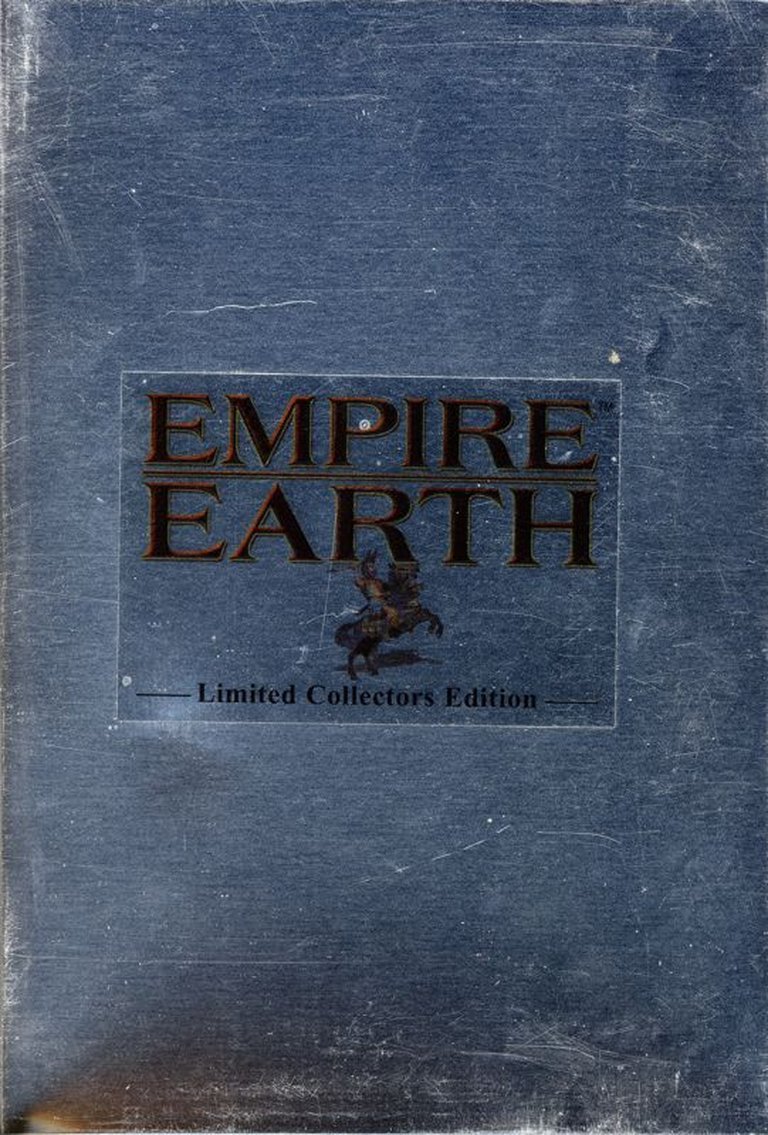
Description
Empire Earth is a history-spanning real-time strategy game that immerses players in 500,000 years of human evolution across 14 epochs, from the Prehistoric Age to the Nano Age. Players collect resources, construct buildings, train citizens, and wage war to conquer rival civilizations while advancing technologically through distinct historical eras. The game features innovative systems like morale-based unit stats and heroes with strategic abilities, alongside a map editor for custom scenarios.
Gameplay Videos
Empire Earth (Limited Collector’s Edition) Cracks & Fixes
Empire Earth (Limited Collector’s Edition) Patches & Updates
Empire Earth (Limited Collector’s Edition) Mods
Empire Earth (Limited Collector’s Edition) Guides & Walkthroughs
Empire Earth (Limited Collector’s Edition) Reviews & Reception
metacritic.com (81/100): What impresses us the most is the sheer size of it — each epoch feels fleshed out and playable, and every era has its own nuances, so it’s almost like getting 14 games in one.
imdb.com (80/100): Empire Earth has all the elements you need in a good strategy game. Great graphics and sounds, good story lines and a challenge.
mygamereviews.com : The ability to have a civilization that is going to be able stand the test of time is truly gratifying experience.
gamesreviews2010.com (85/100): Empire Earth is a truly epic RTS game that takes you on a journey through history. With its innovative epoch system, its epic campaigns, and its robust multiplayer mode, Empire Earth is a game that will keep you entertained for hours on end.
Empire Earth (Limited Collector’s Edition) Cheats & Codes
PC
Enter codes during gameplay by pressing [Enter], typing the code, and pressing [Enter] again. (Requires enabling ‘Cheat Codes’ option in Random Map setup)
| Code | Effect |
|---|---|
| i have the power | Magic/Power to Full |
| asus drivers | Reveal Map |
| somebody set up us the bomb | Win Game |
| my name is methos | All Resources & Reveal Map |
| boston food sucks | +1000 Food |
| atm | +1000 Gold |
| brainstorm | Fast Build |
| columbus | See Fish and Animals |
| friendly skies | Aircraft Flight Time ReFilled |
| coffee train | Restores Health of All Player Units |
| you said wood | +1000 Wood |
| rock&roll | +1000 Rock |
| creatine | +1000 Iron |
| all your base are belong to us | +100,000 Everything |
| the quotable patella | All Units Upgraded |
| ahhhcool | Lose Game |
| display cheat | Print All Cheats |
| the big dig | Lose All Resources |
| boston rent | Lose All Gold |
| uh, smoke? | Lose All Wood |
| headshot | Remove Objects From Map |
| girlyman | Lose All Iron |
| mine your own business | Lose All Rock |
| slimfast | Lose All Food |
| oh ya we rock | Advance to Next Age |
| storm | Controllable Twister |
| bam | Reveal entire map and remove fog of war |
| negerpung | Get all of enemies money |
Empire Earth (Limited Collector’s Edition): Review
Introduction
In the twilight of the RTS genre’s golden age, where Age of Empires II reigned supreme and StarCraft defined competitive play, Empire Earth emerged not merely as a contender but as an audacious manifesto. Developed by Stainless Steel Studios under the visionary Rick Goodman—lead architect of the original Age of Empires—this 2001 title laid claim to an unprecedented scope: 500,000 years of human history compressed into a single real-time strategy experience. The Limited Collector’s Edition, released in November 2001 in a tightly constrained run of just 6,000 units, amplified this ambition with tangible artifacts: a 160-page Brockhaus encyclopedia, a 34-page historical booklet, a branded mousepad, and a dual-sided poster detailing intricate tech trees. This review argues that Empire Earth transcended its era as a “kitchen sink” design, delivering a flawed yet monumental experience that redefined historical RTS through sheer scale, innovative systems, and a willingness to blend epochs into a single, cohesive narrative tapestry. Its legacy endures not as a flawless masterpiece, but as a landmark of ambition—a game where cavemen and cyborgs wage war in the same match, forever challenging players to command the entirety of human destiny.
Development History & Context
The Visionaries and Technological Constraints
Stainless Steel Studios, founded in 1998 by Rick Goodman (lead designer of Age of Empires), embarked on Empire Earth with a deliberate mission: to merge the accessible empire-building of Age of Empires with the grand strategic depth of Civilization. Goodman, leveraging his pedigree, envisioned a game spanning “500,000 years of human history” across 14 epochs, a scope unprecedented in real-time strategy. The team, including designers Jon Alenson and Christopher Theriault, and programmer Damon “Stratus” Gauthier (a StarCraft tournament veteran hired to balance multiplayer), faced significant hurdles. Built on the proprietary Titan engine—a custom 3D environment developed for dynamic large-scale battles—the game pushed early 2000s hardware to its limits. DirectX 7 compatibility imposed strict limitations on modern rendering techniques, forcing reliance on efficient culling and Level of Detail (LOD) techniques to prevent slowdowns during epoch-spanning conflicts.
The Gaming Landscape of 2001
Released into a fiercely competitive RTS market, Empire Earth positioned itself as the antidote to the era’s historical and sci-fi silos. While Age of Empires II dominated the past-focused space and Command & Conquer explored dystopian futures, Empire Earth bridged them, promising “an epic conquest spanning 500,000 years.” Sierra Entertainment’s marketing emphasized Goodman’s Age of Empires pedigree, framing it as a spiritual successor with enhanced scope. The Limited Collector’s Edition capitalized on this, bundling historical references (the Brockhaus encyclopedia) alongside the game, targeting both history enthusiasts and strategy purists. The game’s ambition was buoyed by industry excitement, with previews at E3 2000 and 2001 showcasing Patton’s tanks clashing with Napoleonic grenadiers. Yet, its complexity risked alienating casual players—a tension evident in Sierra’s decision to include a 160-page encyclopedia, implicitly acknowledging the game’s steep learning curve.
Narrative & Thematic Deep Dive
Campaigns: History Reimagined
Empire Earth‘s single-player campaigns are a sprawling tapestry of historical fiction, blending documented events with speculative futurism. The Greek campaign, spanning eight scenarios, anchors itself in the rise of Athens and Alexander the Great, yet injects divine intervention (e.g., the Trojan Horse gifted by gods) to heighten drama. The English campaign, chronicling William the Conqueror to Napoleon, leans into Shakespearean theatrics during Henry V’s reign, culminating in the Battle of Agincourt. The German campaign, however, embraces outright alternate history, reimagining WWI and WWII with Manfred von Richthofen (“the Red Baron”) as a minor character and Operation Sealion as a successful Nazi invasion of Britain. This culminates in a fictionalized U.S.-Soviet alliance thwarted by German cybernetic forces—a bold departure from historical accuracy that underscores the game’s thematic embrace of “what if?” scenarios.
The Russian campaign, set in 2018 and beyond, is the apex of Empire Earth‘s narrative audacity. It follows Grigor Stoyanovich, a dissident who seizes power in Novaya Russia, a neo-totalitarian state. The campaign escalates into sci-fi absurdity: world conquest, the destruction of a Chinese time machine, and a final paradox-resolving mission where loyalists Molotov and Molly Ryan travel back in time to assassinate Grigor. This blend of geopolitical thriller and time-travel paradox, though narratively uneven, encapsulates Empire Earth‘s core thesis: history is not fixed, but a malleable continuum where empires rise and fall, and technology reshapes humanity. The Learning campaign, structured as Phoenician and Byzantine tutorials, reinforces this by framing history as interactive, not passive.
Underlying Themes
The game’s narratives explore cyclical patterns of power, technological hubris, and the erosion of human agency. The German campaign’s successful Nazi victory serves as a cautionary tale about unchecked ambition, while the Russian campaign’s cybernetic successors and time-travel paradoxes critique technological determinism. Heroes like Alexander the Great and Churchill symbolize leadership as both force and inspiration, while Prophets (who invoke earthquakes and plagues) introduce a supernatural layer, questioning whether history is driven by human will or divine intervention. Ultimately, Empire Earth frames civilization as an evolutionary struggle—a theme mirrored in its epoch progression, where each era’s “advancements” (from bronze to nanites) carry seeds of future conflict.
Gameplay Mechanics & Systems
Core Loops and Resource Management
Empire Earth‘s gameplay revolves around a familiar RTS framework—resource gathering, base building, and military production—elevated by epoch-spanning complexity. Players manage five resources (food, wood, stone, gold, iron), gathered by Citizens who transition from prehistoric foragers to futuristic white-collar workers. The Settlement-to-Town-Center-to-Capitol progression system adds strategic depth: populating a Settlement with five units upgrades it to a Town Center (boosting productivity and morale), while ten more units transform it into a Capitol (unlocking advanced economic technologies). This creates a logistical puzzle, as each upgrade demands resource investment and population management.
Combat and the Epoch System
The game’s 14 epochs (Prehistoric to Nano Age) are its defining innovation. Advancing requires researching technologies at Town Centers/Capitols and constructing era-specific buildings, with costs escalating as epochs progress. Each transition unlocks new units (e.g., spearmen in the Stone Age, laser tanks in the Nano Age) while rendering older units obsolete, forcing players to adapt strategies dynamically. Combat emphasizes a “rock-paper-scissors” dynamic: infantry counters archers, cavalry counters infantry, and artillery counters structures. Later epochs introduce aerial and naval units (e.g., B-2 bombers, submarines), alongside futuristic “Cybers” like the Hades mech, whose lasers pierce traditional armor. Morale, a unique system, directly impacts unit effectiveness—Warrior heroes boost nearby troops’ morale, while Strategists heal and demoralize enemies, adding tactical nuance to engagements.
Civilization Builder and Customization
Empire Earth‘s Civilization Builder allows players to allocate 100 “Civ Points” across 100+ attributes, from unit-specific bonuses (e.g., 20% attack boost for bombers) to economic perks (e.g., 20% faster citizen speed). This system, saved for future use, enables profound customization. Predefined civilizations (21 in the base game) offer unique strengths—Byzantine Rome excels in infantry, China in farming—but Civ Points allow hybrid strategies (e.g., a Byzantine navy or Chinese archery). Custom civilizations introduce asymmetrical play, though some combinations proved overpowered (e.g., stacking bonuses in multiplayer). The inclusion of Prophets, who cast calamities (earthquakes, plagues), adds a supernatural layer, blending historical religion with fantasy tactics.
UI and Innovation
The UI, while functional, reflects its Age of Empires heritage: resource meters, build queues, and unit selection menus are intuitive but cluttered during large battles. The scenario editor, however, is a triumph, enabling players to design campaigns with triggers, AI scripting, and custom maps. Random map generation, which created terrains mimicking continental geography (unlike static maps in contemporaries), ensured replayability. Still, the game suffers from pacing issues: early epochs are slow and resource-intensive, while late-game stalemates often devolve into nuclear standoffs—a flaw noted by critics like GameSpot.
World-Building, Art & Sound
Setting and Atmosphere
Empire Earth‘s world-building is a triumph of historical synthesis. The 14 epochs are meticulously researched, from Prehistoric mammoth hunts to Nano Age nanotechnology, with terrain evolving to match—dense forests in prehistoric maps giving way to urban landscapes in industrial epochs. The game avoids “Western bias” by incorporating diverse architectures (e.g., Byzantine domes, pagodas), though future epochs default to sleek, generic sci-fi aesthetics. The atmosphere oscillates between epic and whimsical: Greek battles evoke Homeric grandeur, while the Nano Age’s cybernetic clash feels like a Terminator film. The Russian campaign’s dystopian Volgograd and Novaya Russia’s Kremlin underscore a theme of technological dread, contrasting sharply with the romanticized English countryside of Agincourt.
Visual Direction
Using the Titan engine, Empire Earth employed 3D graphics with mixed results. Units and textures were blocky and low-resolution, especially on close inspection—cavemen’s crude models juxtaposed poorly against the sleek lines of Digital Age tanks. Structures suffered from “sprite-fication”: buildings like the Tower of London were recycled across campaigns, and camera rotation was limited to cutscenes, masking a lack of full 3D rendering. Yet, the art direction excelled in epoch distinction: Preolithic huts, Renaissance cathedrals, and Atomic Age factories each evoked their era’s essence. The Limited Edition’s poster, with its detailed tech trees and unit silhouettes, remains a cherished artifact of its era’s aesthetic.
Sound Design
The audio, composed by Ed Lima and Steve Maitland, is a study in contrasts. The menu theme is orchestral and epic, fitting for a game of such scale. In-game music, however, is repetitive and tonally mismatched—medieval lutes clash with Industrial Age jazz, and future tracks lack futuristic gravitas. Voice acting ranges from amateurish to cringe-worthy: French accents in the English campaign sound “laughably bad,” while Novaya Russia’s dialogue is “corny.” Sound effects are serviceable but unremarkable—archer hits sound generic, and dying cavemen emit comical “puking” noises. Despite these flaws, the sound design enhances immersion: the roar of WWI tanks and the hum of Nano Age drones anchor each era’s identity.
Reception & Legacy
Critical and Commercial Reception
Empire Earth launched to critical acclaim, averaging 81 on Metacritic and 82% on GameRankings. IGN awarded it 8.5/10, praising its “addictive gameplay” and epoch-spanning scope, while GameSpy hailed it as the 2001 PC Game of the Year. Critics lauded its depth and ambition, with PC Gamer calling it “one hell of a good time.” Yet, the game was not without detractors: GameSpot scored it 7.9/10, criticizing its “steep learning curve” and “less-than-stellar graphics,” and Game Informer derided its interface as “clunky.” Commercially, Empire Earth was a blockbuster, selling over 1 million units by 2002 and earning a Silver ELSPA award (100K+ copies in the UK). The Limited Collector’s Edition, priced at a premium, became a rare commodity, its artifacts (encyclopedia, mousepad) coveted by collectors.
Long-Term Impact
Empire Earth‘s legacy is twofold: as a genre innovator and as a cautionary tale of ambition. Its epoch system directly influenced Rise of Nations (2003), which adopted multi-era progression. The Civilization Builder prefigured modern RTS customization, while the scenario editor spawned a vibrant modding community on HeavenGames. Multiplayer persisted years after official servers shut down in 2008, thanks to fan projects like NeoEE. Sequels followed—Empire Earth II (2005) refined the epoch system, while Empire Earth III (2007) was critically panned for simplifying the formula. Yet, the original remains a cult classic, praised for its “sheer audacity” (Hardcore Gaming 101) and replayability. Modern players, via GOG’s digital re-release, still praise its “mastery of historical progression” (My Game Reviews), even as they lament its aged graphics.
Community and Preservation
The game’s community, epitomized by forums like Empire Earth Heaven, has kept it alive through decades of modding. Projects like the EE Tweaks Mod fix pathfinding and support larger maps, while texture packs enhance visuals. Fan-made campaigns, such as “The Art of War,” expand on the base game’s narratives. This grassroots preservation underscores Empire Earth‘s cultural significance—not as a flawless product, but as a shared experience where players debate the ethics of alternate-history German campaigns or share strategies for Nano Age mech rushes.
Conclusion
Empire Earth (Limited Collector’s Edition) stands as a towering, flawed monument to the RTS genre’s creative zenith. Its Limited Edition, with its historical artifacts, was more than a product—it was a physical manifestation of the game’s ethos: that history is a continuum, playable in real-time. Stainless Steel Studios’ ambition yielded a game of staggering scope, where cavemen clash with cyborgs, and Prophets summon plagues amid nuclear fire. While not without flaws—uneven audio, aging visuals, and pacing issues—Empire Earth remains unmatched in its synthesis of past and future. Its legacy endures in the modding communities that sustain it, in the sequels it inspired, and in the nostalgia it evokes. For collectors, the Limited Edition is a time capsule of a bygone era when RTS games dared to be epics. For historians of the genre, it is a reminder that ambition, even when imperfect, can leave an indelible mark on digital history. Empire Earth is not merely a game; it is a testament to the human drive to command time itself.