
- Release Year: 2014
- Platforms: Windows
- Publisher: GSP Software
- Genre: Adventure
- Perspective: 1st-person
- Game Mode: Single-player
- Gameplay: Hidden object, Mini-games, Puzzle elements
- Setting: Oceania
- Average Score: 47/100
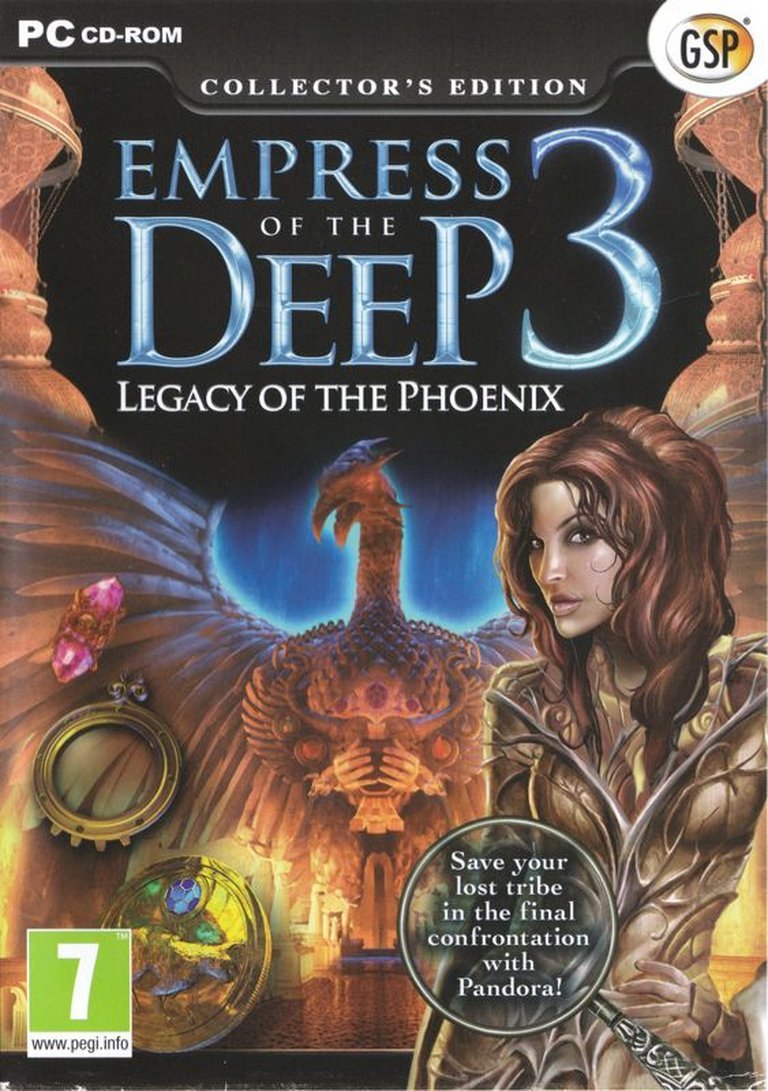
Description
Empress of the Deep 3: Legacy of the Phoenix (Collector’s Edition) is an adventure game where Empress Anna, after defeating her evil twin Pandora, embarks on a quest to find her lost tribe. Guided by a fever dream, she discovers a mysterious floating temple city threatened by a cursed colossus. With the help of a ghostly ally and an ancient phoenix, she must navigate puzzles, hidden objects, and mini-games to uncover the truth behind her tribe’s disappearance and stop the awakening colossus. The Collector’s Edition includes a bonus level featuring ‘The Tower of Zem,’ a gem-matching puzzle game with Relaxed and Timed modes, offering additional challenges and unlockable concept art.
Gameplay Videos
Empress of the Deep 3: Legacy of the Phoenix (Collector’s Edition) Guides & Walkthroughs
Empress of the Deep 3: Legacy of the Phoenix (Collector’s Edition) Reviews & Reception
macgamestore.com (34/100): So far I’ve only quit games with technical issues. This game isn’t only bad, it’s frustrating.
jayisgames.com (60/100): Legacy of the Phoenix is extremely enjoyable as a game you can relax with, let yourself be immersed in the stunningly gorgeous scenery and lured into serenity by the hypnotic music.
Empress of the Deep 3: Legacy of the Phoenix (Collector’s Edition): A Comprehensive Review
Introduction
Empress of the Deep 3: Legacy of the Phoenix (Collector’s Edition) is a hidden object adventure game that continues the saga of Empress Anna, a protagonist locked in a timeless struggle against her evil twin, Pandora. Released in 2014 by Gogii Games and developed by Silverback Productions, this title is the third installment in the Empress of the Deep series, a franchise known for its lush visuals, intricate puzzles, and mythological storytelling. The Collector’s Edition enhances the base game with bonus content, including an additional chapter, a match-3 game called Zem II, and unlockable concept art.
This review will delve into the game’s development history, narrative depth, gameplay mechanics, artistic design, and its reception within the gaming community. By examining these elements, we aim to assess the game’s place in the hidden object adventure genre and its broader impact on casual gaming.
Development History & Context
The Studio and Creators’ Vision
Empress of the Deep 3: Legacy of the Phoenix was developed by Silverback Productions, a studio with a reputation for crafting visually rich and narratively driven hidden object games. The series began with Empress of the Deep: The Darkest Secret (2010), which introduced players to Anna’s underwater world and her conflict with Pandora. The sequel, Empress of the Deep 2: Song of the Blue Whale (2011), expanded the lore by incorporating celestial themes and a deeper exploration of Anna’s royal lineage.
The third installment, Legacy of the Phoenix, was designed to conclude Anna’s arc while introducing new mythological elements, such as the phoenix and the cursed colossus. The game’s development was influenced by the studio’s desire to blend classic adventure gameplay with modern hidden object mechanics, creating an experience that appeals to both casual players and fans of traditional point-and-click adventures.
Technological Constraints and Era
Released in 2014, Legacy of the Phoenix was developed during a transitional period in casual gaming. The rise of digital distribution platforms like Big Fish Games and GameHouse allowed smaller studios to reach broader audiences without the need for physical media. The game’s system requirements reflect this era:
– Windows XP/Vista/7/8 (PC) and Mac OS 10.6.8+ (Mac).
– 1.0 GHz processor, 512 MB RAM, and ~900 MB of storage.
– DirectX 8.1 for PC, ensuring compatibility with older hardware.
These specifications highlight the game’s accessibility, targeting a wide range of players, including those with modest gaming rigs. The fixed/flip-screen perspective and first-person viewpoint were chosen to emphasize immersion, a hallmark of the Empress of the Deep series.
The Gaming Landscape in 2014
The early 2010s saw a boom in hidden object games, driven by the popularity of titles like Mystery Case Files and Dark Parables. Empress of the Deep 3 entered this competitive market with a focus on narrative depth and atmospheric world-building, setting it apart from more formulaic entries in the genre. The Collector’s Edition model, which included bonus content and an integrated strategy guide, was a growing trend, appealing to players who sought additional value in their purchases.
Narrative & Thematic Deep Dive
Plot Summary
Legacy of the Phoenix picks up after the events of Song of the Blue Whale, with Empress Anna having defeated her twin sister, Pandora. However, her victory is short-lived. A fever dream reveals that her lost tribe is in peril, threatened by a cursed colossus in a floating temple city. With the help of the ghost of Jacob (a recurring ally) and an ancient phoenix, Anna escapes her burning palace in the clouds and embarks on a quest to save her people.
The narrative unfolds across several key locations:
1. The Burning Palace: Anna’s initial escape sets the tone for the game’s urgency.
2. The Floating City: A beautifully rendered metropolis built by her lost tribe, now eerily deserted.
3. The Tower of Zem: A bonus chapter unlocked after completing the main story, introducing the match-3 game Zem II.
The plot is driven by Anna’s interactions with a sinister two-headed wizard and his cats, who serve as both allies and obstacles. The game’s central conflict revolves around trust—can Anna rely on the wizard, or is he another pawn of Pandora’s lingering influence?
Characters and Dialogue
- Empress Anna: The protagonist, whose determination and compassion are tested throughout the journey. Her voice acting is serviceable, though some critics found her delivery lacking in emotional depth.
- Jacob (Ghost): A guiding figure who provides exposition and occasional hints. His spectral presence adds a layer of mysticism to the narrative.
- The Two-Headed Wizard: A morally ambiguous character whose duality mirrors the game’s themes of trust and deception. His dialogue is laced with riddles, forcing players to interpret his intentions.
- The Phoenix: A symbolic figure representing rebirth and hope. Its role is more thematic than interactive, serving as a beacon for Anna’s quest.
The dialogue is functional but occasionally stilted, a common critique of hidden object games from this era. The game’s strength lies in its environmental storytelling, with the floating city’s ruins and the colossus’s ominous presence conveying more about the world than the script alone.
Themes
- Duality and Identity: The conflict between Anna and Pandora explores the struggle between good and evil within a single lineage. The two-headed wizard further emphasizes this theme, blurring the lines between ally and adversary.
- Rebirth and Renewal: The phoenix symbolizes Anna’s journey to restore her tribe and reclaim her throne. The Tower of Zem’s match-3 game reinforces this theme through its progressive difficulty and unlockable rewards.
- Trust and Betrayal: The game’s puzzles and interactions often require players to decide whether to trust NPCs, mirroring Anna’s internal conflict.
Gameplay Mechanics & Systems
Core Gameplay Loop
Legacy of the Phoenix follows the hidden object adventure (HOA) formula, blending:
– Hidden Object Scenes (HOS): Players search for items listed in an inventory, often with interactive elements (e.g., morphing objects, paired segments).
– Puzzle Solving: Mini-games and environmental puzzles block progress until solved.
– Inventory Management: Collected items are used to unlock new areas or solve puzzles.
– Exploration: The game’s fixed/flip-screen perspective encourages methodical exploration of its detailed environments.
The game offers three difficulty modes:
– Casual: Faster hint recharges, more navigation aids, and no penalties for mis-clicks.
– Expert: Reduced hints and fewer aids.
– Hardcore: Minimal assistance, catering to veterans of the genre.
Combat and Character Progression
Unlike traditional RPGs, Legacy of the Phoenix lacks combat mechanics. Instead, progression is tied to puzzle-solving and item collection. The game’s challenge stems from:
– Hidden Object Scenes: Some objects are cleverly concealed, requiring keen observation.
– Mini-Games: These range from simple slider puzzles to more complex machinery-based challenges.
– Backtracking: Players must revisit locations to use newly acquired items, a staple of the genre.
The Strategy Guide, accessible via the main menu, provides step-by-step solutions, ensuring players never feel stuck for long. While this feature is helpful, it also underscores the game’s linear design.
UI and Innovation
The user interface is intuitive, with:
– Inventory Bar: Located at the bottom of the screen, holding collected items.
– Hint System: Rechargeable and context-sensitive, pointing players toward missed objects or next steps.
– Journal and Map: The journal tracks objectives, while the map reveals explored areas (though it lacks fast-travel functionality).
One innovative mechanic is the fairy and cat system:
– Fairies: When captured, they grant magical abilities to remove barriers.
– Cats: Leave behind coins used to activate teleporters, reducing backtracking.
However, the game’s lack of fast-travel and occasional vague objectives can lead to frustration, as noted in some player reviews.
Flaws in Design
Critics and players have highlighted several issues:
1. Repetitive Hidden Object Scenes: Some scenes reuse assets, leading to visual fatigue.
2. Grainy Graphics: The hidden object scenes occasionally suffer from low-resolution textures, making small items hard to distinguish.
3. Confusing Navigation: The map’s lack of clarity and the game’s reliance on backtracking can disorient players.
4. Voice Acting: Some characters, particularly the two-headed wizard, have been criticized for sounding “disgusting” or overly melodramatic.
Despite these flaws, the game’s puzzle variety and atmospheric setting provide a compelling experience for fans of the genre.
World-Building, Art & Sound
Setting and Atmosphere
Legacy of the Phoenix excels in creating a dreamlike, mythological world. The game’s environments are a mix of:
– Celestial Palaces: Anna’s burning palace in the clouds sets a dramatic opening.
– Floating Cities: The lost tribe’s metropolis, adorned with intricate machinery and force fields, evokes a sense of wonder.
– Mystical Temples: The Tower of Zem and the colossus’s lair are steeped in ancient lore.
The Oceania-inspired setting (as noted in MobyGames) adds a unique cultural flavor, distinguishing it from the European fantasy tropes common in other HOAs.
Visual Direction
The game’s art style is illustrated realism, blending hand-painted backgrounds with 3D elements. Key visual strengths include:
– Vibrant Colors: The floating city’s azure skies and golden structures create a striking contrast.
– Detailed Animations: Machinery, water effects, and the phoenix’s movements are fluid and immersive.
– Lighting and Shadows: The burning palace’s embers and the colossus’s ominous glow enhance the game’s mood.
However, the hidden object scenes suffer from grainy textures, a common issue in games of this era. This can make smaller items difficult to spot, detracting from the overall polish.
Sound Design
The game’s audio is a mixed bag:
– Background Music: The score is hypnotic and atmospheric, complementing the game’s mystical themes. Tracks like the floating city’s theme evoke a sense of serenity and urgency.
– Voice Acting: While functional, the delivery is often stiff or overacted, particularly for the two-headed wizard. Some players found the voices “disgusting” or mismatched with the characters’ designs.
– Sound Effects: Environmental sounds (e.g., machinery humming, water flowing) are well-implemented, adding to the immersion.
Reception & Legacy
Critical and Commercial Reception
Empress of the Deep 3: Legacy of the Phoenix received mixed to positive reviews upon release. Critics praised its:
– Visual Design: The floating city and celestial settings were highlights.
– Puzzle Variety: The mini-games and hidden object scenes offered engaging challenges.
– Bonus Content: The Collector’s Edition’s Zem II and additional chapter added value.
However, criticisms focused on:
– Repetitive Gameplay: Some reviewers felt the hidden object scenes lacked innovation.
– Technical Issues: Grainy graphics and occasional bugs detracted from the experience.
– Narrative Pacing: The story’s slow build and abrupt conclusion left some players unsatisfied.
On platforms like MacGameStore, the game holds a 3.4/5 rating, with players either loving its relaxed exploration or criticizing its lack of challenge. One reviewer on MacGameStore called it “frustrating” and “terrible,” citing confusing navigation and poor voice acting.
Evolution of Reputation
Over time, Legacy of the Phoenix has been viewed as a solid but unremarkable entry in the Empress of the Deep series. While it doesn’t reach the heights of its predecessors in terms of innovation, it remains a visually stunning and atmospheric experience for fans of hidden object adventures.
The game’s Collector’s Edition model has influenced subsequent titles in the genre, with many developers adopting similar bonus content strategies. However, its linear design and lack of fast-travel have aged poorly compared to more modern HOAs that prioritize player convenience.
Influence on the Genre
Legacy of the Phoenix contributed to several trends in casual gaming:
1. Integrated Strategy Guides: The inclusion of an in-game walkthrough became a staple in Collector’s Editions.
2. Bonus Mini-Games: The Zem II match-3 game showcased how additional content could extend a game’s lifespan.
3. Mythological Storytelling: The game’s blend of fantasy and lore inspired later titles like Spirits of Mystery: Song of the Phoenix.
Despite its flaws, the game’s world-building and artistic direction have left a lasting impression, particularly on players who value immersion over challenge.
Conclusion
Empress of the Deep 3: Legacy of the Phoenix (Collector’s Edition) is a visually captivating but flawed hidden object adventure. Its strengths lie in its lush environments, atmospheric soundtrack, and mythological narrative, which transport players to a dreamlike world of floating cities and ancient curses. The game’s puzzle variety and bonus content add depth, making it a worthwhile experience for fans of the genre.
However, its repetitive hidden object scenes, grainy graphics, and occasional narrative confusion hold it back from greatness. The lack of fast-travel and vague objectives can frustrate players, particularly in an era where convenience is increasingly prioritized.
Final Verdict: Empress of the Deep 3: Legacy of the Phoenix is a solid entry in the series, best suited for players who enjoy relaxed exploration and atmospheric storytelling. While it may not innovate significantly, its artistic direction and bonus content make it a notable title in the hidden object adventure genre. For those seeking a challenge, the game’s Hardcore mode and Zem II mini-game provide additional replayability.
Rating: 7.5/10 – A visually stunning but imperfect journey through a mythological world.
Additional Notes
- Collector’s Edition Exclusives:
- Bonus Chapter: Unlocks the Tower of Zem and the Zem II match-3 game.
- Concept Art: Unlocked via trophies in Zem II.
- Strategy Guide: Integrated for seamless assistance.
- Replayability: The Zem II game and hidden object scenes offer some replay value, but the linear story limits long-term engagement.
- Accessibility: The game’s three difficulty modes cater to both casual and hardcore players, though the lack of fast-travel may deter some.
For fans of the Empress of the Deep series or hidden object adventures in general, Legacy of the Phoenix is a worthy addition to the genre, if not a groundbreaking one.