
- Release Year: 2006
- Platforms: Windows
- Publisher: LION HEART
- Developer: LION HEART
- Genre: Action, Platform
- Perspective: Side view
- Game Mode: Single-player
- Gameplay: Platform
- Setting: Fantasy
- Average Score: 90/100
Description
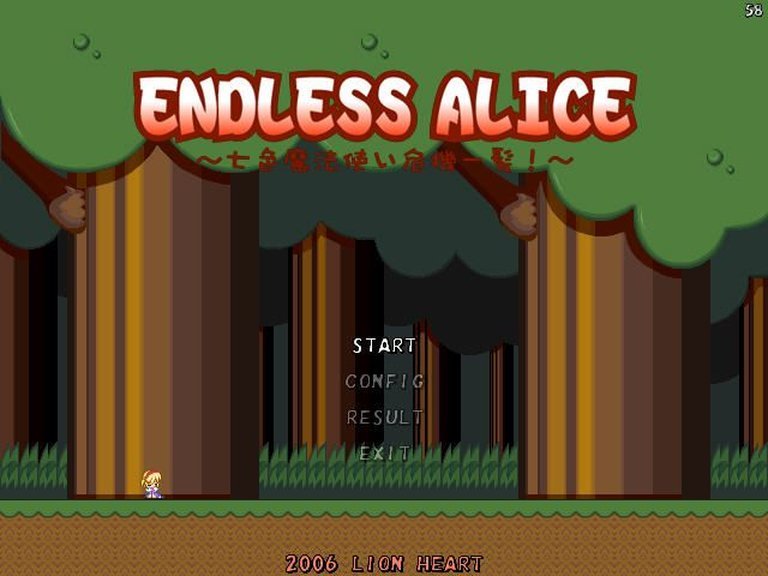
Endless Alice is a 2D side-view platform fangame set in the Tōhō universe, where players control Alice Margatroid, a youkai magician who battles an endless horde of mushrooms using an unlimited supply of dolls. The game features fast-paced action with a fixed/flip-screen perspective, anime-inspired visuals, and occasional appearances by Marisa, who can be hit for bonus points. The challenge lies in surviving as long as possible before losing all life points, with no formal story but a fantasy setting rich in lore.
Gameplay Videos
Where to Buy Endless Alice
PC
Endless Alice Cracks & Fixes
Endless Alice Guides & Walkthroughs
Endless Alice Reviews & Reception
steambase.io (90/100): A triumphant return to form for the series.
store.steampowered.com (90/100): Very Positive – 90% of the 1,150 user reviews for this game are positive.
steamcommunity.com : Having played the test last night for a few hours with a friend of mine I though I’d share my impressions on it. I went into the game expecting anime RoR2 and it’s more or less what I got, jut way more clunky and janky than I expected.
gamevalio.com (91/100): Most players came away satisfied from this experience. While not perfect, the game delivers what it promises and has more positives than negatives.
Endless Alice: A Roguelite Odyssey Through Anime Aesthetics and Endless Possibilities
Introduction: The Duality of a Fangame and a Modern Roguelite
Endless Alice is a game of two faces: a humble 2006 Tōhō fangame and a 2025 Early Access roguelite phenomenon. The former, a niche 2D platformer where Alice Margatroid battles endless mushrooms, is a relic of doujin creativity. The latter, a third-person action-adventure with anime flair, cooperative chaos, and procedural mayhem, is a testament to how far indie ambition can stretch. This review dissects both iterations, exploring their shared DNA, divergent evolutions, and the cultural footprint they’ve left on the gaming landscape.
At its core, Endless Alice is a study in reinvention. The 2006 version is a quirky, single-screen shooter with a singular focus: survive the fungal onslaught. The 2025 reboot, however, is a sprawling, multiplayer-friendly roguelite with deep progression systems, environmental storytelling, and a commitment to player-driven evolution. Both games, despite their differences, share a fascination with endurance, repetition, and the allure of the unknown.
This review argues that Endless Alice (2025) is not just a spiritual successor to its namesake but a bold reimagining of what a Tōhō-inspired game can be—blending the frenetic energy of Risk of Rain 2 with the aesthetic sensibilities of anime action RPGs. Yet, it also grapples with the growing pains of Early Access, where ambition occasionally outpaces polish. Meanwhile, the 2006 original remains a fascinating artifact, a snapshot of fan creativity in the mid-2000s doujin scene.
Development History & Context: From Doujin Obscurity to Early Access Ambition
The 2006 Fangame: A Labor of Love in the Tōhō Sandbox
Developed by the obscure studio LION HEART, the 2006 Endless Alice is a product of its time—a Tōhō Project fangame in an era when the series’ fanbase was exploding. The Tōhō franchise, created by ZUN (Jun’ya Ōta), is a bullet-hell juggernaut, but its lore and characters have inspired countless fan works, from music albums to full-fledged games. Endless Alice fits snugly into this tradition, focusing on Alice Margatroid, the doll-wielding magician from Tōhō’s sixth game, The Embodiment of Scarlet Devil.
Technologically, the 2006 game is a modest affair:
– Engine: Likely built with a lightweight 2D game engine common in doujin circles (e.g., Kirikiri or Game Maker).
– Constraints: Fixed/flip-screen perspective, side-view action, and a resolution befitting early 2000s indie development.
– Innovation: The “endless” mechanic—a wave-based survival mode—was novel for Tōhō fangames, which typically mimicked the series’ danmaku (bullet-hell) formula.
The gaming landscape in 2006 was dominated by:
– The tail end of the PS2/Xbox era.
– The rise of Steam as a digital distribution platform (though still in its infancy).
– A burgeoning indie scene, with titles like Cave Story (2004) proving that small teams could craft memorable experiences.
Endless Alice (2006) didn’t make waves outside niche circles, but it laid the groundwork for a simple, addictive loop: survive, score, repeat.
The 2025 Reboot: A Phoenix Rising from Early Access
Fast-forward to 2025, and Endless Alice has been reborn under HowlingRain, a Taiwanese studio with a penchant for anime aesthetics and roguelite design. This iteration is a radical departure:
– Genre Shift: From 2D platformer to third-person action-adventure roguelite.
– Scope: Six playable characters, 120+ items, 20 enemy types, and eight levels (with more planned).
– Multiplayer: Up to four-player online co-op, a rarity in Tōhō-inspired games.
– Early Access Philosophy: The developers emphasize community feedback, with plans to expand content over a year-long development cycle.
The 2025 version’s development context is starkly different:
– Technological Advancements: Built with a custom engine, leveraging modern rendering techniques (DX12, FSR/DLSS support).
– Market Trends: The roguelite genre is saturated (Hades, Risk of Rain 2, Gunfire Reborn), forcing Endless Alice to carve its niche with anime charm and cooperative play.
– Cultural Shift: The rise of gacha aesthetics and “waifu” culture in gaming, which Endless Alice embraces with its character designs and costume DLCs.
The reboot’s Steam page reveals a studio aware of its competition. The developers cite Risk of Rain 2 as a benchmark, acknowledging the need for tighter enemy AI, better map design, and more distinct buffs. Yet, they also lean into their unique selling points: environmental storytelling, elemental/talent systems, and a virtual world setting that hints at deeper lore.
Narrative & Thematic Deep Dive: Fragments of a Virtual World
The 2006 Game: Minimalism as a Virtue
The original Endless Alice is narratively barebones:
– Premise: Alice fights mushrooms. That’s it.
– Lore: The Tōhō connection implies a supernatural battle in Gensokyo (the series’ setting), but the game offers no exposition.
– Characters: Alice Margatroid is the sole playable character, with Marisa Kirisame (another Tōhō staple) appearing as a bonus target for points.
This minimalism is typical of doujin games, where gameplay often supersedes storytelling. Yet, it also reflects the Tōhō fangame ethos: fans already know the characters, so why explain?
The 2025 Game: Environmental Storytelling and Lore Fragments
The reboot takes a more ambitious approach, though it stops short of a linear narrative. As the developers state:
“We have worldbuilding and character background texts, but there is no actual storyline. At most, we present fragments of the narrative scattered throughout the game—through environments, character dialogues, item descriptions, and enemy lore.”
This environmental storytelling is reminiscent of Dark Souls or Hollow Knight, where lore is pieced together from cryptic clues. Key themes include:
– Virtual Reality: The game’s setting is a “virtual world,” hinting at a digital prison or simulation.
– Survival Against the Odds: The “endless” motif returns, but now it’s about escaping a collapsing system.
– Character Arcs: Each playable character (e.g., Koraku, Shibako, Takehime) has backstory snippets, though full localization is pending.
The lack of a traditional story is a double-edged sword:
– Pros: Encourages replayability and player interpretation.
– Cons: May leave narrative-driven players wanting more.
The developers have hinted at a future story-driven mode, but for now, Endless Alice (2025) is a gameplay-first experience with lore as seasoning.
Gameplay Mechanics & Systems: Roguelite Chaos with Anime Flair
Core Gameplay Loop: Survive, Loot, Repeat
Both versions of Endless Alice revolve around endurance, but the 2025 reboot expands this into a full roguelite framework:
1. Character Selection: Six unique fighters, each with distinct abilities (e.g., sword dashes, grenade launchers, magic beams).
2. Procedural Levels: Eight handcrafted maps with randomized loot and enemy spawns.
3. Item Synergy: Over 120 items that combine in unpredictable ways (e.g., bleed + fire = explosive damage).
4. Boss Battles: Massive, multi-phase encounters that test teamwork and build optimization.
5. Meta Progression: Unlockable talents, elemental affinities, and awakening skills.
Combat and Movement: The Good, the Janky, and the Clunky
Player feedback (e.g., from Steam discussions) highlights a love-hate relationship with the combat:
– Strengths:
– Variety: Each character feels distinct, from the sword girl’s aerial mobility to the grenade launcher’s AoE devastation.
– Co-op Synergy: Abilities chain well in multiplayer (e.g., freezing enemies for shatter combos).
– Weaknesses:
– Clunky Controls: Dash mechanics feel imprecise, and weapon swapping lacks fluidity.
– Enemy AI: Basic foes lack tactical depth, often teleporting unnaturally to keep pace.
– Boss HP Bloat: Early-game bosses drag on, testing patience more than skill.
Progression Systems: Depth with Rough Edges
The 2025 game’s depth comes from:
– Elemental Affinities: Fire, ice, lightning, etc., with synergistic effects.
– Talents/Awakening: Skill trees that unlock new abilities or passive buffs.
– Loot Economy: Gold, disassemblers, and trade-in stations (though some players find these overabundant).
However, the meta progression (persistent upgrades between runs) is light, leaning into the roguelite rather than roguelike philosophy. This design choice aligns with the developers’ goal of reducing frustration for newcomers.
UI and Quality-of-Life: A Work in Progress
Early Access woes are evident in:
– Map Clarity: Players report getting lost in sprawling levels.
– Loot Visibility: Items blend into busy environments.
– Buff Feedback: Some status effects lack visual indicators (e.g., bleed).
The developers have acknowledged these issues, promising iterative improvements.
World-Building, Art & Sound: A Feast for the Senses
Visual Design: Anime Meets Cyberpunk
The 2025 reboot’s art direction is a standout feature:
– Character Designs: Hyper-stylized anime waifus with dynamic animations (e.g., Koraku’s bunny girl outfit).
– Environments: A mix of neon-lit cities, ancient temples, and futuristic ruins, evoking Cyberpunk 2077 meets Nier: Automata.
– Weather Effects: Dynamic storms and day/night cycles (added in later updates).
The 2006 game, by contrast, is a pixelated Tōhō pastiche, charming in its simplicity but limited by its era.
Sound Design: A Mixed Bag
- Music: The 2025 game features an electronic/anime OST that fits its cyberpunk vibe, though it lacks the iconic piano melodies of Tōhō.
- Sound Effects: Gunfire, spells, and enemy screams are serviceable but not memorable.
- Voice Acting: Minimal, with most dialogue appearing as text.
Atmosphere: The Virtual World’s Allure
The game’s virtual reality setting is its most intriguing narrative hook. The environments tell a story of a collapsing digital realm, with:
– Abandoned servers hinting at a lost civilization.
– Glitching textures suggesting reality is unraveling.
– Enemy designs that blend organic and mechanical (e.g., mushroom drones, samurai bots).
This liminal cyberpunk aesthetic sets Endless Alice apart from its peers.
Reception & Legacy: From Obscurity to Cult Appeal
The 2006 Game: A Niche Curio
- Reception: Largely overlooked outside Tōhō fandom. MobyGames lists it with a 3.4/5 average (based on two ratings).
- Legacy: A footnote in doujin history, but a fascinating example of fan-driven experimentation.
The 2025 Game: Early Access Darling
- Steam Reception: 90% Very Positive (1,150 reviews), with players praising its co-op chaos and anime charm.
- Criticism: Common complaints include clunky controls, repetitive enemies, and map navigation issues.
- Sales: Estimated 57.5K copies sold (per SteamDB), with 195K wishlists suggesting strong future potential.
- Community Engagement: The developers actively respond to feedback, a rarity in Early Access.
Influence & Future Potential
Endless Alice (2025) is part of a new wave of anime roguelites, alongside titles like Gunfire Reborn and RoboQuest. Its success could inspire:
– More co-op-focused roguelites with anime aesthetics.
– Deeper environmental storytelling in procedural games.
– Hybrid genres blending Tōhō’s bullet-hell roots with modern action-RPG mechanics.
Conclusion: A Game of Two Eras, One Vision
Endless Alice is a tale of reinvention. The 2006 original is a quaint, forgotten experiment, a testament to the creativity of Tōhō fans. The 2025 reboot, however, is a bold, flawed, and endlessly ambitious roguelite that carves its own path while honoring its namesake’s spirit of endurance.
Final Verdict:
- For Fans of: Risk of Rain 2, Gunfire Reborn, anime aesthetics, co-op chaos.
- Strengths: Gorgeous visuals, deep item synergy, strong co-op gameplay.
- Weaknesses: Clunky controls, underwhelming enemy AI, light narrative.
- Should You Play? If you enjoy roguelites with style and substance, yes—but temper expectations for Early Access jank.
Score: 8/10 (Early Access) – A diamond in the rough, with the potential to shine brighter.
Endless Alice proves that even the most obscure ideas can evolve into something extraordinary. Whether it fulfills its promise remains to be seen, but for now, it’s a thrilling, messy, and utterly compelling journey through a virtual world on the brink.