
- Release Year: 2000
- Platforms: Macintosh, Windows
- Publisher: 1C Company, Empire Interactive Europe Ltd., Feral Interactive Ltd., Strategy First, Inc.
- Developer: Razorworks
- Genre: Simulation
- Perspective: 1st-person, 3rd-person (Other)
- Game Mode: LAN, Online PVP, Single-player
- Gameplay: Dynamic campaigns, Helicopter simulation, Vehicle combat
- Setting: Lebanon, Taiwan, Yemen
- Average Score: 85/100
Description
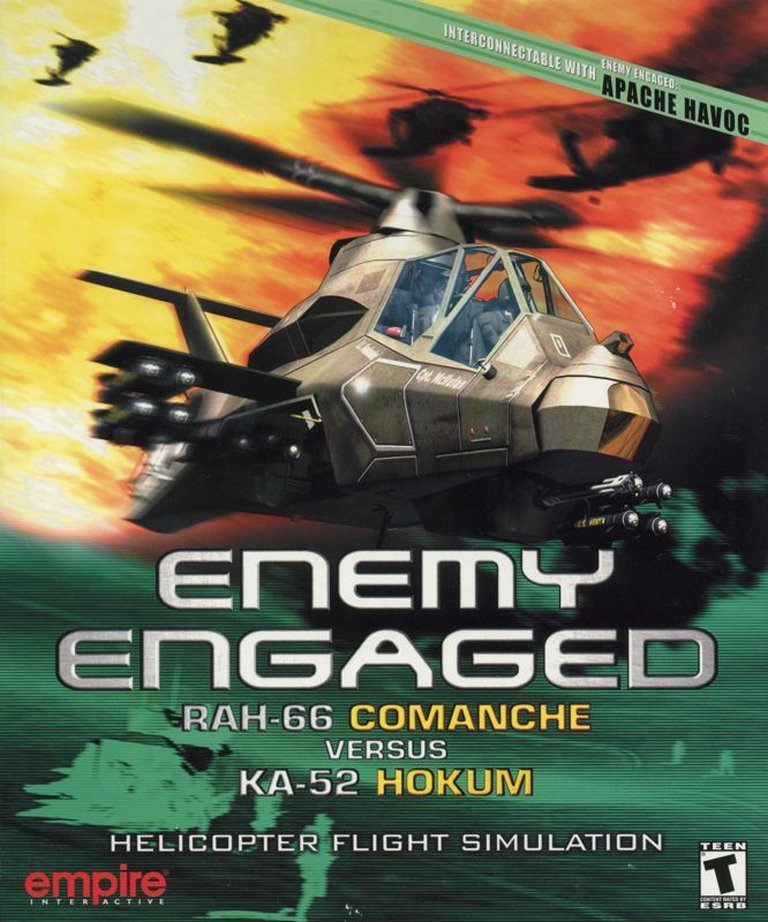
Enemy Engaged: RAH-66 Comanche versus Ka-52 Hokum is a helicopter combat simulation game where players take control of either the advanced U.S. RAH-66 Comanche for NATO forces or the Russian Ka-52 Hokum for Warsaw Pact allies, engaging in intense aerial battles from both pilot and gunner perspectives. Set in three semi-dynamic campaigns across conflict zones in Lebanon, Yemen, and Taiwan, the game offers customizable reality options, improved graphics, and gameplay mechanics over its predecessor, allowing for strategic multiplayer sessions and cross-game compatibility with prior titles.
Gameplay Videos
Where to Buy Enemy Engaged: RAH-66 Comanche versus Ka-52 Hokum
PC
Crack, Patches & Mods
Guides & Walkthroughs
Reviews & Reception
metacritic.com (86/100): Of all the helicopter simulations released this year, Razorworks’ product is in a class by itself.
bobulous.org.uk : This game is great fun, and it actually means something to get good at the game and wonder if you could do the same in the real world.
gamespot.com (90/100): Enemy Engaged sets a higher standard for how immersive a flight sim can be, while it also avoids getting mired down in the technical minutiae of combat aviation.
Enemy Engaged: RAH-66 Comanche versus Ka-52 Hokum: Review
Introduction
Imagine the thrum of dual rotors slicing through the humid air of a Yemeni desert night, your helmet-mounted display locking onto a column of enemy tanks 8 kilometers out, while SAM radars paint your position like a bullseye. In Enemy Engaged: RAH-66 Comanche versus Ka-52 Hokum (2000), Razorworks delivers this pulse-pounding tension as a pinnacle of early-2000s helicopter simulation, where split-second decisions mean the difference between a medal and a fireball. As a sequel to the acclaimed Enemy Engaged: Apache/Havoc (1998), it shifts focus to next-generation rotors: the stealthy American RAH-66 Comanche for NATO forces and the agile Russian Ka-52 Hokum for Warsaw Pact analogs. This game isn’t just a sim—it’s a tactical chess match in the sky, blending raw piloting realism with dynamic warfare. My thesis: Enemy Engaged stands as a landmark in vehicular combat simulations, innovating tunable realism and emergent storytelling that influenced the genre, even as its dated visuals and steep curve remind us of its era’s ambitious constraints.
Development History & Context
Razorworks, a UK-based studio founded in the mid-1990s by a team of aviation enthusiasts including key designers like Kevin Bezant and Dave Lomas, envisioned Enemy Engaged as an evolution of their debut, Apache/Havoc. Drawing from real-world military tech—consulting sources like FAS.org for accurate specs on the Comanche and Hokum—the developers aimed to create a “sim for the new millennium,” as one reviewer put it. The Comanche, a then-prototype stealth heli never fully produced, and the Hokum, a battle-tested Ka-50 variant, were chosen to pit cutting-edge Western innovation against rugged Soviet engineering, reflecting Cold War echoes in a post-1991 world.
Released in 2000 for Windows (with a 2004 Mac port by Feral Interactive), the game arrived amid a booming flight sim renaissance. Jane’s Longbow 2 (1997) had set an impossibly high bar for helicopter realism, while broader gaming trends favored accessible action titles like Half-Life. Technological constraints were stark: Pentium-era PCs with 64MB RAM struggled with the game’s massive terrains and real-time AI, leading to compromises like simplified physics (no full fluid dynamics) and CD-ROM distribution. Publishers Empire Interactive pushed for broader appeal, adding tunable “reality options” to bridge sim purists and casual players. Razorworks’ vision—semi-dynamic campaigns simulating theater-wide conflicts—pushed boundaries, but budget limits meant no mission editor (unlike rivals like Gunship!). Credits highlight a lean team of 62, including composer Alex Cable for tense soundscapes and beta testers like “Hawk” Doyle for balancing. In the landscape of 2000, where Deus Ex emphasized choice, Enemy Engaged carved a niche for procedural warfare, foreshadowing open-world military sims.
Narrative & Thematic Deep Dive
Enemy Engaged eschews linear storytelling for emergent narrative, a bold choice in an era of scripted epics like Final Fantasy IX. The “plot” unfolds across three semi-dynamic campaigns—Lebanon (urban insurgency), Yemen (desert armored clashes), and Taiwan (naval-amphibious showdowns)—where geopolitical analogs pit NATO-inspired Blues against Warsaw Pact Reds. No protagonists with arcs here; you’re an anonymous pilot, rising from lieutenant to colonel via promotions and medals (e.g., Congressional Medal of Honor equivalent). Missions emerge from a war generator: recon a FARP, SEAD an airbase, or escort insertions, all influenced by your actions and AI counterparts.
Themes center on modern warfare’s asymmetry and fog of war. Radio chatter—scripted by experts like CW3 Steve Grimaldi—immerses you in tactical lingo: “This is Alpha-Two, under fire from enemy armor at grid 045-312!” Dialogue from your co-pilot gunner (CPG) adds personality, barking warnings like “Incoming missile, nine o’clock!” or “Low on Hellfires!” amid procedural chaos. Underlying motifs explore technological parity: the Comanche’s stealth (retractable weapons bays) versus Hokum’s brute force (ejector seats, coaxial rotors), symbolizing U.S. precision against Russian resilience. No deep characters, but the telex log and battle reports weave a tapestry of attrition—destroy a refinery, and enemy logistics crumble; fail a CAS run, and your lines retreat.
Critically, the narrative shines in its reactivity: capturing an enemy FARP flips territorial control, spawning new objectives like BDA (battle damage assessment). Flaws emerge in repetition—endless “tubes committed” artillery denials feel scripted—yet the themes resonate, critiquing endless conflict without preachiness. In Yemen’s wadis, ambushing convoys evokes Gulf War echoes; Taiwan’s straits, a hypothetical flashpoint. It’s not Spec Ops: The Line‘s moral depth, but for a sim, it humanizes the cockpit, making every rotor spin a narrative beat.
Gameplay Mechanics & Systems
At its core, Enemy Engaged loops through planning, execution, and adaptation, deconstructing helicopter combat into accessible yet deep layers. Start in the campaign map: assign missions (strike, CAP, CAS) to AI flights while plotting yours—scout via radar (Hokum’s 10km edge) or FLIR, then payload up (e.g., 16 Hellfires on Comanche). Tunable realism sliders let newbies auto-hover while vets wrestle full dynamics, including vortex rings and retreating blade stall.
Combat is the heartbeat: pilot the cyclic/collective while your CPG handles targeting, or manual-override for dual roles. Blues favor fire-and-forget Longbow Hellfires (LOAL/LOBL modes for pop-up ambushes), ripple-firing 16+ to shred tank columns; Reds guide Vikhrs (9.8km range) manually, risking exposure but enabling “curling” tricks—faking locks to arc missiles over hills. Air-to-air demands guts: Stingers/Iglas for close-range dogfights (Mach 2.5 speed, but decoy-spoofed easily), or ATGMs splashing formations. Ground fights reward tactics—low-level “weeds” flying evades SAMs (Chaparral IR vs. Grison radar-command), but tanks’ 2.5km guns demand side/rear shots. Progression ties to performance: kills earn medals, promotions unlock flights; a 90% success rate yields aces.
UI is cockpit-centric: MFDs cycle radar/FLIR/DTV (Hokum’s periscope shines for peeking), HUDs show VSI/speed, HMDs enable 170° off-boresight locks. Innovations like cross-game multiplayer (patch-import Apache/Havoc campaigns for six total) and dynamic AI (units distract via artillery) create emergent chaos—your SEAD run alters fronts. Flaws persist: steep curve (manual lacks cyclic/collective basics), bugs (FARP “bunny-hopping,” infinite SAM ammo), and dated controls (no USB native pre-1.46X). Yet systems like ECM (chaff/flares lasting 3s default) and damage modeling (knock-on engine fires) feel punishingly real—tail rotor loss demands ground-effect hovers. Multiplayer (LAN/Internet) amps tension, with human “funnels” (Hokum orbiting fire) turning skies lethal. Overall, it’s exhaustive: 300+ cannon rounds, 40 rockets, tunable payloads foster replayability, though mods (EECH Central) fix AI aggression.
World-Building, Art & Sound
The game’s world is a sprawling theater of war, with campaigns crafting immersive backdrops from real geopolitics. Lebanon’s urban sprawl—mosques, hotels hiding MANPADS—forces tight-quarters flying; Yemen’s dry riverbeds enable ambushes amid endless dunes; Taiwan’s straits mix naval threats (Kiev carriers demanding low-sea runs) with mountainous LOS blocks. Atmosphere builds dread: dynamic weather (rain slicks cockpits, night erases horizons) and time-of-day cycles (dusk FLIR glows eerie) make patrols tense. World-building shines in procedural scale—maps span 100+km, with factories, refineries as strategic chokepoints; destroying a power station cascades enemy ops failures.
Visual direction, while innovative for 2000, shows age: detailed cockpits (Comanche’s glass MFDs, Hokum’s analog backups) and 360° panning impress, but landscapes flatten (jagged Yemen rocks clip poorly; no shadows on Comanche wings). External views capture rotor blur and missile trails vividly, yet low-poly cities stutter on period hardware. Art contributes immersion via authentic models—Grison’s quad-30mm menace, pylons as rotor-clip hazards—though mods enhance skins (e.g., Alaska campaigns).
Sound design elevates the experience: Alex Cable’s score (CD Track 2) pulses with industrial synths during strikes, fading to radio static for recon. Effects roar—Vikhr whooshes, 30mm chatter shreds armor—while voice scripting (Grimaldi’s authentic calls) grounds you: “Bogey, six o’clock low!” CPG banter (“Low on chaff!”) adds urgency, though repetitive loops grate. Rain patters on canopies; engine torque whines at 120%. These elements forge a cockpit symphony, where audio cues (missile gimbal warnings) outpace visuals, immersing you in the fog of war despite graphical limits.
Reception & Legacy
Upon 2000 launch, Enemy Engaged garnered solid acclaim, averaging 81% from 27 critics (MobyGames). Computer Gaming World awarded 100%, hailing it a “great sim” for its excitement and accessibility; IGN and GameSpot (both 90%) praised dynamic campaigns surpassing Longbow 2, though noting jarring graphics. European outlets like GameStar (81%) lauded physics, while PC Games (72%) critiqued dated visuals. Player scores hit 3.9/5, with gripes on steep learning but praise for immersion. Commercially modest—bundled in packs like Xplosiv Collection—it sold steadily via budget bins ($1.19 on GOG today), bolstered by 36 collectors.
Reputation evolved via community: Patches (up to 1.46X) fixed USB/joystick woes; mods like 1.51D (EECH Central) added A-10 Mavericks, Alaska maps, extending life. The FAQ community (SimHQ) dissected tactics, birthing squadrons. Influence ripples: It inspired Comanche 4 (2001) and mod-heavy sims like Arma series, proving dynamic campaigns viable. As helicopter sims waned post-9/11 (focus shifting to jets), Enemy Engaged endures as a cult touchstone—EECH Central’s enhancements keep it alive, influencing indie revivals. Flaws (bugs, no editor) tempered hype, but its legacy is procedural warfare’s blueprint, predating DCS World‘s modules.
Conclusion
Enemy Engaged: RAH-66 Comanche versus Ka-52 Hokum masterfully fuses simulation depth with tactical emergence, from curl-shot ATGMs to campaign-altering strikes, outshining predecessors in scope while humanizing modern rotors through tense audio and reactive worlds. Its innovations—tunable realism, cross-title play—overcame era constraints, delivering thrills that endure via mods. Yet, dated graphics, bugs, and accessibility hurdles prevent perfection. Verdict: A definitive 8.5/10, essential for genre historians and sim aficionados; it secures Razorworks’ niche in video game history as the unsung hero of dynamic helicopter warfare, proving even unproduced birds can soar eternally.