
- Release Year: 2005
- Platforms: Windows
- Publisher: DreamCatcher Interactive Inc., Halycon Media GmbH & Co. KG
- Developer: Tesseraction Games, Inc.
- Genre: Simulation
- Perspective: 1st-person, 3rd-person
- Game Mode: Single-player
- Gameplay: Fleet command, Naval combat, Realistic simulation, Submarine warfare, Voice command
- Setting: Historical, Ocean, World War II
Description
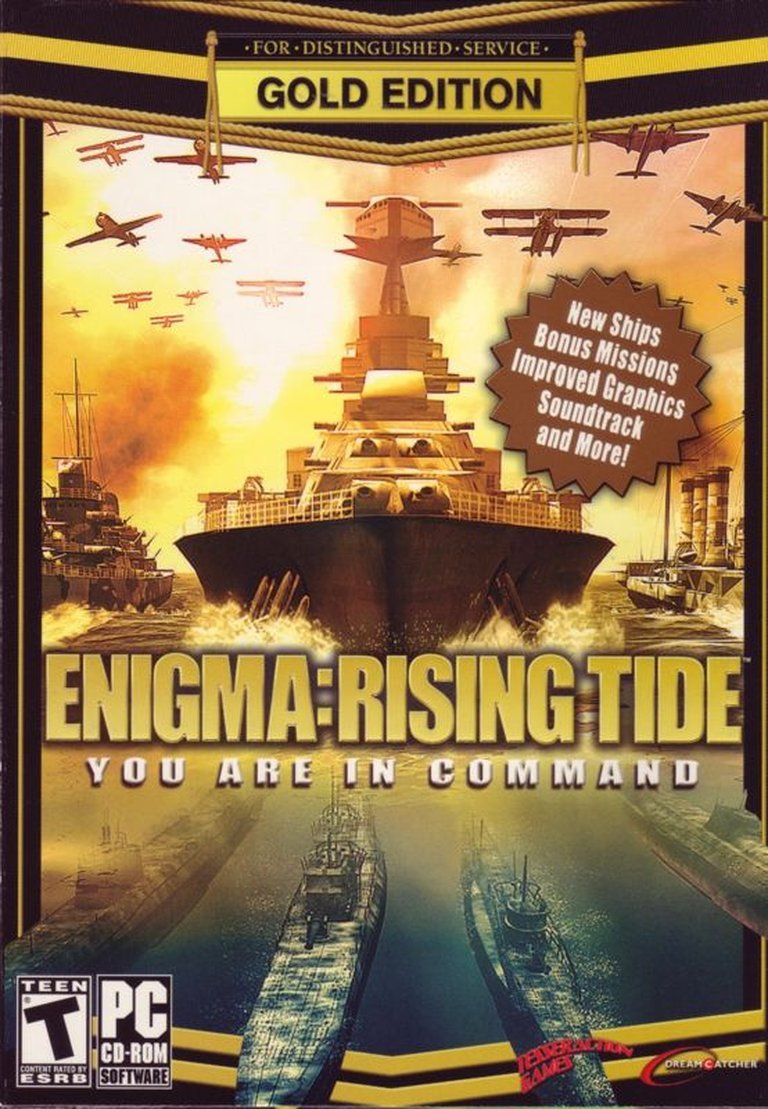
Enigma: Rising Tide (Gold Edition) is a team-oriented naval simulation set in an alternate World War II era where three factions—the United States, Imperial Germany, and the League of Free Nations—vie for control of Earth’s oceans. Players begin as commanders of individual warships and can advance to admirals, strategically overseeing fleets in realistic combat involving submarines, destroyers, and atmospheric conditions, with the Gold Edition adding enhanced graphics, more missions, and voice command features like Professional Crew Response.
Gameplay Videos
Enigma: Rising Tide (Gold Edition) Free Download
Enigma: Rising Tide (Gold Edition) Cracks & Fixes
Enigma: Rising Tide (Gold Edition) Reviews & Reception
reviewgraveyard.com : Nice graphics, great sound effects and a rousing score help to complete the package.
worthplaying.com : Blending elements of a true-to-form naval sim through FPS and RPG elements, Rising Tide makes a nicely suitable introduction to newbies, and also provides enough of a challenge for the most battle-weary console commandant.
Enigma: Rising Tide (Gold Edition): A meticulously detailed, flawed gem of naval simulation history
Introduction: An Alternate Ocean, A Singular Vision
In the vast and often turbulent sea of video game history, few titles chart a course as deliberately niche and ambitiously crafted as Enigma: Rising Tide (Gold Edition). While the naval simulation genre has seen its share of titans—from theossal board-game adaptations of Jutland to the meticulous systems of the Harpoon series—Enigma represents a daring, if uneven, confluence of styles. It is a game that sought to marry the tense, calculated patience of a submarine simulator with the visceral, first-person action of a bridge gunner, all wrapped in a richly textured “what if?” scenario of geopolitical upheaval. Released in 2005 as a definitive updated version of the 2003 original, the Gold Edition did not merely patch a game; it refined a deeply idiosyncratic vision, cementing its status as a cult classic for a dedicated cadre of naval combat enthusiasts. This review will argue that Enigma: Rising Tide is a profound case study in ambition constrained by era and execution—a game whose revolutionary interface and immersive atmosphere were paradoxically both its greatest strengths and the sources of its most persistent flaws. Its legacy is not one of mainstream influence, but of a fiercely loyal community and a testament to the enduring appeal of specialized, mechanically deep simulations.
Development History & Context: The Alchemy Engine and a Small Studio’s Dream
Enigma: Rising Tide was the brainchild of Tesseraction Games, Inc., a small American studio led by producer and writer Kelly Asay and lead designer Alex Jimenez. Development occurred in the early-to-mid 2000s, a period of transition for PC gaming. The era was marked by the rising dominance of graphics-focused action titles and the fragmentation of the simulation market. Tesseraction, operating likely with a tight budget and small team (the credits list 50 individuals, but core development was concentrated), utilized the proprietary Alchemy engine. This engine was ostensibly built for the task of simulating a dynamic, 3D ocean environment—a significant technical hurdle at the time. The team’s ambition is evident in their attempt to model not just ship and submarine physics, but also realistic sea states, weather effects, ballistics, and a complex voice command system.
The gaming landscape of 2003-2005 was receptive to hardcore simulations but increasingly skeptical of their commercial viability. The classic Silent Service and Aces of the Deep series had pioneered submarine warfare, but Aces of the Deep (1994) was already a decade old, and its famed voice command system was primitive. Enigma entered this space with the explicit goal of modernizing the genre’s presentation while deepening its tactical systems. Its publisher, DreamCatcher Interactive, had a history of bringing niche simulations and strategy games to North American audiences, making them a logical, if not blockbuster-oriented, partner. The Gold Edition (2005), published also by Halycon Media GmbH & Co. KG for Europe, was a response to feedback and a chance to leverage the original’s foundation with new content and polish, a common practice for “Gold” releases of that era.
Narrative & Thematic Deep Dive: The Geopolitics of a Seaborne World War
The heart of Enigma‘s identity is its alternate-history narrative, a “what if” scenario of profound and clever design. It posits a world where Imperial Germany won World War I, effectively dominating continental Europe. This victory forced the British Empire into a desperate exile, eventually forging a union with a ascendant Japanese Empire to form the League of Free Nations (LFN). Meanwhile, a economically booming but expansionist United States, seeking new markets and bases, has entered the global fray, leading to a tense, three-way cold war hotening in the late 1930s.
This framework is not mere window dressing. It fundamentally shapes every mission briefing, every ship design, and every geopolitical objective. The factions are not just aesthetic reskins:
* The United States emphasizes coordinated fleet actions, carrier air power (a logical extension of their historical trajectory), and robust surface combatants. Their technology feels like a polished, advanced version of late-1930s USN designs.
* Imperial Germany, having conquered Europe, redirects its industrial might. As the narrative explicitly states (particularly in the epilogue of Chapter 1), the German High Command, seeing the vulnerability of battleships to air power (ala the Scapa Flow raid), pivots to aircraft carriers and naval aviation. This is a historically fascinating twist, leading to prototypes like the converted Bismarck-class “battlecarriers” seen in the game’s epilogue—warships carrying planes while retaining heavy gun batteries.
* The League of Free Nations (British-Japanese alliance) represents a hybrid doctrine, using British radar and fire control paired with Japanese aggression and advanced torpedo technology (think the historic “Long Lance” but potentially earlier).
The story is delivered through a clever blend of diegetic interfaces and cinematic cutscenes. Players receive mission orders via in-game newspaper clippings (evoking period propaganda) and radio transmissions from Admirals. The campaign is structured around a rank-progression system: you begin as the Commander of a single destroyer or submarine, and through successful missions, can rise to command a full task force or fleet as an Admiral. This creates a powerful personal stake; you aren’t just a faceless ace, but an officer ascending through a specific chain of command within this tripartite conflict. Thematic undercurrents explore technological revolution (the dawning carrier age vs. the battleship), imperial ambition, and the fog of war, where intelligence is often fragmentary and loyalties are complex. The narrative’s strength lies in its consistency and its use of gameplay—the missions you fight—to directly illustrate the escalating global tension, from Caribbean destroyer skirmishes to massive fleet actions in the North Atlantic.
Gameplay Mechanics & Systems: Command, Control, and Chaos
Enigma’s gameplay is a unique hybrid, often described as a “team-oriented naval sim.” Its core innovation is the seamless transition between strategic command and first-person action.
1. The Command Interface & “Hands-Free” Philosophy:
At its purest, you operate from a tactical map view, issuing orders to your entire group (which can grow from one ship to a full squadron). You can set patrol courses, designate enemy groups as targets, order torpedo spreads, and call for anti-aircraft fire. The control scheme is brilliantly simplified: you often click on a map location or an enemy icon to issue complex orders, trusting your AI crew to execute them with reasonable competence. This design philosophy aims to make you the commander, not the helmsman of every individual ship.
2. The Voice Command System (VCS) – The Game’s Defining Feature:
This is Enigma‘s most celebrated and groundbreaking element. Using a microphone and the EnigmaSAPI speech recognition utility, players could issue most tactical commands verbally: “Torpedo, enemy destroyer, mark!” “Come left, one-eight-zero.” “General quarters, man your stations.” The Gold Edition’s “Professional Crew Response” enhancement was critical; your crew would vocally confirm orders (“Aye, aye, sir!”, “Torpedoes in the water!”), providing essential audible feedback and dramatically increasing immersion. For its time, this system was remarkably robust, as contemporary reviews (like Worthplaying’s) noted its ability to understand commands even with a speech impediment. It allowed for a truly “hands-free” command experience that felt like being in a warship’s combat information center.
3. First-Person Action & Multi-Role Stations:
When the situation demanded direct intervention, you could click on any weapon station on your own ship’s schematic to jump into a first-person perspective. This meant:
* Manning a deck gun or anti-aircraft cannon, aiming and firing in an FPS style.
* Looking through a submarine’s periscope or hydrophone.
* Controlling depth charge projectors or “hedgehog” launchers.
This created a dynamic flow: strategizing on the map, then grabbing a gun to swat an incoming bomber, then popping back to the periscope to track a target. It successfully merged the strategic sim with arcade action without fully committing to either.
4. Ship Handling, Physics, and Realism:
The game’s physics model for ship movement and ocean dynamics was a major selling point. Vessels heaved and rolled in sync with sea states, affecting gunnery accuracy and torpedo aiming. Ballistics were realistic: torpedoes had defined ranges, speeds, and arming distances; shell trajectories were parabolic. This meant engagements required careful calculation of bearing, angle, and target speed—a true tactical challenge. The Gold Edition enhanced this with more dynamic water, particle effects, and improved damage modeling where fires and flooding had cumulative, sinking effects.
5. AI, Campaign, and Progression:
The AI was competent but divisive. Enemy submarines used “wolf pack” tactics, while aircraft aggressively hunted players. However, as the Swedish review from GameElite.se highlighted, the realism of speed was a double-edged sword. The slow pace of WW2-era vessels—the time it took for a ship to reach an engagement zone or for a torpedo to travel its track—could lead to long periods of waiting, which some found tedious and others found authentically tense. The campaign provided over 90 missions across 35+ training missions and 6 campaign arcs, with dynamically assigned objectives. Progression was tied to survival and mission success, unlocking larger ships and greater command authority.
Flaws and Friction Points:
* Control Complexity: While simplified from hardcore sims, the interface still had a learning curve. Managing multiple ship groups via the map required practice.
* Pace: The deliberate slowness of naval warfare, while realistic, was cited by some (GameElite.se, PC Games Germany) as a detriment to “fun” for players accustomed to faster pacing.
* Limited Multiplayer Scope: A glaring omission in the Gold Edition, as noted by Worthplaying’s review, was any form of multiplayer. The original Enigma had an online component; its removal or severe limitation in the Gold package was a major regression for community longevity.
World-Building, Art & Sound: The Briny Deep and Steel Thunder
Enigma succeeds most powerfully in crafting an atmosphere of wartime tension on the high seas.
Visuals & Environment:
The Alchemy engine’s ocean was a star. The Gold Edition’s enhancements brought more detailed water shaders, realistic wake generation, and dynamic weather—from calm, glassy seas to storm-tossed, foam-capped waves that genuinely impacted visibility and stability. Ship models were meticulously detailed, with historically accurate superstructures, gun turrets, and fittings for all three factions. The alternation of history allowed for fascinating “Kaiserschlacht” (battlecarrier) variants of Bismarck and Tirpitz, a visual treat for history buffs. Lighting was particularly effective: dawn and dusk patrols featured beautiful, low-angle sunbeams glinting off the water, while night missions used searchlights and the ominous red tracers of anti-aircraft fire to carve paths through darkness. The UI, repurposed for the Gold Edition, mimicked period-appropriate radar scopes and ship schematics, reinforcing immersion.
Sound Design & Musical Score:
The soundscape is a masterclass in diegetic and non-diegetic tension. The constant creak of hull steel, the hiss of released steam, the crump of distant shellfire, and the splash of torpedo entries are all rendered with clarity. The voice command system’s success was entirely dependent on clear, crisp audio feedback from the crew, and the Professional Crew Response additions made the bridge feel alive. Timothy Steven Clarke’s musical score is a rousing, period-inspired orchestral piece that swells during fleet actions and recedes to a tense, minimalist drone during stalk-and-hunt sequences, perfectly underscoring the narrative’s stakes.
The Alt-History Aesthetic:
The world-building extended to the visual identity of the factions. German ships carried Imperial war ensigns, US vessels had pre-war grey schemes, and the LFN blended British and Japanese markings. Newspaper headline missions and period-accurate ship names (like the German flagship Kaiser Wilhelm) constantly reinforced the alternate timeline, making the player feel like a participant in a living, plausible history.
Reception & Legacy: A Cult Classic Forged in Obscurity
Critical Reception at Launch:
Reviews for the Gold Edition were mixed but respectful, averaging 74% from critics. The divide was ideological:
* 2404.org (86%) hailed it as “one heck of a fun naval combat and command simulation,” praising its depth and the seamless integration of styles.
* GameElite.se (70%) and PC Games (Germany) (65%) criticized the slow, deliberate pace as a major detractor from the overall experience. The Swedish review explicitly stated that the realism in speed dragged down the impression, a common critique for sims seeking broader appeal.
* The voice command system was almost universally praised as revolutionary and well-executed when it worked.
* The lack of multiplayer was a consistent point of disappointment, seen as a major step back from the original’s ambitions.
Commercial Performance & Cult Status:
Commercially, Enigma was never a blockbuster. It occupied the deep end of the simulation pool, a niche within a niche. However, it found its audience. Its subsequent availability on abandonware sites like My Abandonware and the Subsim community forum is the truest indicator of its legacy. For nearly two decades, a dedicated community has kept it alive. The fact that the game’s ISO is distributed with dgVoodoo wrapper instructions and a community-made patch (v3.0.0) speaks volumes. Players are actively maintaining it on Windows 10/11, a testament to its enduring appeal for a specific type of player—the “armchair admiral” who values atmosphere, authenticity, and tactical depth over cinematic spectacle or accessibility.
Influence and Industry Place:
Enigma had no mass-market influence. It did not spawn sequels or clones. Its innovations, particularly the sophisticated voice command integration, were not picked up by major publishers, who likely saw the technology as a gimmick or too niche for the cost. Instead, its legacy is preservationist and inspirational. It stands as a high-water mark for a specific sub-genre: the “action-accessible” naval simulator. It demonstrated that you could have a game with the strategic depth of Harpoon but the visceral feel of an FPS. For the developers at studios like Naval warfare specialists or indie teams working on projects like Silent Hunter or the modern World of Warships, Enigma is likely a revered footnote—a game that proved the concept of multi-role, command-centric naval combat was viable, even if the market wasn’t ready for its particular blend.
Its place in history is that of a beautiful, flawed artifact—a game that reached for a perfect synthesis of simulation and action but was ultimately held back by the technical and design constraints of its time (notably, the pace and the lost multiplayer). It is remembered not for what it changed in the industry, but for what it achieved in isolation: a deeply immersive, mechanically rich, and narratively compelling alternate-history naval epic.
Conclusion: The Verdict on a Sunken Treasure
Enigma: Rising Tide (Gold Edition) is not a perfect game. Its deliberate pace will alienate the action-seeking玩家; its interface, while improved, still carries a learning curve; and the absence of the original’s multiplayer is a fatal flaw for any game built on “team-oriented” foundations. Yet, to dismiss it on these grounds is to miss its profound and unique accomplishments.
It is a masterclass in atmosphere and niche design. The alternate-history narrative is not an excuse for fantasy, but a coherent framework that justifies every ship and mission. The voice command system, especially with Professional Crew Response, remains one of the most innovative and immersive control schemes ever implemented in a sim. The feeling of sitting in a submarine’s cramped conning tower, whispering “up periscope” and listening for the认同 of your crew, or bellowing “All guns, fire at will!” as a formation of enemy planes descends, is unparalleled.
For the historian of gaming, Enigma is a crucial document. It captures a moment when simulation developers were experimenting with hybrid genres and natural user interfaces. It represents the last, most ambitious gasp of a certain breed of PC naval sim before the genre either became too complex for mainstream consumption (Harpoon) or too streamlined for hardcore realism (World of Warships).
For the player, it is a buried treasure. If you possess the patience to learn its rhythms, the desire to command not just a ship but a developing fleet, and the appreciation for a world built from the keel up, the Gold Edition offers dozens of hours of uniquely engaging gameplay. Its availability through abandonware, supported by a community keeping it alive on modern systems, is a generous gift.
Final Verdict: Enigma: Rising Tide (Gold Edition) earns its place not on a shelf of classics, but in a special cabinet of “essential curiosities.” It is a 9/10 experience for the initiated simulator veteran, a flawed but magnificent ship that sails true to its own fascinating course. For the broader gaming public, it remains an 8/10—a fascinating, historical oddity whose ambitions sometimes ran aground on the rocks of its own realism, but whose legacy as a bold and immersive vision is undeniably secure. It is, in the end, an enigma indeed: a game that asks much of its player and, in return, offers a world unlike any other.