
- Release Year: 2001
- Platforms: Windows
- Publisher: Funbox Media Ltd., Imagineer Co., Ltd., Jordan Freeman Group, LLC, Rage Games Ltd.
- Developer: Rage Games Ltd.
- Genre: Driving, Racing
- Perspective: 1st-person
- Game Mode: Co-op, Online PVP, Single-player
- Gameplay: Online Multiplayer, Track racing, Vehicle Customization
- Setting: Automobile
- Average Score: 78/100
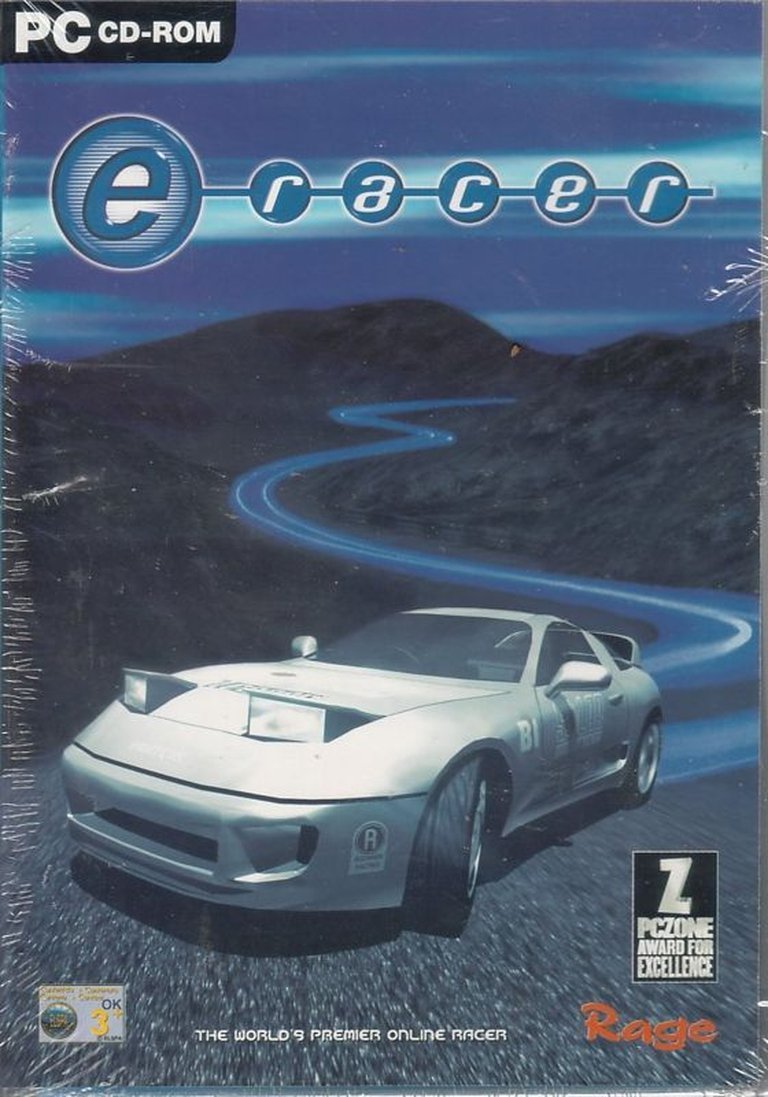
Description
eRacer is an arcade-style racing game that offers both online and offline experiences. Players can compete in challenges, join cooperative play, and download new tracks and cars over the Internet or LAN. The game features three modes: Championship, Arcade, and Time Trial, with 14 tracks and eight cars to unlock and upgrade. Offline, players can race against AI opponents and progress through the championship to access new content.
Where to Buy eRacer
eRacer Free Download
eRacer Cracks & Fixes
eRacer Patches & Updates
eRacer Guides & Walkthroughs
eRacer Reviews & Reception
mobygames.com (59/100): eRacer is a real-world arcade racing game that, as the title indicates, has some features that make it suitable online.
myabandonware.com (97/100): Rage’s eRacer concentrates on online play, and sets it in a modern-day but imaginary competition.
eRacer: A Cult Classic Arcade Racer Caught Between Innovation and Limitation
Introduction
In the crowded landscape of early 2000s racing games, eRacer emerged as a curious hybrid—a title that dared to marry arcade thrills with nascent online multiplayer ambitions, yet stumbled under the weight of its own aspirations. Developed by Liverpool-based Rage Games Ltd., eRacer (2001) promised a “real-world arcade racing” experience with downloadable tracks, aggressive AI, and a progression system that demanded precision. While overshadowed by contemporaries like Colin McRae Rally 2.0 and Need for Speed: Porsche Unleashed, eRacer carved a niche as a flawed but ambitious experiment in online competition and player-driven content. This review explores how eRacer balanced innovation with technical limitations, and why it remains a fascinating time capsule of a transitional era for racing games.
Development History & Context
Studio Vision & Constraints
Rage Games Ltd., known for Hostile Waters: Antaeus Rising and Eurofighter Typhoon, entered the racing genre with eRacer during a tumultuous financial period. The studio aimed to capitalize on the rising popularity of online gaming, leveraging its proprietary 3Dream engine to deliver LAN and internet multiplayer—a bold move in an era dominated by dial-up connections. The team, led by Richard Badger (Project Manager/Lead Programmer) and Andrew Bate (Lead Artist), prioritized modularity, designing tracks and cars for post-launch expansions.
Technological Ambitions
eRacer’s focus on online play was revolutionary. Players could download new tracks, share replays via email, and even check leaderboards on WAP-enabled mobile phones—a precursor to modern cloud-based features. However, technical limitations plagued the experience: latency caused “warping” cars during online races, and the lack of force feedback support alienated wheel peripheral owners. The game’s bundling with Creative’s GeForce3显卡 hinted at its graphical aspirations, but low-poly environments and flat textures betrayed the studio’s budgetary constraints.
Era Context
Released alongside Gran Turismo 3 and Project Gotham Racing, eRacer struggled to compete. Its unlicensed cars (e.g., the Mantis VRS, a BMW M5/Ford Mustang hybrid) and fictional tracks lacked the glamour of licensed rivals. Yet, its focus on accessibility—keyboard-friendly controls, a damage system that avoided realism—positioned it as a “budget” alternative for casual players.
Narrative & Thematic Deep Dive
eRacer eschewed narrative for pure competition. Its thematic core revolved around meritocracy: players climbed from amateur to professional tiers, unlocking cars like the NSX-inspired Aero-Tech SX or the Porsche 911 GT1-esque Dominator GTR by winning races. The game’s progression system mirrored a capitalist grind—prize money funded repairs and upgrades, with poor performance leading to financial ruin.
The absence of human spectators and eerie, lifeless tracks (e.g., Scrap Yard, Chemical Plant) reinforced a dystopian, almost Twisted Metal-like atmosphere. This unintentional bleakness became a bizarre charm point, accentuated by synth-heavy tracks that oscillated between energetic and monotonous.
Gameplay Mechanics & Systems
Core Loop
The Championship mode demanded perfection: finish in the top four (Amateur) or top two (Professional) to unlock new tracks. Races cost entry fees, and damage repairs drained funds, creating a risk-reward tension. The damage system—abstracted as a percentage meter—penalized reckless driving but avoided visual realism, a compromise between arcade fun and simulation stakes.
Driving Model: Identity Crisis
Critics lambasted eRacer’s physics as neither fully arcade nor simulation. Cars exhibited odd weight distribution, with exaggerated drifts and sudden spins. The handbrake was vital for hairpin turns but prone to oversteer. Yet, this jankiness bred a cult following—mastering the Mantis VRS’s quirks felt rewarding, akin to taming a wild animal.
UI & Innovation
The minimalist UI showed laps, damage, and a track map, avoiding clutter. The replay system and ghost car in Time Trial mode were forward-thinking, allowing players to analyze mistakes. However, the lack of customizable controls and steering wheel support felt archaic even for 2001.
World-Building, Art & Sound
Track Design: Highs and Lows
Tracks like Car Park (a multi-level garage with tight corners) and Aircraft Carrier (a coastal runway leading to naval deck jumps) showcased creativity. Yet, many courses suffered from repetitive textures and confusing shortcuts—Stone Quarry’s narrow pathways and unmarked turns frustrated players.
Visuals: A Mixed Legacy
The 3Dream engine delivered smooth performance on mid-tier PCs, but environments felt sparse. Flat billboards replaced crowds, and cars lacked detail beyond glossy paint jobs. The sun-glare effect, while ambitious, often blinded players unnecessarily.
Sound Design: Missed Opportunities
Engine roars lacked punch, and synth tracks (e.g., the menu theme) quickly grated. The game’s silence during races heightened its lonely atmosphere—a divisive choice that some found immersive, others dull.
Reception & Legacy
Critical Divide
Reviews averaged 59%, praising the online features and track diversity while skewering the punishing AI and inconsistent physics. Jeuxvideo.com (75/100) called it “original and well-designed,” while PC Action (35/100) dismissed it as a “poor joke.” Players, however, rated it 3.5/5, celebrating its challenge and unlockables.
Enduring Influence
While eRacer never achieved mainstream success, its modular approach to content (e.g., 2025’s Track Pack DLC) presaged live-service models. The Steam re-release introduced widescreen support and controller remapping, revitalizing interest. Today, it’s remembered as a proto-Trackmania—a janky yet inventive experiment in community-driven racing.
Conclusion
eRacer is a study in contradictions: a game that reached for online innovation but faltered under technical limitations, that balanced arcade fun with brutal difficulty, and that built a small but passionate fanbase despite critical indifference. While it lacks the polish of its peers, its ambition—online leagues, downloadable content, a proto-metagame economy—makes it a fascinating footnote in racing history. For modern players, eRacer offers a nostalgic challenge, best enjoyed as a relic of an era when “e” stood for experimentation as much as “electronic.”
Final Verdict:
A 6.5/10 experience—flawed yet historically significant, eRacer is worth revisiting for racing enthusiasts and historians, but its steep learning curve and dated systems may alienate casual players. Its legacy lies not in perfection, but in daring to imagine an online future that others would later perfect.