
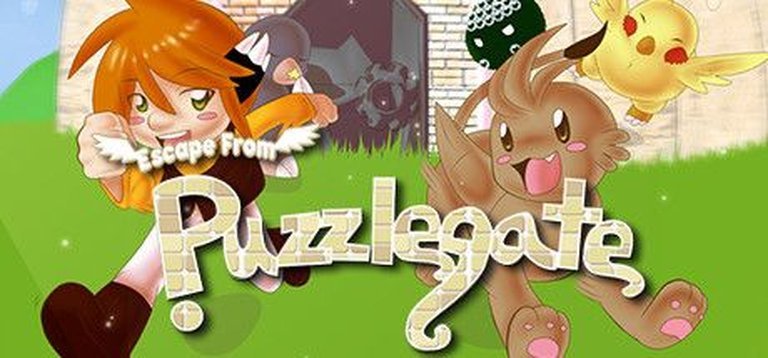
Description
Escape from Puzzlegate is a fantasy puzzle adventure game where Ken, after wandering into a forest out of boredom, becomes trapped behind a mystical door to another world. With the help of a baby sphinx named Ari, he must search for four scattered keys to unlock the door and escape, facing various challenges in this strange, puzzle-filled realm.
Escape from Puzzlegate: A Cipher Wrapped in a Cute, Confounding Enigma
Introduction: The Gate That Few Entered
In the vast, crowded archives of digital amusement, certain titles exist as quiet curiosities—games known more by their listing on a database than by any significant player discourse. Escape from Puzzlegate stands as a prime exemplar of this category. A hybrid visual novel/puzzle game from the tiny indie outfit Moleworks, it promised a charming, cerebral adventure for children yet reportedly delivered an experience that left many adult players baffled and frustrated, as evidenced by its abysmal “Mostly Negative” Steam reception. This review posits that Escape from Puzzlegate is not merely a failed game but a fascinating, symptomatic artifact of indie development in the mid-2010s. It represents a noble but deeply flawed collision of two distinct design philosophies—the branching, narrative-driven visual novel and the logic-bound puzzle game—all wrapped in an aesthetic of deceptively simple cuteness. Its legacy is not one of influence, but of caution: a case study in how targeting an audience can backfire when core mechanics and tonal presentation become fundamentally misaligned.
Development History & Context: The Moleworks Experiment
Escape from Puzzlegate was developed and published by Moleworks, the creative moniker of sole developer Shaynn “Mole-chan” Haugen, who is credited as writer, director, and voice actor (for the character Ari). The game’s development spanned from at least 2008 to its release, a gestation period hinting at a passion project built alongside other commitments. The technological toolkit—Ren’Py for the visual novel segments and Pygame for the puzzle interactions—was a pragmatic choice for a solo developer in the 2010s. Ren’Py offered a robust, accessible framework for dialogue trees and character sprites, while Pygame provided the low-level control needed for custom 2D puzzle mechanics. This dual-engine approach, however, was arguably its foundational flaw; the two systems often feel like estranged siblings sharing a body, with the narrative flow frequently interrupted by jarring transitions into discrete puzzle screens.
The game emerged into a landscape in 2015 where the “visual novel” genre was gaining mainstream traction in the West, largely through adult-oriented or high-drama titles. A family-friendly, puzzle-focused hybrid was a rarity. Moleworks explicitly stated the game was “intended for children ages 7-10” but with “higher difficulty levels” to appeal to adults. This bifurcated target would prove disastrous. The cute, whimsical art style and simple character archetypes clearly signaled a juvenile audience, while the puzzle design, as we will explore, seemingly catered to neither demographic effectively. The game launched quietly on Windows, Mac, and Linux in October 2015, distributed primarily through direct download and Steam, with minimal marketing beyond its official site and community databases like MobyGames and VNDb.
Narrative & Thematic Deep Dive: A Simple Premise, Complex Problems
The plot is a classic isekai-lite premise executed with minimalist efficiency. Ken, a “bright, curious young boy” of ten, wanders into a forest and becomes trapped behind a mystical door to another world. The door requires four keys, scattered across this strange realm. His guide is Ari, a “baby sphinx, age 150 (about 8 years for a sphinx)” who is “lazy” but “incredibly tenacious” with a “mischievous streak.” Their quest takes them through four distinct regions, each governed by a bizarre, whimsical creature.
The narrative structure is entirely linear within each puzzle segment but offers minor branching via dialogue choices that can alter the approach to a puzzle or provide lore. The themes are superficially simple—friendship, curiosity, problem-solving—but are undermined by a pervasive dissonance. Ken is characterized as physically weak but clever, viewing “problems like a puzzle.” This should align him with the player, yet the puzzles often feel like arbitrary logic gates rather than organic challenges from the world. The supporting cast is a gallery of archetypes lifted from children’s fantasy: Midoriko, the “queen of the Kanawa” (laid-back algae beings) who is “quick to anger” over her people’s lazy image; the Topen, greedy mole-like treasure hunters; the Boulekeet, fat birds carried by wind; and the Golepede, “giant rock snakes” that are “exceedingly friendly, if not somewhat dim.”
The central, unintentional theme becomes the frustration of miscommunication. Ken and Ari’s partnership is meant to be synergistic, but the game provides no meaningful mechanical integration of their supposed abilities. Ari is often a passive spectator, breaking the fourth wall with lazy commentary. The dialogue, voiced by a small cast including Shaynn Haugen (Ari), Matthew Garland, and Karen Hayman, is functional but rarely witty or emotionally resonant. The “cute charm” is skin-deep, failing to generate the warmth needed to make the repetitive puzzle-solving palatable. The ultimate irony is that to “escape from Puzzlegate,” the player must solve puzzles that feel like they were designed by the very Golepedes—well-intentioned but dim-witted.
Gameplay Mechanics & Systems: The Fissure Between Novel and Puzzle
This is the core of Escape from Puzzlegate‘s failure. The intended hybrid model is: explore a visual novel scene, gather information/items, then enter a puzzle screen to obtain a key. The execution is catastrophic due to a complete lack of integration.
- Core Loop & Puzzles: The loop is Ken talks to a character → gets a clue or item → enters a puzzle room → solves a logic, pattern, or navigation puzzle → receives a key. The puzzles are entirely disconnected from the narrative context. A puzzle about connecting pipes or rotating tiles bears no relation to the conversation you just had. This destroys any sense of diegetic problem-solving. The puzzles range from trivial to obtuse, with “higher difficulty levels” often meaning opaque, trial-and-error mechanics with poor or missing tutorials. The VNDb tag “Hidden Object Game” is revealing; some puzzles appear to involve scanning a static scene for items, a genre clash that confuses the intended “puzzle game” identity.
- Character Progression & Systems: None exists. There are no stats, no skill trees, no permanent upgrades. Keys are the only collectibles. The only “progression” is linear region-to-region. The visual novel aspect offers no carryover consequences; choices only alter minor dialogue before the puzzle, not the puzzle itself or the story outcome. This renders the “visual novel” component utterly hollow, a mere flavorless wrapper.
- User Interface (UI) & Controls: The UI is a clumsy marriage of Ren’Py’s textbox and Pygame’s custom puzzle screens. Transitions are jarring. The direct control scheme works fine in puzzles but feels superfluous in VN segments where you just click to advance text. The “2D scrolling” perspective is misleading; gameplay is static single-screen puzzles with occasional, minimal scrolling for larger puzzle areas. There is no sense of a “world” to explore, only a series of isolated chambers.
- Innovation or Flaws: The concept of a children’s puzzle adventure embedded in a visual novel is innovative. The execution is a masterclass in flawed systems design. The fatal flaw is the complete absence of a unifying grammar. The narrative never teaches the “language” of the puzzles, and the puzzles never reward narrative understanding. They exist in parallel universes, and the player is forced to commute between them, an exhausting and unrewarding journey.
World-Building, Art & Sound: A Facade of Whimsy
The setting is a “fantasy” realm of disparate, loosely connected biomes: a lake with floating algae beings, wind-swept plains with fat birds, canyons with digging moles, rocky territories with giant snakes. There is no cohesive geography or history, merely a sequence of puzzle-themed zones. This lack of integration bleeds into the visual direction.
The art style is “cute” and “colorful,” as marketing states, but also rudimentary. Character sprites are simple, with limited animations. Backgrounds are static and often sparse. The “2D scrolling” is minimal, used mostly for slight parallax in puzzle fields. The aesthetic is consistent in its simplicity, evoking early 2000s indie flash games rather than a contemporary 2015 release. This simplicity could have been charming if paired with strong writing or engaging puzzles; instead, it highlights the project’s limited scope and resources.
The sound design is even more elusive from available data. The game is listed on IMDb with voice actors for every major character, suggesting full voice acting—a significant effort for a tiny indie project. However, the quality and integration are unknown from sources. The “Free Soundtrack available!” is a notable detail, implying composer Shaynn Haugen (or collaborators) saw the music as a standalone strength. Yet, without critical analysis of the audio, its contribution to atmosphere remains a question mark. One suspects the cheerful, chipper tunes clash with the genuine difficulty spikes, creating a cognitive dissonance akin to playing a frustrating puzzle while nursery rhymes play.
Reception & Legacy: The Chasm Between Intent and Reality
Escape from Puzzlegate‘s critical and commercial reception is the story of a profound disconnect. On Steam, it has a Player Score of 33/100 from approximately 24 reviews, classified as “Mostly Negative.” PlayTracker estimates ~261K owners, but with only ~2K active players, indicating almost no engagement post-purchase. The rationale in negative reviews is not recorded in these sources, but the trajectory suggests complaints about the tedious puzzles, the boring narrative, and the wasted potential of the hybrid concept. The positive reviews (only 8) likely champion its quirky charm and nostalgic puzzle design.
This stands in stark contrast to the VNDb community vote, where it holds a 5.33/10 average from 3 votes. This tiny, self-selected sample from a visual novel database may value its atypical structure or simply be more forgiving of jank. The Metacritic user review page has no entries, signifying total obscurity in that critical sphere. Kotaku‘s lone mention is a generically titled link in their game database, calling it a “cute and colorful game” in a summary pulled from store text, indicating no editorial coverage.
Its industry influence is negligible. It has not inspired clones, nor is it cited in developer post-mortems. It exists in the long tail of the “Escape from…” naming convention, a sub-genre of maze/puzzle games dating to the early 1980s (Escape from Arcturus, Escape from Shazzar!), but adds nothing meaningful to that lineage. Its legacy is purely as a cautionary data point. It demonstrates the perils of:
1. Audience Mismatch: Using a child-friendly aesthetic for puzzles that are neither accessible to children nor satisfying for adults.
2. Hybrid Genre Failure: Not blending systems but juxtaposing them without synthesis.
3. Scope Creep for Solodevs: Attempting a full visual novel and a custom puzzle engine stretched a small team’s resources too thin, resulting in both being underdeveloped.
It is preserved, almost ironically, by curation sites like MobyGames (collected by only 14 players) and VNDb as a testament to the sheer volume of niche, forgotten experiments in game design.
Conclusion: A Well-Intentioned Lock With No Key
Escape from Puzzlegate is not a “bad” game in the sense of being incompetent or malicious. It is a profoundly misjudged one. Shaynn Haugen and Moleworks aimed to create a gentle, brain-teasing adventure for a young audience, embedding puzzles within a story. In doing so, they built two separate, mediocre games that constantly fought for the player’s attention. The visual novel is too shallow to engage, the puzzles too disconnected to feel meaningful. The cute art and voice acting suggest a warmth that the cold, repetitive logic of the gameplay extinguishes.
Its place in video game history is as a minor footnote in the indie evolution of the visual novel. It proves that Ren’Py’s flexibility can be used for more than dating sims and horrors, but also that the engine’s strengths are in branching narrative, not seamless gameplay integration. For historians, it is a snapshot of a solo developer’s ambitious, overreaching vision in the mid-2010s indie boom. For players, it is a locked door—the promise of a “mysterious Puzzlegate” never materializes into a coherent, rewarding experience. The keys are scattered, the puzzles are arbitrary, and the final, simple act of “escaping” feels less like a triumph and more like a release from obligation. It is, in the end, a game that perfectly embodies its own title: a gate that, having finally opened, reveals nothing of value on the other side but the path back to the library shelf.
Final Verdict: 2/10 – A fascinating but failed experiment in genre hybridization, undone by a catastrophic lack of systemic integration and a fatal mismatch between its childlike presentation and its inaccessible puzzle design. Its value lies not in playing, but in analyzing as a case study in indie development pitfalls.