
- Release Year: 2009
- Platforms: iPad, iPhone, Macintosh, Windows
- Publisher: PopCap Games, Inc.
- Developer: SpinTop Games
- Genre: Adventure
- Perspective: 1st-person
- Game Mode: Single-player
- Gameplay: Hidden object, Puzzle elements
- Average Score: 79/100
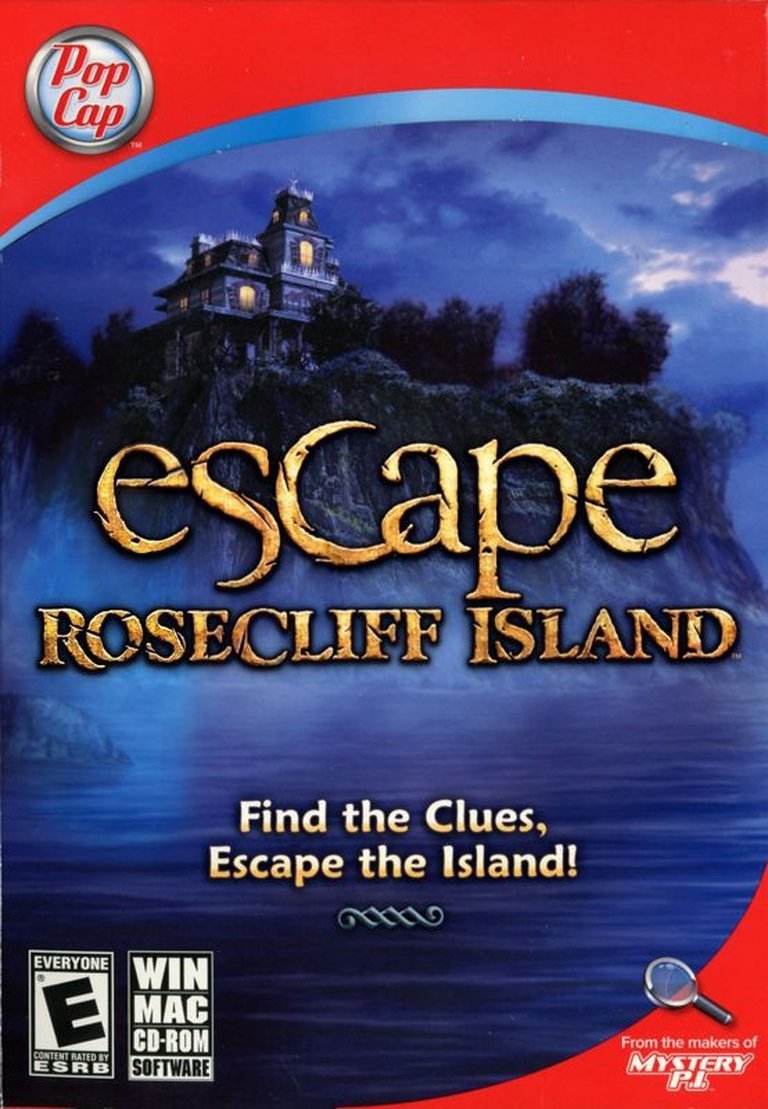
Description
Escape Rosecliff Island is a hidden object adventure where players take on the role of a castaway stranded on a mysterious remote island. The primary objective is to locate and click on listed items (some presented as riddles) across diverse island locations within a time limit, though a relaxed mode without constraints is available. The game features a hint system that highlights objects at the cost of points, hidden locks to discover, and unlockable mini-games including jigsaw puzzles, tile-matching, and word searches. After completing the main quest and finding all fifty locks, players gain access to an ‘Unlimited Seek & Find’ mode challenging them to find every object in each location as quickly as possible.
Gameplay Videos
Where to Buy Escape Rosecliff Island
PC
Escape Rosecliff Island Free Download
Escape Rosecliff Island Guides & Walkthroughs
Escape Rosecliff Island Reviews & Reception
metacritic.com (85/100): Escape Rosecliff Island is a run-of-the-mill hidden object game with simple graphics and too many search missions.
Escape Rosecliff Island: A Masterclass in Casual Gaming’s Golden Age
Introduction
In the pantheon of niche video game genres, few evoke as much passionate debate as hidden object games (HOGs). Often dismissed as simplistic “point-and-click” diversions, they nonetheless captivated millions during the casual gaming boom of the late 2000s. Among these titles, Escape Rosecliff Island (2009) emerged as a quiet masterpiece—a digital enigma that defied expectations by becoming a fixture in players’ libraries for years, even decades. As documented by Rock Paper Shotgun, one user’s posthumous discovery of the game atop his father’s “most played” Steam list (alongside Skyrim and X-COM) hints at its addictive, almost meditative pull. Developed by SpinTop Games and published by PopCap—then at the zenith of its casual gaming empire—the game offered not just escapism, but a meticulously crafted puzzle experience. This review argues that Escape Rosecliff Island remains a paragon of HOG design, celebrated for its ingenious object placement, strategic depth, and enduring replayability, cementing its legacy as a cornerstone of a genre too often underestimated.
Development History & Context
Escape Rosecliff Island arrived at a pivotal moment for casual gaming. The mid-to-late 2000s saw platforms like PopCap and Big Fish Games dominate PC and Mac storefronts, with HOGs evolving from simple “I Spy” clones into narrative-driven adventures. SpinTop Games, founded in 2003, had already established itself as a premier HOG developer known for polished mechanics and artistic flair. By 2009, PopCap had acquired SpinTop, leveraging its expertise to expand into mobile markets, where the genre would find a new audience.
Technologically, the game was a product of its era. Built on a 2D framework with static scenes—optimized for Windows, Mac, and later iOS/iPad—it eschewed cutting-edge graphics for meticulous detail. Its use of Lua scripting, as noted on MobyGames, allowed for efficient scene generation and mini-game implementation. The constraints of CD-ROM distribution and mobile processing power pushed developers toward reusable locations with randomized object lists, a choice that inadvertently became a hallmark of the genre. In 2009, the gaming landscape was saturated with HOGs, but Rosecliff stood apart by focusing on pure gameplay over bloated narratives, a philosophy SpinTop would refine in subsequent titles.
Narrative & Thematic Deep Dive
The premise is deceptively simple: a storm strands you on a “mysterious and remote private island,” requiring you to find hidden objects to escape. As the IMDb synopsis reveals, this narrative serves merely as a framing device—a MacGuffin to justify the gameplay loop. There are no named characters, no dialogue, and no cutscenes. Instead, the story is told through environmental storytelling: a treehouse cluttered with a femur and a revolver (per Rock Paper Shotgun), a beach littered with anachronistic tools, or a cave adorned with cryptic symbols.
This minimalism is intentional. By excising traditional narrative elements, SpinTop forces players to engage with the island as a puzzle box. The themes are existential yet unspoken: isolation, the compulsion to impose order on chaos, and the quiet triumph of human ingenuity. The riddle-based clues (“collects nuts” for a squirrel, “cuts paper” for scissors) transform mundane objects into playful enigmas, reinforcing the game’s whimsical-yet-challenging tone. Unlike later HOGs that embraced dark mysteries (Mystery Case Files) or romantic melodrama, Rosecliff offers a serene, almost Zen-like journey—making its “escape” less a physical act and more a metaphor for cognitive satisfaction.
Gameplay Mechanics & Systems
At its core, Escape Rosecliff Island is a study in refined mechanics. The primary loop involves locating 10–15 objects per scene from a list at the screen’s bottom, with items sometimes disguised as riddles. Time limits add urgency, but a “relaxed mode” (enabled at startup) caters to contemplative players. The hint system—deducting 7,500 points and imposing a one-minute cooldown—encourages strategic use rather than reliance.
What elevates the game is its layered progression:
– Locks: Two hidden “locks” per scene (50 total) unlock bonus modes upon completion, incentivizing thorough exploration.
– Mini-Games: Between stages, players solve puzzles—jigsaws, tile-matching, word searches, and a unique “circle puzzle” where rotating rings reconstruct an image. These break monotony and reward inventory items.
– Unlimited Seek & Find: Post-game, players can hunt for every object in a location, timed for high scores.
– Scoring: Speed bonuses and “Perfect Search” awards (finding objects without errors) create replay incentives, turning casual sessions into skill-based challenges.
These systems prevent the genre’s common pitfall—repetitiveness. As SpinTop’s design philosophy (cited in Rock Paper Shotgun) prioritized “wit behind the layout,” objects are rarely where they belong. A treehouse might host a ballet shoe next to a railway spike, or a beach could hide an enormous acorn. This intentional absurdity transforms hunting into a game of discovery, rewarding keen observation over rote memorization.
World-Building, Art & Sound
The island’s 25 locations—from lighthouses to shipwrecks—are masterpieces of environmental storytelling. The art, though static, bursts with vibrant, hand-painted details. A dock might feature a seagull mid-flight, a sunken rowboat, and a misplaced harp, while a garden could blend flowers with a telescope and a mouse. The Rock Paper Shotgun analysis praises the “packed” scenes for their “incongruous placement,” turning each screen into a visual scavenger hunt.
Sound design amplifies the atmosphere. While no official soundtrack is archived, player reviews (e.g., Sebastianali on Metacritic) laud its “incredible, atmospheric” qualities. Gentle waves, rustling leaves, and subtle chimes create a tranquil backdrop, contrasting with the intensity of timed hunts. The absence of voiceovers or intrusive music allows players to focus, fostering a meditative state—one where the act of searching becomes almost hypnotic.
Reception & Legacy
Escape Rosecliff Island launched to muted but generally positive reviews. MobyGames aggregates a 67% critic score: GameZebo (60%) called it “good-looking” but derivative, while Calm Down Tom (60% on mobile) noted its “stress-free gameplay” made it ideal for late-night sessions. About This Particular Macintosh (80%) praised its “generous difficulty levels” and clever clues. Over time, its reputation soared. On Steam, it boasts a “Very Positive” rating (82% of 174 reviews), with players lauding its “addictive” nature and “reasonable price.”
Legacy-wise, the game exemplified SpinTop’s influence on the genre. Its blend of accessible design and depth prefigured modern HOGs that now include narrative and inventory elements. PopCap’s acquisition of SpinTop in 2007 likely infused Rosecliff with the polish that made it a template for future titles. The game’s longevity—still sold on Steam for $0.99—is a testament to its evergreen appeal. As Rock Paper Shotgun humorously observed, it risks becoming a “family curse,” passed down generations through its hypnotic gameplay.
Conclusion
Escape Rosecliff Island is far more than a hidden object game—it is a digital artifact of casual gaming’s zenith. By stripping the genre to its essentials—meticulous object design, strategic hinting, and varied progression—SpinTop created an experience that is both challenging and serene. Its island, with its 25 whimsical locales and 2,100+ hidden objects, stands as a monument to the power of restraint: a game where the journey matters more than the destination.
For historians, it represents a turning point: a HOG that transcended its niche to become a beloved staple. For players, it remains a sanctuary—a place to unwind, sharpen one’s eye, and lose track of time. In a landscape saturated with bloated narratives, Escape Rosecliff Island endures as proof that profound satisfaction can emerge from the simplest of premises. As the Steam reviews confirm, it’s not just a game; it’s a lullaby for the weary, a puzzle box for the curious, and a masterpiece of its time.