
- Release Year: 2003
- Platforms: Windows
- Publisher: Twilight Frontier
- Developer: Twilight Frontier
- Genre: Action
- Perspective: 3rd-person, Side view
- Game Mode: Co-op, Single-player
- Gameplay: Fighting
- Setting: Anime, Manga
Description
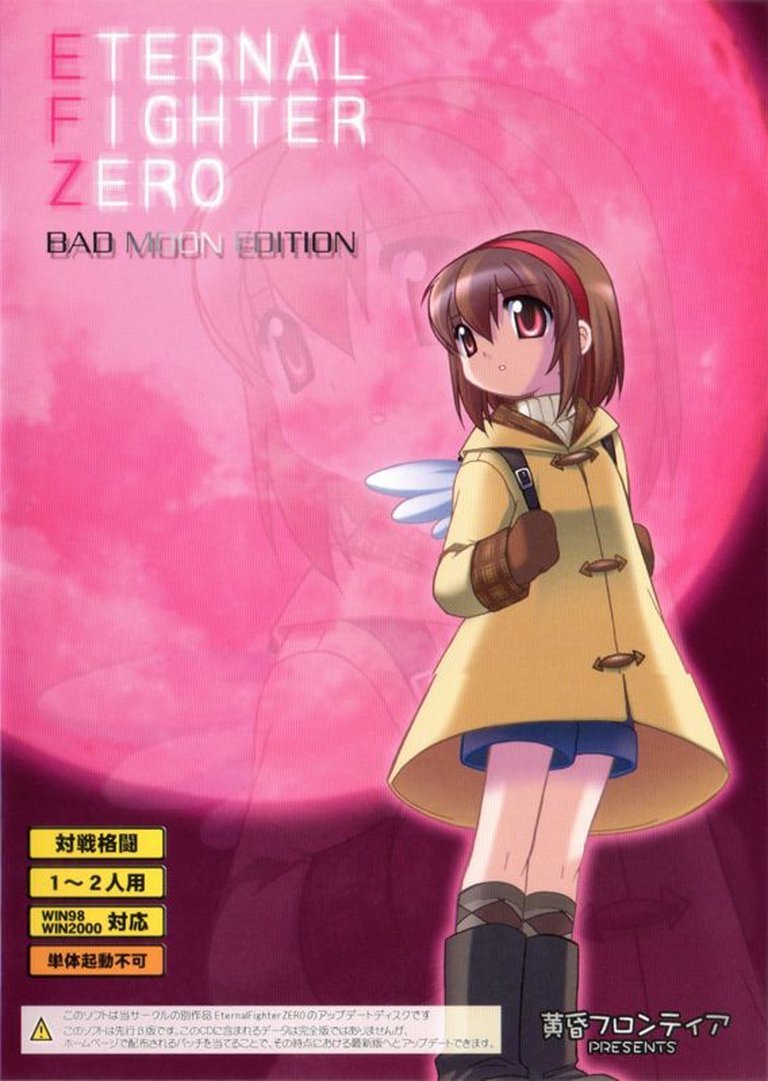
Eternal Fighter Zero: Bad Moon Edition is the second update of a doujin fighting game featuring characters from visual novels by Key and Tactics, introducing four new playable fighters including Ikumi Amasawa, Doppel Nanase, Mishio Amano, and Kaori Misaka. The game retains its 2D anime-style combat mechanics while adding air throws and ‘floatier’ physics for aerial juggling, with move sets and win quotes parodying popular fighting franchises like Street Fighter and King of Fighters.
Gameplay Videos
Eternal Fighter Zero: Bad Moon Edition Patches & Updates
Eternal Fighter Zero: Bad Moon Edition Guides & Walkthroughs
Eternal Fighter Zero: Bad Moon Edition Cheats & Codes
PC (Bad Moon Edition)
Perform the following actions at the character selection screen.
| Code | Effect |
|---|---|
| Highlight Kamio Misuzu, then press [Special] | Unlock Kanna as a playable character |
| Press [High Attack] | Enable random character selection |
| Highlight a fighter, then press [Special] when prompted to select a color | Access alternate color palettes |
Eternal Fighter Zero: Bad Moon Edition: Review
Introduction
In the annals of doujin game history, few titles have achieved the cult status and technical reverence of Eternal Fighter Zero: Bad Moon Edition. Released on August 15, 2003, this Windows-exclusive 2D fighting game stands as a testament to the ingenuity of its developer, Twilight Frontier, and the passionate fan culture that fueled its creation. As the second major update to the original Eternal Fighter Zero, Bad Moon Edition expanded the roster to 20 playable characters drawn from iconic visual novels by Key and Tactics—ONE: Kagayaku Kisetsu e, Kanon, AIR, and MOON.. While its narrative is minimal, its gameplay depth, parodic spirit, and mechanical innovations cemented its legacy as a cornerstone of the doujin fighting genre. This review argues that Bad Moon Edition is not merely a niche curiosity but a meticulously crafted combat system that pushed the boundaries of what doujin games could achieve, blending anime aesthetics with fighting game mechanics to create an experience both accessible to fans and challenging to master.
Development History & Context
Eternal Fighter Zero: Bad Moon Edition emerged from the fertile grounds of Japan’s doujin scene in the early 2000s, a period defined by resource constraints bound by the era’s PC technology and the logistical challenges of small-scale development. Twilight Frontier, a collective later renowned for Immaterial and Missing Power and Touhou Hisoutensoku, crafted this game as a labor of love, leveraging their intimate knowledge of visual novels and fighting games to create a crossover experience. Technically, the game operated on CD-ROM media, limiting asset size but allowing for complex sprite work and animation. The 2003 gaming landscape was dominated by commercial giants like Street Fighter Alpha and Guilty Gear, but doujin games were carving their own niche through passionate communities and Comiket events. Bad Moon Edition debuted at Comiket 64, reflecting its roots in fan-driven distribution. Its development was iterative: building upon the original 2001 release and the Blue Sky Edition expansion, this version refined physics and mechanics while adding new characters. Twilight Frontier’s vision was clear: to honor the source material while creating a competitive fighter that could stand alongside its commercial inspirations, a goal achieved through meticulous balance and parody.
Narrative & Thematic Deep Dive
Bad Moon Edition adopts a “No Plot? No Problem!” approach, eschewing a cohesive narrative in favor of pure crossover fan service. The 20 playable characters originate from melancholy visual novels—ONE, Kanon, AIR, and MOON—where themes of memory, loss, and supernatural phenomena define their stories. In the game, these characters are stripped of their narrative contexts and reimagined as combatants, embodying the Adaptational Badass trope with aplomb. For instance:
– Ikumi Amasawa (MOON.), originally a victim of genetic experimentation, becomes a visceral fighter using her own and her opponents’ blood in attacks like her command grab, which stabs and explodes in a shower of crimson. This transforms her tragic backstory into a grotesque spectacle of violence.
– Mishio Amano (Kanon), a quiet student, wields a flaming spear that channels her repressed anger, while her Final Memory merges fire and lightning—a nod to her unfulfilled desires in the novel.
– Doppel Nanase, an original character and evil clone of Rumi (ONE), represents duality and identity theft, fighting with bare-handed grapples that parody wrestling tropes.
Dialogue and win quotes amplify the game’s parodic nature. Characters deliver quips referencing their visual novels (“So… it’s promised,” says Ayu Tsukimiya, tying to Kanon‘s themes) while simultaneously mocking fighting game tropes—Sayuri Kurata’s win quotes mimic Street Fighter‘s Rugal Bernstein. This duality creates a rich tapestry of in-jokes, rewarding fans of both the source material and fighting games. Underlying themes include redemption (Kanna from AIR, the “True Final Boss,” fights to protect her descendant) and the catharsis of combat, turning introspective stories into explosive confrontations.
Gameplay Mechanics & Systems
Bad Moon Edition’s gameplay is a masterclass in mechanical synthesis, blending elements from Street Fighter, Guilty Gear, and The King of Fighters into a cohesive, deep system. Core combat revolves around four primary mechanics:
- Recoil Guard: A high-risk, high-reward parry system. Executed by blocking at the exact moment of an opponent’s attack, it negates chip damage, cancels guard stun, and allows immediate counterattacks. Mastery of this mechanic is crucial for high-level play, turning defense into offense.
- Instant Charge (IC): A system built around the “Laneforce” (RF) gauge. Players consume this gauge to cancel the recovery frames of nearly any move, enabling combo extensions or escapes from pressure. A “glowing” RF gauge (achieved by not canceling immediately) amplifies damage, rewarding precise timing.
- Final Memories: Desperation moves activated when health is below 1/3 and a full super gauge is available. These supers are often parodic—e.g., Misuzu Kamio (AIR) recreates her iconic death scene with feathers and collapsing wings, while Ayu Tsukimiya transforms into an angel riding a giant taiyaki.
- Floatier Physics & Air Throws: Introduced in this version, the physics emphasize aerial combat with extended jump arcs and reduced gravity. Air throws (e.g., Kaori Misaka’s grapple) facilitate juggling combos, rewarding players for controlling the vertical axis.
Character progression is defined by unique systems:
– Stance Changes: Rumi Nanase switches between sword and bare-handed modes, altering her move properties. Minagi Tohno (AIR) fights alongside her friend Michiru, controlled via special moves.
– Parody Movesets: Characters borrow from other fighters—Mio Kouduki (ONE) cosplays as Kyo Kusanagi (The King of Fighters) mid-combo, while Makoto Sawatari (Kanon) uses fireworks and gas traps to reflect her prank-loving nature.
The UI, though minimalist by modern standards, features a guard meter moved to the HUD for clarity, reflecting iterative refinement. Matches emphasize momentum shifts, with IC and Recoil Guard creating tense “RPS” (rock-paper-scissors) moments. Despite a roster of 20, balance is largely solid, barring SNK Boss-tier characters like Kanna, whose AI becomes near-unbeatable at higher difficulties.
World-Building, Art & Sound
The game’s world-building is a love letter to its visual novel origins, translating atmospheric locales into stages. Key locations include:
– Misuzu Kamio’s Stage (AIR): A sun-drenched town with clouds and wind, evoking her summer memories.
– Unknown’s Stage (ONE): The “Eternal World,” a mental dimension with floating islands and distorted backgrounds, reflecting the novel’s focus on memory.
– Kanna’s Stage (AIR): A snowy field with cherry blossoms, juxtaposing her divine nature with fleeting mortality.
Art direction prioritizes faithfulness to character designs, with cel-shaded sprites capturing the distinct anime styles of each novel. Character animations are fluid—from Ikumi’s blood-splattered effects to Doppel Nanase’s wrestling grapples—though the resolution is limited by 2003 PC constraints. Sound design blends original compositions with remixes of visual novel themes, enhancing the emotional weight of Final Memories. Kanna’s theme, for example, shifts from serene to oppressive as she unleashes her supers. Loading screens showcase fan art, further cementing the community-centric ethos. The overall aesthetic is a vibrant, chaotic fusion of visual novel melancholy and fighting game spectacle.
Reception & Legacy
At launch, Bad Moon Edition garnered a devoted following within doujin circles but lacked mainstream critical attention due to its niche distribution. Its reputation evolved over time: initially praised for its depth and character roster, it was later overshadowed by Melty Blood (another Twilight Frontier title) in the mid-2000s. However, it retained cult status among fighting game purists for its technical complexity. Commercially, it circulated via Comiket and online forums, with no official sales data available.
Its legacy is profound:
– Influence on Doujin Games: Twilight Frontier’s innovations—Recoil Guard, IC, and assist systems—became benchmarks for future doujin fighters, including Queen of Hearts and Immaterial and Missing Power.
– Character Parody Culture: The game’s blend of source material homage and fighting game satire set a precedent for crossover games, inspiring titles like Dengeki Bunko: Fighting Climax.
– Preservation Efforts: Modern ports like Revival (2005) added netcode for online play, ensuring its accessibility. The Memorial Edition (2005) consolidated all versions, cementing its status as a definitive release.
Despite its age, Bad Moon Edition is analyzed in competitive communities for its meta-game, with tier lists debating characters like Kaori Misaka (a boxer with high damage) and Sayuri Kurata (a glass cannon with a parody super). Its legacy endures as a bridge between visual novel fandom and fighting game culture.
Conclusion
Eternal Fighter Zero: Bad Moon Edition is a technical marvel and a cultural touchstone in the doujin gaming renaissance. Its gameplay, a refined blend of parry systems, combo mechanics, and character-specific innovations, remains challenging and rewarding. While its narrative is minimal, its world-building and artistry pay homage to its visual novel roots with reverence and humor. As a product of its time, it reflects the constraints and creativity of early 2000s doujin development, yet its depth ensures it transcends its era. In the pantheon of fighting games, Bad Moon Edition occupies a unique space: it is both a loving tribute and a standalone masterpiece, proving that doujin games could achieve commercial-quality craftsmanship. For historians and players alike, it stands not just as a relic but as a vital artifact of anime-inspired gaming—a testament to how passion and technical prowess can forge eternal legacies. Verdict: An essential, if niche, classic that deserves its place in video game history.