
- Release Year: 1999
- Platforms: Windows
- Publisher: Dinamic Multimedia, S.A., RTL Playtainment, Sold Out Sales & Marketing Ltd.
- Developer: Dinamic Multimedia, S.A.
- Genre: Simulation, Sports
- Perspective: Third-person
- Game Mode: LAN, Single-player
- Gameplay: Business simulation, Football (European), Managerial, Soccer
- Setting: Football (European), Soccer
- Average Score: 68/100
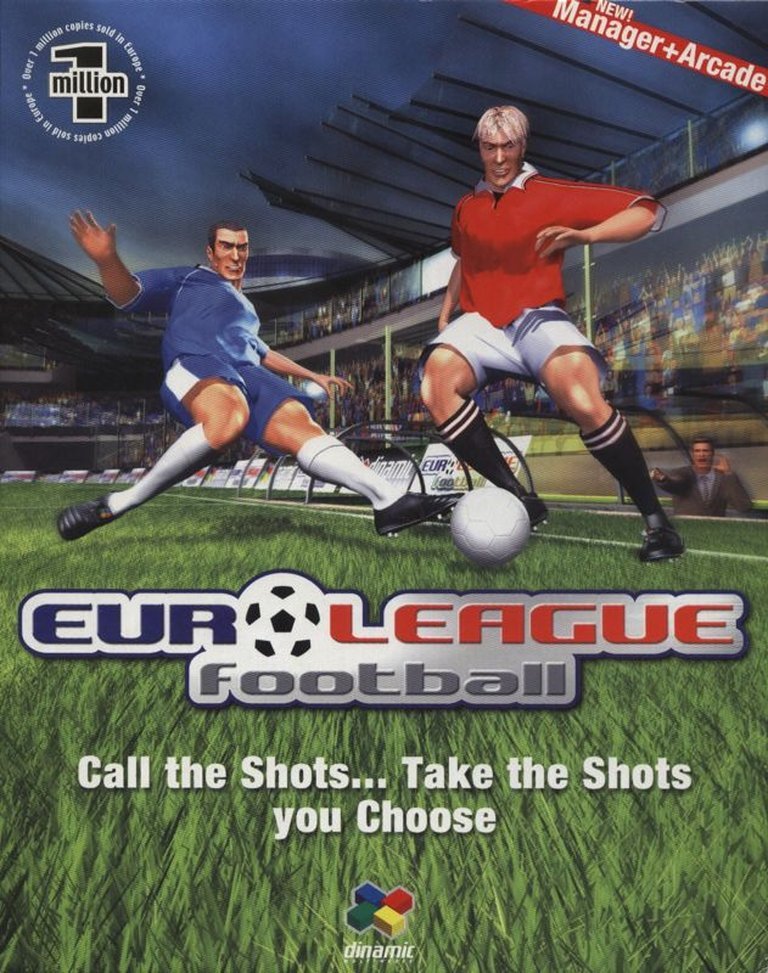
Description
Euro League Football is a football manager simulation game released in 1999, offering players the chance to manage and play with European clubs across various leagues and tournaments, including the Premier League, Third Division, and UEFA Cup. The game features detailed team and player stats from the 1999-2000 season, allowing players to handle every aspect of their team’s campaign, from tactical decisions to match simulations. Matches can be viewed as results, a ball-by-ball overview, or played interactively with arcade-style controls. The game also supports multiplayer tournaments for up to 8 players and includes multiple difficulty settings to cater to both newcomers and experienced players.
Euro League Football Free Download
Euro League Football Reviews & Reception
mobygames.com (52/100): My favorite game
eurogamer.net : Combining football management with raw arcade play, it seemed like the dream ticket.
myabandonware.com (85/100): Good game!
retro-replay.com : Euro League Football delivers a remarkably deep management simulation that will satisfy even the most ardent stat-heads.
Euro League Football Cheats & Codes
UEFA Champions League 1999/2000 (PlayStation)
Enter codes at the main menu.
| Code | Effect |
|---|---|
| Up(2), Triangle, Down(2), Triangle, Left(2), Triangle, Right(2), Triangle | Unlocks four extra teams on the team selection screen and displays the game’s credits after a game. |
FIFA 1999 (PC)
Enter codes while the game is loading.
| Code | Effect |
|---|---|
| win | Unlocks the Winter introduction. |
FIFA Soccer ’99 (PlayStation)
Enter codes at the team edit screen.
| Code | Effect |
|---|---|
| L1, L2, R2, R1, Circle, X, Square, Triangle, Start, Select | Grants extra money (PAL version). |
Euro League Football: A Flawed but Ambitious Fusion of Management and Arcade Soccer
Introduction
In the late 1990s, the football gaming landscape was sharply divided: on one side stood the deep, stat-driven management simulations like Championship Manager, and on the other, the fast-paced arcade thrills of FIFA and Actua Soccer. Euro League Football (1999), developed by Dinamic Multimedia, dared to bridge this divide, offering players the chance to not only manage a club but also step onto the pitch and control the action. It was an ambitious vision—one that promised to revolutionize the genre by blending strategy with real-time gameplay. Yet, as history would show, ambition alone does not guarantee success.
This review explores Euro League Football in exhaustive detail, examining its development, gameplay mechanics, narrative structure, and lasting legacy. Was it a bold innovation or a misguided experiment? Did it succeed in merging two disparate gaming philosophies, or did it fall victim to the pitfalls of trying to be all things to all players? By dissecting its strengths, weaknesses, and the context of its creation, we can better understand its place in the evolution of football games.
Development History & Context
The Studio and Its Legacy
Dinamic Multimedia, a Spanish developer with a strong foothold in the European market, was no stranger to football simulations. The studio had already established itself with the PC Fútbol series, a beloved franchise in Spain that combined management depth with accessible gameplay. By the late 1990s, Dinamic sought to expand its reach beyond its home market, rebranding PC Fútbol 2000 as Euro League Football for international audiences. This was not merely a cosmetic change but an attempt to position the game as a pan-European contender, capable of rivaling the dominance of Championship Manager and FIFA.
The development team, led by producer David Galeano and a cohort of experienced programmers like José Manuel Bento and Francisco Urbano, faced a daunting challenge: integrating a fully playable arcade-style match engine into a traditional management sim. This was uncharted territory. Previous hybrids, such as Sensible World of Soccer, had succeeded by keeping the management layer lightweight. Euro League Football, however, aimed for depth in both domains—a risky proposition given the technological constraints of the era.
Technological Constraints and Design Choices
Released in 1999, Euro League Football was built for Windows PCs with modest specifications: a Pentium 150 processor, 32MB of RAM, and 200MB of hard drive space. These limitations shaped the game’s design in critical ways. The 3D match engine, while ambitious, struggled to deliver the fluidity and polish of contemporaries like FIFA 2000. The player models, though recognizable, lacked the animation fidelity of more advanced titles, and the stadiums often felt sterile and repetitive.
The game’s interface, while visually polished, was criticized for its complexity. Unlike the streamlined menus of Championship Manager, Euro League Football’s UI was cluttered, with nested windows and transitions that could feel cumbersome. This was a reflection of the era’s design trends, where developers often prioritized feature depth over usability. The absence of a printed manual—replaced by a 47-page digital guide—further exacerbated the learning curve, leaving players to navigate the game’s intricacies through trial and error.
The Gaming Landscape of 1999
The late 1990s were a golden age for football games, with fierce competition driving innovation. FIFA 2000 had refined its arcade-style gameplay, while Championship Manager 99/00 set the standard for management depth. Euro League Football entered this crowded field with a unique selling point: the ability to seamlessly transition between management and on-pitch control. However, this hybrid approach was not without precedent. Player Manager (1990) and Sensible World of Soccer (1994) had experimented with similar concepts, though neither had achieved the depth Euro League Football aspired to.
The game’s release was met with cautious optimism. Critics and players alike recognized the potential of its hybrid design, but questions lingered about execution. Could a game truly excel in both management and arcade play, or would it inevitably compromise on one to accommodate the other? As we will explore, Euro League Football’s answer to this question was a resounding “no.”
Narrative & Thematic Deep Dive
The Illusion of Narrative
Euro League Football is not a game with a traditional narrative. There are no scripted storylines, no dramatic cutscenes, and no predefined characters with arcs to follow. Instead, the game’s “story” emerges organically from the player’s decisions and the unfolding drama of the football season. This emergent narrative is a hallmark of management simulations, where the player’s journey—whether guiding a minnow to promotion or steering a giant to continental glory—becomes the story.
The game’s thematic core revolves around the dual roles of a football manager: the strategist and the tactician. On one hand, you are the architect of your club’s future, making long-term decisions about transfers, training, and finances. On the other, you are the orchestrator of on-pitch success, either by setting tactical instructions or by taking direct control of the players. This duality is the game’s greatest strength and its most glaring weakness. When it works, it creates a sense of immersion unmatched by purely managerial or arcade titles. When it fails, it exposes the seams between its two halves, leaving players frustrated by the disconnect between strategy and execution.
Characters and Dialogue
The game’s cast is composed of real-world footballers, managers, and staff, all rendered with varying degrees of accuracy. Player likenesses are present, though often rudimentary by modern standards. David Beckham’s iconic hairstyle and Ronaldo’s gap-toothed grin are recognizable, but the lack of motion-capture fidelity means animations often feel stiff and unnatural.
Dialogue is minimal but functional. Your personal assistant, training staff, and medical team provide updates on player morale, injuries, and tactical suggestions. These interactions, while not deeply narrative-driven, add a layer of immersion, making the player feel like a true manager navigating the complexities of a football club. However, the lack of voice acting for these interactions—outside of match commentary—limits their impact. The game’s reliance on text-based updates, while practical, does little to elevate the emotional stakes.
Themes: The Burden of Expectation
At its heart, Euro League Football is a game about expectation—the expectations of fans, the board, and, most importantly, the player. The pressure to succeed is ever-present, whether you’re managing a struggling Third Division side or a European powerhouse. The game’s difficulty settings attempt to modulate this pressure, offering a gentler experience for newcomers while challenging veterans with intricate stat management.
Yet, the game’s most significant thematic failure lies in its inability to balance these expectations with rewarding gameplay. The management side, while deep, often feels disconnected from the on-pitch action. Tactical instructions set in the management menu are frequently ignored during playable matches, undermining the player’s sense of control. This disconnect is emblematic of the game’s broader struggle: it promises a seamless fusion of management and arcade play but delivers two half-baked experiences instead.
Gameplay Mechanics & Systems
The Management Layer: A Stat-Cruncher’s Dream
Euro League Football’s management mode is its strongest suit. Players are tasked with overseeing every aspect of their club, from transfers and training to finances and fan relations. The depth of options is impressive, with detailed player stats, contract negotiations, and even the ability to design club merchandise. For fans of Championship Manager, this will feel familiar, albeit with a few unique twists.
One standout feature is the staff management system. Hiring and firing coaches, physiotherapists, and scouts adds a layer of realism, as each staff member influences different aspects of your club’s performance. The training system is equally robust, allowing players to focus on specific skills, from set-piece mastery to defensive drills. These mechanics, while complex, provide a satisfying sense of progression as you mold your squad into a cohesive unit.
However, the management mode is not without its flaws. The transfer system, in particular, is criticized for its lack of realism. Players report being able to sign virtually any player they desire, with little resistance from rival clubs. This undermines the strategic depth, as the challenge of negotiating transfers—a cornerstone of real-world football management—is largely absent.
The Arcade Layer: A Missed Opportunity
The playable match mode is where Euro League Football stumbles most spectacularly. On paper, the idea of stepping onto the pitch and controlling your team in a FIFA-style match is compelling. In practice, the execution is deeply flawed.
The controls are clunky and imprecise, particularly when using a keyboard. Player movement feels sluggish, with a turning circle more befitting a battleship than a professional footballer. Passing and shooting are inconsistent, often leading to frustrating moments where simple actions go awry. The AI of computer-controlled teammates is equally problematic, with players frequently making baffling decisions, such as kicking the ball out of play or failing to react to obvious threats.
The goalkeepers are a particular low point. Their animations are slow and unnatural, often leaving them stranded as the ball rolls into the net. The offside rule is poorly implemented, leading to frequent exploitation by players who quickly learn to game the system. These issues are compounded by the commentary, delivered by Dominik Diamond, which is widely panned for its lack of enthusiasm and frequent inaccuracies.
Multiplayer and Difficulty Settings
Euro League Football offers multiplayer tournaments for up to eight players, a rare feature in management simulations of the era. This adds a social dimension to the game, allowing friends to compete in custom leagues and cups. However, the multiplayer experience is hampered by the same gameplay flaws that plague the single-player mode. Clunky controls and inconsistent AI make for a frustrating competitive experience.
The game’s difficulty settings are designed to cater to both newcomers and veterans. For beginners, the stat management can be simplified, reducing the overwhelming complexity of the management mode. For experienced players, the challenge can be ramped up, with more intricate financial and tactical decisions required. While this flexibility is commendable, it does little to address the core issues with the arcade gameplay.
World-Building, Art & Sound
Visual Design: A Study in Contrasts
Euro League Football’s visual presentation is a mixed bag. The management menus are clean and functional, with clear typography and well-organized data. Club badges and player portraits are rendered faithfully, adding a touch of authenticity to the experience. The ball-by-ball match overview, while text-heavy, provides a clear and concise breakdown of key moments, making it easy to follow the action without being overwhelmed.
The playable matches, however, are a different story. The 3D models are basic, with stiff animations and a lack of fluidity. Stadiums are often bland and repetitive, with crowds rendered as poorly drawn cardboard cutouts. The pitch itself is well-defined, but the overall presentation lacks the polish of contemporaries like FIFA 2000. The game’s visuals are functional but uninspired, reflecting the technological limitations of the era.
Sound Design: A Missed Goal
The sound design in Euro League Football is equally uneven. The menu music is pleasant, and the ambient crowd noise during matches is well-sampled, adding to the atmosphere. However, the commentary by Dominik Diamond is a significant misstep. Delivered with little enthusiasm, it often lags behind the action, with lines delivered long after the event they describe. The lack of dynamic commentary—where the announcer reacts to the flow of the game—further undermines the immersion.
The absence of voice acting for staff interactions is another missed opportunity. While text-based updates are functional, they do little to enhance the emotional stakes of the management experience. The game’s sound design, like its visuals, is competent but unremarkable, failing to elevate the overall experience.
Reception & Legacy
Critical Reception: A Divided Verdict
Euro League Football’s reception was lukewarm at best. Critics praised the depth of the management mode but were universally critical of the arcade gameplay. Publications like Eurogamer and GameStar highlighted the game’s ambitious hybrid design but ultimately dismissed it as a flawed experiment. Eurogamer’s review was particularly damning, calling the arcade mode “a rather poor arcade game” bolted onto an “average management game.”
The game’s MobyScore of 6.4 reflects this divided reception. While some players, particularly those nostalgic for the PC Fútbol series, found value in its management depth, the broader consensus was that Euro League Football failed to deliver on its promise of a seamless fusion of management and arcade play.
Commercial Performance and Market Impact
Commercially, Euro League Football struggled to make a significant impact outside of its core Spanish market. The PC Fútbol series had a dedicated following in Spain, but the rebranding as Euro League Football did little to expand its appeal. The game’s flaws, particularly in the arcade mode, likely contributed to its lackluster sales in other regions.
The game’s legacy is one of missed potential. It remains a fascinating footnote in the history of football games, a bold experiment that ultimately fell short of its ambitions. Its hybrid design would later be refined by titles like Football Manager’s “match engine” and FIFA’s career mode, but Euro League Football itself is largely forgotten outside of retro gaming circles.
Influence on Subsequent Games
While Euro League Football was not a commercial or critical success, its hybrid design influenced later titles. The idea of combining management depth with on-pitch control would resurface in games like Football Manager’s “match engine,” which allows players to watch matches unfold in a simplified 3D view. Similarly, FIFA’s career mode would incorporate more management elements, though never to the same depth as Euro League Football.
The game’s most enduring legacy may be its demonstration of the challenges inherent in merging two distinct gaming philosophies. Euro League Football proved that depth in one area often comes at the expense of the other, a lesson that later developers would take to heart.
Conclusion: A Flawed but Fascinating Experiment
Euro League Football is a game of contradictions. It is ambitious yet flawed, deep yet disjointed, innovative yet unpolished. Its management mode offers a satisfyingly complex experience for stat enthusiasts, while its arcade mode is a frustrating mess of clunky controls and poor AI. The game’s hybrid design, while groundbreaking, ultimately fails to deliver a cohesive experience, leaving players with two half-baked games instead of one great one.
Yet, for all its flaws, Euro League Football remains a fascinating artifact of late-1990s gaming. It represents a bold attempt to bridge the divide between management simulations and arcade sports games, a challenge that few developers have dared to undertake. While it may not have succeeded in its ambitions, its legacy endures as a cautionary tale and a testament to the risks of innovation.
For retro gaming enthusiasts and football management aficionados, Euro League Football is worth experiencing, if only to appreciate its place in the evolution of the genre. It is not a masterpiece, nor is it a forgotten classic. Instead, it is a flawed but ambitious experiment—a game that dared to dream big and, in doing so, paved the way for future innovations.
Final Verdict: 6.5/10 – A bold but flawed hybrid that ultimately fails to deliver on its promise.