
- Release Year: 1998
- Platforms: Windows
- Publisher: Torpedo Software
- Developer: Torpedo Software
- Genre: Educational, Geography
- Perspective: Top-down
- Game Mode: Single-player
- Gameplay: Educational content, quiz, Time-based challenges
- Setting: Europe, Geography
- Average Score: 99/100
Description
Europe! is a freeware educational game released in 1998 for Windows, designed to teach players about European geography through interactive quizzes. The game features four modes—Countries, Capitals, Major Exports, and Geographical Features—where players must identify locations on a stylized map of Europe within a time limit. With a scoring system ranging from Beginner to Admiral, the game challenges players to achieve a 90% pass rate, offering a fun and engaging way to learn about Europe’s geography, economies, and landmarks.
Europe! Reviews & Reception
metacritic.com (99/100): A triumphant return to form for the series.
Europe! Cheats & Codes
Europa Universalis (PC)
Push F12 during gameplay, then type one of the following phrases to get the corresponding cheat:
| Code | Effect |
|---|---|
| difrules | God Mode |
| richelieu | Brings all military units under your control |
| oranje | Sets Stability to +3 |
| cortez | Gets rid of Natives |
| alba | Gets rid of Revolts |
| pappenheim | Turns Fog of War On/Off |
| columbus | Explores every Province |
| gustavus | Increases level of Land Technology |
| drake | Increases level of Naval Technology |
| cromwell | Increases the level of the Infrastructure |
| polo | Increases the level of Trade |
| tilly | The computer won’t declare war |
| montezuma | Adds 50000 Ducats to your Treasury |
| pocahontas | Adds 10 Colonists |
| vatican | Add 10 Diplomats |
| dagama | Adds 10 Merchants |
| swift | Adds 10,000 people to your Capitol Province |
| peterthegreat | Limits troops |
| russianhordes | Adds cannon fodder |
| shogun | Closing Japan |
| luther | Starts Reformation Effects |
| calvin | Starts John Calvin Effects |
| trent | Starts Council of Trent Effects |
| event [#] | Triggers specific events (replace [#] with event number) |
Europa Universalis 2 (PC)
Press [F12] during game play, then enter one of the following codes.
| Code | Effect |
|---|---|
| pappenheim | Toggle fog of war |
| columbus | Explore all provinces |
| gustavus | Increase land technology level |
| drake | Increase naval technology level |
| cromwell | Increase infrastructure level |
| polo | Increase trade level |
| oranje | Set stability to +3 |
| montezuma | Additional 50,000 Ducats to treasury |
| pocahontas | Additional 10 Colonists |
| dagama | Additional 10 Merchants |
| vatican | Additional 10 Diplomats |
| swift | Additional 10,000 population to capital province |
| russianhordes | More cannon fodders |
| difrules | God mode |
| event 99035 | Gives you 5000 land tech |
| event 99036 | Gives you 5000 naval tech |
| event 99036 or 99037 | Gives you armies in random points |
| event 99038 or 99039 | Gives you navies in random ports |
| event 99040 | Unknown effect but beneficial |
Europe!: A Comprehensive Review
Introduction
In the vast landscape of video games, few titles have managed to blend education and entertainment as seamlessly as Europe!. Released in 1998 by Torpedo Software, this freeware educational game has carved a unique niche for itself in the gaming world. Europe! is not just a game; it’s a journey through the geographical and cultural tapestry of Europe, designed to educate players about the continent’s countries, capitals, major exports, and geographical features. This review aims to delve deep into the game’s development history, narrative and thematic elements, gameplay mechanics, world-building, and its reception and legacy.
Development History & Context
The Studio and Creators’ Vision
Torpedo Software, the developer and publisher of Europe!, was a small but ambitious studio that sought to create educational games that were both informative and engaging. The vision behind Europe! was to provide a fun and interactive way for players to learn about European geography. The game was designed to be accessible to a wide audience, from beginners to more advanced players, with a scoring system that rated players from “Beginner” to “Admiral.”
Technological Constraints and Innovations
Developed in the late 1990s, Europe! faced the technological constraints of its time. The game was designed for Windows, utilizing the mouse as the primary input device. Despite these limitations, the developers managed to create a visually appealing and functionally robust game. The stylized map of Europe and the intuitive user interface made the game easy to navigate, even for younger players.
The Gaming Landscape in 1998
The year 1998 was a pivotal one in the video game industry, marked by the release of several groundbreaking titles such as The Legend of Zelda: Ocarina of Time, Half-Life, and Metal Gear Solid. Amidst this competitive landscape, Europe! stood out as a unique educational game that catered to a specific niche. While it may not have garnered the same level of attention as these blockbuster titles, it played a crucial role in the educational gaming genre.
Narrative & Thematic Deep Dive
Plot and Characters
Europe! does not follow a traditional narrative structure with a linear plot and characters. Instead, it presents players with a series of challenges and quizzes that test their knowledge of European geography. The game’s “characters” are the countries and capitals of Europe, each with its own unique identity and set of attributes.
Dialogue and Themes
The game’s dialogue is minimal, focusing primarily on providing instructions and feedback to the player. The underlying theme of Europe! is education and the importance of geographical knowledge. The game encourages players to learn about the diverse cultures, economies, and landscapes of Europe, fostering a sense of curiosity and appreciation for the continent.
Gameplay Mechanics & Systems
Core Gameplay Loops
Europe! features four main gameplay modes: Countries, Capitals, Major Exports, and Geographical Features. Each mode presents a unique challenge that tests the player’s knowledge of different aspects of European geography.
- Countries Mode: Players are presented with the name of a European country and must click on the corresponding country on the map within a time limit.
- Capitals Mode: Players are given the name of a capital city and must select the country to which it belongs.
- Major Exports Mode: Players must identify the major exports of a given country from a list of options.
- Geographical Features Mode: Players are shown the name of a geographical feature and must click on its location on the map.
Combat and Character Progression
Europe! does not feature traditional combat or character progression systems. Instead, the game’s progression is tied to the player’s performance in the various quizzes. As players correctly answer questions, they accumulate points and move up the ranking system, from “Beginner” to “Admiral.”
UI and Innovative Systems
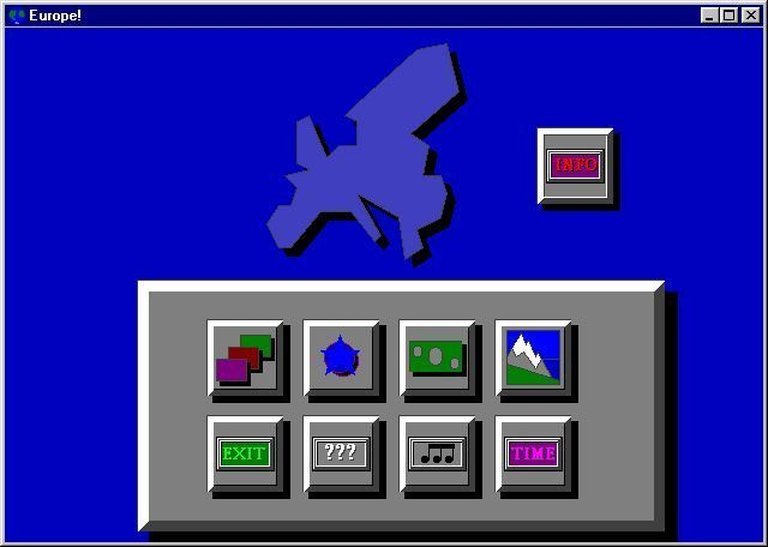
The game’s user interface is simple and intuitive, with a stylized map of Europe and a panel of buttons that allow players to navigate between different modes and settings. The UI is designed to be user-friendly, making it easy for players to understand and interact with the game’s various features.
World-Building, Art & Sound
Setting and Atmosphere
Europe! is set in a stylized representation of Europe, with each country clearly outlined and labeled. The game’s atmosphere is one of exploration and discovery, encouraging players to learn about the diverse landscapes and cultures of the continent.
Visual Direction
The game’s visual direction is clean and straightforward, with a focus on clarity and ease of use. The stylized map of Europe is the centerpiece of the game, with each country represented in a distinct color. The visual design is functional, ensuring that players can easily identify and interact with the various elements of the game.
Sound Design
Europe! features a simple sound design, with minimal audio cues and feedback. The game’s soundtrack is unobtrusive, designed to enhance the player’s focus and engagement without being distracting.
Reception & Legacy
Critical and Commercial Reception
Europe! was released as freeware, meaning it was available to players at no cost. As such, it did not generate significant commercial revenue. However, the game was well-received by players and educators alike, who appreciated its educational value and engaging gameplay.
Influence on Subsequent Games
While Europe! may not have had a direct influence on subsequent games, it contributed to the broader trend of educational gaming. The game’s success demonstrated the potential of video games as tools for learning and education, paving the way for future educational titles.
Conclusion
Europe! is a testament to the power of video games as educational tools. Developed by Torpedo Software in 1998, the game offers a unique and engaging way for players to learn about European geography. With its intuitive gameplay mechanics, clear visual design, and educational focus, Europe! stands as a notable example of how video games can be used to foster learning and curiosity. While it may not have achieved the same level of fame as other titles released in 1998, its legacy as an educational game is undeniable. Europe! is a game that not only entertains but also educates, making it a valuable addition to the world of video games.