
- Release Year: 2004
- Platforms: Windows
- Publisher: Sony Online Entertainment Inc.
- Developer: Sony Online Entertainment Inc.
- Genre: Compilation
- Perspective: Third-person
- Game Mode: MMO
- Gameplay: Open World
- Setting: Fantasy
- Average Score: 90/100
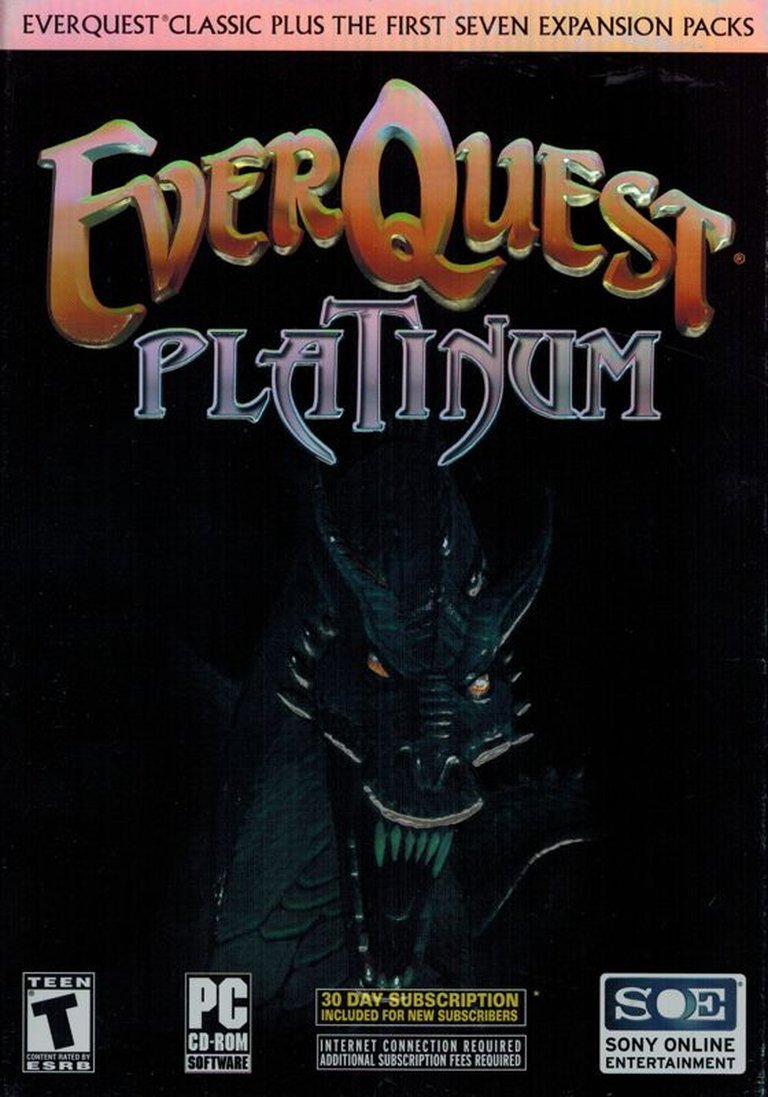
Description
EverQuest: Platinum is a compilation package bundling the original fantasy MMORPG and its first seven expansions, including The Ruins of Kunark, The Scars of Velious, The Shadows of Luclin, The Planes of Power, The Legacy of Ykesha, Lost Dungeons of Norrath, and Gates of Discord. Set in the persistent online world of Norrath, players create characters from diverse races and classes, exploring vast landscapes, battling monsters, and undertaking epic adventures in this groundbreaking 3D role-playing experience.
EverQuest: Platinum Patches & Updates
EverQuest: Platinum Mods
EverQuest: Platinum Reviews & Reception
worthplaying.com : EverQuest has become the premiere MMORPG experience, period.
gamevortex.com (90/100): Everquest is still going strong after 5 years and 7 expansions. Many have fallen to its icy grasp of addiction…
EverQuest: Platinum: Review
Introduction
In the dawn of the 21st century, a single game emerged from Sony Online Entertainment, not merely as a product but as a cultural phenomenon. EverQuest: Platinum, released in 2004 as a compilation of the base game and its first seven expansions, represents more than a bundle—it encapsulates the DNA of modern massively multiplayer online role-playing games (MMORPGs). At its peak, EverQuest transcended entertainment, becoming a digital society with its own economies, hierarchies, and controversies. This review examines how EverQuest: Platinum defined an era, blending revolutionary design with brutal challenges to create a world that, decades later, still echoes in the annals of gaming history. Its legacy is not merely in its technological or narrative innovations, but in its profound, sometimes problematic, impact on how we connect, compete, and coexist in virtual realms.
Development History & Context
EverQuest began in 1996 as a daring vision by John Smedley at Sony Interactive Studios America. Tasked with creating an online game to rival titles like Meridian 59, Smedley hired Brad McQuaid and Steve Clover—amateur developers of the RPG WarWizard—to realize a bold concept: a 3D graphical MUD (Multi-User Dungeon). Sony’s executives, primarily focused on console titles, dismissed the project as a niche experiment, dubbing the team the “Ghouls and Goblins Guys.” This skepticism forced Verant Interactive, a newly spun-off studio, to operate in near-secrecy, developing under the shadow of a corporate structure that repeatedly threatened cancellation.
The technological constraints of the late 1990s were formidable. Dial-up modems operated at 28.8 kbit/s, demanding ingenious networking solutions. Programmer Vince Harron’s “Reliable UDP” protocol allowed EverQuest to balance data reliability and speed—critical for seamless multiplayer in an era of packet loss. The team slept under their desks, fueled by an obsessive “do or die” culture, turning a 20-page design document into a universe of 14 classes, 12 races, and 500+ zones. By 1999, EverQuest was ready to launch, though Sony’s Japanese management remained oblivious until the last moment. Its unexpected success—10,000 copies sold on day one, crippling the San Diego internet infrastructure for a week—proved that MMORPGs could be commercially viable, setting the stage for the genre’s explosive growth.
Narrative & Thematic Deep Dive
The lore of EverQuest is a sprawling tapestry woven from Dungeons & Dragons roots and the creative genius of lead designer Bill Trost. The world of Norrath is born from the Nameless, a primordial entity who created the gods—elemental beings like Fennin Ro (fire) and Water (Prexus)—to shape existence. Veeshan, the Crystaline Dragon, “clawed” Norrath, leaving wounds that became continents and seeding the world with dragons, igniting the Age of Scale. Subsequent ages (Elder, Monuments, Blood, Lost, Enlightenment, Turmoil) chronicle divine interventions: Tunare’s elves, Innoruuk’s dark elves (tear apart the elven king and queen over 300 years), and Rallos Zek’s ogres (cursed after a failed godly war).
Races and gods are inextricably linked. Dwarves swear to Brell Serilis, god of the earth; trolls worship Cazic-Thule, Lord of Fear. This creates a theological framework where morality is relative: a good-aligned cleric might slaughter innocents for loot, while an evil shadowknight could exhibit honor. Expansions deepened this complexity. The Planes of Power (2002) redefined Norrath’s cosmology, introducing the Plane of Knowledge—a neutral hub where all races coexist—and requiring players to conquer elemental deities to access the Plane of Time. The narrative’s strength lies in its ambiguity: gods are fallible, history is rewritten (e.g., the non-canon Prophecy of Trakanon), and players forge their own stories, blurring the line between scripted lore and emergent roleplay.
Gameplay Mechanics & Systems
EverQuest’s core loop is a masterclass in class-based interdependence. Players choose from 14 classes at launch (e.g., Warriors tank, Rogues backstab, Clerics heal), each with unique abilities that demand cooperation. Progression is a slow, arduous grind: monsters respawn in fixed spots (“camping”) to farm experience points and loot, creating a tense, social economy. The Plan of Power expansion streamlined travel with portals, rendering overland exploration obsolete but highlighting the game’s focus on community.
Character advancement is meticulously structured. Levels cap at 60, with spells and gear defining power. Deities influence gameplay: a wizard worshipping Solusek Ro gains fire-based spells, while a shaman of Cazic-Thule accesses fear effects. The UI, minimalist by modern standards, prioritized functionality—text-based chat, hotbars for spells, and a radar for navigation. Combat is tactical but punishing: a single misstep can wipe a party, encouraging cautious exploration. Systems like Dragon Kill Points (DKP) in guilds formalized loot distribution, introducing early forms of player-driven governance. Flaws abound: the lack of quests in the base game left players adrift, and the “hell levels” (e.g., level 50 to 60) felt like artificial padding. Yet these mechanics fostered bonds: relying on a healer or enchanter created unforgettable moments of camaraderie.
World-Building, Art & Sound
Norrath is a world of staggering diversity, from the deserts of Antonica to the fungal forests of Kunark. Keith Parkinson’s box art established a high-fantasy aesthetic, but Rosie Rappaport’s art direction injected whimsy: goblins with visible buttcracks, bee-like Bixies (inspired by Blind Melon’s “No Rain” video), and vibrant zones like the Steamfont Mountains. The 3D engine, revolutionary in 1999, showed its age over time—NPCs used untextured polygons, and spell effects (e.g., Ice Comet) were simple but evocative.
Sound design was equally vital. Jay Barbeau’s soundtrack blended orchestral scores with ambient cues: the lapping waves of Ocean of Tears, the distant roars of dragons. Voice acting was rare, but NPC text overflowed with personality: the snark of merchants, the cryptic warnings of sages. This audio-visual immersion made Norrath feel alive, a place where players could lose themselves for hours. Even as expansions like Shadows of Luclin (2001) updated character models, older zones retained a patchwork charm, symbolizing the game’s evolution.
Reception & Legacy
EverQuest’s reception was a tidal wave of acclaim. Launching in March 1999, it sold 60,000 copies by April, surpassing Ultima Online’s subscriber base. Critics lauded its scope; GameSpot awarded it 1999’s Game of the Year, calling it “the first true online killer app.” Yet reviews noted flaws: repetitive early-game grinding and a “horrible” manual. Controversies emerged swiftly. Players dubbed it “EverCrack,” with reports of addiction-driven suicides like Shawn Woolley’s (2001). The Mystere incident (2000) saw a player banned for fan fiction, sparking debates on intellectual property in virtual worlds. Real-money trading (RMT) bloomed, culminating in eBay bans and Sony’s Station Exchange servers for sanctioned item sales.
By 2004, EverQuest: Platinum had sold over 3 million copies, with 550,000 subscribers at its peak. Its influence is undeniable: Blizzard’s World of Warcraft drew heavily from its class and raid systems. EverQuest won a Technology & Engineering Emmy (2007) and a Hall of Fame award from the Game Developers Choice Online Awards. Yet its legacy is dual-edged. The game’s difficulty alienated casual players, and population declines led to mergers and free-to-play models. Yet it remains a cultural touchstone, inspiring projects like Project 1999 (classic servers) and academic studies on virtual societies. As William Bainbridge notes, EverQuest “mirrors a key concept from real history: the fall and rebirth of civilizations,” enduring as a digital testament to human ingenuity and folly.
Conclusion
EverQuest: Platinum is more than a game; it is a monument to the MMORPG’s golden age. In compiling the base game and seven expansions, it offers a portal to Norrath—a world where divine wars unfold alongside player-driven drama. Its gameplay, though archaic by modern standards, was revolutionary in 1999, demanding collaboration and forging communities that transcended the screen. The lore, a blend of high fantasy and player agency, remains unmatched in its complexity. While its controversies—addiction, RMT, punishing difficulty—highlight the darker side of virtual worlds, they underscore its impact: EverQuest didn’t just create a game; it created a society.
Today, EverQuest stands as a relic of a simpler internet era, yet its spirit persists. For historians, it is a blueprint for online interaction. For players, it is a reminder of magic in a digital age. EverQuest: Platinum may not be playable in pristine form, but its legacy is etched in the DNA of every MMO that followed. It is, in the truest sense, a piece of gaming history—flawed, unforgettable, and utterly transformative.