
Description
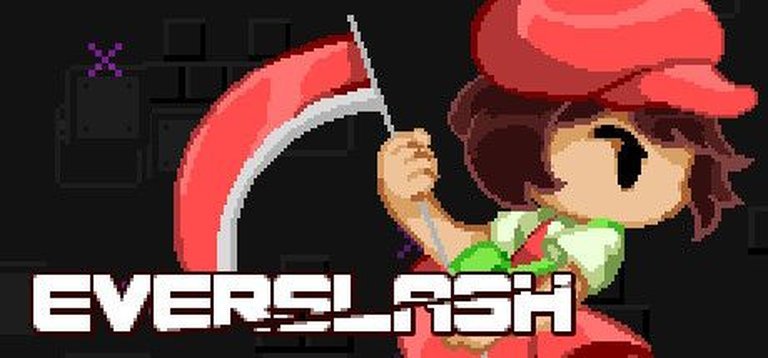
Everslash is a fast-paced 2D side-scrolling platformer set in a laboratory overrun by monsters. Players wield a scythe with a Slash Attack that combines evasion and offense, challenging them to defeat enemies and navigate linear levels to escape the facility in this indie action game.
Where to Buy Everslash
PC
Everslash Guides & Walkthroughs
Everslash Reviews & Reception
niklasnotes.com (93/100): Overall, the game is seen as fun but could benefit from additional content and refinement.
Everslash: A Precision-Carved Niche in the Indie Action Platformer Pantheon
Introduction: The Scythe’s Edge in a Crowded Arena
In the vast and often homogenous landscape of indie 2D action-platformers, Everslash (2020) emerges not with a thunderous roar but with a sharp, precise swish. Developed by the ultra-low-profile duo of Jaemin Park and Bitkumsa under the PsychoFlux Entertainment banner, the game represents a fascinating case study in focused design. Its central, unyielding mechanic—a scythe slash that doubles as an evasive maneuver—is both its defining genius and its entire structural universe. This review posits that Everslash is a game of exquisite, brutal minimalism. It is not a sprawling epic but a meticulously crafted gauntlet, a purity-of-concept experience that prioritizes a single, excellently tuned gameplay loop over narrative depth or content volume. Its legacy is not one of mainstream impact, but of serving as a potent reminder that a single, perfectly executed idea canforge a memorable, if niche, experience within the character-action genre.
Development History & Context: Forged in the Fires of Constraints
Everslash was born from the most contemporary of indie scenarios: a micro-project by a handful of developers with a clear, hyper-focused vision. The “studio” essentially consists of Jaemin Park and Bitkumsa, identities that suggest either a single developer’s alias or a minimal partnership. There is no grand history of prior titles or studio pedigree; its existence is a testament to the accessibility of tools like GameMaker Studio or Godot, which allow for the creation of tight, pixel-art experiences without AAA resources.
The 2020 release date places it in a period saturated with retro-inspired indies, yet post-Celeste and Hollow Knight, where players and critics had raised expectations for both mechanical precision and substantive content. Everslash’s development was likely constrained by immense scope limitations—its 50MB install size and basic system requirements (a 1GHz processor, 1GB RAM) speak to an asset-light, code-centric development philosophy. The technological constraint was not a limitation but a design pillar: the game’s simplicity and performance are direct results of its modest scale. In a market often bloated with content, Everslash’s ambition was purely to be a short, sharp, and perfectly balanced expedition into a single gameplay mechanic.
Narrative & Thematic Deep Dive: Down the Rabbit Hole, Literally
The narrative is delivered with the same minimalist efficiency as the gameplay. You are Mari Yun, a “youth reporter” (a lightly anime-inspired archetype) investigating the disappearance of her older sister, Sewon Yun, a researcher at SongHwa Life Sciences. This simple investigative premise is the narrativeMacGuffin that justifies the descent into the “underground research facility” infested with “strange monsters.”
- Plot as Scaffolding: The story is a linear descent into a mystery. There is no branching narrative, no significant character interactions beyond the implied goal of finding Sewon. The conspiracy (“Who are the people chasing Sewon?”) remains tantalizingly vague, hinted at only through environmental storytelling—the lab setting, the monstrous foes—and the player’s forward momentum. It is less a story to be unfolded and more a reason to be in the game’s world.
- Themes of Scientific Transgression: The setting—a life sciences lab overrun by monsters—invokes classic themes of scientific hubris and biological catastrophe, reminiscent of Resident Evil or The Last of Us‘s Cordyceps premise, albeit filtered through a more fantastical, less grounded lens. The monsters are not zombies but “strange” creatures, suggesting perhaps experimental accidents or interdimensional breaches. The theme, therefore, is one of uncovering hidden, dangerous truths, mirroring Mari’s journalistic purpose.
- Character & Dialogue: Mari is a cipher. Her character is defined by her role (sister, reporter) and her singular visual design (a pixelated girl with a giant scythe). There is no voice acting, and any dialogue is implied to be sparse text-based interactions, if present at all. Sewon exists solely as a missing-person objective. The narrative’s success hinges entirely on the player’s willingness to project motivation onto these archetypes. For some, this vagueness is an bracing absence of clutter; for others, it’s a critical failure to provide emotional stakes.
Gameplay Mechanics & Systems: The Elegance of the Slash-As-Dodge
This is Everslash’s entire raison d’être, and it is here the game’s philosophy crystallizes.
- The Core Loop: One Button, Infinite Nuance: The “Slash Attack” is the only combat/movement tool. Its genius lies in its dual function: attack and invincible dodge. When you press the attack button, Mari performs a slashing arc with her scythe. During the animation’s active frames, she is invulnerable to enemy attacks. This transforms every encounter into a rhythmic puzzle of positioning and timing. You do not have a separate “jump” or “dodge roll”; the slash is your aerial mobility and your shield. This creates an intensely fluid, risk-reward flow: commit to the slash to pass through an enemy’s attack, but mistime it, and you’re exposed.
- Level Design as a Combat Laboratory: The “vast stage” is a linear but densely packed series of rooms and corridors. The level design’s primary purpose is to create scenarios that test and showcase the slash mechanic. Enemies are placed not just to be obstacles, but to create patterns that the player must learn to slice through. The infamous “lasers” mentioned in the Steam forum post (“Are the lasers supposed to be blocked by the boxes?”) highlight this precise, sometimes opaque, design language. The game expects you to understand its internal logic: if a laser passes through a box in one place, it likely does everywhere. This is not always clearly telegraphed, leading to moments of frustration that feel like puzzle solutions rather than arbitrary difficulty.
- Progression & Systems: There is no RPG progression. No new abilities are gained, no stats are upgraded. The entire game is a test of the player’s mastery of that single slash against increasingly complex enemy and hazard arrangements. The “character progression” is purely the player’s skill curve. The UI is brutally simple: a life counter (likely limited, given the punishing difficulty noted in user analysis) and perhaps a score. The lack of Meta-progression (unlockables, currency) is a deliberate design choice that reinforces the game’s purity but also directly feeds the criticism of short length and low replayability.
- Innovation vs. Flaw: The innovation is the unified move. The flaw, as consistently cited in player reviews (“Control Responsiveness” ~5% of negative sentiment), is the implementation’s depth. A single-button system for both attack and evasion leaves little room for error; any perceived input lag or unresponsiveness is catastrophic. The game’s difficulty is not in managing a complex moveset, but in executing one move with pixel-perfect precision repeatedly. This creates a high skill ceiling but a potentially frustrating learning curve.
World-Building, Art & Sound: Atmospheric Consistency Over Grandeur
- Visual Direction: Functional Pixel Art: The game employs a clean, functional pixel art style. The “Female Protagonist” and “Fantasy” tags combine in a design that is cute (Mari’s sprite) contrasted with the grim tool of a scythe and monstrous foes. The “2D scrolling” perspective is strictly side-view. The art serves gameplay first: enemy designs are readable, hazards are clear, and the lab environment is suggestive rather than rich in detail. It is not a graphical showcase but an effective, atmosphericcommunicator. The lab feels sterile and menacing in equal measure through limited palette and tile-based design.
- Sound Design & Music: The Steam tags highlight a “Chiptune” soundtrack, a perfect companion to the pixel art. This musical style evokes nostalgia and intensity, driving the forward momentum. Sound effects are likely crisp and impactful—the shing of the slash, the explosion of a defeated foe, the ominous hum of machinery. The audio is another layer in the game’s sensory feedback loop, providing crucial audio cues for enemy attacks and environmental hazards. It is not ambient but instructional.
Reception & Legacy: The Cult of the Few
- Launch & Critical Reception: Everslash flew almost entirely under the critical radar. Metacritic lists “Critic reviews are not available,” and MobyGames shows no approved critic reviews. This is the fate of many micro-budget indies. Its existence was a whisper in the Steam algorithm, targeted at players searching for “hard” or “character action” 2D platformers.
- Player Reception: A Polarized “Very Positive”: On Steam, it holds a “Very Positive” rating (94% of 51 reviews at one count, 58/4 positive/negative in another). This is a remarkable score, but the absolute numbers (around 60 total reviews) signify a very small, dedicated audience. The “Niklas Notes” AI summary perfectly captures the dichotomy:
- Praised: Unique combat mechanics, challenging difficulty, cute graphics, fun factor, chiptune soundtrack.
- Criticized: Extremely short gameplay (2.1h estimated playthrough), underdeveloped story, occasionally frustrating control responsiveness and level design, low replay value.
- Legacy & Influence: As a cultural touchstone, Everslash has no measurable influence. It did not redefine genres or spawn clones. Its legacy is archetypal. It stands as a prime example of the “precision platformer” niche—games like Wizord, The End Is Nigh, or Cat Bird—that prioritize mastery of a tight control scheme over content sprawl. It is a game for completionists and masocore players who derive pleasure from the pure, distilled act of overcoming a challenging, well-designed obstacle course. Its influence is in its unwavering commitment to its core mechanic, a lesson in design focus for larger studios.
Conclusion: A Flawed Gem for the Discerning Few
Everslash is not for everyone. It is a short, difficult, narratively shallow, and sometimes archaic-feeling experience that demands pixel-perfect execution of a single, brilliant idea. Its technical issues (black screen startup problems noted in multiple forum posts over five years suggest lingering compatibility headaches) and minuscule scale are undeniable barriers.
Yet, for the player who cherishes mechanical purity, Everslash delivers. The thrill of perfectly timing a slash to sail through a barrage of projectiles and an enemy’s attack zone simultaneously is a potent, addictive rush. It understands that in the platformer genre, feeling the control is paramount, and it builds every inch of its world to service that feeling.
Its place in history is not on a pedestal but in a quiet, respected corner of the archive. It is a curio of focus, a game that dared to be only one thing and, for a small audience, succeeded brilliantly at it. It is a testament to the power of a single, well-honed mechanic, and a cautionary tale about the importance of complementary depth. To dismiss it for its brevity is to miss its point; to overpraise it for its brilliance is to ignore its flaws. Everslash is a scythe’s cut: clean, sharp, efficient, and leaving you wanting just a little more. It earns its “Very Positive” score not through scope, but through the sheer, unadulterated integrity of its central fantasy.