
- Release Year: 2022
- Platforms: Browser, Macintosh, Windows
- Developer: robobarbie
- Genre: Adventure, Puzzle
- Perspective: Fixed
- Game Mode: Single-player
- Gameplay: Mini-games, Visual novel
- Average Score: 94/100
Description
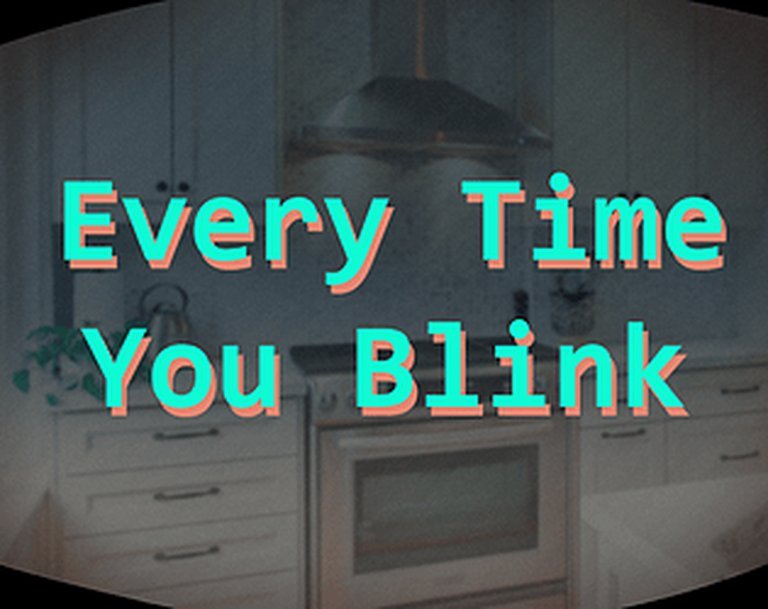
Every Time You Blink is an adventure puzzle game released in 2022. The game follows a recently single individual who reconnects with an old friend and decides to move in together. As the player navigates through various puzzles and scenes that appear with each blink, they uncover deeper emotional layers and questions about the relationship. The gameplay involves solving word puzzles, memory challenges, and budgeting tasks, all while exploring the fixed/flip-screen visual style and visual novel elements.
Gameplay Videos
Every Time You Blink: A Masterclass in Narrative-Driven Puzzle Design
Introduction
In an era where indie games increasingly blur the lines between storytelling and interactivity, Every Time You Blink (2022) emerges as a haunting meditation on love, regret, and the fragility of human connection. Developed in just 72 hours for Ludum Dare 51 under the theme “Every 10 Seconds,” this visual novel/puzzle hybrid transforms its time-constrained origins into a mechanical metaphor for protagonist Myles’ fractured attention span. At its core, the game asks: How do we rebuild trust with others—and ourselves—when every glance backward threatens to destabilize the present? Through deftly interwoven gameplay and narrative, it delivers an experience that lingers long after the final puzzle is solved.
Development History & Context
A Jam-Built Labor of Love
Created by a small team led by developer robobarbie (programming, UI art, and narrative design) alongside writers Destini Islands and Allie Vera, Every Time You Blink exemplifies the creative potential of game jams. Built using the Ren’Py engine—a tool traditionally associated with linear visual novels—the team subverted expectations by integrating four distinct puzzle genres (Wordle, memory tests, word searches, and budgeting math) into a cohesive whole. The game’s rapid development timeline (October 2022) coincided with the height of the Wordle phenomenon, yet it repurposes this cultural moment not as a gimmick, but as a narrative device.
Constraints as Innovation
Limited by Ludum Dare’s 72-hour window, the team relied on curated third-party assets:
– Music: Ghostrifter’s melancholic Purple Dream (CC BY-ND 3.0)
– Backgrounds: Sourced from Unsplash/pexels (e.g., Lisa Fotios’ hotel room)
– SFX: Freesound.org clips for blinks and puzzle completions
This patchwork aesthetic—described by players as “strangely comforting”—became an unintentional strength, mirroring Myles’ stitched-together memories.
Narrative & Thematic Deep Dive
A Story Told Through Gaps
Players inhabit Myles, a recently divorced individual reconnecting with Abel, an old friend (and implied former lover). As they prepare to sign a lease for a shared home, the game dissects their history through fragmented conversations interrupted by mandatory puzzle-solving. Key revelations emerge:
– A locker-room hookup during university strained their friendship.
– Abel’s presence at Myles’ wedding to Diane foreshadowed marital collapse.
– Diane’s suspicion of unresolved attraction between them.
Queer Subtext & Emotional Avoidance
The game avoids explicit labels but drips with queer-coding, particularly in Abel’s dialogue: “How is it that I’m so ‘important’ to you and yet you’re always somewhere else?” Puzzles literalize Myles’ inability to focus during emotionally charged moments; the infamous Wedding Math puzzle, for example, forces players to budget for a doomed marriage while Abel’s voiceover critiques Myles’ life choices.
Gameplay Mechanics & Systems
The Blink Mechanic Reimagined
Unlike Before Your Eyes (2021), which used webcam-based blinking, Every Time You Blink employs metaphorical blinks—transitions triggered by puzzle completion. Each minigame reflects Myles’ mental state:
- Wordle: Struggling to “guess” the right words during arguments.
- Memory Test: Recalling fragmented conversations.
- Word Search: Hunting for meaning in chaos.
- Wedding Math: Calculating the cost of emotional dishonesty.
Flaws as Features
Notably, the game’s jank—unfixed bugs like background glitches and Wordle display errors—were preserved post-jam. Paradoxically, these imperfections heightened the narrative’s themes of imperfection, earning praise from players like Thaddeus_Erik: “The pressure felt real—like I was fighting my own brain alongside Myles.”
World-Building, Art & Sound
Aesthetic of Unease
The game’s lo-fi visuals—static backgrounds spliced with close-ups of Abel’s tattooed arms or Myles’ trembling hands—create an atmosphere of voyeuristic intimacy. Michelle Myers’ locker room photo becomes a fraught space of past desire, while Erik McLean’s pub background underscores the mundanity of life-altering conversations.
Soundtrack as Emotional Anchors
Ghostrifter’s dreamlike synth track loops endlessly, its repetition mirroring Myles’ cyclical guilt. Meanwhile, LAGtheNoggin’s blink SFX (a sharp, wet click) punctuates scene transitions like a metronome of anxiety.
Reception & Legacy
Player Responses: Catharsis Through Frustration
Despite its modest scope, the game resonated deeply:
– 4.7/5 on itch.io (392 ratings)
– Praised for its “ADHD-in-a-nutshell” pacing (pkbaybe)
– Criticized for abrupt puzzles, yet even detractors admitted: “I suffered… but it was worth it” (Lachopechitaa)
Industry Impact
While not a commercial blockbuster, Every Time You Blink influenced later indie titles like Every Hue of You (2023), proving that game jam projects can evolve into culturally significant works. Its legacy lies in redefining puzzle genres as narrative tools, inspiring developers to weaponize gameplay friction for emotional ends.
Conclusion
Every Time You Blink is a testament to the power of constraints. What began as a Ludum Dare prototype became a piercing exploration of how we fragment ourselves to avoid pain—and how love demands reintegration. Though its puzzles may frustrate and its bugs persist, these flaws crystallize its central truth: We are all mosaics of missed connections and half-remembered words, striving to be seen before the next blink carries us away. In the pantheon of indie gems, it earns its place not through polish, but through raw, unflinching humanity.
Final Verdict: A flawed masterpiece that redefines what small-team storytelling can achieve. Essential for fans of narrative innovation—but bring a walkthrough for the math puzzle.