
- Release Year: 2008
- Platforms: Windows
- Publisher: Freeware / Free-to-play / Public Domain
- Developer: Jesse Venbrux
- Genre: Simulation
- Perspective: 1st-person
- Game Mode: Single-player
- Average Score: 75/100
Description
Execution is an experimental art game that explores the consequences of one’s actions through a brief, impactful sequence designed to provoke thought and reflection. Created by Jesse Venbrux using GameMaker, the game challenges players to experience its narrative at least twice to fully grasp its meaning, though its intense content may deter some. Set in a first-person perspective, Execution blends simulation and psychological horror, leaving a lasting impression on those who engage with its unsettling themes.
Where to Buy Execution
PC
Execution Reviews & Reception
gamesreviews2010.com (75/100): Execution is a must-play for fans of psychological horror and survival horror enthusiasts alike.
praxisgamereviews.blogspot.com : Execution suggests that consequences are meaningless if they don’t have a lasting effect, so this aspect of gameplay clashes with one of the implicit artistic goals of gaming.
Execution Cheats & Codes
PlayStation 2
At the main menu, select ‘Options’, ‘Cheat Codes’, then enter one of the following case-sensitive codes to activate the corresponding cheat function.
| Code | Effect |
|---|---|
| KellyKG12R | Unlocks Kelly Kelly’s second costume |
| DXCostume69K2 | Unlocks Triple H and HBK’s DX attire |
Xbox 360
At the main menu, select ‘Options’, ‘Cheat Codes’, then enter one of the following case-sensitive codes to activate the corresponding cheat function.
| Code | Effect |
|---|---|
| KellyKG12R | Unlocks Kelly Kelly’s second costume |
| DXCostume69K2 | Unlocks Triple H and HBK’s DX attire |
Execution: A Masterclass in Minimalist Horror and Player Agency
Introduction
In the vast landscape of video games, few titles dare to challenge the very foundations of player interaction and moral responsibility as boldly as Execution (2008). Created by Jesse Venbrux, this experimental art game is a stark, unflinching exploration of the consequences of one’s actions, wrapped in a minimalist yet profoundly unsettling package. Unlike traditional games that offer players the safety net of save files and replays, Execution forces players to confront the permanence of their choices, blurring the line between virtual and real-world morality. This review delves deep into the game’s development, narrative, gameplay mechanics, and its lasting impact on the gaming landscape.
Development History & Context
Execution emerged in 2008, a time when the gaming industry was dominated by blockbuster titles and increasingly complex narratives. Jesse Venbrux, known for his work on the Karoshi series, sought to create something radically different—a game that questioned the implicit assumptions of video games themselves. Developed using GameMaker, Execution was a departure from mainstream trends, focusing instead on philosophical and ethical dilemmas.
The game’s development was rooted in Venbrux’s desire to challenge the notion of player agency. At a time when games like Bioshock (2007) were exploring themes of free will and moral choice, Execution took a more radical approach. It stripped away the layers of gameplay mechanics, narrative depth, and visual spectacle to present players with a single, irreversible decision. This minimalist approach was not just a stylistic choice but a deliberate attempt to force players to engage with the game on a deeper, more personal level.
Narrative & Thematic Deep Dive
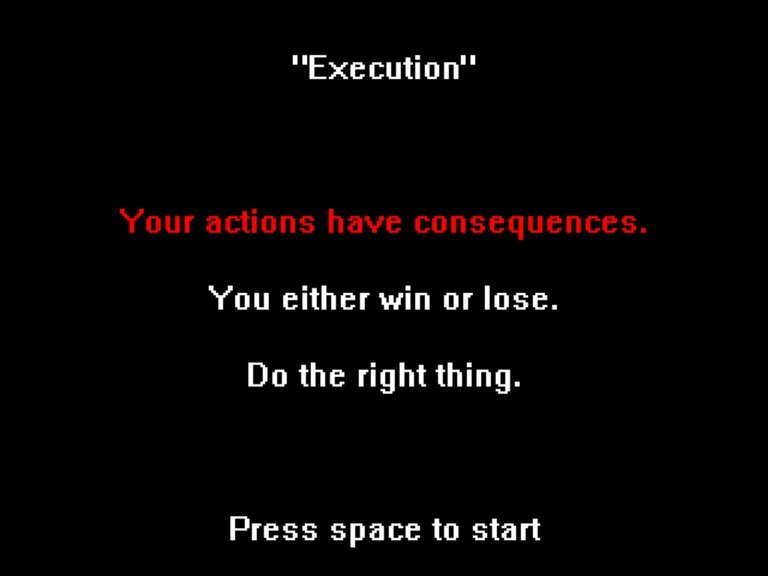
Execution begins with three statements that serve as its philosophical foundation:
1. Your actions have consequences.
2. You either win or lose.
3. Do the right thing.
These statements set the stage for the game’s central dilemma. Players are presented with a prisoner tied to a stake in a dimly lit room. The only interaction available is to aim a gun at the prisoner and fire. The game’s narrative is sparse, but its themes are profound. The prisoner’s identity, the reason for their imprisonment, and the player’s role in this scenario are left deliberately ambiguous. This ambiguity forces players to project their own interpretations onto the game, making the experience deeply personal.
The game’s most striking feature is its handling of consequences. If the player chooses to shoot the prisoner, they are met with a “You Lose” screen, and the game ends. However, the game also writes a small amount of data to the player’s registry, ensuring that any subsequent attempt to replay the game results in a message: “It’s already too late.” This mechanic is a bold statement on the permanence of actions. Unlike traditional games where players can reload a save file to undo their mistakes, Execution forces players to live with the consequences of their choices, much like in real life.
Conversely, if the player chooses to exit the game without shooting the prisoner, they are rewarded with a “You Win” screen. This outcome challenges the traditional notion of winning in video games, which often involves overcoming obstacles through violence. Execution suggests that sometimes, the most moral choice is to disengage entirely.
Gameplay Mechanics & Systems
Execution is not a game in the traditional sense. It lacks the complex mechanics, progression systems, and replayability that define most video games. Instead, it is an interactive experience designed to provoke thought and introspection.
Core Gameplay Loop
The gameplay loop in Execution is minimalist to the point of being almost non-existent. Players are presented with a single scenario and a single choice: to shoot or not to shoot. This simplicity is deceptive, as it forces players to confront the weight of their decision without the distractions of combat, exploration, or narrative progression.
Combat and Interaction
The only interaction available in Execution is the act of shooting the prisoner. This mechanic is deliberately stark and unadorned, emphasizing the gravity of the action. There are no enemies to fight, no puzzles to solve, and no items to collect. The game’s focus is solely on the moral dilemma presented to the player.
UI and Feedback
The game’s user interface is equally minimalist. The only feedback players receive is the “You Win” or “You Lose” screen, depending on their choice. This lack of feedback reinforces the game’s themes of consequence and permanence. There are no second chances, no do-overs, and no explanations.
World-Building, Art & Sound
Execution’s world-building is intentionally sparse. The game’s setting is a dimly lit room with a prisoner tied to a stake, evoking a sense of isolation and despair. The visual design is minimalist, with a focus on creating an atmosphere of tension and unease. The use of shadows and muted colors contributes to the game’s oppressive mood.
The sound design is equally effective in creating a sense of dread. The absence of music and the use of ambient sounds, such as the rustling of tumbleweeds, enhance the game’s eerie atmosphere. The sound of the gunshot, when the player chooses to fire, is jarring and final, reinforcing the irreversibility of the action.
Reception & Legacy
Execution was released as freeware in 2008 and quickly gained attention for its bold approach to player agency and moral choice. The game’s reception was mixed, with some players praising its thought-provoking nature and others criticizing its lack of traditional gameplay elements.
Critical Reception
Critics who engaged with Execution on its own terms recognized it as a significant experiment in interactive storytelling. The game’s minimalist approach and its focus on consequence were seen as innovative and challenging. However, some critics dismissed it as a gimmick, arguing that its lack of replayability and traditional gameplay mechanics made it more of an art piece than a game.
Player Reception
Player reactions to Execution were equally divided. Some players appreciated the game’s bold statement on the consequences of actions, while others found it frustrating and unsatisfying. The game’s use of the registry to prevent replayability was particularly controversial, with some players seeing it as a clever mechanic and others viewing it as an unnecessary restriction.
Legacy
Despite its mixed reception, Execution has had a lasting impact on the gaming landscape. It has inspired other developers to explore similar themes of consequence and permanence in their games. Titles like The Stanley Parable (2013) and Undertale (2015) have drawn inspiration from Execution’s approach to player agency and moral choice.
Execution also remains a topic of discussion in academic circles, where it is often cited as an example of how video games can be used to explore complex philosophical and ethical questions. Its minimalist design and focus on consequence have made it a subject of study in game design courses, where it is used to illustrate the potential of video games as a medium for artistic expression.
Conclusion
Execution is a game that defies easy categorization. It is not a traditional video game in the sense of offering entertainment or escapism. Instead, it is an interactive experience designed to provoke thought and introspection. Its minimalist design, focus on consequence, and bold use of the registry to prevent replayability make it a unique and challenging experience.
While Execution may not be for everyone, its impact on the gaming landscape is undeniable. It has inspired other developers to explore similar themes and has sparked important discussions about the nature of player agency and moral choice in video games. For those willing to engage with its challenging themes, Execution offers a profound and thought-provoking experience that lingers long after the game has ended.
Final Verdict: Execution is a bold experiment in interactive storytelling that challenges the very foundations of player agency and moral responsibility. Its minimalist design and focus on consequence make it a unique and thought-provoking experience, though its lack of traditional gameplay elements may not appeal to all players. For those interested in the potential of video games as a medium for artistic expression, Execution is a must-play.