
- Release Year: 2022
- Platforms: Android, iPad, iPhone, Linux, Macintosh, Windows
- Publisher: Nyan Studio Games
- Developer: Nyan Studio Games
- Genre: Action
- Perspective: Side view
- Game Mode: Online PVP, Single-player
- Gameplay: Arcade, Platform
- Average Score: 95/100
Description
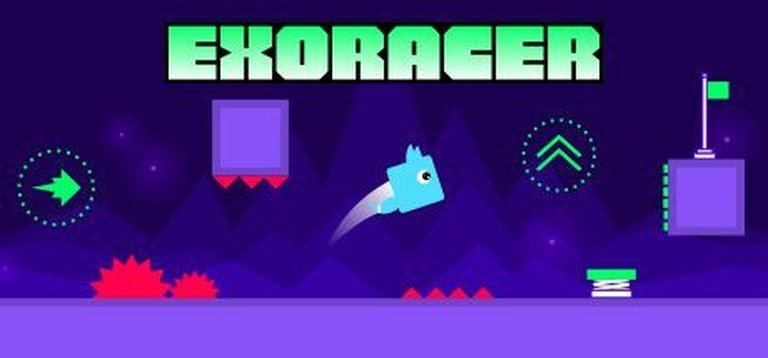
Exoracer is a vibrant side-scrolling platformer where players race through short, obstacle-filled levels to achieve the fastest times, competing for world records or engaging in chaotic 4-player multiplayer races to climb the trophy road. Developed by Nyan Studio Games, the game combines addictive arcade gameplay with a level editor for creating custom courses, a replay viewer for performance analysis, and cosmetic customization options. Initially released on mobile in 2022 and now available on Steam and other platforms, it challenges players with superhuman reflexes and quick reflexes in fast-paced, competitive environments.
Gameplay Videos
Where to Buy Exoracer
PC
Exoracer Patches & Updates
Exoracer Mods
Exoracer Guides & Walkthroughs
Exoracer Reviews & Reception
justuseapp.com (94/100): This game is fun, addictive, and very enjoyable… for the first day or two you play it for.
Exoracer: A Symphony of Speed and Community in the Modern Platformer Renaissance
Introduction
In the crowded pantheon of indie platformers, where pixelated nostalgia and hyper-competitive speedruns often dominate, Exoracer emerges not merely as a game, but as a cultural phenomenon forged from a decade of quiet passion. Conceived by solo developer Frédéric Schertenleib of Nyan Studio Games, this unassuming title—born on mobile in 2022 before conquering Steam in 2024—redefines the genre through its brutal simplicity and communal ambition. With its one-tap control scheme and laser focus on competitive multiplayer racing, Exoracer transcends the limitations of its minimalist design to deliver an experience that is simultaneously accessible to newcomers and ruthlessly demanding for veterans. This review dissects Exoracer‘s meteoric rise, dissecting its genesis, dissecting its gameplay, and ultimately affirming its place as a landmark achievement in accessible, community-driven arcade gaming.
Development History & Context
Nyan Studio Games, founded in 2021 by French developer Frédéric Schertenleib, represents the quintessential modern indie success story: a solo endeavor honed over nearly a decade of unpaid passion projects. Schertenleib’s journey began not with formal training, but with self-taught Flash game development in his teens, followed by a Computer Science degree at Lyon University and professional experience at Sandstorm Interactive in Argentina, where he specialized in multiplayer technology. This background uniquely positioned him to tackle the live-service challenges of Exoracer, which he began developing in October 2021. Crucially, Exoracer is the culmination of five unpublished platformers, each acting as a laboratory for refining mechanics and understanding player engagement. This iterative process—fueled by Schertenleib’s free time—is evident in the game’s polished, responsive core.
Technologically, Exoracer leverages the Unity engine and C#, a pragmatic choice that allowed Schertenleib to rapidly prototype and deploy across multiple platforms. Its initial release on Android (June 30, 2022) and iOS capitalized on the mobile gaming landscape’s hunger for bite-sized, competitive experiences amid the pandemic’s digital boom. The gaming zeitgeist of the early 2020s favored hyper-casual accessibility married to competitive depth, a void Exoracer filled with its minimalist design and asynchronous multiplayer. By 2024, as cross-play became the industry standard, Schertenleib’s expansion to Windows, macOS, Linux, and iPad/iPhone was a strategic masterstroke, transforming a mobile hit into a genre-defining multiplatform contender. The constraints of mobile development—limited input and screen space—ultimately became Exoracer’s greatest strength, forcing the creation of elegant, one-tap controls that would define its identity.
Narrative & Thematic Deep Dive
While Exoracer eschews traditional narrative in favor of pure gameplay, its thematic underpinnings are woven into the fabric of its competitive structure and developer history. The game’s plot is a non-linear sprint toward personal mastery and communal validation—a universal quest distilled to its essence. Players embody anonymous racers, their journey punctuated by fleeting moments of triumph and defeat in two-minute bursts. The absence of named characters or dialogue is not a limitation but a deliberate choice, emphasizing that the narrative is the player’s own story: overcoming a spike jump, reclaiming a lost trophy, or discovering a hidden shortcut in a community level.
Themes of perseverance and iterative improvement permeate the experience, mirroring Schertenleib’s decade-long development odyssey. The trophy system—where winners gain 8 trophies, losers lose 4 to 8, and an “underdog bonus” mitigates skill disparity—is a microcosm of the game’s philosophy: competition should be punishing but fair, fostering a cycle of striving. Seasonal levels, handpicked by the developer, introduce themes of curation and communal celebration, while the level editor embodies democratic creativity, enabling players to become architects of their own challenges. This absence of explicit narrative is Exoracer’s greatest strength; it substitutes story with the raw, emotional drama of high-stakes races, where the tension between rivals and the ghost of a personal best create a compelling, player-driven epic.
Gameplay Mechanics & Systems
At its core, Exoracer is a masterclass in distilled mechanics. The one-tap control scheme—jumping on the ground, swinging on poles, and boosting mid-air—deceptively masks a game of staggering depth. This simplicity belies a punishing learning curve, where millisecond timing and perfect route optimization separate novices from grandmasters. The gameplay loop revolves around two pillars: time-trial solo runs and frantic 4-player PvP races lasting exactly 120 seconds. The latter is a symphony of chaos and strategy, where players vie for the fastest time on procedurally selected short levels (often just 30-60 seconds long), with the winner determined by the clock rather than direct combat.
Progression is driven by the trophy system, a brilliant risk-reward mechanic that incentivizes climbing the ranks while protecting newcomers. At 250 and 500 trophies, players unlock Medium and Hard level tiers, and at 800, seasonal community levels appear. This gated progression prevents overwhelming beginners but risks creating matchmaking hell, as noted in reviews where high-trophy players dominate “Easy” maps. The level editor is Exoracer’s crown jewel, featuring a visual scripting language that enables players to craft fiendishly complex levels with logic gates and triggers. While initially locked behind a small purchase on mobile, it’s a testament to Schertenleib’s vision of player-driven content, with over 80,000 community levels ensuring infinite replayability.
Flaws exist, however. The minimalist UI can obscure critical information, and the reliance on random level selection in multiplayer breeds repetition. Some players report bugs like phantom hitboxes or lag-induced deaths, though the Steam version’s 96% positive rating suggests these are mitigated post-launch. Still, the core loop—jump, swing, race, improve—remains an addictive, dopamine-fueled masterpiece.
World-Building, Art & Sound
Exoracer’s world is not a physical place but a vibrant, abstract arena of competition. Its minimalist 2D aesthetic—bold primary colors, clean lines, and geometric hazards—evokes classic arcade games like Geometry Dash but with a modern, neon-infused flair. Levels are compact, often consisting of a single screen repeated or scrolled horizontally, with no narrative lore or environmental storytelling. Instead, atmosphere is generated through contrast: the stark simplicity of the visuals makes every spike and boost pad feel like a monumental obstacle, while the subtle parallax scrolling adds depth without distraction.
Sound design, composed by Luca Tomassini, is similarly functional yet evocative. Electronic chimes punctuate successful jumps, while a pulsating soundtrack escalates during races, creating a sense of urgency. The audio cues are crisp and responsive, turning gameplay into a percussive experience where taps and falls are rhythmically linked to the music. This synergy between visual restraint and auditory feedback reinforces the game’s focus on mechanical purity, making Exoracer a feast for the senses in its subtlety. The art direction’s strength lies in its scalability—equally compelling on a phone’s tiny screen or a PC monitor—proving that minimalist design can create a timeless, universally appealing aesthetic.
Reception & Legacy
Exoracer’s launch trajectory is a case study in indie triumph. Its mobile debut (June 2022) generated over 1 million downloads, buoyed by Apple’s “Game of the Day” feature (September 2022) and inclusion in “New Games We Love” across 60+ countries. Critics lauded its “one-tap genius” and addictive multiplayer, with Dutch magazine Gameplay (Benelux) praising its “hilarious” races and “above-human reflexes” requirements. However, early critiques flagged matchmaking imbalances and repetitive level selection, issues that Schertenleib actively patched.
Upon its Steam release (August 2024), Exoracer exploded into a “Very Positive” phenomenon (96% of 58 reviews). Players hailed its “snappy controls,” “brilliant level editor,” and “zero pay-to-win monetization.” Tags like “Precision Platformer,” “Difficult,” and “Multiplayer” dominate, underscoring its niche appeal. Legacy-wise, Exoracer has influenced a wave of minimalist racers, proving that competitive depth need not rely on complex controls. Its level editor and community-driven content model echo Super Mario Maker’s success, while its trophy system offers a blueprint for fair competitive progression. Most importantly, it revitalized the “arcade platformer” for a new generation, demonstrating that solo developers can carve out cultural icons in an industry dominated by studios.
Conclusion
Exoracer is more than a game; it is a testament to the power of iterative passion and community collaboration. Frédéric Schertenleib’s decade-long journey, distilled into a year of explosive development, has yielded a title that is simultaneously a brutal speedrunning challenge and a welcoming creative sandbox. Its one-tap controls belie unforgiving depth, its minimalist aesthetic belies fierce competitive spirit, and its humble mobile origins belie its multiplatform ambition. While minor flaws in matchmaking and repetition linger, they are overshadowed by the game’s sheer addictive brilliance and the developer’s responsive stewardship.
In the pantheon of video game history, Exoracer stands as a modern classic—a rare fusion of accessibility and mastery that honors its arcade forebears while charting a new course for community-driven design. It is not merely a game to be played, but a living ecosystem to be mastered, shared, and celebrated. For anyone who has ever dreamed of a race where every jump is a victory and every defeat is a lesson, Exoracer is not just recommended—it is essential. This is the platformer reimagined for the digital age, and its legacy is only beginning.