
- Release Year: 2010
- Platforms: Windows
- Publisher: Intenium GmbH, Viva Media, LLC
- Developer: Deep Shadows
- Genre: Adventure
- Perspective: 1st-person
- Game Mode: Single-player
- Gameplay: Hidden object, Puzzle elements
- Setting: Horror
- Average Score: 60/100
Description
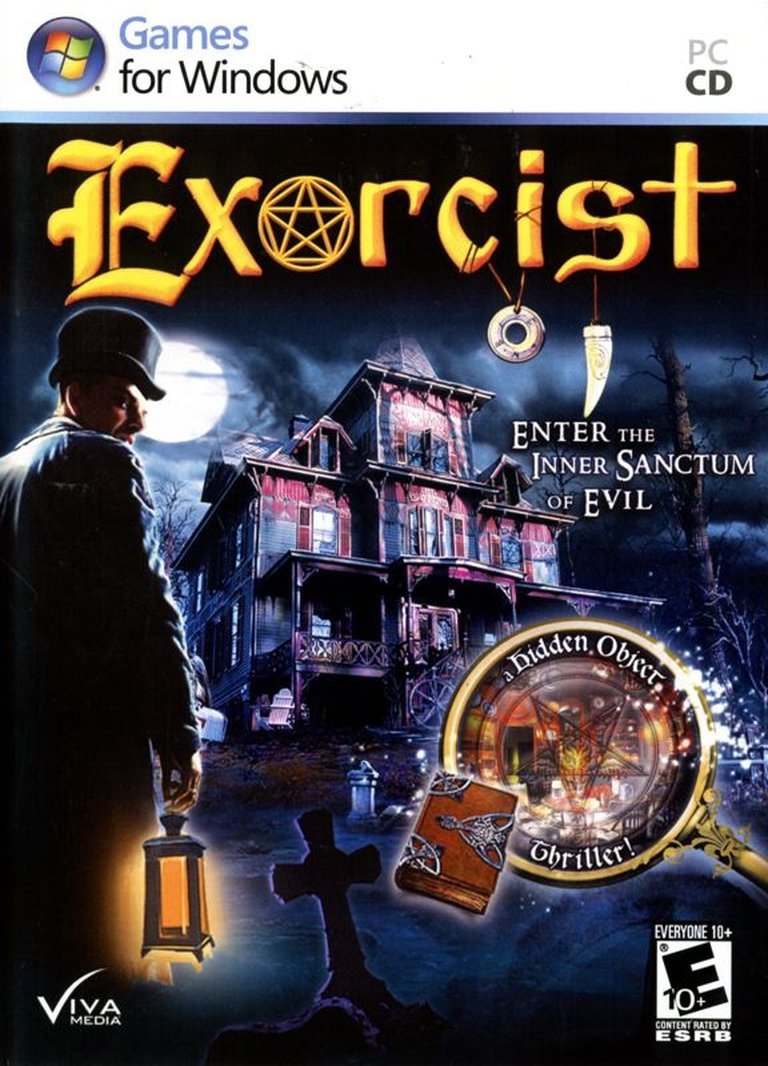
In ‘Exorcist’, players step into the role of Garret ‘Ghostfighter’, a professional exorcist with the ability to see demons and lost souls. After receiving a taunting letter from his arch-nemesis Mephisto hinting at the fate of his long-lost love Margo, Garret embarks on a dark journey to uncover the truth. The game blends hidden object gameplay with adventure elements, challenging players to find concealed items, solve puzzles, and reassemble clues like fragments of Mephisto’s letters. With a gothic horror setting, inventory-based puzzles, and mini-games, the game weaves a supernatural narrative where players must outwit demons and unravel mysteries to progress through each chapter.
Gameplay Videos
Where to Buy Exorcist
PC
Exorcist Guides & Walkthroughs
Exorcist Reviews & Reception
mobygames.com (60/100): Average score: 60% (based on 1 ratings)
Exorcist Cheats & Codes
iOS
Redeem codes in the game.
| Code | Effect |
|---|---|
| aYviWJd37d9Q | Redeemable rewards |
| 3J9CbTymdC6R | Redeemable rewards |
| Z2zKcOfthfMg | Redeemable rewards |
| fg22juUUI42Y | Redeemable rewards |
| E1MNTVENuX1J | Redeemable rewards |
| eR3A0ckCHO8y | Redeemable rewards |
| x7zQCtTZ2jSe | Redeemable rewards |
| ADVMYLPeJlfg | Redeemable rewards |
| NnvMXXL76nNs | Redeemable rewards |
| CBkpJMSNCyQS | Redeemable rewards |
| skQUnSKBh0Mt | Redeemable rewards |
| Ww6YXpJE1gpl | Redeemable rewards |
| lRSWjVi5htnJ | Redeemable rewards |
| jkzXfZmc2YZc | Redeemable rewards |
| Buto5sZGfeBP | Redeemable rewards |
| hrzg2ZWkwbVw | Redeemable rewards |
| soiV3HgOM9Bs | Redeemable rewards |
| bDZyvXAkSLhe | Redeemable rewards |
| f3z5k6Lu79UF | Redeemable rewards |
Exorcist: A Hidden Object Adventure in the Shadows of the Occult
Introduction
In the vast and often overlooked landscape of horror-themed hidden object games, Exorcist (2010) emerges as a curious artifact—a game that attempts to blend the tension of supernatural horror with the methodical, almost meditative, gameplay of the hidden object genre. Developed by Deep Shadows and published by Intenium GmbH and Viva Media, Exorcist is a title that, while not widely celebrated, offers a unique glimpse into the niche subgenre of horror adventure games. This review will dissect Exorcist in exhaustive detail, exploring its development context, narrative ambitions, gameplay mechanics, and its place within the broader Exorcist franchise and gaming history.
Development History & Context
The Studio and Creators’ Vision
Deep Shadows, the developer behind Exorcist, is a studio with a modest portfolio, primarily known for creating casual and hidden object games. Their work often leans into atmospheric storytelling, and Exorcist is no exception. The game was released in 2010, a period when hidden object games were experiencing a surge in popularity, particularly in the casual gaming market. Titles like Mystery Case Files and Dark Parables had already established the genre’s appeal, blending puzzle-solving with narrative-driven exploration.
Exorcist was conceived as part of a trilogy, with Exorcist II (2011) and Exorcist III: Inception of Darkness (2012) following shortly after. The game’s premise is rooted in the broader Exorcist franchise, which began with William Peter Blatty’s 1971 novel and the subsequent 1973 film adaptation directed by William Friedkin. However, unlike the films, which are deeply embedded in psychological and theological horror, Exorcist (2010) adopts a more fantastical and adventure-oriented approach.
Technological Constraints and Design Choices
The game was developed for Windows, with a shareware business model that allowed players to try a portion of the game before purchasing. This model was common in the casual gaming market of the late 2000s and early 2010s, where developers sought to attract players with low-risk entry points. The game’s technical specifications are modest, requiring only a keyboard and mouse for input, and it was distributed via CD-ROM and digital download.
Visually, Exorcist employs a first-person perspective, a choice that immerses the player in the game’s eerie environments. The art style is dark and gothic, with detailed hand-drawn scenes that evoke a sense of foreboding. The game’s sound design, while not groundbreaking, contributes to its atmosphere, though the voice acting—particularly for supporting characters—has been criticized for its over-the-top delivery, which undermines the game’s attempts at serious horror.
The Gaming Landscape of 2010
The year 2010 was a transitional period for the gaming industry. While AAA titles like Mass Effect 2 and Red Dead Redemption dominated the mainstream, the casual gaming market was thriving, driven by digital distribution platforms like Big Fish Games and Steam. Hidden object games, in particular, found a dedicated audience among players who enjoyed puzzle-solving and narrative-driven experiences without the demand for twitch reflexes or complex mechanics.
Exorcist entered this market as a niche title, catering to fans of horror and adventure games. Its connection to the Exorcist franchise likely served as a marketing hook, though the game’s actual ties to the films and novels are tenuous at best. Unlike the franchise’s cinematic entries, which explore themes of faith, evil, and human vulnerability, Exorcist (2010) is more concerned with delivering a straightforward adventure experience with supernatural trappings.
Narrative & Thematic Deep Dive
Plot and Characters
Exorcist follows the journey of Garret “Ghostfighter,” a professional exorcist with the ability to see demons and spirits. The game begins with Garret receiving a taunting letter from his arch-nemesis, Mephisto, who hints at the fate of Garret’s long-lost love, Margo. This premise sets the stage for a personal quest that unfolds across a series of haunted locations, each filled with puzzles, hidden objects, and supernatural challenges.
The narrative is divided into chapters, each of which requires the player to assemble pieces of Mephisto’s letter to progress. The story is linear, with Garret moving from one location to the next, uncovering clues and confronting demons along the way. The game’s writing attempts to evoke a gothic horror atmosphere, with dialogue that leans into archaic phrasing and melodramatic delivery. However, the voice acting often undermines this tone, particularly in the case of supporting characters, whose performances are hammy and lack subtlety.
Themes and Symbolism
At its core, Exorcist is a game about confrontation—both with external evil and internal doubt. Garret’s journey is not just a physical one but also a spiritual and emotional one, as he seeks to uncover the truth about Margo’s disappearance. The game’s use of religious iconography, such as crosses and holy water, reinforces its themes of faith and redemption, though these elements are often reduced to mechanical puzzle-solving tools rather than explored in depth.
The game’s antagonist, Mephisto, serves as a classic representation of evil—a cunning, manipulative figure who delights in tormenting Garret. However, Mephisto’s character is underdeveloped, serving more as a plot device than a fully realized villain. The game’s reliance on tropes from the Exorcist franchise, such as demonic possession and exorcism rituals, is superficial, lacking the psychological depth and theological complexity that define the films and novels.
Dialogue and Writing
The game’s dialogue is a mixed bag. While the writing itself is competent, with a clear attempt to evoke a gothic horror tone, the delivery often falls flat. Garret and Mephisto’s voice actors fare better than the supporting cast, but even their performances are occasionally overdone. The game’s script is filled with exposition, which can feel heavy-handed at times, particularly in the early chapters where the player is still acclimating to the game’s mechanics.
One of the more interesting narrative elements is the game’s use of tarot cards and letters as storytelling devices. These artifacts serve as both collectibles and narrative triggers, revealing bits of the story as the player progresses. However, the game’s reliance on these devices can feel repetitive, as the player is constantly tasked with finding and reassembling the same types of objects.
Gameplay Mechanics & Systems
Core Gameplay Loop
Exorcist is, at its heart, a hidden object game with adventure elements. The core gameplay loop involves exploring detailed scenes, finding items from a list, and using those items to solve puzzles or progress to new areas. The game’s first-person perspective enhances the immersion, allowing players to feel as though they are truly exploring Garret’s world.
The hidden object mechanics are standard for the genre. Players are given a list of items to find in each scene, with some items hidden behind interactive elements (e.g., lifting a rock to find a lizard). The game also includes “blue” items, which are concealed and require additional interaction to reveal. This mechanic adds a layer of complexity to the hidden object searches, preventing them from becoming too repetitive.
Inventory and Puzzle-Solving
The inventory system is straightforward, with players collecting items and using them to solve puzzles. For example, a player might find a key and use it to unlock a door, or combine a cross with holy water to create a tool for banishing demons. The puzzles themselves are varied, ranging from simple lock mechanisms to more complex challenges like reassembling shattered letters or restoring damaged paintings.
One of the game’s strengths is its integration of puzzles into the environment. Rather than feeling like arbitrary roadblocks, many of the puzzles are logically tied to the game’s narrative and setting. For instance, a puzzle involving gears in a lighthouse feels appropriate given the location, and the solution requires the player to think critically about how the mechanisms work.
Hint System and Difficulty
The game includes a hint system, represented by a skull icon at the bottom of the screen. When activated, the hint system highlights the location of one of the required items. However, the hint system has a cooldown period, encouraging players to rely on their own observation skills rather than spamming hints. This design choice helps maintain the game’s challenge without becoming frustrating.
The difficulty curve is generally well-balanced, though some puzzles can be overly obscure, particularly in the later chapters. The game’s reliance on hidden object searches can also become tedious for players who prefer more varied gameplay. However, the inclusion of mini-games and environmental puzzles helps break up the monotony.
User Interface and Controls
The user interface is clean and intuitive, with the inventory, hint system, and objective list all easily accessible. The game’s controls are simple, relying on point-and-click mechanics that are standard for the genre. The cursor changes depending on the context—normal, action, examination, or movement—which helps guide the player’s interactions with the environment.
One minor criticism is the lack of a map or fast-travel system, which can make backtracking between locations feel tedious. Given the game’s linear structure, this omission is not a major flaw, but it does highlight the game’s casual gaming roots, where players are expected to take their time exploring each scene thoroughly.
World-Building, Art & Sound
Setting and Atmosphere
Exorcist takes place across a variety of gothic and supernatural locations, including haunted houses, taverns, forests, and a lighthouse. Each location is richly detailed, with intricate artwork that evokes a sense of decay and mystery. The game’s environments are filled with clutter, which serves both as a backdrop for the hidden object searches and as a way to immerse the player in the game’s world.
The atmosphere is one of the game’s strongest aspects. The dark, moody visuals, combined with the eerie sound design, create a sense of unease that permeates the entire experience. The game’s use of light and shadow is particularly effective, with dimly lit scenes that force the player to scrutinize every corner for hidden items or clues.
Visual Direction
The art style is hand-drawn and detailed, with a focus on gothic architecture and supernatural imagery. The game’s color palette is muted, with heavy use of blacks, grays, and deep reds, which contribute to its horror aesthetic. The character designs, while not as detailed as the environments, are serviceable, with Mephisto’s demonic visage standing out as a particularly striking visual.
One area where the visuals fall short is in the animation. The game’s static scenes and limited animations can make the world feel lifeless at times, particularly in comparison to more dynamic hidden object games. However, the detailed backgrounds more than make up for this shortcoming, providing a rich canvas for the player’s exploration.
Sound Design and Music
The sound design is atmospheric, with ambient noises like creaking doors, howling wind, and distant whispers enhancing the game’s horror elements. The music is similarly moody, with a gothic score that complements the visuals. However, the voice acting is a weak point, with many of the supporting characters delivering lines in an over-the-top manner that undermines the game’s attempts at serious horror.
The game’s sound effects are well-implemented, with each interaction—whether it’s picking up an item or solving a puzzle—accompanied by a satisfying audio cue. This attention to detail helps make the gameplay feel more immersive, even if the overall sound design is not as polished as that of higher-budget titles.
Reception & Legacy
Critical and Commercial Reception
Exorcist received mixed reviews upon release. GameZebo, one of the few outlets to review the game, gave it a score of 60%, praising its atmosphere and puzzle design but criticizing its voice acting and repetitive gameplay. Player reception was similarly lukewarm, with an average score of 2.5 out of 5 on MobyGames. The game’s shareware model likely limited its commercial success, as it struggled to stand out in a crowded market of hidden object games.
Despite its modest reception, Exorcist found a small but dedicated audience among fans of horror-themed adventure games. Its gothic aesthetic and supernatural themes resonated with players who enjoyed the darker side of the hidden object genre. However, the game’s lack of innovation and reliance on genre tropes prevented it from achieving broader acclaim.
Influence and Legacy
Exorcist is not a game that has left a significant mark on the gaming industry. Its legacy is primarily confined to its status as a niche title within the Exorcist franchise and the hidden object genre. The game’s sequels, Exorcist II and Exorcist III: Inception of Darkness, followed a similar formula, with incremental improvements but no major departures from the original’s design.
The game’s most notable contribution is its attempt to blend horror themes with hidden object gameplay, a combination that remains relatively rare in the genre. While Exorcist is not the first or last game to attempt this fusion, its gothic atmosphere and supernatural storytelling set it apart from more lighthearted hidden object titles.
In the broader context of the Exorcist franchise, Exorcist (2010) is a footnote—a minor entry that does little to expand or reinterpret the themes of the films and novels. However, its existence is a testament to the franchise’s enduring appeal and its ability to inspire creative works across different media.
Conclusion
Exorcist (2010) is a flawed but fascinating entry in the hidden object genre. Its gothic atmosphere, detailed environments, and supernatural themes make it a compelling experience for fans of horror adventure games. However, its repetitive gameplay, underwhelming voice acting, and lack of innovation prevent it from standing out as a classic.
The game’s greatest strength is its world-building. The richly detailed scenes and eerie sound design create a sense of immersion that is rare in casual games. The puzzles, while occasionally obscure, are generally well-integrated into the environment, and the narrative, while simplistic, provides enough intrigue to keep players engaged.
Ultimately, Exorcist is a game that will appeal most to fans of the hidden object genre and horror enthusiasts who enjoy atmospheric storytelling. It is not a groundbreaking title, but it is a competent and enjoyable one, offering a unique blend of supernatural horror and puzzle-solving that is worth experiencing for those who appreciate the niche it occupies.
Final Verdict: 6.5/10 – A solid but unremarkable hidden object adventure with a strong horror aesthetic.