
- Release Year: 2000
- Platforms: Windows
- Publisher: Interplay Entertainment Corp., Titus Interactive, S.A.
- Developer: Digital Integration Ltd.
- Genre: Compilation
- Perspective: First-person
- Game Mode: LAN, Single-player
- Gameplay: Combat missions, Flight Simulation, Military Operations
- Setting: Albania, Modern military
- Average Score: 61/100
Description
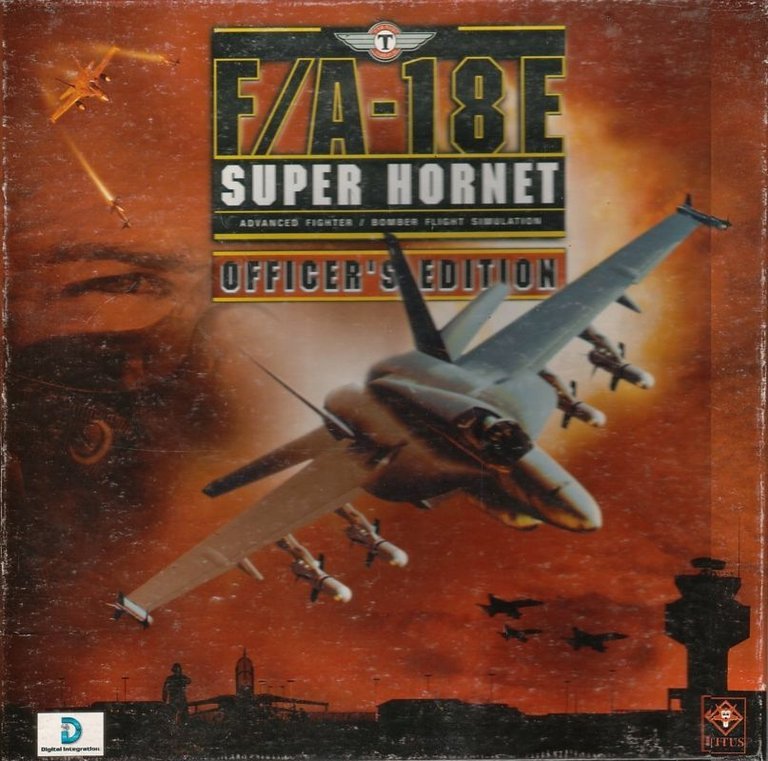
F/A-18E Super Hornet: Officer’s Edition is a combat flight simulator compilation that combines the base game and its expansion, ‘The Albanian Campaign’. Players pilot the titular F/A-18E Super Hornet fighter jet, engaging in realistic missions featuring detailed cockpit interactions, carrier operations, and advanced weapons systems. Set against military conflicts, the game emphasizes authentic flight mechanics, avionics, and tactical warfare, offering both training missions and expanded combat scenarios through its bundled content.
Gameplay Videos
F/A-18E Super Hornet: Officer’s Edition Cracks & Fixes
F/A-18E Super Hornet: Officer’s Edition Patches & Updates
F/A-18E Super Hornet: Officer’s Edition Reviews & Reception
en.wikipedia.org (64/100): Timing may be SUPER HORNET’s worst enemy, having arrived after JANE’S F/A-18. Although definitely a solid sim, it’s somewhat eclipsed by Jane’s representation of the F/A-18E, especially regarding the carrier landings, HARM missile operation, wingmen, and bad weather.
ign.com (55/100): F/A 18 certainly looks good but looks aren’t everything.
retro-replay.com : The F/A-18E Super Hornet: Officer’s Edition offers a deeply immersive flight simulation experience that caters to both veteran aviators and ambitious newcomers.
F/A-18E Super Hornet: Officer’s Edition – A Naval Aviation Sim Between Innovation and Mediocrity
As the pixelated exhaust of ‘90s flight simulators faded against the dawn of 21st-century gaming, F/A-18E Super Hornet: Officer’s Edition (2000) offered a sturdy—if unremarkable—bridge between hardcore simulation and accessible arcade action. Bundling Digital Integration’s original 1999 F/A-18E Super Hornet with its Albanian Campaign expansion, this compilation sought to deliver definitive naval warfare immersion. Twenty-three years later, we examine whether this package ascended to the ranks of classics like Jane’s F/A-18—or stalled on the runway of forgotten sims.
Development History & Context
Studio Vision & Technological Constraints
Developed by Digital Integration—a British studio famed for Apache Longbow (1995) and F-16 (1998)—Super Hornet emerged in the twilight of the “golden age” of combat flight sims. The team prioritized technical fidelity, collaborating with the U.S. Navy to model the Super Hornet’s avionics, while technological limitations (DirectX 6-era graphics, 1024×768 resolution caps) constrained visual ambition.
A Crowded Skiescape
The game launched into a stratified market. Jane’s F/A-18 (1999) dominated high-fidelity simulation, while Falcon 4.0 (1998) carved a niche in dynamic campaign depth. Super Hornet’s November 1999 EU release (and 2000 North American debut) faced an unforgiving climate: critics quickly judged it a “Durchschnitts-Simulation” (average sim), per German outlet PC Player—competent but overshadowed.
Narrative & Thematic Deep Dive
The Silent War: Geopolitics as Backdrop
Unlike narrative-driven contemporaries, Officer’s Edition grounds its stakes in documentary-level brevity. The base game’s 40 missions simulate hypothetical NATO interventions across the Barents Sea and Indian Ocean, while the Albanian Campaign expansion (2000) introduces a fictionalized Balkan conflict:
– Ethical Dilemmas: Missions emphasize distinguishing military targets from civilian zones, mirroring real-world Kosovo War precision ethics.
– Minimalist Storytelling: Briefings adopt military-report terseness, with wingmen radio chatter substituting character arcs.
Themes of Control & Fragility
The game subtly explores human-machine symbiosis: mastering the Hornet’s HOTAS (Hands On Throttle and Stick) systems becomes a metaphor for wartime authority. Yet, abrupt mission failures remind pilots of their vulnerability amidst storms, fuel limits, and SAM sites.
Gameplay Mechanics & Systems
The Sim-Arcade Spectrum
Digital Integration straddled realism and accessibility:
– Flight Model & Avionics
A Newtonian physics engine simulated weight distribution and G-forces, while interactive 2D/3D cockpits allowed switch-by-switch control.
– Carrier Ops: Pitch-perfect deck landings—complete with hand-signal-directing crew—defined the experience.
– Weapons Systems
Twenty armaments, from AIM-9 Sidewinders to Harpoon anti-ship missiles, demanded nuanced deployment via HOTAS-compatible inputs.
Progression & Mission Design
– Training Gauntlet: 20 rookie labs drilled takeoffs, navigation, and bombing runs.
– Campaign Structure: Linear sorties in the base game gave way to Albanian Campaign’s escalating NATO strikes. Repetitive objectives (“destroy radar site X”) drew criticism (GameStar: “[missions] resemble the original too closely”).
– Multiplayer: LAN support for 24 players enabled cooperative strikes and adversarial dogfights—a rarity in 2000.
Flaws & Innovations
– AI Shortcomings: Dumbfire enemy pilots undermined tension (PC Player: “opponents pose no challenge”).
– Mission Editor: A robust toolkit empowered players to craft custom scenarios, extending longevity.
World-Building, Art & Sound
Visual Fidelity: A Study in Ambivalence
– Aircraft Models: The Hornet’s polygonal fuselage shimmered under dynamic lighting, but low-resolution terrain (especially in the base game’s Indian Ocean) aged poorly.
– Weather Systems: Snowstorms and night missions obscuring HUDs showcased the engine’s strengths.
Atmospheric Sound Design
– Diegetic UI: Radar pings, missile lock-ons, and throttle roars consumed the soundscape, with cockpit alerts ratcheting tension.
– Score: Absent music during flights heightened realism—a stark contrast to Hollywood-esque contemporaries.
Reception & Legacy
Launch-Day Turbulence
– Critical Consensus: Averaging 64% across German outlets (GameStar 65%, PC Player 64%), reviewers praised systems depth but lamented “middling excitement” (Computer Gaming World).
– Commercial Stall: Overshadowed by Jane’s F/A-18, sales slumped despite an E3 2000 “Best Jet Sim” award.
Post-Release Trajectory
– Modding Community: Mission packs and cockpit mods trickled into forums like Retro Replay, sustaining niche appeal.
– Rediscovery: GOG.com and Steam re-releases (2017 onward) introduced the sim to new audiences, though DCS World’s F/A-18 module (2018) ultimately eclipsed it.
Conclusion: A Contrail in Aviation History
F/A-18E Super Hornet: Officer’s Edition remains a paradox: technically earnest yet artistically dated, ambitious in scope but hobbled by finicky execution. Its legacy lies not in revolutionizing the genre but in preserving late-‘90s military simulation ethos—before hyperrealism bifurcated the market into arcade thrills (Ace Combat) and hardcore study-sims (DCS). For historians, it’s a vital artifact of turn-of-the-century design; for players, a competent—if flawed—time capsule best appreciated by naval aviation devotees.
In the annals of flight sims, it’s no Jane’s F/A-18—but it’s also no mere footnote.