
- Release Year: 2003
- Platforms: Windows
- Publisher: Buka Entertainment, Encore, Inc., GMX Media, Gramis, Pointsoft GmbH, Red Ant Enterprises Pty Ltd., Zeta Multimedia S.A.
- Developer: G5 Software LLC
- Genre: Action, Simulation
- Perspective: 1st-person
- Game Mode: LAN, Online Co-op, Online PVP, Single-player
- Gameplay: Arcade mode, Helicopter Combat, Mission-based, Simulation Mode
- Setting: Caribbean, Eastern Europe, Middle East, South-East Asia
- Average Score: 62/100
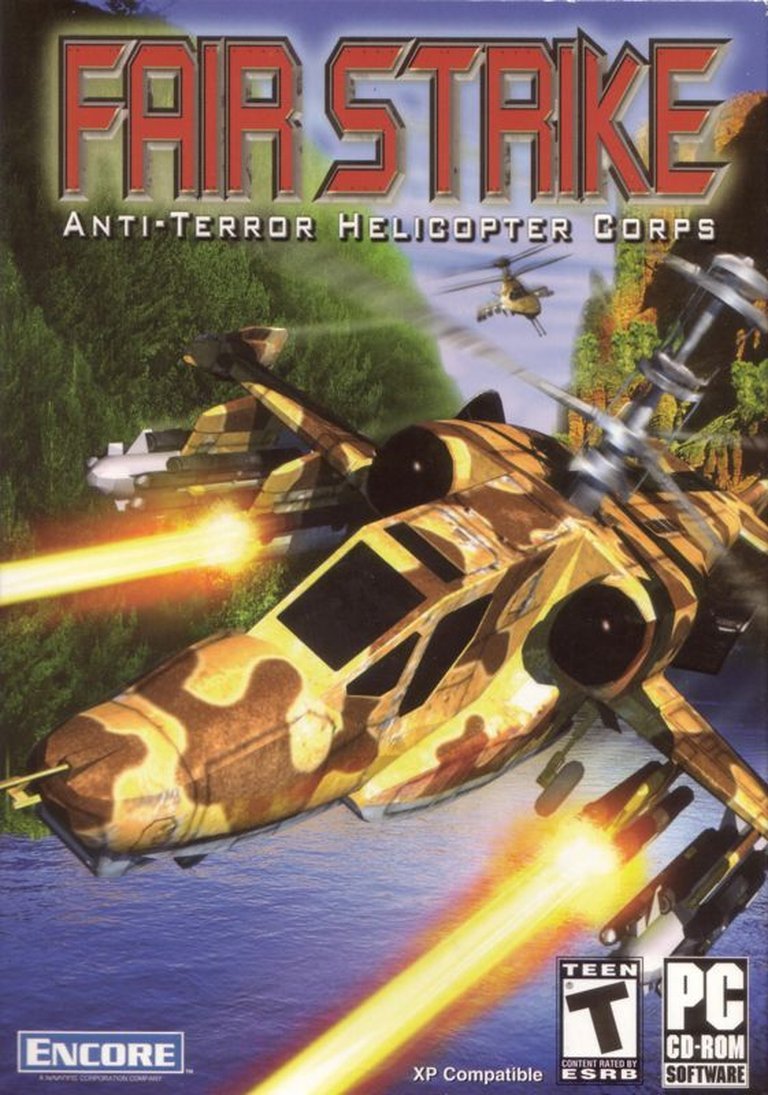
Description
Fair Strike is a helicopter combat action-simulation game released in 2003, where players pilot six realistic attack helicopters—including the AH-64A Apache, RAH-66 Comanche, PAH-2 Tiger, KA-50 Hokum, KA-52 Alligator, and Ka-58 Black Ghost—to battle terrorists across 38 missions set in diverse global hotspots like the Caribbean, Eastern Europe, South-East Asia, and the Middle East, with options for arcade-style action or realistic simulation modes, plus multiplayer co-op and deathmatch supporting 2-16 players.
Where to Buy Fair Strike
PC
Fair Strike Cracks & Fixes
Fair Strike Patches & Updates
Fair Strike Guides & Walkthroughs
Fair Strike Reviews & Reception
metacritic.com (56/100): Mixed or Average
gamespot.com : Fair Strike isn’t all bad, but it buckles under the weight of many problems.
monstercritic.com (61/100): competent if not particularly thrilling combat helicopter flight sim.
Fair Strike: Review
Introduction
In the shadow of post-9/11 gaming landscapes, where military shooters and simulations surged with themes of global counter-terrorism, Fair Strike emerged as a gritty, rotor-blade heartbeat from Russia’s G5 Software—a 2003 Windows title that dared to blend arcade pyrotechnics with helicopter simulation authenticity. Known alternatively as Ударная Сила (Striking Force) in its homeland and Terror Hunter elsewhere, this obscure gem pilots players through 38 missions across terrorist hotspots, pitting elite aviators against narco-lords, separatists, and fundamentalists. Its legacy? A cult curiosity for aviation diehards, now resurrected on Steam at bargain-bin prices, evoking nostalgia for an era when Comanche 4 and Enemy Engaged ruled the skies. Yet, as a historian of flight sims, my thesis is clear: Fair Strike is a noble but flawed experiment in vehicular combat, ambitious in scope yet undermined by technical woes and half-baked execution, cementing its place as a footnote rather than a cornerstone in gaming history.
Development History & Context
Developed by Moscow-based G5 Software LLC—a studio known for mid-tier Russian titles like The Stalin Subway and Battle Mages—Fair Strike was spearheaded by lead game designer and project manager Nikita Gerasimov, alongside lead programmers Alexander Tabunov and Alexey Vasilenko, lead artist Maxim Ryumin, and producer Vlad Suglobov. A team of 68 credits (61 developers, 7 thanks) pooled expertise in programming (Vladimir Olderogge, Andrey Davydov), mission design (Sergey Chuprakov, Sergey Samokhov), and art (Pavel Stebakov, Gleb Yanchikov), many of whom overlapped on period pieces like WWI: The Great War. Published primarily by Buka Entertainment in Russia, with Western ports by Pointsoft GmbH (Germany), Encore Inc. (US), and others like Red Ant (Australia) and GMX Media (UK), it launched November 13, 2003, amid a crowded helicopter sim scene.
The early 2000s PC gaming landscape was defined by maturing 3D engines post-Half-Life and Unreal, but helicopter titles faced steep tech hurdles: physics modeling for rotor dynamics, destructible environments, and multiplayer over dial-up/LAN. G5’s vision—to democratize modern attack helos like the AH-64A Apache, RAH-66 Comanche, PAH-2 Tiger, KA-50 Hokum (Black Shark), KA-52 Alligator, and fictional KA-58 Black Ghost—targeted both arcade fans craving Desert Strike-style destruction and sim purists eyeing Comanche 4‘s realism. Constraints abounded: Pentium III 800MHz minimums, GeForce 2/Radeon 7500 GPUs with 32MB VRAM, and DirectX 9.0b demanded optimizations for era hardware. StarForce DRM plagued retail copies (incompatible with Vista+), while no tutorials reflected rushed localization. Post-9/11 zeitgeist amplified its anti-terror narrative, but G5’s inexperience with Western polish—evident in Russian-labeled cockpits and sparse manuals—doomed broader appeal. Steam re-release (2015, ESDigital Games) patched some issues, breathing digital life into this Eastern European underdog.
Narrative & Thematic Deep Dive
Fair Strike‘s story is a minimalist propaganda reel for the War on Terror era: set in a near-futuristic 2005, players command an elite multinational squadron combating “awful guys” whose “basic aims” are murder and narcotics. Four campaigns span the Caribbean (narco-terrorists), Eastern Europe (separatists), South-East Asia, and Middle East (fundamentalists), framed as urgent strikes against world-destabilizing syndicates. Briefings are terse text dumps or clumsy cutscenes with desynced voice-overs, hokey accents, and mispronunciations—e.g., garbled radio chatter lacking immersion. No named protagonists or deep characters emerge; you’re an anonymous pilot amid vague wingmen issuing cryptic orders like “patrol” (ambiguously defined).
Thematically, it doubles down on jingoistic heroism: “brave pilots and their lethal celestial weapons” versus faceless villains, echoing Tom Clancy tropes with destructible everything symbolizing overwhelming air superiority. Dialogue is sparse, functional (“Kill them all!”), underscoring arcade roots over narrative depth—no moral ambiguity, branching paths, or interpersonal drama. Missions evoke procedural escalation: escort tankers, raze bunkers, dogfight helos, but repetitive “abballern von Feindstellungen” (blasting enemy positions) and unclear objectives (e.g., which buildings to destroy?) sap tension. Underlying themes of technological dominance falter amid bugs—wingmen ignore commands, goals mislead—turning empowerment fantasy into frustration. As history, it mirrors 2003’s cultural pulse: unnuanced anti-terror sims pre-Call of Duty‘s polish, but lacks Apache: Air Assault‘s cinematic flair.
Gameplay Mechanics & Systems
At its core, Fair Strike loops through mission selection → loadout customization → takeoff → waypoint navigation → target annihilation → extraction, blending arcade accessibility with sim rigor. Six helos differentiate via loadouts (rockets, missiles, guns) and paint schemes, but handling converges: agile hovers, torque physics in sim mode (real challenge via rudder/collective), arcade auto-leveling for “blowing things up.” Perspectives toggle 1st-person (chase cam), behind-view, or cockpit (detailed but illegible Russian gauges, poor readability).
Combat shines in destructibility—tankers explode spectacularly, trees ignite, bunkers crumple—but devolves to point-and-shoot: lock-ons trivialize AAAs, AI foes spawn predictably, lacking canyon dogfights or dynamic ambushes. Progression ties to campaign unlocks, no RPG trees; multiplayer (2-16 players, co-op/deathmatch via Internet/LAN) adds replayability, though matchmaking ghosts modern play. UI falters: radio menus vanish mid-read, no mid-mission saves (long ops restart fully), joystick configs reject popular models (Logitech woes force keyboard/mouse). Innovations like dual modes praise accessibility—sim for purists, arcade for casuals—but flaws dominate: choppy FPS, crashes, endless loads, eintönig missions (waypoint-hopping sans variety). Custom loadouts innovate modestly, yet untaught weapon modes frustrate. Verdict: solid loop for 30-38 diverse missions, but execution renders it “not fish, not fowl.”
World-Building, Art & Sound
Settings evoke hotspots sans depth: Caribbean jungles, European badlands, Asian/Middle Eastern deserts—glatt (smooth) terrains lack Comanche‘s furrows, no dynamic weather beyond clouds. Atmosphere builds via fiery chaos—ships sink, troops scatter—but sparse foliage, simple 3D models, and mieße (crappy) textures date visuals, even maxed. High hardware demands irony atop grottig (grotty) effects; cockpits impress aviation buffs with accuracy, yet uninstrumented.
Sound design passably immerses: rotor wash hums, Clancy-esque orchestral scores swell tension, explosions pack punch (if uninspiring). Voice work falters—lip-sync fails, accents grate—but radio chatter adds pilot verisimilitude. Collectively, elements foster “hardcore sim” mood for fetishists, per reviews, yet fail immersion: bland vistas, no wind shear audio, loading screens kill momentum. As artifact, it captures 2003’s transitional graphics—pretty skies/water, but “polygonarme” (low-poly) overall.
Reception & Legacy
Launch reception averaged middling: MobyGames 49% critics (13 reviews)—Bonusweb 72% lauded controls/modes, PC Action 70% mouse flight, but GameSpot 4.9/10 slammed flaws (“punishment over entertainment”), Joystick (France) 20% (“cul entre deux chaises”—ass between chairs). Metacritic 56/100 (mixed), PC Gamer 61%, echoing “abwechslungsarm” (unvaried) missions, poor graphics. Commercial? Niche sales via budget publishers; #8,798 Windows ranking, 30 collectors. Russian origins buoyed domestic appeal, but West dismissed vs. Comanche 4.
Steam revival (2015, $0.99) flips script: 76% Mostly Positive (92 reviews), nostalgia for “early 2000s heli sims” amid War Thunder echoes. Influence? Marginal—paved Russian sim exports, helicopters in Apache: Air Assault, but forgotten amid Battlefield dominance. Legacy: cautionary tale of ambition sans polish, preserved via abandonware sites/ModDB, influencing no majors but cherished by rotorheads for variety/authenticity.
Conclusion
Fair Strike endures as a product of its time: a bold, six-helo anti-terror sim from G5 Software, blending arcade blasts and sim physics across globe-spanning campaigns, with multiplayer flair. Yet, repetitive missions, buggy controls, dated visuals, and absent tutorials hobble its potential, yielding mediocre execution over genre innovation. In video game history, it slots as an obscure 2003 relic—flawed footnote to Comanche‘s throne, revived for budget nostalgia. Verdict: 5.5/10—play for heli history, skip for modern skies; a “decent bang for the buck” at Steam prices, but no pantheon inductee.