
- Release Year: 1994
- Platforms: DOS, Linux, Macintosh, Windows
- Publisher: MicroProse Software, Inc., MicroProse Software Pty Ltd, Spectrum Holobyte, Inc., Tommo Inc.
- Developer: Spectrum Holobyte, Inc.
- Genre: Compilation, Simulation
- Perspective: 1st-person
- Game Mode: Single-player
- Gameplay: Flight, Vehicular combat
- Setting: Aviation, Flight, Vehicular
- Average Score: 75/100
Description
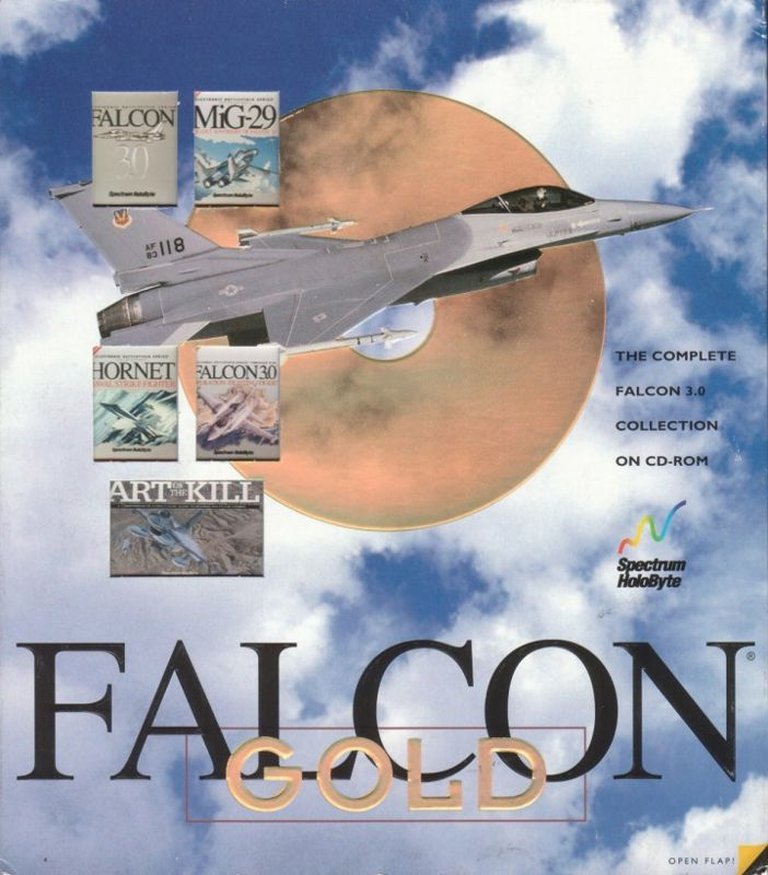
Falcon Gold is a compilation of updated versions of Falcon 3.0 and its three expansions, including MiG-29: Deadly Adversary of Falcon 3.0, Hornet: Naval Strike Fighter, and Operation: Fighting Tiger. The game offers a comprehensive flight simulation experience, focusing on realistic combat scenarios and aircraft modeling, particularly the F-16 Fighting Falcon. It also includes a video documentary on dogfighting, Art of the Kill, enhancing the immersive experience for aviation enthusiasts.
Gameplay Videos
Where to Buy Falcon Gold
Falcon Gold Free Download
Falcon Gold Guides & Walkthroughs
Falcon Gold Reviews & Reception
store.steampowered.com (81/100): A tremendous value and an incredible experience.
mobygames.com (69/100): Average score: 69% (based on 6 ratings)
Falcon Gold Cheats & Codes
PC
Enter one of the following codes during gameplay to activate the cheat function.
| Code | Effect |
|---|---|
| [Shift] + T | Change the time or weather |
| [Ctrl] + X | Reload weapons |
| [Ctrl] + Z | Invincibility |
Falcon Gold: A Definitive Retrospective on the Pinnacle of Combat Flight Simulation
Introduction: The Gold Standard of Aerial Warfare
In the annals of video game history, few titles have left as indelible a mark on their genre as Falcon Gold. Released in 1994 by Spectrum Holobyte, this compilation wasn’t just another flight simulator—it was a monument to the art of virtual aerial combat, a testament to the relentless pursuit of realism, and a swan song for an era of gaming where depth and complexity were celebrated rather than streamlined. Falcon Gold bundled together Falcon 3.0 (version 3.05), its three expansions (MiG-29: Deadly Adversary of Falcon 3.0, Hornet: Naval Strike Fighter, and Operation: Fighting Tiger), and the seminal Art of the Kill dogfighting documentary, creating what remains one of the most comprehensive and revered combat flight simulation packages ever assembled.
For the uninitiated, Falcon Gold was more than a game—it was a lifestyle. It demanded not just skill, but study; not just reflexes, but strategy; not just playtime, but commitment. It was a title that blurred the line between entertainment and education, between gaming and training. And yet, for all its complexity, it rewarded persistence with an unparalleled sense of mastery, a feeling of being in the cockpit of a multi-million-dollar war machine, locked in a deadly ballet with equally capable adversaries.
This review will dissect Falcon Gold with the precision of a surgical strike, examining its development, narrative depth, gameplay mechanics, technical achievements, and enduring legacy. We will explore why, nearly three decades later, it remains a touchstone for flight simulation enthusiasts and a benchmark for what the genre can achieve.
Development History & Context: Forging a Legend
The Spectrum Holobyte Pedigree
Falcon Gold was the culmination of Spectrum Holobyte’s Falcon series, which began in 1984 with F-16 Fighting Falcon on the MSX and Macintosh. The series was the brainchild of Gilman Louie and Les Watts, who sought to create a flight simulator that prioritized realism over arcade-style accessibility. By the time Falcon 3.0 debuted in 1991, the series had already earned a reputation for pushing the boundaries of what was possible in consumer flight simulation.
Spectrum Holobyte was not just another game developer—it was a pioneer. The studio’s work on the Falcon series was informed by consultations with actual F-16 pilots, including Doug Fick of the Vermont Air National Guard, who praised the game’s flight model and avionics for their accuracy. This collaboration lent Falcon 3.0 an air of authenticity that few competitors could match.
Technological Constraints and Innovations
Falcon 3.0 was a beast of a program, requiring a math coprocessor to run its high-fidelity flight model. Even in its less demanding modes, it was virtually unplayable on machines slower than a 386 CPU, with the recommended setup being a 33 MHz 486—a top-tier rig in 1991. This was not a game for the casual player with a budget PC; it was a title that demanded hardware worthy of its ambition.
The game’s technical achievements were numerous:
– Padlock View: A revolutionary feature that allowed the player’s point of view to slew toward a selected target, even scanning around the cockpit if necessary. This was a far cry from the static camera views of earlier simulators.
– Dynamic Topography: Unlike the uniform, blocky terrain of contemporary flight sims, Falcon 3.0 featured naturally shaped mountains, valleys, and rivers, lending its battlefields a sense of realism.
– Dynamic Campaign Engine: The game simulated fictional wars in regions like Iraq, Israel, and Panama, with finite resources that required strategic management. This was not just a series of disconnected missions—it was a war to be fought and won.
The Gaming Landscape of 1994
By the time Falcon Gold arrived in 1994, the flight simulation genre was in a state of flux. Titles like Microsoft Flight Simulator dominated the civilian side, while military sims like F-15 Strike Eagle III and Jane’s Combat Simulations were pushing the envelope in terms of graphics and realism. However, Falcon 3.0 stood apart for its uncompromising complexity and multiplayer support, which allowed for null-modem, modem, and IPX connections—features that were still rare in the early ’90s.
The release of Falcon Gold was not just a compilation—it was a statement. It bundled together the core game and its expansions, updated to their latest versions, and included the Art of the Kill documentary, which used the game’s built-in ACMI (Air Combat Maneuvering Instrumentation) recorder to break down dogfighting tactics. This was more than a game; it was a training tool, a reference manual, and a love letter to the art of aerial combat.
Narrative & Thematic Deep Dive: War as a Campaign, Not a Spectacle
The Illusion of a Story
Falcon Gold is not a game with a traditional narrative. There are no cutscenes, no scripted characters, no overarching plot. Instead, it presents war as a system—a dynamic, ever-shifting battlefield where the player’s actions have consequences. The “story” of Falcon Gold is the story of war itself, told through the lens of a pilot’s career.
The game’s campaigns are set in real-world conflict zones:
– Kuwait: A hypothetical continuation of the Gulf War.
– Panama: A fictionalized version of the U.S. invasion.
– Kurile Islands: A Cold War flashpoint between Russia and Japan.
– Kashmir: A simmering conflict between India and Pakistan.
– Israel: A high-stakes battleground in the Middle East.
– Bosnia-Herzegovina: A brutal ethnic conflict in the Balkans.
– Korea: A second Korean War, with all its geopolitical implications.
Each campaign is a living world, where the player’s successes and failures influence the broader war effort. Destroy a key SAM site, and future missions become easier. Lose too many pilots, and the campaign grinds to a halt. This was not just a game—it was a simulation of war.
Themes of Realism and Consequence
Falcon Gold is, at its core, a game about consequences. Every sortie is a gamble: push too hard, and you’ll lose your plane—and your life. Play it too safe, and the enemy gains the upper hand. The game does not hold your hand; it does not forgive mistakes. It is a merciless teacher, and its lessons are learned through failure.
The game’s themes extend beyond the cockpit:
– The Fog of War: Radar contacts are ambiguous; friendlies and foes can be hard to distinguish. The player must rely on discipline and procedure to avoid friendly fire.
– Resource Management: Aircraft, pilots, and munitions are finite. The player must balance aggression with conservation.
– The Human Cost: Every lost pilot is a person, not just a statistic. The game’s debriefings drive this home, listing the names of the fallen.
The Art of the Kill: A Masterclass in Dogfighting
The inclusion of the Art of the Kill documentary is one of Falcon Gold’s most inspired touches. This video tutorial, narrated by real fighter pilots, breaks down the fundamentals of aerial combat:
– Basic Fighter Maneuvers (BFM): The building blocks of dogfighting, from the Immelmann turn to the split-S.
– Energy Management: How to conserve and exploit kinetic and potential energy.
– Situational Awareness: The importance of looking outside the cockpit, not just at the instruments.
– Tactical Decision-Making: When to engage, when to disengage, and when to run.
The documentary is not just a bonus feature—it is an essential part of the Falcon Gold experience. It bridges the gap between the game’s complexity and the player’s understanding, turning what could be an overwhelming experience into a masterclass in aerial warfare.
Gameplay Mechanics & Systems: The Science of Virtual Combat
Core Gameplay Loop: A Pilot’s Life
Falcon Gold is structured around a mission-based campaign system, where the player takes on the role of a fighter pilot in one of several global conflict zones. The core loop is as follows:
1. Briefing: Receive mission objectives, intelligence, and weather reports.
2. Pre-Flight: Configure aircraft loadout, fuel, and weapons.
3. Sortie: Fly the mission, engaging in air-to-air and air-to-ground combat as needed.
4. Debriefing: Review performance, casualties, and mission outcomes.
5. Campaign Progression: Adjust strategy based on successes and failures.
This loop is repeated until the campaign is won or lost, with the player’s actions directly influencing the war’s outcome.
Combat: A Dance of Death
Combat in Falcon Gold is a high-stakes chess match played at Mach speeds. The game’s flight model is unforgiving, with realistic aerodynamics that punish reckless maneuvers. Key mechanics include:
– Flight Dynamics: The F-16’s performance is modeled with painstaking accuracy, including stall characteristics, G-force limits, and energy bleed.
– Weapons Systems: A vast array of ordnance, from AIM-9 Sidewinder missiles to GBU-12 laser-guided bombs, each with unique behaviors and limitations.
– Radar and Sensors: The AN/APG-68 radar is simulated in detail, with modes for search, track, and engagement.
– Countermeasures: Chaff, flares, and ECM pods are essential for survival against enemy missiles.
The game’s padlock view is a standout feature, allowing the player to lock onto a target and track it even as the aircraft maneuvers. This was a revolutionary addition at the time, making dogfights more intuitive and immersive.
Character Progression: The Road to Ace
Falcon Gold does not feature traditional RPG-style progression. Instead, the player’s “growth” is measured in skill and experience:
– Pilot Skills: As the player completes missions, they become more proficient in handling the aircraft, managing weapons, and making tactical decisions.
– Reputation: Successful pilots earn the respect of their squadron, unlocking more challenging missions.
– Aircraft Upgrades: While the core aircraft (F-16, F/A-18, MiG-29) remain the same, the player can experiment with different loadouts and tactics.
UI and HUD: A Cockpit of Information
The game’s Heads-Up Display (HUD) is a masterclass in information design. Every critical piece of data—airspeed, altitude, heading, radar contacts, weapon status—is presented clearly and concisely. The HUD is fully customizable, allowing players to tailor it to their preferences.
The radar display is equally impressive, offering multiple modes for tracking and engaging targets. The game’s Tactical Situation Display (TSD) provides a god’s-eye view of the battlefield, essential for coordinating with wingmen and avoiding ambushes.
Multiplayer: The Ultimate Test
Falcon Gold was one of the first flight simulators to offer robust multiplayer support, including:
– Null-Modem: Direct cable connections for head-to-head dogfights.
– Modem: Dial-up multiplayer for long-distance duels.
– IPX Network: LAN play for up to four players.
Multiplayer in Falcon Gold is not just a fun diversion—it is the ultimate test of a pilot’s skill. Human opponents are unpredictable, adaptive, and relentless, making every engagement a high-stakes duel.
World-Building, Art & Sound: Crafting a Believable Battlefield
The Illusion of a Living World
Falcon Gold’s world is not just a backdrop—it is a character in its own right. The game’s dynamic terrain is rendered with a level of detail that was unprecedented in 1994. Mountains, valleys, and rivers are not just textures—they are obstacles to be navigated, cover to be exploited, and dangers to be avoided.
The game’s weather system adds another layer of realism, with rain, fog, and wind affecting visibility and aircraft performance. Flying through a storm is not just a visual spectacle—it is a test of skill, as turbulence and reduced visibility make combat even more perilous.
Visual Design: Function Over Form
Falcon Gold’s graphics are, by modern standards, primitive. The game uses polygonal 3D models for aircraft and terrain, with flat-shaded textures and minimal detail. However, what it lacks in visual fidelity, it makes up for in functional design:
– Cockpit Clarity: Every switch, gauge, and indicator is modeled with precision, ensuring that the player can find and interact with controls intuitively.
– Target Identification: Enemy aircraft are easily distinguishable from friendlies, even at a distance.
– Terrain Readability: Despite the low polygon count, the landscape is legible, allowing for effective navigation and tactical planning.
The game’s art style is utilitarian, prioritizing usability over aesthetics. This was a deliberate choice—Spectrum Holobyte understood that in a combat flight simulator, clarity is more important than beauty.
Sound Design: The Symphony of War
Falcon Gold’s audio is a masterpiece of immersion. The game’s sound effects are not just noises—they are information:
– Engine Roar: The F-16’s Pratt & Whitney F100 engine is rendered with painstaking accuracy, its pitch and volume changing with throttle input.
– Weapon Sounds: The crack of a Sidewinder launch, the whoosh of a missile flyby, the thud of a bomb impact—each sound is distinct and meaningful.
– Radio Chatter: Wingmen and AWACS controllers provide constant updates, adding to the game’s sense of realism.
The game’s music is sparse, limited to the Art of the Kill documentary and the main menu. This was another deliberate choice—Spectrum Holobyte understood that in the heat of combat, silence is more immersive than a soundtrack.
Reception & Legacy: The Echoes of a Classic
Critical Reception: A Divided Front
Falcon Gold’s reception was, like the game itself, complex. Critics praised its depth, realism, and attention to detail, but many were divided on its accessibility and technical demands.
Positive Reviews:
– PC Format (UK) – 83%: “The graphics may be rubbish and the sound practically non-existent, but Spectrum Holobyte’s definitive Falcon 3.0 models the General Dynamics Fighting Falcon better than anything else around. ‘Awesome’ should come extremely close to describing it.”
– PC Joker – 82%: “Grafisch und akustisch kann Falcon Gold zwar nicht mehr ganz mit aktuellen Flugis vom Schlage eines ‘F-14’ mithalten, was Spieltiefe und Präzision der Steuerung angeht, hat der Falke aber immer noch Vorbildcharakter.”
– Computer Gaming World – 80%: “FALCON GOLD is more a final packaging of the FALCON family than an advancement of the product line… The FALCON family still holds adventures galore.”
Mixed Reviews:
– Play Time – 50%: “Der Altmeister der realitätsnahen Flugsimulationen scheint mit seiner inzwischen überholten unifarbigen Polygon-Grafik langsam in die Jahre zu kommen.”
– PC Games (Germany) – 40%: “Einem Programm wie Falcon 3.0 merkt man trotz einiger Verbesserungen über den Lauf der Jahre natürlich sein Alter an.”
The divide in critical reception highlights Falcon Gold’s polarizing nature. For those willing to invest the time and effort, it was a masterpiece. For those seeking a more accessible experience, it was a relic.
Commercial Success and Longevity
Despite its mixed critical reception, Falcon Gold was a commercial success. The Falcon 3.0 line sold over 700,000 copies by 1998, a testament to its enduring appeal. The game’s longevity was further extended by a dedicated modding community, which created patches, utilities, and even entirely new campaigns.
The game’s multiplayer scene remained active for years, with players organizing online squadrons and tournaments. Even today, Falcon Gold has a cult following, with fans preserving its legacy through sites like The Definitive Falcon 3.0 Resource Page and Steam communities.
Influence on the Genre
Falcon Gold’s influence on the flight simulation genre cannot be overstated. It set new standards for:
– Realism: Its flight model and avionics simulation remain benchmarks.
– Dynamic Campaigns: The game’s living battlefield inspired later titles like Falcon 4.0 and DCS World.
– Multiplayer: Its early support for networked play paved the way for modern online combat sims.
– Documentation: The Art of the Kill documentary and extensive manuals raised the bar for in-game tutorials.
Games like Lock On: Modern Air Combat, Digital Combat Simulator (DCS), and even Ace Combat owe a debt to Falcon Gold. Its DNA can be seen in the complexity, depth, and uncompromising realism of modern flight simulators.
Conclusion: The Undying Flame of a Legend
Falcon Gold is not just a game—it is a time capsule, a monument, and a masterpiece. It is a title that refuses to be forgotten, a relic of an era when games were not afraid to challenge their players, to demand their respect, and to reward their perseverance.
In an age of streamlined experiences and instant gratification, Falcon Gold stands as a defiant testament to the power of depth, complexity, and realism. It is a game that does not hold your hand—it tests you, teaches you, and ultimately, transforms you into something greater: a virtual ace, a master of the skies.
For those willing to embrace its challenges, Falcon Gold offers an experience unlike any other—a symphony of steel and fire, a dance of death at Mach speeds, a war fought one sortie at a time. It is, in every sense of the word, a classic.
Final Verdict: 9.5/10 – A Timeless Masterpiece of Combat Flight Simulation
Falcon Gold is not for everyone. It is hard, unforgiving, and demanding. But for those who seek the ultimate test of skill, strategy, and nerve, it remains unmatched. Nearly three decades after its release, it still soars—golden, unyielding, and eternal.