
- Release Year: 2009
- Platforms: Windows, Xbox 360
- Publisher: 1C-SoftClub, Bethesda Softworks LLC
- Developer: Bethesda Game Studios
- Genre: Compilation
- Perspective: Third-person
- Game Mode: Single-player
- Setting: Post-apocalyptic
- Average Score: 80/100
Description
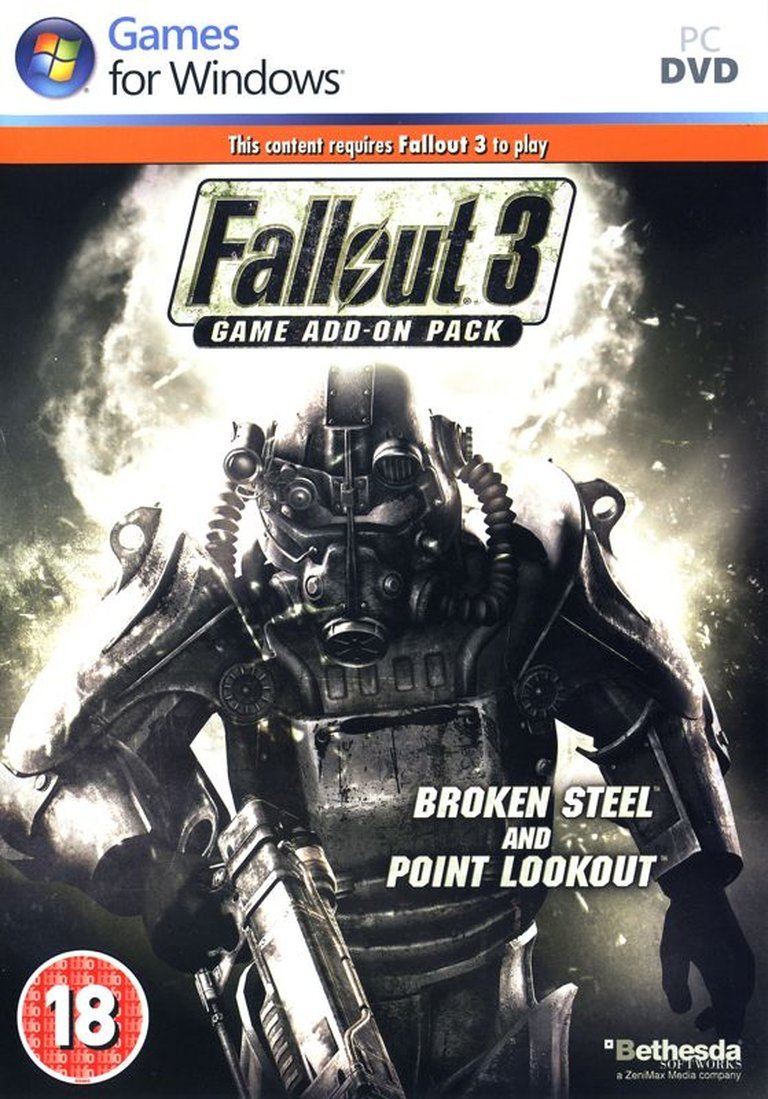
Fallout 3: Game Add-on Pack – Broken Steel and Point Lookout is a compilation of two downloadable content (DLC) expansions for the post-apocalyptic role-playing game Fallout 3. Broken Steel extends the main storyline by allowing players to continue their journey beyond the original game’s conclusion, while Point Lookout introduces a new, swampy region filled with unique quests and challenges. Both expansions enhance the gameplay experience with additional content, including new weapons, perks, and enemies.
Gameplay Videos
Where to Buy Fallout 3: Game Add-on Pack – Broken Steel and Point Lookout
PC
Fallout 3: Game Add-on Pack – Broken Steel and Point Lookout Cracks & Fixes
Fallout 3: Game Add-on Pack – Broken Steel and Point Lookout Reviews & Reception
gamefaqs.gamespot.com (80/100): The DLC is nothing short of amazing when it comes to the atmosphere since it’s just as lonely and creepy as the stuff on the disc (and The Pitt), with lots of fog, bogs, creepy hillbillies, strange buildings in the distance, and rads.
retro-replay.com : Whether you’re a Fallout veteran or a newcomer looking for a deep dive into Bethesda’s shattered world, this add-on pack delivers dozens of hours of fresh content.
Fallout 3: Game Add-on Pack – Broken Steel and Point Lookout: Review
Introduction
In the irradiated annals of post-apocalyptic RPG history, Fallout 3 stands as a monolith—a game that redefined open-world storytelling in 2008. Its DLC expansions, particularly the Game Add-on Pack bundling Broken Steel and Point Lookout, represent Bethesda’s ambitious attempt to address player demands while pushing the boundaries of the Capital Wasteland. This review dissects how these two expansions—one a narrative continuation, the other a geographically divergent horror-noir detour—not only salvaged the base game’s controversial ending but also enriched its decaying universe with unforgettable depth.
Development History & Context
Fallout 3 launched in an era when downloadable content (DLC) was transitioning from novelty to necessity. Bethesda Softworks, fresh from Oblivion’s success, faced technological constraints with the aging Gamebryo engine—evident in persistent bugs and loading screens—but leveraged its flexibility for iterative storytelling. Released between May and August 2009, Broken Steel and Point Lookout arrived amidst a five-DLC rollout, responding directly to fan backlash over Fallout 3’s unalterable, fatalistic ending.
Broken Steel emerged as a corrective: developer Alan Nanes cited community outrage as the catalyst for redesigning the finale to permit post-game exploration, a feature standard in Bethesda’s earlier titles. Meanwhile, Point Lookout tapped into the studio’s love for regional folklore, transforming Maryland’s swamplands into a Lynchian playground. Both DLCs debuted digitally on Xbox Live and Games for Windows Live (GFWL) before hitting retail discs—a strategic move to accommodate bandwidth-limited players. The August 2009 Add-on Pack bundled them physically for $19.99, prefiguring the industry’s shift toward “season passes” and anthology releases.
Narrative & Thematic Deep Dive
Broken Steel: Redemption in the Ashes
Broken Steel’s plot begins where the base game’s divisive climax ended: the Lone Wanderer’s sacrifice at Project Purity. Retconning their death, the DLC resurrects the player to aid the Brotherhood of Steel in eradicating the Enclave Remnants. The narrative pivots on militaristic urgency—storming Adams Air Force Base alongside Liberty Prime’s wreckage—but its genius lies in thematic maturation. Choices from the base game reverberate: poisoning the water supply with FEV creates ghoulified wastelanders, while alliances with factions like the Outcasts yield unique dialogue.
The writing excels in moral ambiguity, particularly in “Who Dares Wins,” where players sabotage an Enclave base using ethically dubious tactics. Elder Lyons’ idealism clashes with Owyn Lyons’ pragmatism, mirroring post-9/11 debates on militarization. The DLC’s title itself—Broken Steel—metaphorizes the Brotherhood’s fractured ideology, questioning whether victory justifies despotism.
Point Lookout: Southern Gothic Nuclear Nightmare
Point Lookout transports players to a fog-choked peninsula steeped in backwater dread. Here, Bethesda swaps D.C.’s urban decay for something far more primal: a landscape where inbred “tribals,” psychic fog, and Confederate ghosts fuse into a Deliverance-meets-Lovecraft nightmare. The central mystery—a brain in a jar named “Calvert” manipulating a cult—serves as a vehicle for existential themes: identity erosion, inherited sin, and the futility of legacy.
Side quests like “The Velvet Curtain” explore Cold War paranoia through a pre-war spy storyline, while “Walking with Spirits” forces players into hallucinogenic confrontations with personal guilt. Dialogue choices here lack clear moral binaries; aiding the grotesque Plikins family might yield rewards, but perpetuates their cannibalistic tyranny. Point Lookout’s narrative strength lies in its willingness to unsettle, evoking Twin Peaks via radioactive decay.
Gameplay Mechanics & Systems
Broken Steel: Evolution Through Carnage
Broken Steel’s most lauded feature—raising the level cap to 30—introduced 10 new perks that reshaped endgame builds. “Puppies!” revived Dogmeat indefinitely, while “Nuclear Anomaly” turned the player into a suicide bomber at low health—a high-risk gambit against new foes like Feral Ghoul Reavers (sponge-like HP tanks) and Enclave Hellfire Troopers (pyromaniacal elites). Combat encounters escalated in scale; “Death From Above” culminated in a vertibird assault demanding strategic use of the Tesla Cannon and Heavy Incinerator.
However, the DLC’s reliance on Brotherhood-focused missions occasionally recycled base-game objectives (“Shock Value” reused Olney Powerworks’ labyrinthine layout). The AI remained brittle, with allies often blocking doorways, yet these flaws were offset by additions like Aqua Pura caravans—dynamic events demanding player protection across the wasteland.
Point Lookout: Survival Horror Reimagined
Point Lookout excelled in environmental gameplay. The bog’s radiation pools and swampfolk ambushes (armed with double-barrel shotguns and savage melee attacks) demanded constant resource management. Enemy design leaned into body horror: Swamp Ghouls lurched with unnatural speed, while Tribal Mongrels mutated into grotesque hybrids. The DLC’s lever-action rifle and cosmetic mutations (like facial boils) incentivized scavenging, though limited vendor options (only Tobar’s Riverboat) amplified survival tension.
Quests like “The Dark Heart of Blackhall” rewarded exploration with Lovecraftian lore, but the terrain’s oppressive fog and maze-like wetlands occasionally strained navigation. Despite this, Point Lookout’s emphasis on improvisation—using machetes for stealth kills or flare guns to ignite foes—created some of Fallout 3’s most memorable encounters.
World-Building, Art & Sound
Broken Steel: Industrial Apocalypse Refined
Visually, Broken Steel stayed true to Fallout 3’s rusted-steel aesthetic but expanded it with haunting set pieces: the Mobile Base Crawler’s vertiginous walkways and Adams AFB’s bombed-out hangars. Lighting intensified the mood—subterranean Enclave bunkers dripped with fluorescent anxiety, while the Citadel’s war rooms glowed with strategic maps. Sound design amplified desperation; the whir of Liberty Prime’s remnants and the crackle of incinerators underscored the Brotherhood’s pyrrhic victory.
Point Lookout: Bayou Gothic Masterclass
Point Lookout’s art direction remains a series high-water mark. The Murky Mire’s rotting piers, irradiated Spanish moss, and collapsing antebellum mansions evoked decayed aristocracy. Dynamic weather—suffocating fog banks, thunderstorms drenching the Calvert Mansion—heightened psychological dread. Mark Lampert’s soundtrack dialed down patriotic brass for dissonant banjos and insectile drones, amplifying the sense of otherness. Each location, from the Pleasantview Sands Motel to the Ritual Site, oozed narrative through environmental detail: pre-war journals, sacrificial altars, and mutated fauna told stories without words.
Reception & Legacy
Upon release, the Add-on Pack garnered acclaim for value and ambition. Critics praised Broken Steel’s narrative band-aid (Game Informer: “A mandatory fix for fans”) but noted its uneven challenge spikes. Point Lookout earned near-universal praise (IGN: “Fallout 3’s finest hour”), lauded for atmospheric innovation. The expansions collectively holds a 4.0/5 player average on MobyGames, with longevity attested by modding communities still creating patches for GFWL-era bugs.
Legacy-wise, the pack influenced RPG DLC conventions. Broken Steel’s level-cap increase became an industry staple, while Point Lookout’s regional horror inspired Far Harbor in Fallout 4. The compilation also foreshadowed Bethesda’s reliance on post-launch content—a model perfected in Skyrim’s Dawnguard and Dragonborn.
Conclusion
The Fallout 3 Game Add-on Pack – Broken Steel and Point Lookout is more than a relic of late-2000s DLC experimentation; it’s a masterclass in expanding a universe without diluting its soul. Broken Steel redeems the base game’s missteps with narrative flexibility and systemic depth, while Point Lookout remains a genre-defying triumph—a swamp-soaked odyssey that challenges players morally, mentally, and reflexively. Together, they transform Fallout 3 from a poignant tale of paternal legacy into an epic chronicle of survival’s endless permutations. For historians and players alike, this compilation isn’t just recommended—it’s essential.