
- Release Year: 2006
- Platforms: PlayStation 2, Windows
- Publisher: Global Star Software Inc.
- Developer: Atomic Planet Entertainment Limited
- Genre: Strategy, Tactics
- Perspective: Third-person
- Game Mode: Hotseat, Online PVP, Single-player
- Gameplay: quiz, trivia
- Setting: Game show
- Average Score: 51/100
Description
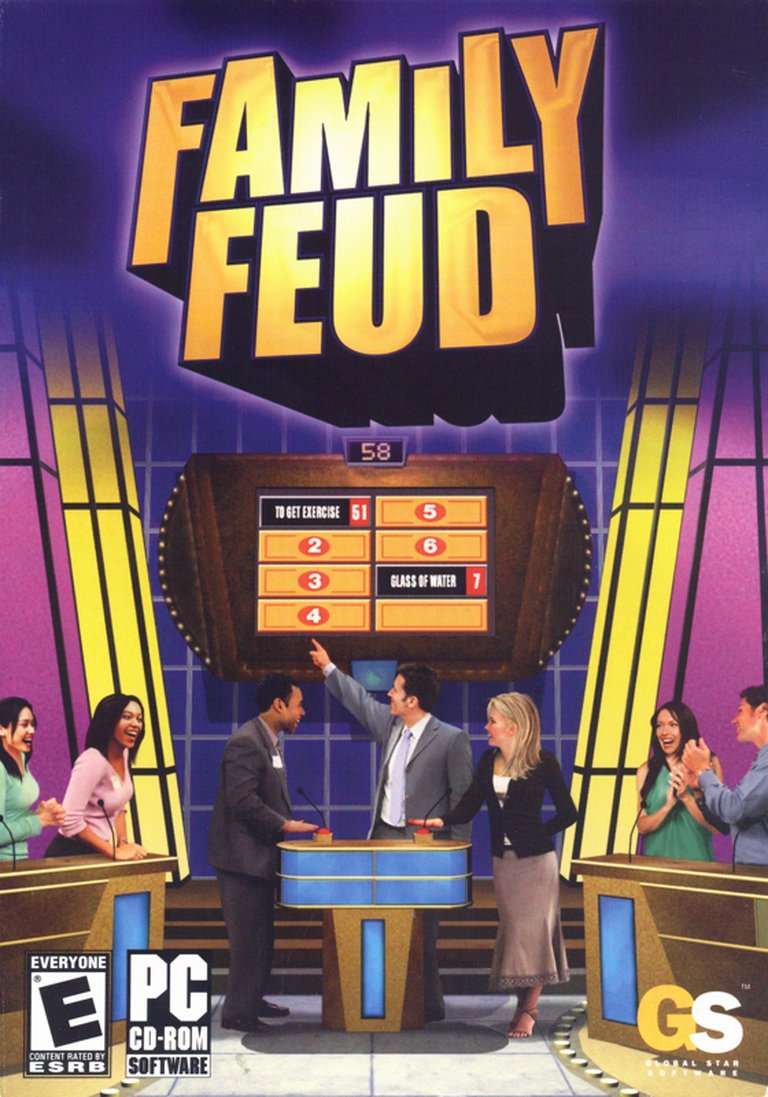
Family Feud is a digital adaptation of the classic TV game show where two families compete by guessing the most popular answers to survey questions like ‘Things a jockey needs’ or ‘Clothes that don’t go on hangers.’ The game features over 1,000 questions and includes both standard and quick play modes. In standard mode, players go through five rounds of buzzer-based face-offs, answer-guessing with strike penalties, and a final speed round. Multiplayer options include hot-seat local play, online matches, or solo play against AI, with an answer recognition system that accommodates typos and word variations. Customizable family avatars, unlockable clothing, and studios add personalization to the experience.
Gameplay Videos
Family Feud Cracks & Fixes
Family Feud Patches & Updates
Family Feud Reviews & Reception
metacritic.com (33/100): Ugly is the word best used to describe Family Feud. It’s clunky, slow-moving, poorly drawn, and has an AI that’s as dumb as a box of rocks. In short, it just isn’t any fun to play.
monstercritic.com (72.5/100): As far as quiz-based party games go, Family Feud is solid. It’s put together very well and manages to capture the feel of being on a gameshow better than most.
opencritic.com (72.5/100): As far as quiz-based party games go, Family Feud is solid. It’s put together very well and manages to capture the feel of being on a gameshow better than most.
Family Feud (2006): A Cluttered Stage of Missed Opportunities
Introduction
More than a game show, Family Feud is a cultural institution—a televised monument to the chaos of collective thinking and the thrill of guessing what “100 people surveyed” might say. But the 2006 video game adaptation, developed by Atomic Planet Entertainment and published by Global Star Software, stands as a cautionary tale of how not to translate lightning-in-a-bottle charisma into interactive form. Beneath its flimsy façade of licensed branding lies a half-hearted simulation that misunderstands its source material’s appeal, buckling under technological limitations, uninspired design, and a startling lack of polish. This review dissects how a game about predicting popular answers became an unpopular answer itself.
Development History & Context
Studio Vision & Technological Constraints
Atomic Planet Entertainment, a UK-based developer with a résumé of licensed titles (Dora the Explorer, AMF Bowling Pinbusters!), took the reins for this Family Feud adaptation. The studio’s pedigree leaned toward budget-friendly, family-oriented projects—a fitting yet perilous choice. Released in October 2006 for PlayStation 2, Windows, and Game Boy Advance, the game arrived amid a saturated market of mid-2000s trivia games (Buzz!, You Don’t Know Jack) and the PS2’s twilight years.
The era’s technological constraints are palpable: the game’s 3D character models resemble polygonal mannequins draped in ill-fitting clothing, while animations lean into jerky, robotic gestures. Atomic Planet attempted to modernize the formula with online multiplayer and a “family editor” for cosmetic customization, but these features clashed with hardware limitations. Online play, a nascent frontier for consoles, suffered from lag and a barren player base, while the character creator—allowing players to tweak body types and outfits—unlocked negligible visual variety.
The Gaming Landscape
Licensed game show adaptations were notoriously hit-or-miss in the 2000s. While Jeopardy! and Wheel of Fortune leveraged straightforward quiz mechanics, Family Feud’s reliance on survey-based spontaneity posed unique challenges. Unlike the 1990s Feud games (such as GameTek’s NES and Genesis titles), which embraced stylized 2D presentation, the 2006 iteration strained for 3D realism without the budget to match. Competing directly with Buzz!: The Mega Quiz’s vibrant party energy, Family Feud (2006) felt like a relic upon arrival—a cheap cash-in during an era when “multimedia experiences” often meant FMV slideshows.
Narrative & Thematic Deep Dive
The Illusion of Camaraderie
Family Feud’s TV magic hinges on its human elements: the nervous laughter after a bizarre answer, the camaraderie of teammates huddling to strategize, and the host’s improvisational wit. The game’s attempt to virtualize these dynamics falls into an uncanny valley of social interaction. Without a human host (Todd Newton’s voiceover is functional but lifeless), the familial banter reduces to canned applause and repetitive dialogue.
Thematic dissonance is glaring. While the show celebrates the unpredictability of everyday people, the game’s AI contestants oscillate between omniscient and oblivious. In one moment, the CPU guesses the #1 answer instantly; in another, it stumbles over obvious responses. This undermines the core fantasy of outsmarting competitors, replacing organic tension with artificial frustration.
Gameplay Mechanics & Systems
Core Loop: A Broken Survey
The game includes two modes: Standard (five rounds escalating to Fast Money) and Quick Play (single-player trivia). The face-off mechanic—where players buzz in to guess top answers—works passably with keyboard/mouse controls but feels sluggish on PS2. Input latency mars the urgency of buzzing, while the on-screen keyboard (a necessity for text answers) lags behind contemporaries like Scene It?
Strike System & AI Quirks
The three-strike rule highlights the AI’s shortcomings. CPU opponents either steal rounds effortlessly with implausible guesses or fail to identify answers visible from the start. Inconsistent answer recognition compounds issues: synonyms like “nap” vs. “sleep” may not register, while some misspellings are forgiven arbitrarily. The absence of difficulty settings makes losses feel punitive rather than challenging.
Multiplayer & Customization
Local multiplayer (hot-seat) offers fleeting fun but lacks the spectator engagement of the TV show. Online play, a technical feat for 2006, is hobbled by unstable matchmaking and minimal rewards. The family editor, while novel, unlocks costumes and studios through grinding—a hollow incentive when visuals are this rudimentary.
Fast Money: The Final Letdown
The bonus round should be the climax, but rigid timers and clunky input methods sap its excitement. Without the live audience’s energy or the host’s playful prodding, scoring 200 points feels like a mathematical chore, not a victory lap.
World-Building, Art & Sound
Visuals: A Dated Stage
Atomic Planet’s attempt to mirror the Richard Karn-era set results in a murky, low-poly approximation. Studio backgrounds (including unlockable retro sets) are drab and undersaturated, with texture pop-in marring transitions. Character models lack expressiveness, cycling through three animations: cheering, shrugging, and clapping. The UI, though functional, apes the show’s neon fonts without flair.
Sound Design: Silence Where There Should Be Laughter
Gene Wood’s iconic buzzer and clap cues are recycled, but their impact dulls without context. Todd Newton’s flat delivery (“Survey says…”) lacks Dawson’s charm or Harvey’s improvisational bite. The soundtrack loops gratingly, devoid of the original’s jazzy urgency.
Reception & Legacy
Commercial & Critical Performance
The game bombed. IGN’s pithy 27% review branded it “ugly” and “clunky,” citing “slow-moving” gameplay and “poorly drawn” visuals. Player reviews on MobyGames lamented its “dumb AI” and “lack of replayability.” Sales data is scarce, but its eBay resale value ($7–$26) hints at bargain-bin obscurity.
Industry Influence
The 2006 Family Feud exemplifies the pitfalls of licensing without innovation. Its failure contrasts sharply with Ludia’s 2010 reboot, which embraced stylized graphics and streamlined controls. Yet even its minor contributions—online multiplayer in trivia games, cosmetic unlocks—were drowned out by superior contemporaries.
Conclusion
Family Feud (2006) is less a game and more a taxidermied version of a show that thrives on spontaneity. Atomic Planet’s interpretation misdiagnoses the series’ appeal, prioritizing superficial recreations over thoughtful interactivity. While later adaptations (Family Feud Decades, Family Feud Live!) salvaged the concept with humor and polish, this entry remains a footnote—a relic of an era when licensed games too often conflated branding with quality. For historians, it’s a case study in squandered potential; for players, it’s a strikeout. Survey says: Avoid.