
- Release Year: 2012
- Platforms: PlayStation 3, Windows, Xbox 360
- Publisher: Activision Publishing, Inc.
- Developer: Heavy Iron Studios, Inc.
- Genre: Action
- Perspective: Third-person
- Game Mode: Co-op, Online Co-op, Single-player
- Gameplay: Character Switching, Puzzles, Shooter, Upgrades
- Setting: Animated, Multiverse, Parallel universes, TV series
- Average Score: 39/100
Description
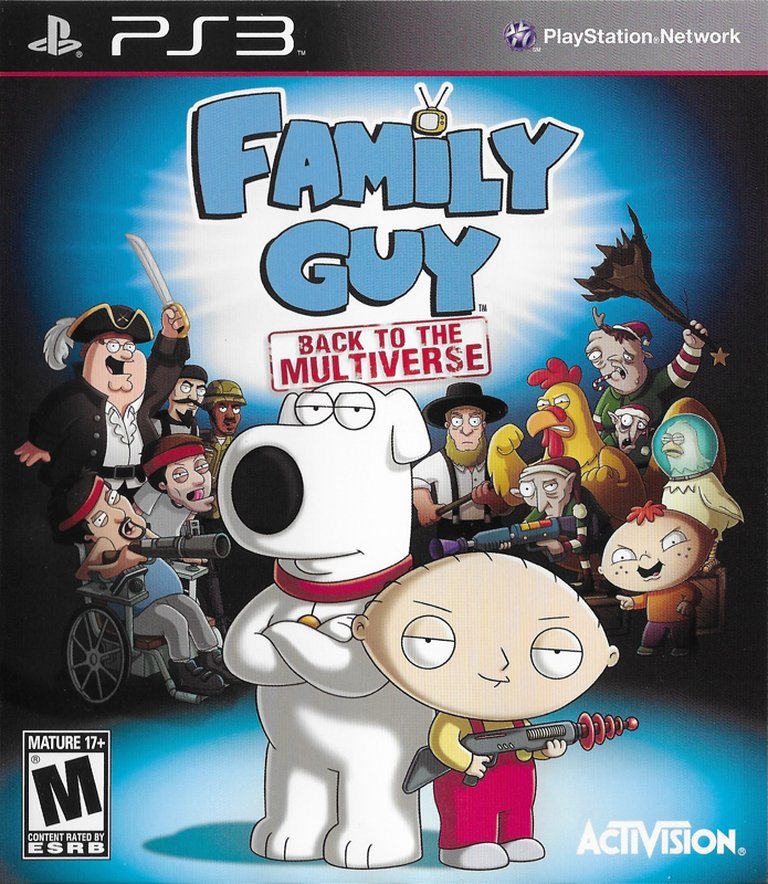
Family Guy: Back to the Multiverse is an action-adventure shooter based on the TV series, serving as a sequel to the ‘Road to the Multiverse’ episode. Players control Brian and Stewie Griffin across seven distinct universes—each ruled by unique factions like the Amish or giant chickens—to prevent Stewie’s evil half-brother Bertram from building an army to kill him. The game features third-person gameplay with character-specific weapons, offline/online multiplayer, and unlockable content including costumes, maps, and playable characters.
Gameplay Videos
Family Guy: Back to the Multiverse Free Download
Family Guy: Back to the Multiverse Patches & Updates
Family Guy: Back to the Multiverse Mods
Family Guy: Back to the Multiverse Guides & Walkthroughs
Family Guy: Back to the Multiverse Reviews & Reception
metacritic.com (39/100): As an exercise in fan service, Back to the Multiverse hits a lot of notes that fans of the series will recognize and appreciate. It’s certainly offensive, but so is the source material, so that shouldn’t be a surprise. As a game, it’s a very average third person shooter that doesn’t do anything special, but doesn’t do anything horrible either.
ign.com : Family Guy: Back to the Multiverse doesn’t suck. That might shock you, it might be hard to believe, but I swear it to be true.
Family Guy: Back to the Multiverse Cheats & Codes
PC
At the main menu, select “Options”, choose “Cheat”, and enter one of the following codes to activate the corresponding cheat function.
| Code | Effect |
|---|---|
| RMTE | Level select |
| CAST | All characters in Multiplayer mode |
| DKSD | All weapons in Multiplayer mode |
| GTSM | All weapons in Single Player mode |
| WRDB | All costumes |
| GGTY | Infinite ammunition |
| PWTR | Maximum money |
| MNKY | One shot kills |
PS3
At the main menu, select “Options”, choose “Cheat”, and enter one of the following codes to activate the corresponding cheat function.
| Code | Effect |
|---|---|
| RMTE | Level select |
| CAST | All characters in Multiplayer mode |
| DKSD | All weapons in Multiplayer mode |
| GTSM | All weapons in Single Player mode |
| WRDB | All costumes |
| GGTY | Infinite ammunition |
| PWTR | Maximum money |
| MNKY | One shot kills |
Xbox 360
At the main menu, select “Options”, choose “Cheat”, and enter one of the following codes to activate the corresponding cheat function.
| Code | Effect |
|---|---|
| RMTE | Level select |
| CAST | All characters in Multiplayer mode |
| DKSD | All weapons in Multiplayer mode |
| GTSM | All weapons in Single Player mode |
| WRDB | All costumes |
| GGTY | Infinite ammunition |
| PWTR | Maximum money |
| MNKY | One shot kills |
Family Guy: Back to the Multiverse: Review
Introduction
In the pantheon of licensed video games, few properties have been as consistently scrutinized as Family Guy. A cultural touchstone known for its boundary-pushing humor and die-hard fanbase, the animated series has long been a magnet for interactive adaptations. Family Guy: Back to the Multiverse, released in November 2012, arrived with the ambitious promise of translating the beloved “Road to the Multiverse” episode into a full-blown action-adventure. Developed by Heavy Iron Studios and published by Activision, the game positioned itself as a high-octane romp through parallel universes, starring Brian and Stewie Griffin. Yet, as this review will dissect, Back to the Multiverse is a quintessential cautionary tale of a licensed title drowning in its own fan service. It captures the spirit of the show’s irreverence but sacrifices gameplay depth, resulting in an experience that feels like a hollow echo of its source material—one that only the most devoted fans will tolerate.
Development History & Context
Back to the Multiverse emerged from the fertile ground of post-2010 licensed game development, an era dominated by quick, low-budget adaptations of popular media. Heavy Iron Studios, the developer, had a reputation for handling family-friendly franchises like SpongeBob SquarePants (e.g., Battle for Bikini Bottom), but this project marked a sharp pivot into mature, raucous territory. Activision, aiming to capitalize on the show’s enduring popularity, greenlit the game with a clear directive: deliver a faithful Family Guy experience. The studio leveraged the show’s original writers (Anthony Blasucci, Mike Desilets) and voice cast, including Seth MacFarlane, to ensure authenticity. However, technological constraints and market realities loomed large. Wii and Nintendo 3DS versions were scrapped in August 2011, as the team prioritized a single polished experience for PlayStation 3, Xbox 360, and PC. This decision, while pragmatic, limited the game’s reach and likely accelerated its development timeline. The final product, built on middleware like Havok for physics and FMOD for audio, exemplified the era’s trend of cel-shading to mimic TV aesthetics—a choice that, in execution, felt dated by 2012.
Narrative & Thematic Deep Dive
The plot directly sequelizes the Season 8 episode “Road to the Multiverse,” with Stewie’s half-brother Bertram (presumed dead in the main universe) returning from an alternate reality where he survived. Fuelled by narcissistic rage, Bertram vows to erase all universes where he doesn’t exist, assembling a multiversal army to annihilate Stewie. Brian and Stewie pursue him through seven (later expanded to ten) wildly divergent realms, including a frat boy dystopia, an Amish-dominated wasteland, a pirate enclave ruled by Long John Peter, and a domain inhabited by giant chickens. The narrative leans heavily on continuity porn, resurrecting obscure villains like Crippletron and Santa’s disgruntled elves while forcing confrontations with fan-favorites like Ernie the Giant Chicken.
Thematically, the game grapples with identity and multiversal chaos. Bertram’s quest embodies a toxic obsession with self-worth, while Stewie and Brian’s dynamic—marked by bickering and reluctant camaraderie—anchors the story. The dialogue, penned by show writers, blends original lines with recycled sound clips, creating a disjointed experience. Moments like Lois’s crass “C-section scar” gag in the frat boy universe amplify the show’s signature offensiveness, but the humor often lands with thuds, relying on shock value over cleverness. The ending, breaking the fourth wall with Stewie’s quip about sales determining Bertram’s return, underscores the game’s self-awareness of its own disposable nature.
Gameplay Mechanics & Systems
Back to the Multiverse is a third-person shooter at its core, with light action-adventure elements. Players control Brian and Stewie, switching between them on-the-fly in single-player or via local co-op. Stewie wields high-tech gadgets (laser gun, flamethrower), while Brian relies on conventional firearms (shotgun, pistol). Weapon selection often dictates puzzle-solving—e.g., Stewie’s freeze ray immobilizes enemies for environmental hazards—but these moments are few and far between.
The core gameplay loop revolves around mindless combat and resource collection. Enemies, from Amish zealots to mutated elves, are damage sponges, requiring repetitive shooting to defeat. Boss fights against characters like Evil Stewie or Crippletron lack innovation, reducing to pattern memorization. A cash-based upgrade system lets players buy health boosts, ammo capacity, and new weapons (e.g., Brian’s rail gun), but upgrades feel superficial, failing to address the gameplay’s monotony. Multiplayer, touted as a feature, offers competitive and cooperative modes but is widely criticized as a tacked-on afterthought. Its lack of depth—coupled with the campaign’s brevity (5-6 hours)—makes the experience feel incomplete. Controls are functional but clunky, with camera issues plaguing tight spaces. Ultimately, the gameplay is a shallow imitation of titles like Ratchet & Clank, lacking their polish or creativity.
World-Building, Art & Sound
The game’s greatest strength lies in its audacious world-building. Each universe is a meticulously crafted parody: the frat boy realm is a neon-soaked hellscape of binge drinking and lowbrow humor; the Amish universe postulates an oil-depleted future where technology is shunned; the pirate dimension is a vibrant, anachronistic mess. These settings, while visually repetitive, brim with gags—from visual puns (e.g., a parody of the FBI anti-piracy logo on a ship’s mast) to interactive elements (e.g., smashing barrels in the Amish level). The art direction employs cel-shading to emulate the show’s 2D style, but the results are crude. Textures are muddy, character models are stiff, and environments lack detail, making the game resemble a high-definition PS2 title rather than a contemporary release.
Sound design is a double-edged sword. Walter Murphy’s score injects energy, but the audio is dominated by recycled clips from the show, creating a disjointed, inauthentic feel. Voice acting by the original cast (MacFarlane, Alex Borstein, etc.) is technically proficient but lacks enthusiasm, sounding like a paycheck gig. Sound effects—gunshots, explosions—are serviceable but unmemorable. In essence, the audiovisual package succeeds in evoking Family Guy’s tone but fails to elevate it to a cohesive, polished experience.
Reception & Legacy
Upon release, Back to the Multiverse was met with derision from critics and lukewarm reception from fans. Aggregated scores paint a damning picture: Metacritic ratings hover at 39 (Xbox 360), 40 (PS3), and 42 (PC), with “generally unfavorable” reviews dominating. Critics praised its faithfulness to the show’s humor and voice acting, but condemned the gameplay. IGN awarded it a 6/10, calling it “an episode of the show merged with an average third-person shooter,” while GamesRadar lamented it as a “hopelessly moronic” experience. Player reviews on platforms like Metacritic are equally polarized, with scores averaging a middling 5.5/10, reflecting a niche appeal to hardcore fans.
Commercially, the game underperformed, with no concrete sales figures disclosed. Its legacy is one of infamy: it was removed from Steam in December 2014, a digital purging that erased it from modern storefronts. In the annals of licensed games, it stands alongside E.T. the Extra-Terrestrial and Shaq Fu as a cautionary tale—a product that prioritized brand recognition over gameplay innovation. Its cancellation of Wii and 3DS versions underscores the era’s shifting priorities, while its self-aware fourth-wall break in the ending now reads as a meta-commentary on its own fleeting relevance.
Conclusion
Family Guy: Back to the Multiverse is a relic of a bygone era of licensed gaming, a game that could only exist in the space between a hit TV show and the cynical churn of the video game industry. It succeeds as a loving tribute to Family Guy’s comedic spirit, packing its levels with references, gags, and the show’s signature offensive humor. Yet, this fidelity comes at the cost of gameplay, which is monotonous, simplistic, and devoid of the creativity its source material thrives on. For die-hard fans, it offers a fleeting thrill of seeing beloved characters in new contexts; for everyone else, it’s a tedious slog through poorly executed mechanics and outdated visuals.
In the grand tapestry of video game history, Back to the Multiverse occupies a niche of infamy—a “so bad it’s fascinating” title that encapsulates the pitfalls of prioritizing IP over quality. Its removal from digital storefronts has cemented its status as a footnote, a cautionary reminder that even the most beloved franchises deserve better than hollow, cash-in adaptations. As Stewie might quip, it’s a game best left in the multiverse of missed opportunities. Verdict: A cautionary tale of licensed gaming that serves as a funhouse mirror to Family Guy’s humor—faithful, but ultimately hollow and forgettable.