
- Release Year: 2017
- Platforms: Android, iPad, Macintosh, Windows
- Publisher: Big Fish Games
- Developer: Picross
- Genre: Nonograms, Number puzzle, Picross, Word
- Perspective: 1st-person
- Game Mode: Single-player
- Gameplay: Nonogram, Picross
- Setting: Fantasy
- Average Score: 83/100
Description
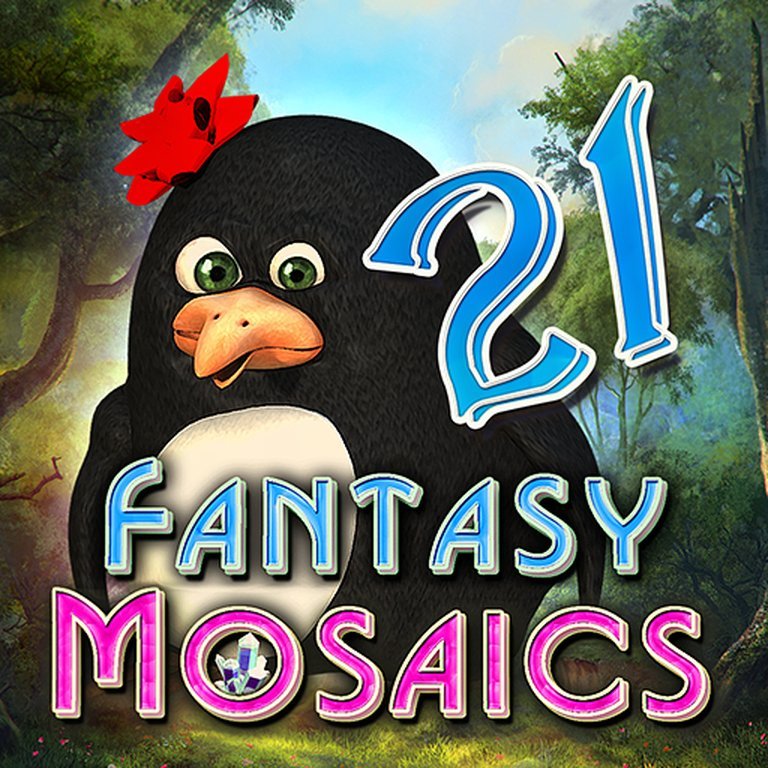
Fantasy Mosaics 21: On the Movie Set transports players to a vibrant film production set where they join the penguin family to solve colorful nonogram puzzles. By using logic and numerical clues to fill in grids, players reveal stunning pixel art scenes and uncover the story behind the movie’s creation, offering a casual yet engaging puzzle experience with a cinematic theme.
Gameplay Videos
Where to Buy Fantasy Mosaics 21: On the Movie Set
PC
Fantasy Mosaics 21: On the Movie Set Reviews & Reception
rgamereview.com : This is another highly addictive chapter. In this colorful quirky penguin adventure series!
Fantasy Mosaics 21: On the Movie Set: Review
Introduction
In the ever-evolving landscape of casual puzzle gaming, few franchises have demonstrated the consistency and iterative refinement of Fantasy Mosaics. Now with its 21st installment, On the Movie Set arrives not as a revolutionary disruptor, but as a masterful distillation of what makes this series endure. This review delves into how the game leverages its Hollywood-themed backdrop to deliver a quintessential Fantasy Mosaics experience—one that honors its legacy while artfully navigating the delicate balance between formulaic comfort and thematic freshness. Our thesis: Fantasy Mosaics 21 exemplifies the series’ strength in transforming niche puzzle mechanics into accessible, visually rewarding journeys, proving that even predictable genres can thrive through meticulous execution and charming world-building.
Development History & Context
Fantasy Mosaics 21 is the brainchild of developer Andy Jurko, a solo creator whose tenure in the puzzle game space spans over a decade. Built on the accessible GameMaker engine—a choice that underscores the series’ commitment to cross-platform compatibility (Windows, macOS, Android, iPad)—the game emerged from a clear vision: to democratize nonogram/picross puzzles without sacrificing artistic merit. Released in early 2017 (February on Android, May on Windows), it arrived during a period when mobile and casual PC games were saturating the market. The puzzle genre, particularly nonograms, had established itself as a reliable niche, but Fantasy Mosaics stood apart through its vibrant pixel art and family-friendly tone. Technologically, the game eschews modern graphical grandeur for functional elegance, requiring minimal resources (1.6 GHz CPU, 1GB RAM) to run—a testament to its design philosophy that substance outweighs spectacle. This era saw the rise of “cozy gaming,” where low-stakes, visually engaging experiences like this one found a dedicated audience seeking respite from high-octane titles.
Narrative & Thematic Deep Dive
While plot is rarely the centerpiece of nonogram games, On the Movie Set crafts a light, charming narrative framing device. The story begins when Mrs. Penguin receives an enigmatic invitation to a “famous movie studio,” prompting the penguin family to explore its cinematic backlots. Through brief, text-driven vignettes between puzzle stages, players uncover snippets of the studio’s operations—from bustling soundstages to star-studded red carpets. The narrative is intentionally simplistic, serving as a thematic glue rather than a deep narrative tapestry. Dialogue is sparse, relying on visual storytelling to convey the penguins’ whimsical curiosity. Thematically, the game revels in the magic of filmmaking, transforming puzzle-solving into a metaphor for “directing” pixel art frames. Underlying this is a subtle celebration of creativity and collaboration, as players “develop” each mosaic like a film project. The lack of complex characters or conflict aligns with the series’ ethos: puzzles, not plot, are the protagonists.
Gameplay Mechanics & Systems
At its core, Fantasy Mosaics 21 adheres to the nonogram formula: players deduce which cells to fill based on numerical clues for each row and column, revealing pixel art images. What elevates this iteration is its “enhanced color palette,” introducing multi-color complexity beyond binary fill/cross mechanics. Puzzles now require players to switch between color palettes, adding strategic depth without overwhelming newcomers. The interface remains impeccably streamlined: a grid displays clues on the left and top, with a simple color-selector palette below. Logic reigns supreme, with no time limits or penalties for errors, fostering a meditative pace. The game innovates subtly through thematic puzzle design—later stages incorporate film reel motifs, cameras, and clapperboards as solved images, rewarding players with instant visual payoffs. However, the lack of a hint system and occasional ambiguous color transitions (in later puzzles) may frustrate novices. Progression is linear, with increasingly complex grids, but the difficulty curve is forgiving, aligning with the series’ casual appeal.
World-Building, Art & Sound
The movie studio setting provides a vibrant, self-contained universe for exploration. Environments range from glittering soundstages to prop warehouses, each serving as a backdrop for puzzle-solving. The art direction is a triumph of pixel art economy: puzzles reveal cinematic icons like directors’ chairs, Oscar statuettes, and film strips, rendered in crisp, blocky detail. The color palette is deliberately bold—saturated teals, magentas, and golds evoke Hollywood glamour—yet maintains clarity for puzzle-solving. Animations are minimal but effective, with satisfying cell-filling sounds and gentle transitions between stages. Complementing the visuals is a soothing, jazz-infused soundtrack that oscillates between upbeat and mellow, mirroring the studio’s energetic yet creative atmosphere. Sound effects—soft clicks for cell fills, subtle fanfare for completed puzzles—reinforce the tactile satisfaction of progress. Together, these elements transform abstract logic into a tangible, immersive experience.
Reception & Legacy
Upon release, Fantasy Mosaics 21 garnered modest yet positive attention. On Steam, it holds an 83/100 player score from 6 reviews, with 5 praising its polished puzzles and thematic charm, and 1 citing repetitiveness—a common critique in the genre. Commercially, it fueled the series’ ongoing viability, appearing in discounted “Mega Packs” alongside adjacent titles (#22: Summer Vacation, #23: Magic Forest). While devoid of mainstream critical reviews (Metacritic lists no critic scores), its longevity is evident: the franchise remains active, with #21 regularly bundled as a “classic” entry. Its legacy lies in exemplifying the Fantasy Mosaics template—proving that iterative refinement (e.g., multi-color mechanics) and thematic novelty can sustain a puzzle series for over a decade. It influenced mobile puzzle design by prioritizing accessibility and visual reward, cementing nonograms as a viable casual genre.
Conclusion
Fantasy Mosaics 21: On the Movie Set is not a groundbreaking reinvention, but a flawless execution of a beloved formula. It transforms the logic of nonogram puzzles into a cinematic celebration, where each solved mosaic feels like a scene in a film directed by the player. The game’s strengths lie in its accessibility, artful pixel art, and the subtle depth of its multi-color mechanics—all wrapped in a charming, low-stress package. While its narrative simplicity and genre repetition may deter some, these are intentional concessions to its identity as a pure puzzle experience. Historically, #21 stands as a benchmark for cozy gaming: a title that prioritizes player satisfaction over novelty, proving that reliability and charm can outshine fleeting innovation. For devotees of the series or newcomers seeking intellectual calm, it remains a masterpiece of its niche—a pixelated love letter to logic, art, and the enduring magic of movies.