
- Release Year: 2021
- Platforms: Luna, PlayStation 4, PlayStation 5, Stadia, Windows, Xbox One, Xbox Series
- Publisher: Ubisoft Entertainment SA
- Developer: Ubisoft Toronto
- Genre: Action, Free-roaming, Open World, Sandbox, Shooter, Stealth
- Perspective: First-person
- Game Mode: Online Co-op, Single-player
- Gameplay: Base building, Combat, Crafting, Dynamic World, Emergent Gameplay, Exploration, Guerrilla Progression, Recruiting Allies, Resource gathering, Skill upgrades, Stealth, Vehicle Traversal
- Setting: Caribbean, Fictional Island, Offshore Platform, Oil Rig, Sea pirates, Tropical
- Average Score: 82/100
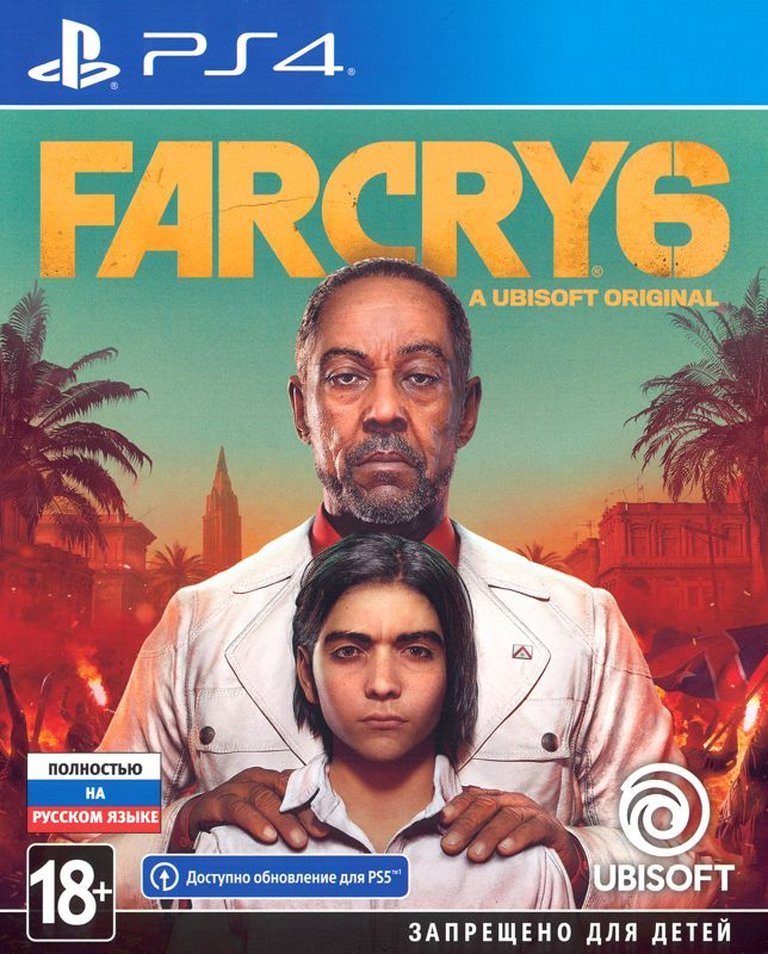
Description
Far Cry 6 is an open-world first-person shooter set in the fictional Caribbean island nation of Yara, ruled by the brutal dictator Antón Castillo. Players assume the role of a guerrilla fighter leading a revolution to overthrow the regime, navigating a dense tropical environment filled with diverse terrains and wildlife. The game blends action, stealth, and exploration, offering a dynamic world where player choices influence emergent gameplay. With a robust crafting system, upgradable skills, and the ability to recruit allies and establish bases, players must strategize and adapt to unpredictable enemy behaviors while utilizing an arsenal of weapons, vehicles, and mounts.
Gameplay Videos
Where to Buy Far Cry 6
PC
Far Cry 6 Free Download
PlayStation 4
Far Cry 6 Cracks & Fixes
Far Cry 6 Mods
Far Cry 6 Guides & Walkthroughs
Far Cry 6 Reviews & Reception
metacritic.com (94/100): Arguably the best Far Cry to date, Far Cry 6 maximizes PS5 capability while delivering a terrific experience.
ign.com : Ubisoft’s newest colorful explodathon is the best it’s been in a long time.
imdb.com (70/100): Overall, “Far Cry 6” is not a bad game by any means, and at most part its a pretty good one.
gamerevolution.com : Far Cry 6 does have the staple arsenal of guns, open world, big villain, and full-featured co-op, this installment disappointingly fails to evolve the series in any meaningful way.
Far Cry 6 Cheats & Codes
PC
Create a custom desktop shortcut, add ‘-DEVMODE’ to the Target path, launch the game from the shortcut, and press the tilde (~) key to open the console.
| Code | Effect |
|---|---|
| God | Invincibility (cannot take damage or die) |
| Invisible | Enemies cannot detect you |
| Superpunch | One-shot kills with melee attacks |
| Fast Forward | Extremely fast movement speed |
| LowGrav | Low gravity (jump to enormous heights) |
Far Cry 6: A Revolution in Familiarity
Introduction: The Legacy of Chaos and the Promise of Change
The Far Cry franchise has long been synonymous with open-world anarchy, charismatic villains, and the intoxicating freedom of guerrilla warfare. Since Far Cry 3 (2012) redefined the series with its tropical madness and the iconic Vaas Montenegro, Ubisoft has iterated on a formula that blends exploration, emergent gameplay, and over-the-top violence. Far Cry 6, released in 2021, arrives as both a celebration and a reckoning—a game that doubles down on what fans love while grappling with the weight of its own legacy. Set in the fictional Caribbean island of Yara, a stand-in for Cuba under the iron fist of dictator Antón Castillo (Giancarlo Esposito), the game promises a revolution not just in its narrative but in its mechanics, world-building, and thematic depth.
Yet, as with any long-running franchise, Far Cry 6 faces a critical question: Can it evolve without alienating its core audience? This review dissects the game’s ambitions, its successes, and its stumbles, placing it within the broader context of Ubisoft’s open-world design philosophy and the evolving expectations of players in 2021.
Development History & Context: Crafting a Revolution
A Global Collaboration Under Constraints
Far Cry 6 marks a shift in development leadership, with Ubisoft Toronto taking the helm as the primary studio, supported by a staggering 10 additional Ubisoft subsidiaries, including Montreal, Kyiv, Berlin, and Shanghai. This global collaboration was necessitated by the game’s sprawling scope but also complicated by the COVID-19 pandemic, which forced remote work and delayed the original February 2021 release to October.
The game runs on the Dunia 2 engine, upgraded with ray tracing (PC) and AMD FidelityFX Super Resolution support, reflecting Ubisoft’s push for next-gen visuals. However, the engine’s age—debuting in Far Cry 3—shows its limitations, particularly in AI behavior and physics.
A Political Statement or a Safe Bet?
Narrative Director Navid Khavari positioned Far Cry 6 as a “political” game, a deliberate contrast to Far Cry 5’s controversial ambiguity. Inspired by the Cuban Revolution and Khavari’s family history (his parents fled the Iranian Revolution), the game explores themes of fascism, imperialism, and forced labor, framed through the lens of a modern guerrilla uprising.
Yet, Ubisoft’s cautious approach to real-world parallels is evident. While Yara is a thinly veiled Cuba, the game avoids direct commentary on contemporary Cuban politics, instead crafting a fictionalized dictatorship that borrows from historical figures like Fulgencio Batista. This balancing act—between authenticity and marketability—defines much of Far Cry 6’s identity.
The Esposito Effect: Casting a Villain for the Ages
The game’s marketing hinged on Giancarlo Esposito’s portrayal of Antón Castillo, a calculated move to evoke the menace of his Breaking Bad character, Gus Fring. Esposito’s motion-capture performance and voice work were recorded early, shaping Castillo’s in-game model and mannerisms. His presence elevates the game’s narrative gravitas, though his screen time is surprisingly limited—a recurring critique in reviews.
Narrative & Thematic Deep Dive: Revolution as Spectacle
Plot: A Tale of Two Revolutions
Far Cry 6’s story follows Dani Rojas, a fully voiced protagonist (a first for the series since Far Cry 3), who joins the Libertad guerrilla movement after escaping Antón Castillo’s brutal regime. The narrative unfolds across three major regions (Madrugada, Valle de Oro, El Este), each tied to a lieutenant of Castillo’s regime:
- Madrugada: Home to the Montero family, resisting Castillo’s tobacco farms.
- Valle de Oro: Where the rap group Máximas Matanzas fights propaganda.
- El Este: A stronghold of the Legends of ‘67, veterans of the original revolution.
The plot culminates in a confrontation with Castillo, whose leukemia and grooming of his son Diego add tragic depth to his tyranny. The game offers two endings:
1. The Revolutionary Ending: Dani refuses leadership, leaving Yara’s future uncertain.
2. The Escape Ending: Dani flees to Miami, abandoning the revolution.
Themes: Freedom, Exploitation, and the Cost of Revolution
Far Cry 6 grapples with heavy themes but often undermines them with tonal whiplash. Key ideas include:
– The Cycle of Violence: The game questions whether revolutions truly liberate or merely replace one oppressor with another.
– Imperialism and Exploitation: The Viviro drug (a cancer cure derived from tobacco) symbolizes corporate and colonial extraction.
– Family and Legacy: Castillo’s relationship with Diego mirrors real-world dictators grooming successors.
However, the game’s satirical humor (e.g., a cockfighting minigame, a CD-launching slingshot) clashes with its darker moments, creating a disjointed tone that some critics found jarring.
Characters: A Mixed Bag of Memorable and Forgettable
- Antón Castillo (Giancarlo Esposito): A chilling villain whose presence looms large, though his limited screen time diminishes his impact.
- Dani Rojas: A welcoming change from mute protagonists, though their personality is underdeveloped.
- Juan Cortez (voiced by an uncredited actor): A charming rogue who serves as Dani’s mentor.
- Clara Garcia: The moral center of Libertad, though her death feels rushed.
Side characters like Chicharrón (a rooster companion) and Guapo (a crocodile) add levity but highlight the game’s struggle to balance tone.
Gameplay Mechanics & Systems: Evolution or Stagnation?
Core Gameplay Loop: Familiar Yet Refined
Far Cry 6 retains the series’ open-world sandbox structure but introduces key refinements:
– Resolver Weapons: DIY guns (e.g., a CD-launching slingshot, a nail gun) add creativity but feel gimmicky.
– Supremo Backpacks: Special abilities (e.g., homing missiles, invisibility) that trivialize combat if overused.
– Amigos System: Animal companions (e.g., Chorizo the Dachshund, Guapo the Crocodile) that aid in combat and exploration.
Progression and Customization: A Step Back?
The game abandons the skill tree in favor of gear-based progression, where players find armor and accessories that grant perks. While this encourages exploration, it removes player agency, forcing reliance on RNG drops.
Combat and Stealth: A Mixed Bag
- Gunplay: Satisfying but unbalanced—some weapons (e.g., the Resolver SMG) dominate.
- Stealth: Improved with body dragging and distractions, but AI inconsistencies (e.g., enemies ignoring corpses) break immersion.
- Vehicle Combat: Clunky controls and overpowered enemy vehicles make traversal frustrating.
World Design: A Playground with Problems
Yara is visually stunning, with diverse biomes (jungles, cities, beaches), but its repetitive structure (outposts, checkpoints) leads to fatigue. The lack of meaningful side content (e.g., fetch quests, repetitive liberations) exacerbates this.
World-Building, Art & Sound: A Tropical Paradise with Flaws
Visual Design: A Feast for the Eyes
- Lighting and Weather: Dynamic day-night cycles and tropical storms enhance immersion.
- Character Models: Detailed but suffer from uncanny valley in cutscenes.
- Environmental Storytelling: Abandoned villages and propaganda posters reinforce Yara’s oppressive atmosphere.
Sound Design: A Symphony of Chaos
- Pedro Bromfman’s Score: A blend of Latin rhythms and orchestral tension that elevates key moments.
- Voice Acting: Esposito shines, but side characters vary in quality.
- Ambient Sounds: Jungle noises, gunfire echoes, and radio broadcasts create a living world.
Reception & Legacy: A Revolution Half-Realized
Critical Reception: Praise and Backlash
Far Cry 6 received mixed reviews, with critics praising its world design and gunplay but criticizing its repetitive structure and narrative inconsistencies.
- Positive: IGN (8/10) called it “the best the series has been in years.”
- Negative: Polygon criticized its Latin American stereotypes and shallow politics.
Commercial Success and Awards
- Sales: Strong debut, ranking #11 in 2021 U.S. sales.
- Awards: Nominated for Best Performance (Esposito) at The Game Awards 2021.
Legacy: The End of an Era?
Far Cry 6 feels like a swan song for the classic Far Cry formula. While it refines mechanics, it fails to innovate, leaving fans wondering: Is it time for a revolution in the series itself?
Conclusion: A Flawed but Fun Farewell to the Old Formula
Far Cry 6 is a paradox—a game that perfects the Far Cry experience while exposing its limitations. Its world is breathtaking, its gunplay is exhilarating, and Esposito’s performance is magnetic, but its repetitive structure, tonal whiplash, and lack of meaningful evolution hold it back.
Final Verdict: 7.5/10 – A Revolution Deferred
For fans of the series, Far Cry 6 is a must-play—a polished, chaotic sandbox that delivers on its promises. For newcomers, it’s a flawed but fun introduction to the franchise. Yet, for the future of Far Cry, it’s a warning: The revolution must come, or the series risks stagnation.
¡Viva la Revolución? Maybe next time.