
- Release Year: 2007
- Platforms: Android, bada, BlackBerry, iPhone, Nintendo DSi, PlayStation 3, PSP, Symbian, Windows
- Publisher: ak tronic Software & Services GmbH, Alawar Entertainment, Inc., HeroCraft Ltd, iWin, Inc.
- Developer: Melesta
- Genre: Action, Strategy, Tactics
- Perspective: Top-down
- Game Mode: Single-player
- Gameplay: Business simulation, Managerial, Time management
- Average Score: 68/100
Description
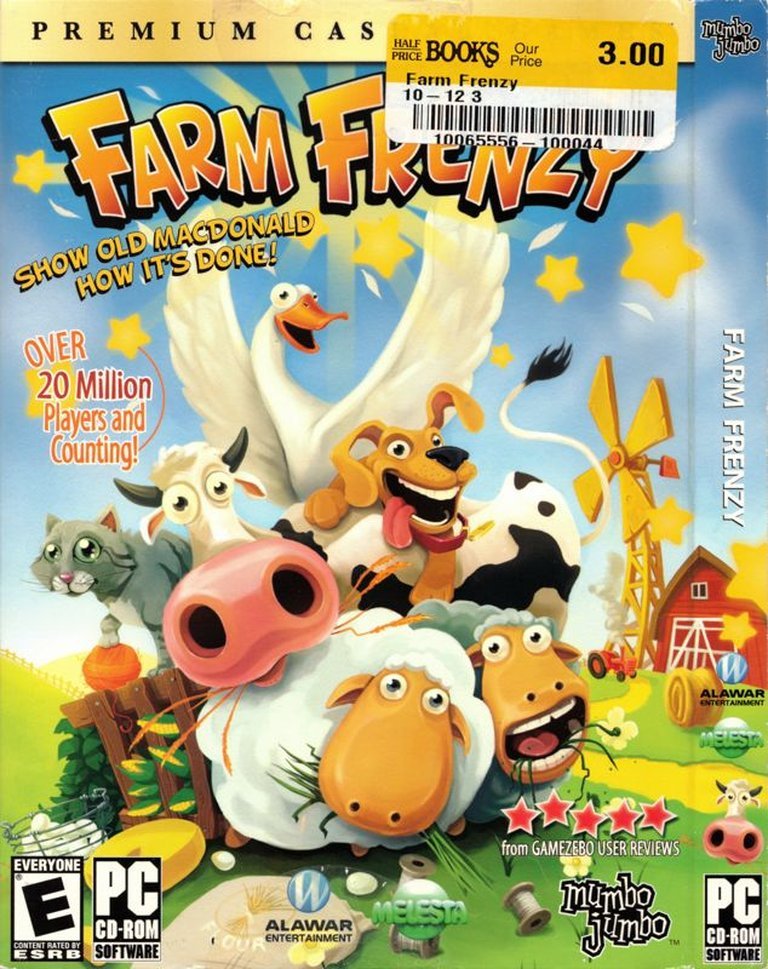
Farm Frenzy is a time-management game where players manage a farm, raising animals and selling products to the market. The game features a central farm area where animals roam, and players interact with various farm implements and machines to collect resources, process them into refined products, and ship them to the market. Players must also manage threats like bears that randomly appear and can harm the animals. The goal is to complete levels by meeting specific resource or money targets, with upgrades available to improve efficiency and unlock new levels.
Gameplay Videos
Where to Buy Farm Frenzy
Farm Frenzy Free Download
PC
Farm Frenzy Cracks & Fixes
Farm Frenzy Mods
Farm Frenzy Guides & Walkthroughs
Farm Frenzy Reviews & Reception
steambase.io (97/100): Farm Frenzy has earned a Player Score of 97 / 100.
mobygames.com (70/100): Farm Frenzy is a straightforward time-management game, where the player controls a farm, raising animals and selling products to the market.
ign.com (40/100): Daily chores have never been more entertaining as you cultivate your fields, feed your animals, and gather the items they produce.
vgtimes.com (67/100): Farm Frenzy is a real-time top-down management simulator where you become a real farmer.
Farm Frenzy Cheats & Codes
PC
Type the code anywhere while playing the game.
| Code | Effect |
|---|---|
| vichyssoize | Grants unlimited coins/money/gold |
Farm Frenzy: Review
The Chaotic Charm of Digital Agriculture That Defined a Decade of Casual Gaming
Introduction
In 2007, a Belarusian studio named Melesta unleashed Farm Frenzy onto an unsuspecting casual gaming market dominated by match-3 puzzles and hidden-object titles. What began as a modest time-management experiment grew into a franchise spanning 20+ sequels and spin-offs, proving that even the simplest agrarian fantasies could captivate millions. This review argues that Farm Frenzy—despite its mechanical straightforwardness—revitalized the farming simulator genre for the digital age, marrying frantic multitasking with a deceptively strategic economic core. Its legacy lies not in complexity, but in perfecting the “just one more crop” compulsion loop that has since become an industry staple.
Development History & Context
The Alawar-Melesta Synergy
Developed by Melesta (now Melesta Games) under publisher Alawar Entertainment, Farm Frenzy emerged from a six-month production cycle with a skeleton crew of five developers. Fresh off titles like Build-a-Lot, Melesta sought to streamline the managerial-sim formula for the burgeoning downloadable games market. As Kirill Plotnikov (Executive Producer) noted in interviews, the goal was “accessible depth”—a game children could grasp intuitively but adults would find strategically engaging.
Technological Constraints as Creative Fuel
Built using C++, DirectX 8.0, and proprietary tools, the team leveraged Maya and 3dsMax for assets optimized for low-end PCs and early smartphones (the game later ported to iPhone, Symbian, and Android). These constraints birthed iconic design choices:
– Top-down perspective: Eliminated camera controls, focusing players on click precision.
– Drag-and-drop-free UI: All actions mapped to single clicks on static hotspots (wells, factories, trucks) to accommodate touchscreens pre-multi-touch.
– Abstracted storage: A finite grid of bottom-row boxes forced rapid decision-making, transforming inventory management into a spatial puzzle.
A Casual Gold Rush Era
Launched alongside Plants vs. Zombies (2009) and FarmVille (2009), Farm Frenzy exploited the 2007–2012 casual gaming boom. Its shareware model—offering free trials with premium unlocks—proved wildly profitable, earning Alawar accolades like “Best Casual Game” at Russia’s 2008 Game Developers Conference (KRI). Amidst Flash-game saturation, Farm Frenzy stood out by rejecting idle automation; players couldn’t afk-farm while crops grew. Every second demanded active intervention—a philosophy that resonated in the pre-autoplay mobile landscape.
Narrative & Thematic Deep Dive
The Paper-Thin Plot with Lasting Resonance
Farm Frenzy eschews narrative pretense. There’s no fiery redemption arc for a bankrupt farmer—just a never-ending supply chain where geese lay eggs, cows excrete milk, and bears materialize like capitalist gremlins. Yet this vacuum became thematic strength. By reducing storytelling to progress-bar objectives (“Collect 10 Cheese!”), Melesta tapped into a primal fantasy: the self-sufficient homestead, weaponized into a micro-economy.
Subtextual Class Warfare
Beneath the cartoon veneer lies a brutalist satire of industrialized agriculture. Players aren’t pastoral caretakers but ruthless efficiency drones:
– Animal commodification: Sheep aren’t named—they’re cotton-generating units.
– Bear exploitation: Wandering predators are caged, boxed, and sold as exotic goods.
– Upgrade-or-perish: Stars earned from speedrunning levels fund automations (e.g., faster egg-to-powder converters), emancipating players from manual labor while enslaving them to ROI calculations.
The game’s unspoken thesis? Capitalism thrives on controlled chaos—a lesson delivered via clucking chickens and exploding storage sheds.
Gameplay Mechanics & Systems
Core Loop: The Art of Controlled Panic
Farm Frenzy masquerades as a farming sim but operates as a resource-tycoon RTS:
1. Inputs: Click well for water ➔ grow grass ➔ buy animals.
2. Outputs: Harvest eggs/cotton/milk ➔ box them ➔ load trucks.
3. Value-Add: Refine raw goods into higher-margin products (e.g., milk → cheese → cake).
4. Crisis Management: Quarantine bears mid-rampage before they ravage livestock.
Innovation: The Bear Paradox
Bears—randomly spawned chaos agents—elevate Farm Frenzy beyond mundane harvesting. Players must:
– Trap them quickly (click cage ➔ deploy near bear).
– Box them before escape (3–5 second window).
– Sell them ASAP (storage decay forces prioritization).
This system injects risk/reward tension: Bears yield profit but demand attention at peak inefficiency—often during truck-delivery lag times.
Flawed Progression
While upgrades (funded by speedrun stars) reduce grind, late-game levels suffer from:
– Obtuse difficulty spikes: Players report “suddenly impossible” goals without warning (Mobilgamer.cz).
– Input bottlenecks: Click delays on early smartphones caused failed bear captures (GameSpot’s Android review cited unresponsive touch controls).
– Pacing asymmetry: No time limits reduce urgency, yet speed bonuses are essential for progression—a schism that frustrates completionists.
World-Building, Art & Sound
Aesthetic: Soviet-Era Saturday Morning Cartoons
Artist Sergey Starokhozyaev’s visuals evoke Eastern European children’s books—all primary colors and squishy proportions. The farm floats in a diorama-like void, emphasizing functional abstraction over realism. Buildings resemble Fisher-Price toys; bears grin with dopey malice. This whimsy softens the game’s underlying ruthlessness, making 3 AM grinding sessions feel innocent.
Sound Design: Folksy Feedback Loops
Sergey Khmelevsky’s soundtrack blends balalaikas and MIDI hoedowns, punctuated by:
– ASMR-ish SFX: The plink of collected eggs, sploosh of watering grass, and bear roars muffled by cages.
– Absent ambient noise: Silent pastures heighten focus on kinetic audio cues (players hear mismanagement via idle animal bleats).
Critics praised the audio’s “brain-tickling” qualities (GameZebo), though Android ports suffered sound-dropout bugs (GameSpot).
Reception & Legacy
Critical Divide: Simple vs. Shallow
Farm Frenzy polarized reviewers:
– Praise: “Addictive and surprisingly strategic” (Digitally Downloaded, 80%); “A ducky game filled with sheep thrills” (GameZebo, 70%).
– Condemnation: “Bland with flawed execution” (Nintendo Life, 40%); “Missed opportunity” (GameSpot, 65%).
The divide centered on expectations: Casual fans lauded its “one-more-turn” compulsion; hardcore players dismissed it as spreadsheet-lite.
Commercial Triumph & Cultural Osmosis
Despite middling critical scores, the game:
– Sparked a franchise: Sequels explored Roman, Viking, and Arctic themes, selling 50M+ copies collectively (Alawar, 2020).
– Pioneered mobile ports: The 2009 iPhone version grossed Top 10 in 12 countries, proving touchscreens’ viability for management sims.
– Influenced giants: Hay Day (2012) and Stardew Valley (2016) borrowed its animal-product chain mechanics, albeit with softened edges.
The Speedrun Underground
A player-led community emerged around “Three-Star S-Ranks,” sharing frame-perfect click patterns to optimize level times—an unexpected hardcore legacy for a “casual” title.
Conclusion
Farm Frenzy is gaming’s equivalent of a roadside diner: unassuming in presentation, mechanically utilitarian, yet undeniably influential. It eschewed narrative pretense and graphical bombast to focus on a single question: How much chaos can one cursor withstand? While later farming sims refined its systems (or buried them beneath pastoral romance), Melesta’s debut remains essential. It proved managing virtual livestock could be as gripping as headshots or heists—if framed through the lens of capitalist absurdism. For pioneering click-and-wait addiction loops and birthing a golden age of agrarian sims, Farm Frenzy earns its place as a foundational text in casual gaming’s pantheon.
Final Verdict: A flawed masterpiece—rough around the edges yet impossible to put down. For historians, it’s a watershed moment. For players, it’s the game that made farming feel like a blood sport.