
- Release Year: 2011
- Platforms: Windows
- Publisher: S.A.D. Software Vertriebs- und Produktions GmbH
- Developer: Alawar Melesta
- Genre: Strategy, Tactics
- Perspective: Top-down
- Game Mode: Single-player
- Gameplay: Business simulation, Managerial, Time management
- Setting: Ancient Roman
Description
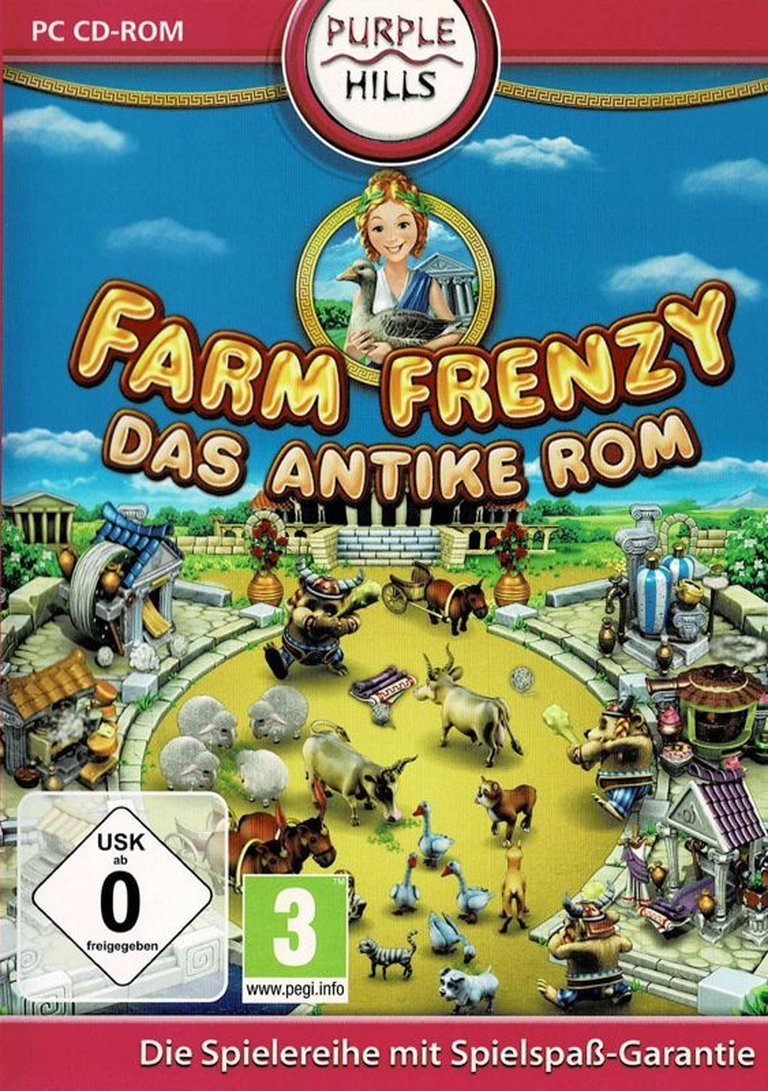
In Farm Frenzy: Ancient Rome, players manage a farm set in the Roman Empire to support Roman troops by producing and collecting goods. As Scarlett, you must plant grass, raise animals to generate raw materials, sell products at the market, and defend against ‘bearbarians’ (barbarians) to protect livestock, all while earning stars for upgrades between levels in this time management simulation.
Gameplay Videos
Where to Buy Farm Frenzy: Ancient Rome
PC
Farm Frenzy: Ancient Rome Mods
Farm Frenzy: Ancient Rome Guides & Walkthroughs
Farm Frenzy: Ancient Rome Reviews & Reception
virtualworldsland.com : Immerse yourself in this awesome farm based time management game that’s sure to impress.
Farm Frenzy: Ancient Rome: A Chronotopic Masterpiece of Casual Design
Introduction: The Empire of Time Management
In the bustling ecosystem of casual gaming circa 2010-2011, few series commanded the quiet, enduring authority of Alawar’s Farm Frenzy. What began as a charming twist on the time management genre had, by its third main entry, become a annualized institution. Farm Frenzy: Ancient Rome, released in early 2011 as a thematic spin-off anchored to the Farm Frenzy 3 framework, represents a fascinating apex and a turning point. It is a game that confidently transplants its frantic, click-heavy core into a setting of historical grandeur, not through gritty realism, but through a hilarious anachronistic lens. This review will argue that Ancient Rome is not merely a reskin but a significant iterative step that deepened the series’ strategic lattice through its “building supply” system, while simultaneously exposing the creative and thematic limits of a formula reaching its saturation point. To understand its place is to understand the delicate balance between accessibility and depth, between historical pastiche and pure, unadulterated casual gameplay.
Development History & Context: A Belarusian Blueprint for Global Domination
Farm Frenzy: Ancient Rome was developed by Melesta Games, a studio based in Minsk, Belarus, and published worldwide by Alawar Entertainment. This partnership, forged at Casual Connect 2007 between Melesta’s Alexey Meleshkevich and Alawar’s Kirill Plotnikov, had by 2011 become a well-oiled machine. The Farm Frenzy series was a commercial juggernaut, consistently topping portals like Big Fish Games, RealNetworks, and MSN Games. The development cycle, as pieced together from credits and series history, was tight—likely around six months—following a pattern established after the original’s success.
The technological context was that of the late 2000s/early 2010s casual PC market: Adobe Flash was king for browser-based titles, but the downloadable PC client market (via portals like Big Fish and GameHouse) was thriving. Games were built for low-spec machines (the recommended Pentium III 800MHz speaks volumes) and sold as 60-minute trials before a one-time purchase. Ancient Rome needed to be instantly accessible, visually clear on small resolutions, and mechanically foolproof. The team of 21 credited developers, led by Director Alexey Meleshkevich, Lead Developer Vadim Suhorukov, and Game Designer Oleg Shalnev, operated within these constraints. They took the established Farm Frenzy 3 engine—which itself introduced the protagonist Scarlett and a global narrative framework—and applied a new thematic skin. The vision, as stated in marketing copy, was to “take the time management Farm Frenzy games back to the glorious days of the Roman Empire.” Crucially, this was not an attempt at historical simulation. The goal was a playful, cartoonish “Rome” where the primary Roman touchstones were the galley (ship) used for market trade and the chariot (cart) for supply runs, alongside the ever-present threat of “bearbarians”—a perfect, pun-filled encapsulation of the series’ tone.
Narrative & Thematic Deep Dive: Scarlett’s Ancestral Echo
The narrative scaffolding of Ancient Rome is both simple and perplexing, a hallmark of the series’ approach to story. The player controls a “young woman called Scarlett,” who in this iteration is supporting Roman troops with food. The official description from MobyGames and Gamepressure presents a dual narrative: “A long time ago, when Rome ruled the world, a courageous young woman named Scarlett farmed her land… Today, an equally spirited young woman named Scarlett has become an accomplished farmer. What magical bond ties these two women together?”
This framing device, pulled directly from Farm Frenzy 3, posits that the “ancient Roman Scarlett” is an ancestor or past-life incarnation of the modern, globetrotting Scarlett introduced in Farm Frenzy 3. Between levels, the modern Scarlett solves “a tantalizing mystery involving a family heirloom” in comic-style cutscenes. The source material is frustratingly thin on specifics regarding these cutscenes or the heirloom’s nature—the MobyGames entry lists Inga Boyarskaya as the Script writer, but no script excerpts exist in the provided material. This suggests the narrative was a minimal, functional overlay, a reward for progression rather than a deep driving force.
Thematically, the game attempts to weave the mundane mechanics of farm management into the epic tapestry of the Roman Empire. The player’s goal is to “support the roman troops,” elevating butter-making and wool-shearing to acts of patriotic duty. This creates a gentle, almost absurdist incongruity: the heroic labor of empire-building is reduced to optimizing cake production chains to meet a quota before a time limit. The “bearbarians” are the perfect thematic foe—not historical enemies, but a punning stand-in for any disruption to the farm’s productivity. The Roman setting is thus a superficial, aesthetic coat of paint applied to the universal grammar of resource gathering and time pressure. It provides a fresh visual palette—columns, togas on animal pens, Roman-esque UI elements—but does little to interrogate or engage with actual Roman agriculture or history. The theme is pure, surface-level branding, successful in creating a distinct identity within the series but offering no substantive historical commentary.
Gameplay Mechanics & Systems: The Web of Cement, Logs, and Granite
To analyze Ancient Rome is to dissect the Farm Frenzy formula at its most refined. The core loop remains: plant grass → feed animals → collect goods → store → sell/process. Water from the well is the foundational, renewable resource. Animals (geese, sheep, cows) produce raw goods (eggs, wool, milk). These can be sold directly or processed into higher-value goods (powdered eggs, cookies, cakes, costumes, cheese, etc.). All actions are performed via rapid mouse clicking, with the constant tension of perishable goods vanishing if not collected and the threat of “bearbarians” destroying livestock and products if not caged (by clicking them repeatedly).
Where Ancient Rome innovates and deepens the system is in its Building Supply Dependency for upgrades, a mechanic heavily detailed in the walkthroughs on CasualGameGuides. In prior games, upgrades for production buildings (like the cake bakery) were typically purchased with stars earned from level completion. Here, upgrading to Level 2 requires Cement, to Level 3 requires Logs, and to Level 4 requires Granite. These are not purchased from a store with money; they must be produced on-farm from complex recipes:
* Cement requires Eggs, Sand, and Water.
* Logs require Cookies, Milk, and the labor of a Sheep.
* Granite requires Cakes, Milk, Stones, and the labor of a Cow.
This creates a profound, multi-layered dependency graph. To upgrade your cake factory (which uses Eggs and Flour), you need Cement, which needs Eggs and Sand. To upgrade your costume factory (which uses Wool and Decorations), you need Logs, which need Cookies (from Eggs) and Milk (from Cows). To upgrade your cheese factory (which uses Milk and Granite), you need Granite, which needs Cakes (from Eggs) and Milk from Cows. The player is forced to juggle multiple production chains simultaneously, often using the same animal (a cow’s milk is needed for both Logs and Granite) or raw material (Eggs are needed for Powdered Eggs, Cookies, Cakes, and Cement) in conflicting ways.
This is the game’s primary strategic depth. As the walkthrough notes: “Because of building supply requirements, you will find that it is best to just get enough to get to a middle level and then start production. If you spend too much time getting the upgrade supplies, you will just run out of time.” It introduces a critical planning horizon absent from simpler entries. You must look ahead at level goals, your current upgrade state, and the supply requirements for the next upgrade tier, all while meeting immediate production quotas. The “short-term” goal (complete level objectives) is inextricably linked to the “long-term” goal (stockpiling Cement/Logs/Granite for future efficiency).
Other mechanics are series staples refined:
* The Star System: Every level completion (even replay) grants stars. These are spent between levels on permanent upgrades for all facilities (Well, Warehouse, Cart/Chariot, Galley/Ship, Cage, Cats, Dogs). The walkthroughs universally prioritize Cage upgrades first, as caging “bearbarians” faster and more reliably is the single greatest factor in reducing time loss and protecting assets.
* Multi-Source Resources: Some goods (like Sand, Stones, Decorations) must be purchased from the city via the chariot/cart, introducing a resource management and timing element for these imports.
* Animal Labor: Sawmills (for Logs) require Sheep, and Granite Factories require Cows. This ties the supply chain directly to living assets, whose production is not instantaneous, adding another layer of scheduling.
* New End-Game Products: The Roman theme introduces Sailcloth and ultimately Ship-building. Sailcloth (made from Cloth and Paint) and Logs are combined in the Shipyard to build ships, which are high-value end-game sales. This pushes the late-game economy into a new tier.
The game’s pacing is real-time, with each level having a par time for Gold, Silver, or Bronze ranking, though no hard “game over” time limit. This encourages optimization and replay, a core的心理 for casual completionists. The UI, as implied by the walkthrough’s instructions (“Click on the buildings to make them produce faster”), is functional but requires constant attention to the red “overheating” bar on buildings.
World-Building, Art & Sound: A(kind of) Roman Extravaganza
Visually, Ancient Rome embraces a clean, bright, cartoonish aesthetic consistent with the series. The settings are pastel-hued Roman-themed farms: low stone walls,Pot-like clay pots, olive trees, and banners with eagles. The animal designs are humorous—geese with tiny laurel wreaths, bears in “barbarian” furs (sometimes dressed in silly costumes after being caged). The animation is described in reviews as “fluid” and “amazing,” though it is necessarily simple 2D sprite work. The “hilarious visual gags” promised in marketing likely refer to the bears’ antics and the anachronistic costuming.
The art direction’s success lies in its consistency and clarity. Every element is readable at a glance on a small window: the well, the warehouse, each animal pen, each production building. The Roman theme is applied consistently to the building sprites (e.g., the market is a Roman agora stall, the ship is a galley). It creates a cohesive, if historically shallow, world. The sound design, credited to composer Sergey Khmelevsky and musician Artem Galytzyn, is functional—upbeat, looping tracks that match the frantic pace, with clear, cartoony sound effects for clicks, animal noises, and the clank of a bear going into a cage.
Where the world-building falters is in the disconnect between the epic narrative and the silly gameplay. One never feels like a Roman farmer provisioning a legion; one feels like a frantic manager of a cartoon zoo with Roman props. The atmosphere is lighthearted and busy, not immersive or historically resonant. It is a theme park version of Ancient Rome, effective for branding but not for world-building depth.
Reception & Legacy: A Silent Success in a Crowded Field
Official critical reception data is nearly non-existent. MobyGames shows no critic reviews and a paltry 1.2/5 user score from a single rating. Metacritic lists no user reviews. This silence is deafening for a game in a prolific series. However, this points to a key reality of the casual market: these games were reviewed primarily on the distribution portals themselves (Big Fish, GameHouse) where they received high user ratings (4.3/5 on WildTangent, 4.2 on Gamepressure as noted). The critical discourse happened in forums, blog comments, and through word-of-mouth among the vast casual audience, not in traditional games press.
Its commercial legacy is tied to the Farm Frenzy brand. It was part of a yearly release cadence that saw main sequels (FF3, FF4) and multiple spin-offs (Gone Fishing, Viking Heroes, Ancient Rome). It was included in the Farm Frenzy Collection (2015), indicating it was considered a valuable part of the franchise’s library. Its influence is twofold:
- Systemic Deepening: The Cement/Log/Granite upgrade dependency system was a significant complication of the core economy. It raised the strategic ceiling for dedicated players, as evidenced by the incredibly detailed walkthroughs that plan 90 levels of production chains. This system likely informed the design of later, even more complex entries like Farm Frenzy 4 and Farm Frenzy Refreshed, which feature even more elaborate multi-farm mechanics.
- Thematic Template: Ancient Rome perfected the “historical reskin” formula for the series. It directly paved the way for Farm Frenzy: Viking Heroes (2011), which applied the same logic—swap Rome for Vikings, swap galleys/chariots for longships, swap cement/logs/granite for presumably other themed supplies—to another popular historical setting. This became the go-to strategy for annualizing the franchise without reinventing the core loop.
Its weakness, the hollow narrative and repetitive core despite new themes, likely contributed to the series’ eventual decline in prominence. By the late 2010s, the casual market had shifted towards mobile and hyper-casual, and the complex, click-intensive Farm Frenzy formula felt increasingly like a niche product for a dedicated, aging audience.
Conclusion: An Imperially Themed Milestone in a Declining Empire
Farm Frenzy: Ancient Rome is a paradox. It is simultaneously one of the most mechanically sophisticated entries in its series and one of the most thematically vacant. It represents the zenith of the “classic” Farm Frenzy design—the point where the simple joy of clicking animals and managing flows was saddled with a robust, interdependent upgrade system that could challenge even seasoned players, as seen in the labyrinthine level strategies of the walkthroughs. The cement/log/granite dependency web is a masterclass in emergent complexity from simple rules.
Yet, it also highlights the creative exhaustion of the format. The Roman skin is a charming but paper-thin veneer. The narrative framing is perfunctory. The 90 levels, while expertly tuned for increasing difficulty, ultimately repeat the same pattern of juggling geese, sheep, and bears under a time pressure par. It is a game you either adore for its zen-like busywork and strategic puzzles, or find mind-numbingly repetitive.
In the grand history of video games, Farm Frenzy: Ancient Rome is not a landmark. It will not be discussed alongside genre-defining pioneers. But within the specific, lucrative, and now largely preserved ecosystem of 2000s-2010s casual PC gaming, it stands as a peak artifact. It is the most polished, mechanically rich, and confidently themed iteration of a formula that entertained millions quietly in the background of their computers. It is the Roman Empire of its niche: vast in its internal infrastructure, impressively organized, but built on a foundation of borrowed aesthetics and ultimately vulnerable to the shifting tides of market trends. Its legacy is not in innovation, but in perfecting a specific, click-driven catharsis for a dedicated few, a testament to the enduring, if narrow, appeal of turning farm management into a timed puzzle of imperial proportions.