
- Release Year: 1995
- Platforms: Arcade, Neo Geo CD, Neo Geo, Nintendo Switch, PlayStation 4, SEGA Saturn, Wii, Windows Apps, Windows, Xbox One
- Publisher: D4 Enterprise, Inc., GameBank Corp., Hamster Corporation, SNK Corporation, WizardWorks Group, Inc.
- Developer: SNK Corporation
- Genre: Action
- Perspective: Side view
- Game Mode: Hotseat, Single-player
- Gameplay: 2D scrolling, Escape holds, Fighting, Pseudo-3D, Throws
- Setting: Contemporary North America
- Average Score: 80/100
Description
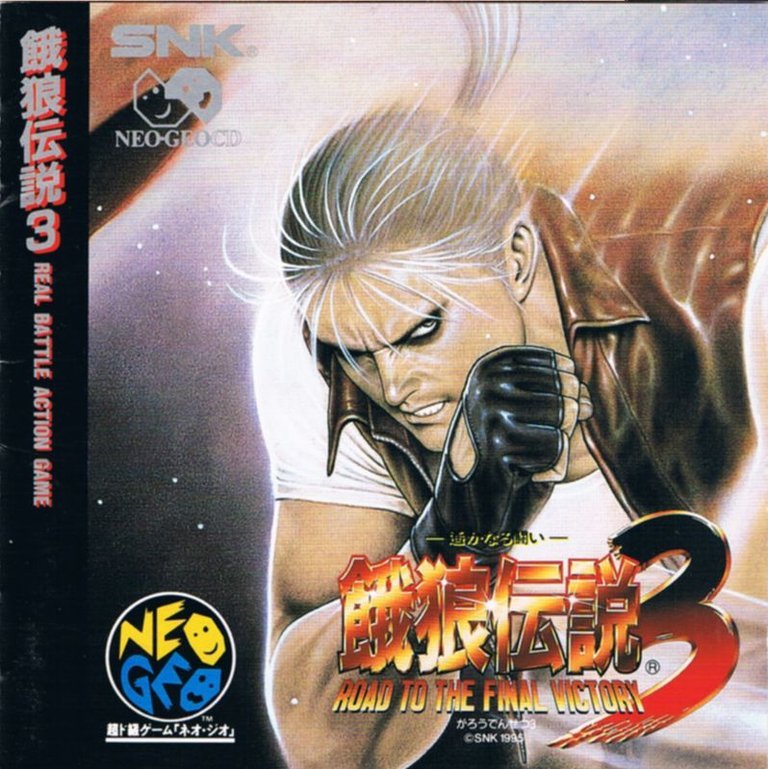
Fatal Fury 3: Road to the Final Victory is a 2D side-view fighting game set in contemporary North America, featuring one-on-one combat with pseudo-3D mechanics that allow players to escape holds, throws, and other attacks. As part of SNK’s popular Fatal Fury series, it continues the saga of street fighters in urban environments with anime-style visuals.
Gameplay Videos
Fatal Fury 3: Road to the Final Victory Free Download
Fatal Fury 3: Road to the Final Victory Guides & Walkthroughs
Fatal Fury 3: Road to the Final Victory Reviews & Reception
metacritic.com (70/100): Fatal Fury 3 is a competent enough fighter, it’s not a must download title.
gamesreviews2010.com (90/100): Fatal Fury 3: Road to the Final Victory is a masterpiece of the fighting game genre.
Fatal Fury 3: Road to the Final Victory Cheats & Codes
Sega Saturn (Japanese Version)
Requires Pro Action Replay/GameShark cheat device.
| Code | Effect |
|---|---|
| F6000924 C305 | Master Code (must be on) |
| 36007D19 0060 | Unlimited Energy for Player 1 |
| 36007D1A 0060 | Unlimited Energy for Player 2 |
Arcade
Hold buttons during character selection or loading screen.
| Code | Effect |
|---|---|
| B + C (both controllers) through ‘Now Loading’ screen | Little Fighters in Vs. Mode |
PC
Perform button sequences at character selection screen or in specific modes.
| Code | Effect |
|---|---|
| Highlight Terry->Hon Fu->Mai->Geese->Bob->Sokaku Mochizuki->Andy->Franco->Joe Higashi->Blue Mary, press Low Kick once on each | Unlock Ryuju Yamazaki and the Jins (Jin Chonshu and Jin Chonrei) |
| Hold both 1P and 2P’s Low Kick and High Punch when confirming fighters | Tiny Fighters / Small Fighters in VS Mode |
NeoGeo CD
Perform button sequence at character selection screen after loading saved data.
| Code | Effect |
|---|---|
| Highlight Terry->Hon Fu->Mai->Geese->Bob->Sokaku->Andy->Bash->Joe->Mary, press B on each | Unlock Ryuju Yamazaki and the Jins (Zin Chonshu and Zin Chonrei) |
| Hold B+C on both controllers through ‘Now Loading’ screen | Little Fighters in versus mode |
Arcade (MAME/Emulator)
Enable cheats via MAME cheat XML/interface.
| Code | Effect |
|---|---|
| maincpu.rw@00EDF2=6002 | Walk Through Stage Boundaries (part 1) |
| maincpu.rw@00EDFE=6002 | Walk Through Stage Boundaries (part 2) |
| maincpu.rw@0103D4=6000 | Walk Through Stage Boundaries (part 3) |
| maincpu.rw@0103E0=6000 | Walk Through Stage Boundaries (part 4) |
Fatal Fury 3: Road to the Final Victory — A Pivotal, Flawed Masterpiece in SNK’s Fighting Game lineage
Introduction: The Hungry Wolf’s Ambiguous Crescendo
In the mid-1990s, the 2D fighting game genre was a brutal, creative arms race. While Capcom’s Street Fighter series often commanded the mainstream spotlight, SNK’s Fatal Fury (known as Garō Densetsu in Japan) carved its own niche with a focus on dramatic, cinematic storytelling, distinct character archetypes, and a signature “plane-shifting” mechanic that promised tactical depth. By 1995, with the monumental success of The King of Fighters ’94, SNK faced a curious challenge: what to do with its original flagship series. Fatal Fury 3: Road to the Final Victory is the fascinating, contradictory answer—a game that aggressively evolves the series’ core mechanics while simultaneously controversially stepping back in other areas. It is not the universal classic its predecessors became, nor the outright misstep some claimed. Instead, it is a bold, transitional, and deeply idiosyncratic title that embodies the creative risk-taking and technical constraints of its era, leaving a legacy of brilliant ideas mired by uneven execution. This review will argue that Fatal Fury 3 is a pivotal “what-if” in fighting game history: a game whose mechanical innovations were ahead of its time but whose execution, particularly in roster management and certain design choices, prevented it from achieving the iconic status of its contemporaries.
Development History & Context: SNK at the Neo Geo’s Peak
Fatal Fury 3 was developed by the core SNK team, led by producers Takashi Nishiyama (the series’ creator) and Hiroshi Matsumoto, with key design contributions from Takashi Tsukamoto and Takahisa Yariyama. It was released for the arcades on SNK’s Neo Geo MVS system in March 1995, followed by home ports on the AES (cartridge), Neo Geo CD, Sega Saturn (developed by SIMS), and Windows PC (developed by Kinesoft with additional work by NuFX and WizardWords).
The game was developed during the peak of the Neo Geo’s lifecycle. The system’s formidable hardware allowed for large, detailed sprites and vibrant backgrounds, which SNK fully exploited for FF3. However, the home port landscape was fragmented and challenging. The Neo Geo CD, while offering CD-quality audio, was notorious for its lengthy load times—a significant issue for a fast-paced fighting game. The Sega Saturn port, despite the system’s 2D prowess, suffered from occasional slowdown during plane transitions, as noted in several contemporary reviews. The Windows version was particularly notorious for compatibility issues, with MobyGames trivia noting it was “one of the few games that had problems running on Non-Intel powered games,” a major flaw in the era of PowerPC Macs and certain clones.
Crucially, Fatal Fury 3 arrived at a moment of internal SNK synergy and external pressure. Internally, The King of Fighters series had become the company’s premier team-based fighting franchise, siphoning design focus and character popularity. Externally, Capcom’s Street Fighter II and its myriad iterations (including Super and Zero) dominated global arcades, while 3D fighters like Virtua Fighter and Tekken were rising on the 32-bit consoles. FF3 was thus SNK’s attempt to modernize its original series, not with more characters, but with a fundamentally new spatial system, positioning it as a distinct alternative to the single-plane standard.
Narrative & Thematic Deep Dive: The Jin Scrolls and a Return to Form
The plot of Fatal Fury 3 serves as both a sequel and a soft reboot, directly following the events of Fatal Fury Special. Three years after Terry Bogard’s victory over Wolfgang Krauser, Terry returns to South Town for the opening of the Pao Pao Cafe 2, run by Richard Meyer and his capoeira apprentice, Bob Wilson. His friend Joe Higashi arrives with ominous news from Cheng Sinzan: Geese Howard, Terry’s arch-nemesis who famously plummeted from his Geese Tower at the end of the first Fatal Fury, is alive. He faked his death to recover and plan his revenge.
This rumor sets Terry, Andy, Joe, and Mai on an investigation that inadvertently pulls them into a larger, more mystical conflict centered on the “Jin Scrolls” (or “Hidensho”). These three sacred scrolls, created during the Qin Dynasty, are said to contain secrets of ultimate martial power. The scrolls have been scattered, and their collection can only occur during an era of martial strife—precisely the kind South Town provides. The primary antagonist is Ryuji Yamazaki, a brutal Yakuza-connected weapons dealer and drug trafficker based in the Kowloon Walled City, who seeks the scrolls for power. Guarding the scrolls are the twin Chinese orphans, Jin Chonshu and Jin Chonrei, who serve as the game’s penultimate and final bosses, respectively.
Thematically, FF3 is a story about resurrection and legacy. Geese’s return literally defies canon death, emphasizing the inescapable nature of past sins. The Jin Scrolls represent a “lost” or “hidden” legacy of martial arts, a meta-commentary on the Fatal Fury series itself trying to reclaim its identity amidst the King of Fighters juggernaut. The character motivations are tightly bound to this MacGuffin:
* The Newcomers: Blue Mary seeks Yamazaki for personal vengeance (linked to her lost boyfriend). Franco Bash fights to rescue his kidnapped son from Yamazaki. Hon-Fu is a Hong Kong cop on Yamazaki’s trail. Sokaku Mochizuki, a Buddhist monk, is tied to the scrolls through his clan’s ancient rivalry with Mai’s Shiranui school. Bob Wilson is just happily running a bar.
* The Returning Cast: Their connections are more personal. Terry’s quest is dual-purposed: confirm Geese’s survival and stop the chaos Yamazaki brings. Mai and Andy are drawn into the conflict through their friendships and, in Mai’s case, her clan’s direct history with Sokaku.
The narrative is delivered primarily through brief victory speeches and character bios, a hallmark of SNK at the time, but it effectively weaves a coherent, if pulp-inspired, conspiracy thriller. The “Road to the Final Victory” subtitle is literal: the player’s performance-based path determines whether they face just Yamazaki or must also confront the Jin twins, making the narrative outcome a direct result of player skill.
Gameplay Mechanics & Systems: The Oversway Revolution and Its Complications
This is where Fatal Fury 3 makes its most significant—and divisive—contribution. It abandons the series’ established two-plane system for the “Oversway System,” creating three distinct fighting lanes: Foreground (closer to the screen), Main Plane (standard), and Background (farther away).
- Navigation: The main plane is the default. Players use LP + LK to “Oversway” into the Background lane and LK + HP to move into the Foreground lane. This is not a jump; it’s a sidestep/dodge.
- Strategic Implications: This creates a complex vertical tactical layer. An opponent in a sway lane can be attacked with an Anti-Oversway Attack (a specific command normal). Conversely, you can use a Quick Sway (simply tapping the oversway buttons) to avoid an attack and leave your opponent open. Attacks launched from a sway lane (Oversway Attacks) return the character to the main plane.
- Design Quirks & Criticisms: Critically, characters cannot jump or perform special moves while in the Foreground or Background lanes. This restriction is a major point of contention. Proponents argue it balances the system, preventing cheesy, infinite evasion tactics. Critics, like Next Generation magazine, felt it made the extra planes feel like a “gimmick” used only for brief evasion, stating the game is “standard fare” beyond this feature. The lanes also change the dynamics of throws and certain attacks; being hit by a knockdown move in a sway lane can send you off the screen (foreground) or deep into the background, requiring a specific recovery run.
Alongside Oversway, FF3 introduced several other systems:
- Variable Jump Height: Holding a direction while jumping adjusts the arc, allowing for more precise spacing and scary cross-ups.
- Air Guard: The ability to block in mid-air, a significant defensive tool.
- Combination Arts (Custom Combos): A precursor to later “cancel” systems. Each character has a specific sequence of normal attacks that can be chained together in unique ways, encouraging experimentation.
- Super Special Moves & Hidden Abilities:
- Super Special Moves activate when the life gauge flashes red (at low health).
- Hidden Abilities are hyper versions of these supers. There are two ways to use them: a 1-in-1024 random chance when inputting the Super Special Move command, or by activating a secret “Super Mode” via code before the match, which guarantees access to the Hidden Ability command when the gauge is red—but only once per round. This created a deep, secret-layer meta-game for advanced players.
- Fighting Level (Ranking) System: After each round in Arcade mode, the player is graded from E to S based on performance (time, damage taken, moves used). This average grade determines the final boss route. A high average unlocks the Jin twins as final bosses after a second Yamazaki fight; a low average ends with Yamazaki. This was a novel attempt to tie skill to narrative branching.
Roster Reduction & Character Balance: Perhaps the most controversial decision was shrinking the playable roster. Fatal Fury Special had 15+ characters. FF3 features only 10 core playable characters: Terry, Andy, Joe, Mai, and Geese return, joined by five newcomers—Blue Mary, Bob Wilson, Franco Bash, Hon-Fu, and Sokaku Mochizuki. The bosses Ryuji Yamazaki and the Jin twins are only playable via codes or in versus mode on some ports. Reviews were split: GamePro praised doing “more with fewer fighters (hidden moves and so on),” while Mega Fun lamented that “the old bonesnappers, especially Terry, Andy and Ice [Hon-Fu], are simply overpowered,” leading to imbalance. The removal of fan favorites like Kim Kaphwan and Duck King was a sore point for many.
World-Building, Art & Sound: A Vibrant, Theatrical South Town
Visually, Fatal Fury 3 represents a clear “evolution” from its sprite-based predecessors. All character sprites were completely redrawn—larger, more detailed, and with a greater number of animation frames. The backgrounds are lush, multi-layered stages that utilize the Neo Geo’s color palette brilliantly. Each stage tells a story:
* Sound Beach (Terry): A sunny pier with yachts, seagulls, and Ukee the monkey. Transitions to a serene sunset/night.
* Howard Arena (Andy): A rainy riverside balcony with Asian architecture, beautifully lit at night.
* East Side Park (Mai): An aquarium with fish, penguins, and whales, with the water ominously turning greenish.
* Geese Tower: A classic return, but now it catches fire round by round, a fantastic dramatic touch.
* Pao Pao Cafe 2 (Bob): Richard Meyer’s bar, lively with berimbau players and a cheering crowd.
* Delta Park (Jin Twins): A Chinese garden that transforms into a hellish, blue-flamed inferno for Chonrei’s round.
The art style is firmly in the anime/manga tradition, with exaggerated poses, dramatic animations for special moves, and expressive “hit stun” reactions. The character designs are iconic: Blue Mary’s confident swagger, Franco’s heavy-footed kickboxing stance, Sokaku’s serene menace.
The sound design is a major highlight, especially on CD-based versions (Neo Geo CD, Saturn, Windows). The soundtrack is fully orchestrated and CD-quality, a huge leap from the chiptune originals. Each character has a distinct, memorable theme that enhances their personality—Mai’s flamenco-inspired, Joe’s energetic Brazilian beats, Geese’s ominous organ dirge. The voice samples are crisp and Japanese (with an optional English translation patch noted in some reviews), delivering iconic fight grunts and special move calls. The Video Games (German) review specifically praised the “unbloody” (unblutig) presentation and the excellent sound feedback for aesthetic and effective moves, contrasting it with the excessive violence of competitors.
Reception & Legacy: A Divisive Gem
Contemporary Reception (1995-1996):
* Arcade Success: Game Machine listed it as the 2nd most popular arcade board in April 1995 in Japan. It was a strong performer.
* Critical Divide: Reviews were generally positive (Moby aggregate 75%) but with stark contrasts.
* Praise: Hobby Consolas (96%), Defunct Games (91%), and GamePro (90%) lauded the new three-plane system, improved graphics, deep secret mechanics (Hidden Abilities), and ranking system. They saw it as a bold evolution.
* Mixed/Critical: Next Generation (2/5) found the oversway a nice idea but the rest “standard fare.” CVG (Arcade 71%, Neo Geo CD 79%) called it “uninspiring” and “one for fans only,” missing the “feel” of a Fatal Fury game. The Sega Saturn port received particular criticism for slowdown and jerky animation during plane transitions (CVG Saturn: 40%, Fun Generation: 70% citing worse sound than original). The Windows port was widely panned for controller issues and compatibility.
* Commercial Performance: The AES version sold over 34,810 copies in its first week in Japan (Famitsu), a solid number for a niche home console.
Long-Term Legacy & Re-evaluation:
* The “Best of the Original Series?” This is a common debate among SNK fans. Many, like the Defunct Games retrospective, argue FF3 is the peak of the pre-Real Bout series due to its refined mechanics and sprite work, over even Fatal Fury Special. Others see it as a fascinating detour that Real Bout (1995) later refined and “corrected” by returning to two planes but with more fluid movement.
* Mechanical Influence: The Oversway System is its most enduring legacy. While not directly copied, its philosophy of vertical spatial strategy influenced later games. SNK’s own The King of Fighters series incorporated a limited sidestep/dodge mechanic. Modern fighters like Street Fighter 6‘s Drive System and King of Fighters XV‘s Shatter Strike/Shift movements echo the idea of using an extra axis for evasion and positional advantage.
* Roster & Character Impact: The introduction of Blue Mary was a watershed moment. She became one of SNK’s most popular characters, transcending Fatal Fury to appear in King of Fighters, Capcom vs. SNK, and The King of Fighters XV. Bob Wilson and Hon-Fu also gained cult followings. Ryuji Yamazaki would become a King of Fighters staple. The Jin twins, while less prominent, remain iconic final bosses.
* Historical Position: FF3 is the last “mainline” Fatal Fury before the series’ radical mechanical reboot with Real Bout Fatal Fury (which reintroduced two planes, added “Ring-Outs,” and more aggressive offense). It sits at a crossroads: the end of an era and a bridge to the more acclaimed Real Bout and Garou: Mark of the Wolves. Its inclusion in compilations like Fatal Fury: Battle Archives Volume 1 and the ACA Neo Geo line has allowed modern audiences to reassess it, often with more appreciation for its ambition than its 1995 critics.
Conclusion: A Flawed, Visionary stepping stone
Fatal Fury 3: Road to the Final Victory is not a flawless classic. Its reduced roster feels like a retreat, its new plane system is implemented with frustrating restrictions, and its home ports (especially Saturn and Windows) are technically blemished. Yet, to dismiss it is to overlook one of the 90s’ most audacious attempts to evolve the 2D fighting game template.
Its strengths are monumental: the Oversway System, for all its quirks, introduced a genuine, meaningful third dimension to combat before many competitors. The Combination Arts and Hidden Ability systems added unprecedented layers of discovery and mastery. Visually and aurally, it was a showcase for the Neo Geo’s power, with gorgeous, theatrical stages and a brilliant CD soundtrack. Narratively, it successfully re-contextualized the Fatal Fury mythos around the Jin Scrolls, giving even its newcomers clear stakes.
Its place in history is that of a pivotal experiment. It proved that the Fatal Fury series could still innovate mechanically, even at the cost of fan-favorite characters. Its ideas were too good to die; they were refined and absorbed into SNK’s later successes. For the historian, FF3 is an essential study in ambitious design meeting practical compromise. For the player, it remains a deeply satisfying, uniquely strategic fighter that, once its oddities are mastered, offers a experience unlike any other in the genre. It is the brave, imperfect, and brilliant penultimate chapter of the original Fatal Fury saga—a “Road to the Final Victory” that ultimately paved the way for greater triumphs.
Final Verdict: 8.5/10 — A visionary but uneven evolution. A must-play for SNK historians and fighting game connoisseurs willing to grapple with its idiosyncrasies. Its mechanical innovations earn it a permanent place in the canon, even if its execution prevents it from being crowned king.