
- Release Year: 2021
- Platforms: Android, Linux, Macintosh, Windows
- Publisher: Choice of Games LLC
- Developer: Choice of Games LLC
- Genre: Adventure
- Perspective: Text-based / Spreadsheet
- Game Mode: Single-player
- Gameplay: Interactive fiction, RPG elements, Text adventure
- Setting: Fantasy
- Average Score: 54/100
Description
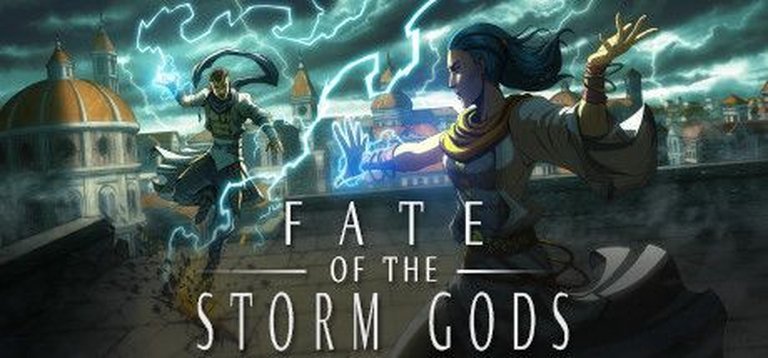
In ‘Fate of the Storm Gods’, you play as a Weather Builder—a Storm God residing in the celestial workshop atop Mount Gion—tasked with controlling atmospheric forces for the realm below. When a human royal breaches your domain to report catastrophic weather chaos and homunculi attacks in the Southern lands, you must investigate ancient enemies known as Weather Eaters who thrive on environmental destruction. This 275,000-word interactive fiction blends fantasy and RPG elements, offering branching choices where you can either restore balance to nature or revel in catastrophic power, while navigating alliances with fellow Builders and shaping the fate of both mortal and divine realms.
Where to Buy Fate of the Storm Gods
PC
Fate of the Storm Gods Patches & Updates
Fate of the Storm Gods Mods
Fate of the Storm Gods Guides & Walkthroughs
Fate of the Storm Gods Reviews & Reception
steambase.io (54/100): Fate of the Storm Gods has earned a Steambase Player Score of 54 / 100. This score is calculated from 13 total reviews on Steam — giving it a rating of Mixed.
Fate of the Storm Gods: Review
Introduction
In an era dominated by photorealistic graphics and open-world exploration, Fate of the Storm Gods (2021) dares to strip gaming back to its narrative roots. Developed by Choice of Games LLC, this 275,000-word interactive fiction title immerses players in a mythic struggle between demi-god Weather Builders and their chaotic counterparts, the Weather Eaters. While its text-based format may seem archaic, the game leverages the power of imagination to craft a tale of elemental power, moral ambiguity, and existential identity. This review argues that Fate of the Storm Gods is a flawed but fascinating experiment in player agency, offering a richly detailed world hampered by uneven pacing and underdeveloped plot threads.
Development History & Context
Studio and Vision
Fate of the Storm Gods emerged from Choice of Games LLC, a studio renowned for narrative-driven titles built on their proprietary ChoiceScript engine. Writers like Bendi Barrett (Avatar of the Wolf) thrive in this framework, which prioritizes branching storytelling over visual spectacle. Barrett’s vision—explored in a 2021 interview—centered on creating a “sustained mood” by blending mythic scale with intimate character arcs. The game’s themes of outsider identity and power dynamics reflect Barrett’s fascination with “how extraordinary beings navigate worlds they don’t fully understand.”
Technological and Industry Landscape
Released in January 2021, the game entered a market saturated with AAA blockbusters and indie darlings alike. Yet its text-based design sidestepped trends, catering to a niche audience hungry for complex storytelling. Built using ChoiceScript, a language optimized for stat-tracking and branching dialogue, the game faced constraints typical of interactive fiction: minimal visual or auditory feedback, reliance on prose, and a UI limited to menu selections. Despite these limitations, Fate of the Storm Gods leveraged its format to offer unparalleled narrative flexibility, including LGBTQ+-inclusive romance options and genderfluid protagonist customization.
Narrative & Thematic Deep Dive
Plot and Characters
Players assume the role of a Weather Builder—a quasi-divine being tasked with regulating atmospheric forces from Mount Gion. The story ignites when a human royal breaches the protagonist’s sanctum, revealing cataclysmic weather disruptions caused by the Weather Eaters, ancient foes who feed on chaos. Accompanied by Humil, a homunculus grappling with sentience, the Builder must navigate political intrigue, environmental collapse, and their own moral compass.
Barrett populates the world with memorable figures:
– Humil: A loyal automaton whose awakening autonomy mirrors the protagonist’s growth.
– The Weather Eaters: Villains who blur the line between exploitation and survival.
– Romantic Options: Including a stalwart royal, a cunning criminal, and even a morally ambiguous Eater.
Themes
The game interrogates themes of power, identity, and responsibility. As Barrett noted, the PC’s journey forces them to “reevaluate allegiances and question assumptions.” Weather manipulation becomes a metaphor for control—whether to stabilize ecosystems or dominate them. The homunculi’s rebellion further explores agency, asking whether servitude justifies violence. However, these ideas often feel underexplored, with rushed resolutions likened by one IFDB reviewer to Game of Thrones’ anticlimactic “winter badguy” finale.
Gameplay Mechanics & Systems
Core Loop and Progression
As a text-based RPG, gameplay revolves around dialogue choices, skill checks, and stat management. Players allocate points to elemental affinities (wind, earth, fire) and social traits (diplomacy, intimidation), shaping both combat and narrative outcomes. For example, mastering lightning allows decisive strikes in battles, while high charisma unlocks peaceful resolutions.
Innovations and Flaws
The game’s standout feature is its nonlinear storytelling:
– Four romance paths with gender-inclusive options.
– Multiple endings ranging from utopian restoration to tyrannical rule.
– Humil’s divergent arcs (loyal companion or independent thinker).
Yet flaws emerge in pacing and balance. Early chapters immerse players in worldbuilding, but late-game conflicts resolve abruptly. Combat, while cinematic in prose, lacks mechanical depth, reducing epic showdowns to repetitive skill checks. The Steam version’s achievement system—29 in total—adds replayability but fails to mask the undercooked climax.
World-Building, Art & Sound
Visual and Atmospheric Design
With no graphics beyond EJ Dela Cruz’s cover art, the game relies on vivid prose to depict its dual worlds: the ethereal Workshop of the Westerly Wind and the crumbling human strongholds below. Descriptions of storms “tearing plains into deserts” and homunculi with “metallic skin reflecting lightning” evoke a mythic tone reminiscent of Avatar: The Last Airbender.
Sound Design
The absence of music or sound effects amplifies the text’s weight, forcing players to “hear” howling winds and crackling flames through language alone. While this minimalist approach honors interactive fiction traditions, it may alienate those accustomed to multimedia immersion.
Reception & Legacy
Critical and Commercial Response
At launch, Fate of the Storm Gods garnered mixed reviews (53% positive on Steam). Praise focused on its inclusivity and Humil’s arc, while criticism targeted unresolved plot threads and a “tapestry of beautiful threads that was never completed” (IFDB). Despite a modest player base, its 275,000-word scope cemented Choice of Games’ reputation for ambitious storytelling.
Industry Influence
While not revolutionary, the game contributed to the resurgence of interactive fiction, proving that text-based narratives could tackle themes rivaling AAA titles. Its LGBTQ+ representation also set a benchmark for player-driven identity in RPGs.
Conclusion
Fate of the Storm Gods is a paradox: a narrative powerhouse hobbled by its own ambition. Bendi Barrett’s worldbuilding and thematic depth shine, particularly in Humil’s evolution and the Weather Eaters’ moral grayness. Yet rushed endings and uneven pacing leave players yearning for the epic finale promised by the setup. For interactive fiction enthusiasts, it’s a worthy journey—but one that stumbles short of greatness. In the pantheon of Choice of Games titles, it stands as a flawed gem: a storm of potential that never quite unleashes its full fury.
Final Verdict: A compelling but incomplete odyssey, best suited for patient readers craving mythic storytelling over mechanical polish.